University of Wisconsin-Madison Courses
English 177: Literature and Videogames (Spring 2014)
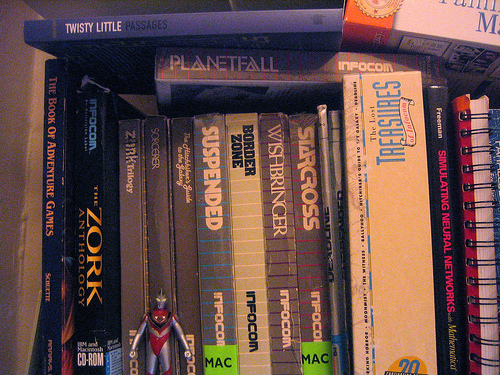
Sean Duncan's "Infocom Shelf"
This class will examine the relationship between literature and videogames by looking at a range of artifacts: novels about videogames, works of interactive fiction, electronic literature, and modern digital games that take on certain literary qualities. The goal of this class is not necessarily to equate videogames with novels or poems but to instead consider how videogames intersect with and complicate the category of "literature." Students in this class will read novels, play games, and make games. No technical expertise is required. The course will take place in one of UW-Madison's WisCEL classrooms and will use a "lecture lab" format. Students will register for both a lecture section and a discussion section, but the latter will be used both for discussing and making. Students will learn how to make works of interactive fiction and games with platforms such as Twine.
[Image Credit: "Infocom Shelf" by Sean Duncan]
Syllabus
Professor: Jim Brown
Teaching Assistants: Brandee Easter, Rick Ness, Becca Tarsa
Meeting Place: 3250 Helen C. White
Lecture Meeting Time
Monday, 12:05pm-12:55pm
Lab Meeting Times
Section 301: Monday, 1:20pm-2:10pm (Becca Tarsa)
Section 302: Monday, 1:20pm-2:10pm (Becca Tarsa)
Section 303: Monday, 1:20pm-2:10pm (Rick Ness)
Section 304: Wednesday, 1:20pm-2:10pm (Rick Ness)
Section 305: Wednesday, 1:20pm-2:10pm (Becca Tarsa)
Section 306: Wednesday, 1:20pm-2:10pm (Rick Ness)
Jim's Office: 6187E Helen C. White
Jim's Office Hours: M/W, 1:15pm-2:30pm [Make an Appointment]
Jim's Email: brownjr[at]wisc[dot]edu
Brandee's Office Hours: R 12:30pm-2:30pm
Office Hours Location: 7153 Helen C. White
Brandee's Email: bdeaster[at]wisc[dot]edu
Becca's Office Hours: W, 2:10pm-3:30pm
Office Hours Location: 3251 Helen C. White
Becca's Email: tarsa[at]wisc[dot]edu
Rick's Office Hours: M, 2:10pm-3:30pm
Office Hours Location: 3251 Helen C. White
Rick's Email: rness2[at]wisc[dot]edu
Course Website: http://courses.jamesjbrownjr.net/177_spring2014
Course Objectives
- Learn strategies for conducting close analysis of videogames and literature
- Develop effective writing and design processes
- Collaborate with others on writing and design projects
Required Texts, Games, and Equipment
Available at Rainbow Bookstore
- Ready Player One, by Ernest Cline
- First Person: New Media as Story, Performance, and Game, edited by Noah Wardrip-Fruin and Pat Harrigan
Available at Amazon:
- Lucky Wander Boy (Kindle Version), by D.B. Weiss
Available at various websites for various platforms:
Available at various websites and stores:
- USB Flash Drive (at least 16GB)
Course Work
All course work will be uploaded to Learn@UW, and TAs will inform you of the proper procedures for doing so. The grade breakdown for work in this class is as follows (see the Assignments page for details):
- 15% Attendance
- 10% Livetweeting lectures
- 10% Storify of one day's Lecture Tweets
- 20% Catalogue of Obsolete Entertainments Entry
- 25% OASIS Twine Game (Group Project)
- 20% Videogame Storify (Group Project)
Attendance
Success in this class will require regular attendance. With adequate notice, absences resulting from religious observances and university-endorsed extracurricular activities will be excused. TAs will take attendance at the beginning of both lecture and lab meetings. You are required to attend class daily, arrive on time, do assigned reading and writing, and participate in all in-class work. Please save absences for when you are sick or have a personal emergency. If you find that an unavoidable problem prevents you from attending class or from arriving on time, please discuss the problem with your TA.
Lateness
If you are more than 5 minutes late for class, you will be considered absent. If there is something keeping you from getting to class on time (i.e., you have a long trek across campus right before our class), please let your TA know during the first week of class.
Computers, Smartphones, etc.
Please feel free to use your computer or any other device during class, provided that your use of it is related to what we are working on in class. Please silence cell phones during class.
Late Assignments
Due dates for assignments are posted on the course schedule. TAs will not accept late work, and anything submitted after the deadline will receive a grade of zero.
Intellectual Property
All writing and design involves some level of appropriation - we cite the work of others and in some cases we even imitate that work. However, copying and pasting existing texts, having another student complete an assignment for you, or any other violations of UW's academic misconduct policy will result in a failing grade. If you have questions about the University of Wisconsin's Academic Misconduct policy, please see the Student Assistance and Judicial Affairs website.
Technology Policy
We will use technology frequently in this class. Although we are assuming that you have some basic knowledge of computers, such as how to use a keyboard and mouse, and how to use the Web and check email, our use of technology will be explained in class. If you don’t understand what we are doing, please ask for help. If you are familiar with the technology we are using, please lend a helping hand to your classmates.
Course Website and Email
You should check your email daily. Class announcements and assignments may be distributed through email. The course website will also have important information about assignments and policies. Pay close attention to the course calendar as we move through the semester. We reserve the right to move things around if necessary.
Contacting Instructors
If you have questions, you should first contact the TA assigned to your Lab section either in person or via email. If your TA cannot answer the question, s/he will contact Brandee or Jim for help. Emails to Jim, Brandee, Becca, or Rick must come from your wisc.edu email address. They must include a title explaining the email, a salutation (for example, "Dear Jim"), a clear explanation of what the email is about, and a signature.
Schedule
LWB = Lucky Wander Boy
RP1 = Ready Player One
First-Person = First-Person: New Media as Story, Performance, and Game
1/22
Introductions
Week 1 Lab: No meeting
Unit 1: The Catalogue of Obsolete Entertainments
1/27
Read: LWB, through location #1192
In class: LWB Lecture, introduction to Storify, practice livetweeting lectures
1/29
Read: LWB, through location #2179
In class: LWB Lecture, livetweeting
Week 2 Lab: Reading discussion
2/3
Read: LWB, through location #3148
In Class: Play games from Catalogue of Obsolete Entertainments
2/5
Read: First-Person, “Cyberdrama” (1-33)
In Class: First-Person Lecture, livetweeting
Week 3 Lab: Reading discussion
2/10
Read: LWB, finish novel
In Class: LWB Lecture, livetweeting
2/12
Read: First Person, “Ludology” (35-69)
In Class: First-Person Lecture, livetweeting, discuss paper assignment
Week 4 Lab: Reading discussion
2/17
Read: Chapter on Imitation from Crowley and Hawhee (PDF)
In Class: Lecture on imitation, livetweeting
2/19
In Class: Collaborative Research
Week 5 Lab: Writing Workshop
2/24
Write: Complete Draft of Catalogue Paper (due prior to class)
In Class: Writing Workshop - Peer Review
2/26
In Class: Writing Workshop - Peer Review
Week 6 Lab: Writing Workshop
2/28: Paper due at noon
Unit 2: Easter Eggs
3/3
Read: RP1, through page 60
In Class: RP1 Lecture, livetweeting
3/5
Read: RP1, through page 115
In Class: RP1 Lecture, livetweeting
Week 7 Lab: Discuss RP1
3/10
Read: First Person, “Critical Simulation” (71-116)
In Class: Lecture on “Critical Simulation," livetweeting
3/12
Read: RP1, through page 179
In Class: Twine Lecture (Brandee), play “Cyberqueen”
Week 8 Lab: Discuss RP1
SPRING BREAK
3/24
In Class: Twine Lecture-recap (Brandee), replay “Cyberqueen”
3/26
Read: RP1, through page 294
In class: Guest Lecture - Porpentine
Week 9 Lab: Brainstorm Twine Projects, discuss “Cyberqueen”
3/28
Watch streaming lecture, complete quiz by midnight
3/31
Read: RP1, finish novel
In Class: RP1 Lecture, livetweeting
4/2
In Class: Twine workshop
Week 10 Lab: Twine Workshop
4/7
In Class: Twine workshop
4/9
In Class: Twine workshop
Week 11 Lab: Twine Workshop
4/11 Twine game due at noon
Unit 3: Untangling Games and Stories
4/14
Play: Braid
In Class: Braid Lecture, livetweeting
4/16
Play: Braid
In Class: Braid Walk-Through
Week 12 Lab: Play/discuss Braid
4/21
Play: Braid as Spatial Storytelling
Read: First-Person, “Game Theories” (117-164)
In Class: "Game Theories" Lecture, livetweeting
4/23
In Class: Braid and Game Time
Week 13 Lab: Play/discuss Braid, discuss reading
4/28
Play: Gone Home
In Class: Gone Home Guest Lecture, livetweeting
4/30
Play: Gone Home
In Class: Gone Home Walk-Through
Week 14 Lab: Play/Discuss Gone Home
5/5
Play: Gone Home
Read: First-Person, “Hypertexts & Interactives” (165-206)
In Class: "Hypertexts & Interactives" Lecture, livetweeting
5/7
In Class: Storify Workshop
Week 15 Lab: Play/discuss Gone Home, discuss reading
5/13: Storify Due at 7:25pm
Assignments
Livetweeting Lectures
During lectures in this class, students will be using Twitter to "livetweet." This will serve as a way for students to engage with the lecture material, ask questions about that material, and even to interact with each other during lecture.
You are required to tweet at least five times during class discussion, and you must use the lecture hashtag #eng177 in order to get credit for your tweets. You are encouraged to retweet anything you find interesting or worthy of passing along, but a retweet does not count toward your five tweets. While you will not be graded on the content of your tweets, your TAs will be tracking the Twitter conversation during class to make sure that your posts pertain to lecture. In addition, TAs will be ensuring that each student meets the minimum number of required tweets.
If you already have a Twitter account, you may use that account during lecture. You may also choose to set up a separate Twitter account for this class. Regardless, the Twitter account you use for this class cannot be "protected," and you will have to share your Twitter username with your TA.
While there are any number of ways to approach livetweeting during lecture, here are a few suggestions for how you might approach these posts:
- Summary: A summary of a point or argument made during lecture. This kind of tweet might summarize an argument made by the person lecturing, or it might summarize an argument that the lecturer is citing.
- Link: A link to something mentioned during lecture or to something relevant to the discussion.
- Question: A question you have about material covered in the lecture. TAs will keep an eye on the Twitter stream, and we will try to answer your questions either during the lecture period or during Labs.
- Answer: An answer to a classmate's question. Maybe you know the answer to a question asked during lecture. Why not answer it?
Lecture Storify
Due Date: Due one week after the lecture day that you are discussing in your Storify. TAs will schedule these with you at the beginning of the semester.
Once during the semester, you will compose a summary of a day's tweets using Storify, a web service that allows you to synthesize a collection of tweets and text. Your TA will provide you with a signup sheet for scheduling which Lecture day you will cover with your Storify. We'll cover how to use Storify in lecture and lab.
Your lecture Storify will be graded on a credit/no credit basis, and it will be worth 10% of your grade. Your job in this assignment is to identify some pattern or trend during the Twitter conversation and to synthesize some of the tweets from that day into a coherent story. You'll use Storify to embed tweets, and you'll write text that explains the trends and patterns that you've noticed.
When creating this Storify, keep in mind that you'll be using this tool for your final project (a Storify that documents how you and a partner traversed one of the games we're playing in class). So, this assignment offers you a chance to synthesize one day's discussion as well as a chance to become familiar with Storify. Take advantage of this opportunity as it will help you during that final project.
In order to get credit for this assignment, you'll need to do the following:
- Include at least 20 tweets from the lecture day that you're analyzing.
- Locate some pattern (or set of patterns) from the Twitter conversation, linking together tweets into a coherent story.
- Use your own words to synthesize the conversation. Your Storify should include text written by you in addition to embedded tweets, images, video, and links.
- Create a Storify that is generally well written and free of grammatical errors.
The Catalogue of Obsolete Entertainments
Due Date: 2/28 at noon
In D.B. Weiss' Lucky Wander Boy, Adam Pennyman is working to create what he calls The Catalogue of Obsolete Entertainments, a collection of videogame reviews that analyze old games such as Pac-Man and Micro-Surgeon. The reviews are written in a very particular style, and D.B. Weiss seems to want to show us that Pennyman takes these games and their cultural implications very seriously (perhaps too seriously). Your task during this 750-1000 word paper (3-4 pages, double-spaced, 12-point Times New Roman) is to write your own entry for The Catalogue of Obsolete Entertainments, imitating Pennyman's style.
You will choose which game to write about, but it must be a game that could conceivably be in Pennyman's catalog. Our cutoff date for Adam's "classical" period is any game made up to and including 1983 (the year of the videogame crash). This means that you can't write about a contemporary videogame and that you'll have to do some research on older games. In addition, you can't write about any of the games that Pennyman writes about in Lucky Wander Boy. In addition to finding a game to review, you'll need to play that game (using any number of emulators online for old game systems) and conduct some research on it.
Your entry into the Catalogue should mimic Pennyman's style in terms of both how the review looks (providing technical specifications at the beginning, etc.) and his writing style. In class, we'll discuss some strategies for imitation.
This paper will represent 20% of your grade. When grading these papers, your TAs will be asking the following questions:
- Have you chosen an appropriate game?
- Does your catalogue entry demonstrate that you've researched and played the game?
- Does your entry look like those composed by Pennyman? Is is formatted similarly?
- Have you effectively imitated Pennyman's style and approach to reviewing games?
- Is your entry generally well written and free of grammatical errors?
OASIS Twine Game
Due Date: 4/11 at noon
In Ernest Cline's Ready Player One, the characters move through a massive online game world called the OASIS, and the central plot focuses on an easter egg embedded in the OASIS by its creator, James Halliday. Halliday is obsessed with 1980s popular culture, and each of the puzzles he creates for the easter egg are focused on that obsession. In this project, you'll be using a platform called Twine to create your own puzzle game inspired by Halliday's various puzzles in the OASIS.
For this project, you'll work in groups of three or four, and you'll create an easter egg puzzle based not on 1980s culture but instead on contemporary popular culture. So, while Halliday was obsessed with anything from The Breakfast Club to Family Ties, you should feel free to pursue your own interests and obsessions from contemporary culture.
Regardless of what inspires your puzzle game, the goal is to create a game that calls for the player to solve puzzles in order to reach some "win" state. In addition to submitting your Twine game, you'll submit a walk-through document. This will serve as the "key" to your game. While your TAs will be evaluating your game by playing it, these documents will help them if they get stuck.
This project will represent 25% of your grade. When grading these projects, your TAs will be asking the following questions:
- Does your game make use of the affordances of Twine, using code to create a dynamic reading and playing experience?
- Does your game ask the player to solve puzzles in ways similar to Halliday's easter egg?
- Is the game coherent and clear? Do all of its pieces hold together? Does the player leave the experience with a clear sense of what you are trying to communicate?
- Are your project and walk-through document generally well written and free of grammatical errors?
Game Storify
Due Date for Braid Storify: 4/25 at Noon
Due Date for Gone Home Storify: 5/6 at Noon
Due Date for Final Revised Storify: 5/13 at 7:25pm
Our final unit has included the games Braid and Gone Home, each of which use the videogame medium differently to tell stories. In this project, you'll pair up with one person from your Lab section to "livetweet" the process of playing the game and then to create a Storify that synthesizes all of those tweets. Together with your partner, you will be creating Storifies for both of these games, but only one will be submitted for the final project. This will give you an opportunity to choose which Storify you'd like to submit for credit, and it will also mean that you'll have an opportunity to revise the Storify that you decide to submit.
You should plan several gameplay sessions with your partner. One group member should be playing the game, while the other is livetweeting the action. Members should change roles often. The tweets are an opportunity to record your progress and insights about the game, note when you are stuck or how you solved certain puzzles or problems, point out "light bulb moments" during gameplay, and connect the game to class readings. You should also link to other texts or resources (for example, texts, songs, or films alluded to during the game or pieces others have written about the game). Much like lecture livetweets, you should use Twitter in whatever way works best for you and in ways that shed light on your group's experience of playing the game.
After completing the game, your group will create a Storify that synthesizes all of your game tweets and tells the story of how you finished or "solved" the game. The Storify does not have to encompass the entire game--you can choose a section of the game to focus on as you compile tweets and other resources for the STorify.
Your Storify should also incorporate relevant sections from First-Person, and it can also incorporate sources you discover on your own. All group members should contribute to all portions of the project (playing the game, livetweeting, composing the Storify).
This project will represent 20% of your grade. The breakdown is as follows:
Braid Storify: 5% (Credit/No Credit)
Gone Home Storify: 5% (Credit/No Credit)
Finale Revised Storify: 10%
When grading these projects, your TAs will be asking the following questions:
- Does your Storify identify a central theme that arose during gameplay?
- Does the Storify include what your group discovered and struggled with while playing the game?
- Does your Storify incorporate various media to tell your story, including Tweets, images, and video?
- Does your Storify demonstrate that you've conducted research by connected the game to sources we have read in class and sources that you've discovered on your own?
- Is your Storify generally well written and free of grammatical errors?
English 236: Writing And The Electronic Literary (Spring 2014)

Photo Credit: "Turmoil" by Clonny
In her influential volume Electronic Literature: New Horizons for the Literary, Katherine Hayles explains that "writing is again in turmoil." The spread of mechanical type allowed for more writers and more texts, troubling those who were accustomed to a manuscript culture in which texts were copied by hand. In a similar way, Hayles explains that electronic literature opens up difficult questions about writing in our current moment: "Will the dissemination mechanisms of the internet and the Web, by opening publication to everyone, result in a flood of worthless drivel?...What large-scale social and cultural changes are bound up with the spread of digital culture, and what do they portend for the future of writing?" But Hayles also argues that electronic literature encompasses a broad range of digital writing practices, from video games to interactive fiction to hypertext. She proposes that we shift from a discussion of "literature" to the "literary," which she defines as "creative artworks that interrogate the histories, contexts, and productions of literature, including as well the verbal art of literature proper." This course will use Hayles' definition of the literary in order to read, play with, and create digital objects.
Syllabus
Professor: Jim Brown
Class Meeting Place: 2252A Helen C. White
Class Time: Monday, 2:30pm-5:00pm
Jim's Office: 6187E Helen C. White
Jim's Office Hours: M/W, 1:15pm-2:30pm [Make an Appointment]
Jim's Email: brownjr [at] wisc [dot] edu
Course Website: http://courses.jamesjbrownjr.net/236_spring2014
Course Objectives
In this course, we will develop the following skills and strategies:
- Conduct Medium-Specific Analyses of Digital Objects and Environments
- Develop a Writing/Design Process
- Use New Media Technology to Express Ideas
- Collaborate on Creative Projects
- Practice Critical Reading Skills
Required Texts
Electronic Literature, N. Katherine Hayles
Making Comics, Scott McCloud
The Private Eye, issues 1-5 and "The Making of The Private Eye" [available for as a pay-what-you-want download at panelsyndicate.com
Course Work
In this class, the following work will be evaluated:
- Attendance and Participation
- Short Writing Assignments
- Collaborative Interactive Fiction Project
- Collaborative Comic Project
Learning Record
Grades in this class will be determined by the Learning Record Online (LRO). The LRO will require you to observe your own learning and construct an argument for your grade based on evidence that you accumulate throughout the semester. You will record weekly observations and you will synthesize your work into an argument for your grade. You will construct this argument twice - once at the midterm and once at the end of the course. We will be discussing the LR) at length during the first week of class. See below for more details.
Attendance
Success in this class will require regular attendance. I will take attendance at each class meeting, and your Learning Record will include a discussion of attendance. You are required to attend class daily, arrive on time, do assigned reading and writing, and participate in all in-class work. Please save absences for when you are sick or have a personal emergency. If you find that an unavoidable problem prevents you from attending class or from arriving on time, please discuss the problem with me.
Lateness
If you are more than 10 minutes late for class, you will be considered absent. If there is something keeping you from getting to class on time (i.e., you have a long trek across campus right before our class), please let me know during the first week of class.
Computers, Smartphones, etc.
Please feel free to use your computer or any other device during class, provided that your use of it is related to what we are working on in class. Please silence cell phones during class.
Grades
Grades in this course will be determined by use of the Learning Record, a system which requires students to compile a portfolio of work at the midterm and at the end of the semester. These portfolios present a selection of your work, both formal and informal, plus ongoing observations about your learning, plus an analysis of your work in terms of the five dimensions of learning and the goals for this course. You will evaluate your work in terms of the grade criteria posted on the LRO site, and you will provide a grade estimate at the midterm and final.
The dimensions of learning have been developed by teachers and researchers, and they represent what learners experience in any learning situation:
1) Confidence and independence
2) Knowledge and understanding
3) Skills and strategies
4) Use of prior and emerging experience
5) Reflectiveness
In addition to analyzing your work in terms of these dimensions of learning, your argument will also consider the specific goals for this course. These goals are called Course Strands (these are also listed above in the "Course Objectives" section):
1) Medium Specific Analysis
2) Writing/Design Process
3) Digital Expression
4) Collaboration
5) Critical Reading
The LRO website provides detailed descriptions of the Course Strands and the Dimensions of Learning.
Your work in class (and in other classes during this semester) along with the observations you record throughout the semester will help you build an argument in terms of the dimensions of learning and the course strands. We will discuss the LRO in detail at the beginning of the semester, and we will have various conversations about compiling the LRO as the semester progresses.
Late Assignments
Due dates for assignments are posted on the course schedule. While I will not be grading your assignments, I will be providing comments and feedback. I will not provide feedback on late assignments. Also, late assignments will be factored into your argument in the LR (see the grade criteria for more details).
Intellectual Property
Much of what we'll be working on this semester involves the appropriation of existing texts. This is no different than any other type of writing - all writing involves appropriation. The key will be to make new meaning with the texts that you appropriate. Copying and pasting existing texts without attribution does not make new meaning. Some of your work will make use of different materials (text, video, audio, image), and you will have to be mindful of intellectual property issues as you create texts for this class. If you have questions about the University of Wisconsin's Academic Misconduct policy, please see the Student Assistance and Judicial Affairs website.
Technology Policy
We will use technology frequently in this class. Although I am assuming that you have some basic knowledge of computers, such as how to use a keyboard and mouse, and how to use the Web and check e-mail, most things will be explained in class. If you don’t understand what we are doing, please ask for help. If you are familiar with the technology we are using please lend a helping hand to your classmates.
Course Website and Email
You should check your email daily. Class announcements and assignments may be distributed through email. The course website will also have important information about assignments and policies. Pay close attention to the course calendar as we move through the semester. I reserve the right to move things around if necessary.
Emails to me must come from your wisc.edu email address. They must include a title explaining the email, a salutation (for example, "Dear Jim"), a clear explanation of what the email is about, and a signature.
Schedule
Unit 1: Computational Writing
January 27
Read: Hayles, pp1-30; Gillespie, Letter to Linus
Presentations:
["The Electronic Literary"]
[Introducing "Intermediation"]
February 3
Read: Hayles pp43-70; Moulthrop, Reagan Library, Browse Learning Record
Write: Summary/Analysis Paper 1 Due
In Class: Discuss learning record, readings, and Summary/Analysis papers
Presentations:
[Intermediation]
[Introducing "The Body and the Machine"]
February 10
Read: Hayles, pp87-126; For a Change, by Dan Schmidt
In Class: Discuss readings
Presentations:
["The Body and the Machine"]
[Introducing "How E-Lit Revalues Computational Practice"]
Friday, February 14
LRO PART A DUE AT NOON
February 17
Read: Hayles, pp131-157; Glass, by Emily Short
Write: Summary/Analysis Paper 2 Due
In Class: Discuss readings, Twine Workshop
[How Electronic Literature Revalues Computational Practice]
February 24
Read: Montfort, pp. 1-36; Adventure (Crowther and Woods)
In class: Twine Workshop
March 3
Read: Montfort, pp. 37-64
In Class: Twine Workshop
Interactive Fiction Project 1.0 due by end of class
March 9
MIDTERM LRO DUE AT MIDNIGHT
March 10
Interactive Fiction Project 2.0 Due prior to class
In class: Twine Workshop
March 14
IF FINAL PROJECT DUE AT NOON
Unit 2: Networked Writing
March 24
Read: Private Eye 1-3, McCloud "Writing With Pictures"
In Class: ComicLife workshop
March 31
Read: Private Eye 4-5, "The Making of Private Eye," McCloud "The Power of Words"
In Class: Comics Project Workshop-Storyboarding, Layout, Art
April 7
Read: McCloud "Stories for Humans"
In Class: Comics Project Workshop-Storyboarding, Layout, Art
April 14
Read: McCloud "World Building"
In Class: Comics Project Workshop-Revisions
April 21
In Class: Comics Project Workshop-final revisions, beginning building website
April 28
In Class: Comics Project Workshop-continue work on website
May 5
In Class: Comics Project Workshop-complete and roll-out website
May 12
FINAL LRO DUE AT NOON
Assignments
Summary-Analysis Papers
Due Dates
February 3
February 17
S-A papers due prior to the beginning of class, submitted to your Dropbox folders.
As we read Hayles' Electronic Literature, we will be learning new theoretical concepts that help us make sense of works of electronic literature. In an attempt to apply those concepts, we will write three short Summary Analysis (S-A) papers.
Paper Assignments
Paper 1 (2/3)
Define Hayles' concept of "intermediation," and use it to conduct an analysis of Stuart Moulthrop's Reagan Library.
Paper 2 (2/17)
Hayles says that electronic literature "revalues computational practice." Summarize what she means by this phrase and use this idea to analyze Emily Short's Glass
Keep the following things in mind as you write your S-A papers:
Summary
The summary section can be no longer than 250 words in the three short papers. Fairly and adequately summarizing a theoretical concept is a difficult task, especially when space is limited. The summary section of S-A papers should very concisely and carefully provide a summary of Hayles' theoretical concept. Please note that you are providing a summary of a particular concept and not the entire chapter. Because your summaries are limited to 250 words, you won't be able to mention every single point the author makes. Your job is to decide what's important and to provide a reader with a clear, readable, fair summary of the concept. While you may decide to provide direct quotations of the author, you will need to focus on summarizing the author's argument in your own words.
Analysis
The analysis section can be no longer than 500 words in the three short papers. In the analysis sections of these papers, you will focus on applying the theoretical concept described in the summary section. You will use the concept you've summarized to explain how a piece of electronic literature works, and you will explain how one of Hayles' concepts allows us to make sense of this piece of literature. Just as Hayles does throughout the book, you will provide a close reading of a piece of literature (we will study examples in class).
Grade Criteria
While I will not be grading your papers, I will be providing feedback. Here is what I will be looking for:
* Is your paper formatted correctly (double-spaced, observes the word limit, name in upper-left-hand corner)?
* Does your summary fairly and concisely summarize Hayles' theoretical concept?
* Have you used your own words to summarize the concept?
* Does your analysis use Hayles' theoretical concept to explain and interpret the assigned work of electronic literature?
* Have you devoted the appropriate amount of space to the two sections of the paper? Remember that the word counts I provide are just guides (not strict word limits), but also remember that both summary and analysis have to be adequately addressed in the paper.
* Is your paper written effectively and coherently with very few grammatical errors?
* Was the paper turned in on time? (Reminder: I do not accept late work.)
Interactive Fiction Project
Due Dates:
March 3
Project 1.0 (due by the end of class)
March 10
Project 2.0; Paper, first draft (both saved to Dropbox prior to class)
March 12 (noon)
Final Project and Paper Due (both saved to Dropbox prior to class)
Description
We've read about the history of Interactive Fiction (IF) and have played with/read some works of IF. Using Twine, you will work with one other person to design your own work of IF. Your project should be inspired by a previous work of IF and should also incorporate some of the ideas from Nick Montfort's Twisty Little Passages. Your goal is to create a meaningful and relatively complex experience for the interactor.
In addition to designing this piece of interactive fiction, each pair of students will write a paper describing and explaining what you've created. Your paper will be no more than 1000 words (four pages double-spaced) and will do the following:
- Explain the inspiration for your project. Remember that you should be drawing on both Montfort's text and on the games we've been playing to develop ideas for your work of IF.
- Explain your project in the terms laid out by Montfort in Twisty Little Passages. You may choose to describe your game in terms of the basic components of IF (laid out in Chapter 1), or in terms of Montfort's discussion of riddles, or you might compare your game to one of the examples of IF he discusses in the text.
- Explain how you incorporated feedback that you received during the testing phase. Your classmates will play the various versions of your game, and you will incorporate the feedback you receive during these "user tests." Your paper should explain what changes you made and how you addressed this feedback.
Grade Criteria
When responding to these projects, Eric and I will be asking:
- Does your project show evidence that you have understood and made use Montfort's discussion of IF in Twisty Little Passages?
- Does your project take advantage of the Twine system? Does it provide a meaningful and relatively complex experience for the interactor?
- Does your paper explain the inspiration for your project, and does it draw on the works of IF that we've discussed and played?
- Does your paper explain how your piece of IF works, and how you've incorporated feedback?
- Was your project submitted on time? (I do not accept late work.)
- Does your paper observe the word limit?
- Does your paper have minimal grammatical and/or structural problems?
Comics Project
Our final project will be to create a comic in collaboration with a class at the University of Utah. We will model our process on the one that Marcos Martin and Brian K. Vaughan use in the creation of The Private Eye, and our class will focus on artwork while the Utah class focuses on writing. However, these roles will inevitably bleed into one another.
This project will mean collaboration amongst all members of our class and with members of the Utah class, and this means that individual roles will be determined as we go depending on each person's interests. If you are interested in drawing, you will have an opportunity to contribute to that portion of the project. If you'd rather focus on page layout, then you can do that. At times, people will likely move between roles and subgroups.
Given the fluid structure of this collaboration, you will have two primary sets of tasks during the course of the project:
1) Get involved! This can take many forms, but your job is to find a place where you can contribute to the project.
2) Document your contributions. In order to discuss this project during your final LRO, you'll need evidence to analyze and evaluate. This means that you'll want to document your participation by saving copies of drafts, planning documents, sketches, meeting notes, or any other artifacts that emerge out of the collaboration.
You'll be receiving feedback on this project from me and your peers throughout this project, and you'll receive feedback on the final results as well. However, as with everything in this class, you won't be getting a letter grade on any individual portion of the project or on the final product. This is why it's imperative that you document your various processes and products - such documentation will be important during the composition of your final LRO.
English 706: New Media Interfaces and Infrastructures (Fall 2013)
 New media scholarship is pushing beyond the study of texts or artifacts and attempting to study the systems, infrastructures, codes, and platforms that produce those artifacts. By examining and tinkering with the interfaces and infrastructures of new media, scholars across various disciplines and subdisciplines are looking to develop research methods that account for how interfaces are shaped by computational and networked infrastructures.
In this course, we will examine and enter this conversation, exploring how new media technologies expand the available means of persuasion and shape writing and expression. We will read and apply theories that link our interface experiences with texts, images, and sounds to the computational infrastructures that help to shape those experiences. We will also work in various digital environments to produce digital artifacts and scholarship. No technological expertise is required for this course, and students will have the freedom to tinker in platforms with which they have little or no experience.
Syllabus
English 706: New Media Interfaces and Infrastructures
Professor: Jim Brown
Class Meeting Place: 2252 Helen C. White
Class Time: Wednesday, 9:00am-11:30am
Office: 6187E Helen C. White
Office Hours: Monday 12:30-2:30 [Make an Appointment]
Email: brownjr [at] wisc [dot] edu
Website: http://courses.jamesjbrownjr.net/706_fall2013
Course Goals:
- Analyze and synthesize recent scholarship on digital media
- Research various hardware and software platforms
- Collaborate on digital media projects
Required Texts:
These texts are available for purchase at Rainbow Bookstore
- Brooke, Collin. Lingua Fracta: Towards a Rhetoric of New Media
- Chun, Wendy. Programmed Visions: Software and Memory
- Galloway, Alexander and Eugene Thacker. The Exploit
- Jones, Steven and George K. Thiruvathukal. Codename Revolution: The Nintendo Wii Platform
- Kirschenbaum, Matthew. Mechanisms: New Media and the Forensic Imagination
- Ramsay, Stephen. Reading Machines: Toward an Algorithmic Criticism
- Wardrip-Fruin, Noah. Expressive Processing: Expressive Processing: Digital Fictions, Computer Games, and Software Studies
Other Readings (available for download):
- Banks, Adam. Race, Rhetoric, and Technology: Searching for Higher Ground (excerpt)
- Bogost, Ian. Persuasive Games (excerpt)
- Brock, Kevin. "Critical Essay—One Hundred Thousand Billion Processes: Oulipian Computation and the Composition of Digital Cybertexts"
- Brown Jr., James J. Ethical Programs (excerpt)
- Losh, Elizabeth. Virtualpolitik: An Electronic History of Government Media-Making in a Time of War, Scandal, Disaster, Miscommunication, and Mistakes (excerpt)
- Manovich, Lev. The Language of New Media (excerpt)
- Montfort, Nick. "Continuous Paper: The Early Materiality and Workings of Electronic Literature."
- Montfort, Nick and Ian Bogost. Racing the Beam (excerpt)
- Rieder, David. "Snowballs and Other Numerate Acts of Textuality."
- Rieder, David. "From GUI to NUI: Microsoft’s Kinect and the Politics of the (Body as) Interface"
- Selfe, Cynthia and Richard Self. "The Politics of the Interface."
Learning Record
Grades in this class will be determined by the Learning Record Online (LRO). The LRO will require you to observe your own learning and construct an argument for your grade based on evidence that you accumulate throughout the semester. You will record weekly observations and you will synthesize your work into an argument for your grade. You will construct this argument twice - once at the midterm and once at the end of the course. We will be discussing the LR) at length during the first week of class. See below for more details.
Course Work (More details available in Assignments section of the website)
- Attendance
Success in this class will require regular attendance as we discuss the readings and share work. - Questions for Discussion
For each assigned reading, I will create a Google Document in which you should post questions for discussion. See the Assignments section for more details. - Group Lab Projects
- Final Project (group or individual)
Grades
Grades in this course will be determined by use of the Learning Record, a system which requires students to compile a portfolio of work at the midterm and at the end of the semester. These portfolios present a selection of your work, both formal and informal, plus ongoing observations about your learning, plus an analysis of your work in terms of the five dimensions of learning and the goals for this course. You will evaluate your work in terms of the grade criteria posted on the LRO site, and you will provide a grade estimate at the midterm and final.
The dimensions of learning have been developed by teachers and researchers, and they represent what learners experience in any learning situation:
1) Confidence and independence
2) Knowledge and understanding
3) Skills and strategies
4) Use of prior and emerging experience
5) Reflectiveness
In addition to analyzing your work in terms of these dimensions of learning, your argument will also consider the specific goals for this course. These goals are called Course Strands (these are also listed above in the "Course Objectives" section):
1) Analysis and synthesis of scholarly arguments
2) Digital Media Research
3) Collaboration
The LRO website provides detailed descriptions of the Course Strands and the Dimensions of Learning.
Your work in class (and in other classes during this semester) along with the observations you record throughout the semester will help you build an argument in terms of the dimensions of learning and the course strands. We will discuss the LRO in detail at the beginning of the semester, and we will have various conversations about compiling the LRO as the semester progresses.
Schedule
Introduction: Beyond Screen Essentialism
September 4
Read: Kirschenbaum (through page 158), Montfort
September 11
Read: Kirschenbaum, Burgess (Dropbox)
Software
September 18
Read: Wardrip Fruin (through page 168), Bogost (Dropbox)
September 25
Lab Day
October 2
Read: Wardrip-Fruin, Rieder "Snowballs"
Book Review: Lauren
October 9
Software Studies Presentations
Read: Chun, Losh (Dropbox)
Hardware
October 16
Read: Jones and Thiruvathukal, Montfort and Bogost (Dropbox)
Book Review: Jenna
October 19
Midterm Learning Record due at noon
October 23
Lab Day
Book Review: Jim
October 30
Read: Banks, Prologue and Introduction, (Dropbox), Rieder "Gui to Nui," Selfe and Selfe (Dropbox)
Book Review: Rick
November 6
Open Lab
Book Review: Kathleen
Algorithm
November 13
Platform Studies Presentations
Book Review: Neil
November 20
Proposals for Final Project Due
Read: Galloway and Thacker
Book Review: Deidre and Anthony
November 27
Read: Brooke, Manovich (Dropbox)
Book Review: Maggie
December 4
Read: Ramsey, Brock "One Hundred Thousand Billion Processes: Oulipian Computation and the Composition of Digital Cybertexts"
Lab Day (Eric Alexander visits)
Book Review: Andrew
December 11
Final Presentations
December 17
Final Learning Record due at 9:00pm
Assignments
Questions for Discussion (Google Docs)
For each reading, we will have a shared Google Document in which you will post questions prior to class. These contributions will not be graded, but participation is required.
By midnight on Monday, you should post two different kinds of questions to our Google Document:
1) Questions of Clarification
These questions should be about terms or concepts you didn't understand or about moments in the argument you found unclear. These questions are, for the most part, focused on understanding the reading, and we will address these first during class discussion.
2) Questions for Discussion
These questions are more geared toward opening up class discussion, and they can be focused on connections you see to other readings, the implications of the argument we've read, or ways that you think the argument might be applied to research questions.
This document will be open during class discussion, and it will serve as a collaborative note-taking space.
Book Review Pecha Kucha
Once during the semester, each student will review a book that is cited by one of the texts we've read as a class (you cannot review a text that is on the syllabus). Reviews will take the form of a Pecha Kucha presentation - a presentation of 20 slides, each shown for 20 seconds (6 minutes and 40 seconds total).
Your primary task in this review is to explain how the argument works and how it engages with other scholarship. You should not focus your efforts on an evaluation of the argument or on whether or not you disagree with the author. See the grading criteria below for some tips about how to approach these reviews, and please feel free to ask me questions.
When providing feedback on these presentations, I will be looking for the following:
- Does your presentation adequately summarize the text and its argument?
- Do you explain the text's significance, its most important features, and its contributions to a scholarly conversation?
- Have you explained how this text connects with the texts we're reading for this class?
- Have you avoided a discussion of whether or not you disagree with the author? Have you avoided a discussion of flaws or shortcomings in the argument?
- Have you followed the rules of engagement
- Have you paid close attention to the design of your slides?
- Have you followed the Pecha Kucha rules (20 slides, shown for 20 seconds each)
Software Studies Presentation
During our unit on software, we will be reading about different approaches to analyzing new media objects at the level of code and computation. In groups, you will testing out these approaches and analyzing computational objects. The objects we will be analyzing are:
Reagan Library, a work of electronic literature by Stuart Moulthrop
Taroko Gorge, a poetry generator by Nick Montfort
ELIZA, a version of the famous ELIZA chatbot created by Michael Wallace
Each of these objects is written in Javascript, but you do not need to be an expert in Javascript to conduct an analysis of them. As you examine the code, you might find the W3Schools documentation on Javascript useful. Each group will be assigned one of these objects and will be tasked with doing three things:
1) Providing a detailed explanation of how the program works. This explanation should be accessible to non-programmers, but it can and should contain snippets of code along with explanations of that code. The key here is to provide a detailed account of how the software is doing what it is doing.
2) Providing an interpretation of the object's use of computational processes using some of the theories and approaches we are examining in class (including, but not limited to, concepts such as expressive processing, procedural rhetoric, invisible code, etc.)
3) Create a "remix" of your assigned work.
The first two tasks will be completed as part of a collaboratively authored paper, but the third will most likely take the form of a web page. In class, we will discuss some ways of approaching the remix portion of the assignment.
You will share your papers with me and classmates using Dropbox, but you can use Google Documents to collaboratively author those papers. In addition, you will have the opportunity to present your work in class. This presentation will be a somewhat informal one, in which you will walk us through how your object works and how you've chosen to remix it.
When responding to these projects, here are the questions I'll be asking:
- Have you provided an accessible and accurate account of how this object works
- Does your interpretation of the work link computational mechanism to surface effects, explaining how computation is being used as an express and/or rhetorical medium?
- Does your remix transform the work, taking the existing data and processes in a new direction to make new arguments and express new ideas?
- Is your paper clearly written and generally free of grammatical errors?
- Does the project show evidence that the group has effectively collaborated on both the paper and the remix?
Platform Studies Presentation
In Racing the Beam, Bogost and Montfort try to draw attention to an area of new media research that has been neglected - platform. Offering a description of the various levels of new media studies - reception/operation, interface, form/function, code, platform - they suggest that a platform is "a cultural artifact that is shaped by values and forces and which expresses views bout the world, ranging from 'games are typically played by two players who may be of different ages and skill levels' to 'the wireless service provider, not the owner of the phone, determines what programs may be run" (148). A study of platform is a study of what shapes and constrains the design and use of certain new media artifacts.
While Bogost and Montfort say that platform studies need not focus on hardware (as their study of the Atari 2600 does), we will be undertaking a platform study by way of hardware. While the software studies project focused on the code and form/function levels (along with some attention to reception/operation and interface), this project moves to platforms.
The class will be divided into two groups. One group will study the Nintendo Entertainment System, and the other will study the Macintosh Classic. Our focus is not only on these pieces of hardware (though, we will look at them closely) but also on the platforms out of which they emerged. We will study the NES console as a window into the NES platform and the Macintosh Classic as a window into the Macintosh platform.
One goal is to examine how "hardware and software platforms influences, facilitates, or constrains particular forms of computational expression" (Bogost and Montfort). While this is a focus on how platforms affect design and designers, we will also be interested in how that platform shapes the end user experience.
The aim is to use these two pieces of hardware to ask broader questions about the platforms out of which they emerged, and this approach is one more way of paying close attention to the "guts" of our various new media interfaces and infrastructures.
Just as we did with the software studies project, you will produce both a paper and an informal presentation. You will share your papers with me and classmates using Dropbox, but you can use Google Documents to collaboratively author those papers. In addition, you will have the opportunity to present your work in class. Again, this presentation will be a somewhat informal one, in which you will walk us through the system you are studying (both at the level of the particular piece of hardware and its platform).
When responding to these projects, here are the questions I'll be asking:
- Have you provided an accessible and accurate account of the technical details of your object of study and its platform?
- Does your study demonstrate how the platform shapes or constrains the activities of both designers and end users?
- Does your study shed light on the particularities of this platform, the cultures out of which it emerged, and its various idiosyncracies?
- Is your paper clearly written and generally free of grammatical errors?
- Does the project show evidence that the group has effectively collaborated on both the paper and the presentation?
Final Projects
The final project for this course will be a paper and/or a digital object that accounts for new media at the level of both interface and infrastructure. Throughout the semester, we have talked about theories and approaches to new media that move beyond reception or surface effects. We have attempted to link these surface affects to various computational mechanisms and infrastructures. You will continue this work in the final project.
The final project can be a continuation or expansion of one of the group projects (software studies or platform studies), but it does not have to be. You can collaborate with other students, or you can choose to work on your own project.
If the final project is a piece of writing, it should be the length of a typical journal article (roughly 6000-8000 words), and you should have a particular journal in mind while writing it. If your project includes both writing and a digital component, the writing can be shorter than this. If your project is a purely digital composition, it should (on its own) demonstrate a significant scholarly intervention.
Projects are due on December 11, and we will do informal presentations of projects on this same day. The possibilities for this project are pretty much wide open, but you will need to complete a project proposal (500-1000 words) by November 20. That proposal should include the following:
- Abstract: 250 words that explains the project, its argument(s), and its intervention(s)
- Research Question(s): What question or questions are you asking? This should be a clearly articulated question or set of questions that engage with existing research.
- Method/Approach: We've covered approaches and methods such as software studies and platform studies. While you are not confined to these methods for your project, your proposal should lay out what method or approach you plan to use. That might be a qualitative research method, rhetorical analysis, any of the approaches we've covered in class, or any other method that is appropriate for what you hope to accomplish.
- Work Plan: What will you accomplish between November 20 and December 11, and how will you accomplish it? This should be as detailed as possible, and it should provide a realistic timeline for your work.
I will provide written feedback on these proposals that addresses the feasibility of the project and that helps you further refine your research questions and approaches.
Rules of Engagement
What is the purpose of a graduate seminar, and how does one use such a space to usefully engage with texts? I offer this document as an answer to that question and as a kind of constitution for our class.
The military root of the phrase "rules of engagement" is unfortunate because we are actually interested in something as nonviolent as possible. Of course, any interpretation of a text will do violence to it. This is the nature of interpretation. We fit a text or a set of ideas into a pre-existing framework that we already have. This is unavoidable. But we can try our best to forestall that violence or to at least soften the blow. In the interest of this kind of approach, I offer the following rules:
1. Disagreement and agreement are immaterial.
Our primary task is to understand, and this does not require agreement or disagreement. The only agreement the seminar asks of you is this: I agree to read, consider, analyze, and ask questions about these texts.
In his essay "The Rhetoric of Hitler's Battle," Kenneth Burke presents us with a succinct encapsulation of this first rule of engagement:
The appearance of Mein Kampf in unexpurgated translation has called for far too many vandalistic comments. There are other ways of burning books than on the pyre - and the favorite method of the hasty reviewer is to deprive himself and his readers by inattention. I maintain that it is thoroughly vandalistic for the reviewer to content himself with the mere inflicting of a few symbolic wounds upon this book and its author, of an intensity varying with the resources of the reviewer and the time at his disposal. Hitler's "Battle" is exasperating, even nauseating; yet the fact remains: If the reviewer but knocks off a few adverse attitudinizings and calls it a day, with a guaranty in advance that his article will have a favorable reception among the decent members of our population, he is contributing more to our gratification than to our enlightenment" (The Philosophy of Literary Form, 191)
Of course, we will not be reading anything like Mein Kampf, but the principle still stands. We are more interested in enlightenment than gratification.
2. An argument is a machine to think with.
This is another version of I.A. Richards's claim that “a book is a machine to think with." The "with" here should be read in two different ways simultaneously. We read "with" an argument by reading alongside it. We "tarry" with it. We get very close to it and join it during a long walk. Notice that this requires that we stay with the author rather than diverging down a different path, questioning the route, or pulling out our own map. But "with" here also means that the argument is a tool that we must first understand before using. Our job is to learn how this tool works. It has multiple moving parts and purposes. It has multiple audiences. We need to understand all of this before we make any attempt to use the argument, and we certainly need to do all of this before we can even think about disagreeing with it.
3. Ask that question sincerely, or the principle of "generous reading."
Why the hell would s/he argue that? If you find yourself asking this question, then take the next step by answering your own question. Why would s/he argue that? If I am indignant about the argument, does this suggest that I am not the audience? If the argument seems ridiculous, is it relying on definitions that I find foreign? If I think the argument is brilliant, is it because I am in fact the target audience, so much so that I am having a difficult time gaining any kind of critical distance?
The principle of "generous reading" has little to do with being "nice." Instead, it is more about reading in a generative way, in a way that opens the text up rather than closes it down. This requires that we read a text on its own terms, understanding how an argument is deploying certain concepts and ideas (see Rule #2).
Inter L&S 102: Writing and Coding (Fall 2013)
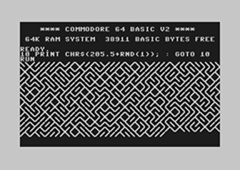
10print running on a Commodore 64
We typically think of computer programming as a technical skill, one that involves the disciplines of math and science, and we often consider software to be a tool, something that helps us complete tasks efficiently. However, software can be more than a tool, and many writers and scholars in the humanities write code. We can use computer programming to create literature and to explore new ways of expressing ideas. In this class, we'll examine computer programming as a writing practice, as a way to express ideas and make arguments. From video games to digital storytelling to electronic poetry, software can be used to create worlds and to play with language.
This course is part of a Freshman Interest Group (FIG), and students also enroll in two other courses: "Introduction to Composition" and "Introduction to Computation." This FIG does not require that students know anything about programming a computer or about digital games. The class offers multiple opportunities to tinker with various technologies and to try out new writing practices. The only requirement is curiosity. In this class, we will ask: What happens when we explore the relationships between writing and coding? What do these practices have in common, and how are they different?
Syllabus
Professor: Jim Brown
Teaching Assistant: Brandee Easter
Class Meeting Place: 2252A Helen C. White
Class Time: Monday, 2:30pm-5:00pm
Jim's Office: 6187E Helen C. White
Jim's Office Hours: Monday 12:00-2:00pm [Make an Appointment]
NOTE: Some office hours meetings will happen via Google Chat, Skype, Learn@UW instant messaging, or some other technology
Jim's Email: brownjr [at] wisc [dot] edu
Brandee's Office: 7153 Helen C. White
Brandee's Office Hours: Tuesday 1pm-5pm [Make an Appointment]
Brandee's Email: bdeaster [at] wisc [dot] edu
Course Website: http://courses.jamesjbrownjr.net/102_fall2013
Course Objectives
In this course, we will:
- Learn how to evaluate and analyze new media objects
- Use digital technologies to express ideas and make arguments
- Develop sustainable writing and design processes
- Work collaboratively on computer programming and game design projects
Required Texts:
- 10 PRINT CHR$(205.5+RND(1)); : GOTO 10, by Nick Montfort, Patsy Baudoin, John Bell, Ian Bogost, Jeremy Douglass, Mark C. Marino, Michael Mateas, Casey Reas, Mark Sample, and Noah Vawter [Available as a free download]
- Papers, Please (game) [Available for $9.99 at the game website]
- Persuasive Games, by Ian Bogost, [Available at Rainbow Bookstore]
Course Work
In this class, the following work will be evaluated (details can be found in the "Assignments" section of the course website):
- Attendance and Participation
- Group Persuasive Game Project (game + presentation)
- Group 10print Project (presentation)
- Group Arduino Project
Learning Record
Grades in this class will be determined by the Learning Record Online (LRO). The LRO will require you to observe your own learning and construct an argument for your grade based on evidence that you accumulate throughout the semester. You will record weekly observations and you will synthesize your work into an argument for your grade. You will construct this argument twice - once at the midterm and once at the end of the course. We will be discussing the LR) at length during the first week of class. See below for more details.
Attendance
Success in this class will require regular attendance. I will take attendance at each class meeting, and your Learning Record will include a discussion of attendance. You are required to attend class daily, arrive on time, do assigned reading and writing, and participate in all in-class work. Please save absences for when you are sick or have a personal emergency. If you find that an unavoidable problem prevents you from attending class or from arriving on time, please discuss the problem with me.
Lateness
If you arrive five minutes after class is scheduled to begin, you will be considered late. If you are more than 10 minutes late for class, you will be considered absent. If there is something keeping you from getting to class on time (i.e., you have a long trek across campus right before our class), please let me know during the first week of class.
Computers, Smartphones, etc.
Please feel free to use your computer or any other device during class, provided that your use of it is related to what we are working on in class. Please silence cell phones during class.
Grades
Grades in this course will be determined by use of the Learning Record, a system which requires students to compile a portfolio of work at the midterm and at the end of the semester. These portfolios present a selection of your work, both formal and informal, plus ongoing observations about your learning, plus an analysis of your work in terms of the five dimensions of learning and the goals for this course. You will evaluate your work in terms of the grade criteria posted on the LRO site, and you will provide a grade estimate at the midterm and final.
The dimensions of learning have been developed by teachers and researchers, and they represent what learners experience in any learning situation:
1) Confidence and independence
2) Knowledge and understanding
3) Skills and strategies
4) Use of prior and emerging experience
5) Reflectiveness
In addition to analyzing your work in terms of these dimensions of learning, your argument will also consider the specific goals for this course. These goals are called Course Strands (these are also listed above in the "Course Objectives" section):
1) Digital Analysis
2) Digital Expression
3) Writing/Design Process
4) Collaboration
The LRO website provides detailed descriptions of the Course Strands and the Dimensions of Learning.
Your work in class (and in other classes during this semester) along with the observations you record throughout the semester will help you build an argument in terms of the dimensions of learning and the course strands. We will discuss the LRO in detail at the beginning of the semester, and we will have various conversations about compiling the LRO as the semester progresses.
Late Assignments
Due dates for assignments are posted on the course schedule. While I will not be grading your assignments, I will be providing comments and feedback. I will not provide feedback on late assignments. Also, late assignments will be factored into your argument in the LR (see the grade criteria for more details).
Intellectual Property
Much of what we'll be working on this semester involves the appropriation of existing texts. This is no different than any other type of writing - all writing involves appropriation. The key will be to make new meaning with the texts that you appropriate. Copying and pasting existing texts without attribution does not make new meaning. Some of your work will make use of different materials (text, video, audio, image), and you will have to be mindful of intellectual property issues as you create texts for this class. If you have questions about the University of Wisconsin's Academic Misconduct policy, please see the Student Assistance and Judicial Affairs website.
Technology Policy
We will use technology frequently in this class. Although I am assuming that you have some basic knowledge of computers, such as how to use a keyboard and mouse, and how to use the Web and check e-mail, most things will be explained in class. If you don’t understand what we are doing, please ask for help. If you are familiar with the technology we are using please lend a helping hand to your classmates.
Course Website and Email
You should check your email daily. Class announcements and assignments may be distributed through email. The course website will also have important information about assignments and policies. Pay close attention to the course calendar as we move through the semester. I reserve the right to move things around if necessary.
Emails to me must come from your wisc.edu email address. They must include a title explaining the email, a salutation (for example, "Dear Jim"), a clear explanation of what the email is about, and a signature.
Schedule
Unit 1: Rhetorical Computing
September 9
Read: Bogost, preface and pp. 1-14
Play: "Papers, Please"
In class: Discuss syllabus, discuss reading, discuss Papers, Please
September 16
Read: Bogost pp. 15-64
Play: "Papers, Please"
In class: Discuss LRO, discuss reading, discuss Papers, Please
September 23
Read: Bogost (your group's assigned chapter)
In class: Group presentations, game design workshop
September 27
[LRO PART A due at noon]
September 30
In class: Game design workshop
October 4
[Version 1.0 of game due at noon]
October 7
In class: Game design workshop
October 11
[Version 2.0 of game due]
October 14
In class: Game design workshop
Unit 2: Creative Computing
October 21
[Version 3.0 of game due]
Read: 10 PRINT pp. 1-18, pp31-50 ("Introduction" and "Mazes")
In class: Discuss reading, presentations
October 25
[Midterm LRO Due at Noon]
October 28
Read: 10 PRINT "Regularity" and "Randomness"
In class: Discuss reading, 10print workshop
November 4
Read: 10 PRINT "Basic," "The Commodore 64," and "Conclusion"
In class: Discuss reading, 10print workshop
November 11
10print presentations
Unit 3: Physical Computing
November 18
Read: Levi-Strauss (Dropbox), "Kinect-ing Together"
In Class: Arduino Workshop
NOTE: This workshop will run from 2:30 until 6:30, and dinner will be provided.
November 25
Arduino Workshop
December 2
Arduino Workshop
December 9
Physical Computing Project Presentations
December 21
[Final LRO due at 7:45am]
Assignments
Follow the links below for detailed descriptions of class projects.
Persuasive Game Project
During our reading of Persuasive Games, we have begun to think about how educational, political, and advertising games use procedures to persuade. In this project, you will have the opportunity to create your own persuasive game. You will also present your game to the class, explaining your group's issue and how your game sheds light on that issue.
In groups, you'll use the programming language Scratch to create a game that makes a procedural argument about an issue associated with your assigned section of the book. For instance, if your group was assigned the advertising section, you will make a game that uses procedural rhetoric as an advertising tool.
You will have ample class time to workshop your game (creating various versions, playtesting, revising the game, etc) and to work with your group members to build your game. Note that there are due dates for versions of the game. While there are not specific benchmarks for these versions, each version must be a playable version of the game. For instance, while version 1.0 will not incorporate all features and may only be a rough sketch of what you have planned, it must be a playable game.
Presentation
Throughout the game design process, you will also be crafting a 15-minute presentation about your game. You will be gathering information for the presentation and planning out how you will explain your game to the class. Early stages of this planning may be notes and an outline, but it should be progressing toward a 15-minute presentation that you will deliver on November 5.
Your group's presentation will explain the context of your game and the procedural arguments that your game makes. You may use any presentation software, but you should plan to incorporate visuals. All members of the group must speak during the final presentation, and you should be prepared to answer questions (as audience members for other group presentations, you should be also be prepared to ask questions).
DesignLab
During your work on this project, you must meet with the consultants at DesignLab at least once. The consultants at DesignLab can help you with both your game and your presentation by offering advice about how to best present your argument or explain your issue. Note that DesignLab is not a "help desk" and is not focused on providing answers to questions about software (these kinds of questions should be directed toward me and Brandee). Instead, DesignLab consultants are available to help you with creative development and planning.
When providing feedback, Brandee and I will be looking for the following:
-
Game
- Does your game make an effective and coherent procedural argument about your issue?
- Does your game provide sufficient context for the issue?
- Does your project demonstrate an understanding of the class readings and an application of their terms and concepts? You should be applying what you've learned in the Bogost readings and in our discussions about other games.
- Has your group effectively managed the project, allowing all group members to take part in all phases (research, writing, coding, testing, etc)?
- Has your group incorporated feedback from others in the class?
- Is your project free from grammatical errors and generally well designed?
-
Presentation
- Does your presentation explain how your game responds to your assigned chapter in Persuasive Games?
- Does your presentation provide sufficient context for someone who is not familiar with the issue or with your game?
- Does your presentation explain your game's procedural argument?
- Do all members of the group speak during the presentation?
- Does your presentation incorporate visuals in a way that helps the audience?
- Was your group prepared to answer questions about your issue and your game?
- Are your slides free from grammatical errors and generally well written?
10Print Collaborative Paper and Presentation
The authors of 10 Print argue that creative computing allows us to explore the possibilities of a language, platform, or machine. Specifically, the 10 PRINT one-liner can be a useful way of understanding the various ways a certain computer language enables and constrains software design. In this project, your task will be to research a version of the 10 PRINT program. Versions of the program have been written in various languages and for various machines, and in group's you will be working to explain how your chosen version of 10 PRINT works and why that version of the program is interesting.
Each group will be assigned one of the "REM" chapters in 10 PRINT and will be tasked with writing a 1000-word paper and creating a 15-minute presentation. The paper will describe how your version of the program works while the presentation will focus on the significance of that version of the program and what it tells us about the language in which it's written.
For instance, if your group were to choose the Python version of 10 PRINT (this version of the program is not actually described in the text), that group's paper would offer a detailed account of how the program works and their presentation would explain what the Python version of 10 PRINT can tell us about the Python language.
Here are some things to consider as you work:
Paper
When describing how your version of the program works, you should model your discussion on pages 8-16 of the 10 PRINT text. Your explanation does not have to be as detailed as the one presented by the authors, but this section of the book offers a model for explaining how a program works.
Presentation
Your group's presentation will explain how your assigned version of 10 PRINT works, will cover some of the history of the computer language you are researching, and will explain what 10 PRINT tells us about the language in which it is written. This will require some research into the programming language you're discussing, and it may also mean attempting to write code in that language. In some cases, this will require using emulation software, much like the Frodo emulator I've used in class to emulate the Commodore 64.
You may use any presentation software you'd like for the presentation (Keynote, Powerpoint, Prezi, etc.), but you should plan to incorporate visuals. All members of the group must speak during the final presentation, and you should be prepared to answer questions (as audience members for other group presentations, you should be also be prepared to ask questions).
When providing feedback, Brandee and I will be looking for the following:
- Does your paper adequately explain your version of 10 PRINT?
- Does your presentation provide sufficient context for your assigned language? Does it provide some history of the language and how it's used?
- Does your presentation explain how your version of 10 PRINT sheds light on the language in which it is written?
- Do all members of the group speak during the presentation?
- Does your presentation incorporate visuals in a way that helps the audience?
- Was your group prepared to answer questions about your version of 10 PRINT?
- Are your paper and presentation free from grammatical errors and generally well written?
Physical Computing Project
In our first two projects, we have considered code as writing, as an attempt to express ideas by way of procedures and processes. From videogames to various versions of the 10 PRINT one-liner, we have reimagined writing beyond the alphabetic. Code can be an expressive medium.
In this project, we will extend that line of thought into physical environments. By using the Arduino kits introduced during our workshop with Kevin Brock, we will design a responsive and interactive installation that asks an interactor to think differently about his or her body and about the physical space s/he is occupying. Your goal is to use the Arduino kit and a physical environment to communicate an idea. Previous projects asked you to build and study things that involve keyboard inputs and screen outputs. While a computer screen will be part of this new project, it will be coupled with the physical environment. The Arduino can accept various kinds of information (light, sound, a button push), and you will use those affordances to design a physical computing project that attempts to make us reflect on physical space and bodies.
Groups will choose some location on campus (indoors or outdoors) and make use of the physical environment to design an installation. The environment you choose is part of your installation, so you'll want to make use of it as much as possible. The choice of location will shape and constrain what you can or can't do with the project.
Like our previous projects, you will share your results in both a short paper and a presentation. Your paper will be short - a-500 word explanation that tells us what ideas you're trying to convey with your physical computing project. How are you asking an interactor to reimagine the physical space you've chosen? How are you asking that interactor to rethink how his or her body interacts with that space? These are the kinds of questions you should be answering in the 500-word paper.
In addition, your group will craft a 15-minute presentation. Presentations will need to show your project in action, either with video or images. You'll need to ask people to interact with your project, and you should document these interactions as well. You can use smart phones or any other type of equipment to document interactions. If you need access to equipment, let me know. Your presentation will need to do the following:
1) Explain the technical details of how the project works.
2) Explain the idea or ideas you're trying to convey with the project.
3) Demonstrate the project in action.
3) Discuss what you might change if given the chance to revise the project again.
As Brandee and I respond to projects, papers, and presentations, we'll be asking the following questions:
Projects
- Does your project take full advantage of the affordances of the Arduino board?
- Does the project successfully ask an interactor to reconsider bodies and physical space?
- Can an interactor make sense of the project in the course of interaction, without any explanation on the part of the designers.
Papers
- Does your paper clearly explain the idea your trying to convey with the project?
- Is the paper free of grammatical errors and generally well written?
Presentation
- Does your presentation show your project in action? Does it show us people interacting with it?
- Do all members of the group speak during the presentation?
- Does your presentation incorporate visuals in a way that helps the audience?
- Was your group prepared to answer questions about the project?
- Is it free from grammatical errors and generally well written?
English 550: Digital Rhetorics (Spring 2013)

Page from Lauren Redniss's Radioactive
Aristotle describes rhetoric as the faculty of observing, in any particular case, the available means of persuasion. Digital technologies have expanded these available means, calling for new ways of understanding rhetorical theory and rhetorical expression. This course will investigate emerging modes of expression in order to rethink and reimagine the available means of persuasion. The course includes a discussion of the history of rhetoric and its contemporary applications, and students will then both analyze and produce digital objects. While composing digitally, we will also build new theoretical approaches for reading and writing digitally. We will be asking: How do we cultivate a rhetorical sensibility for digital environments? What new rhetorical theories do we need for digital technologies? What are the available means of persuasion when using such technologies? No specific technical expertise is required for this course.
Syllabus
Professor: Jim Brown
Teaching Assistant: Deidre Stuffer
Class Meeting Place: 2252 Helen C. White
Class Time: Monday, 2:30-5:00pm
Jim's Office: 6187E Helen C. White
Jim's Office Hours: Monday, 12:30-2:30pm [Make an Appointment]
Jim's Email: brownjr [at] wisc [dot] edu
Deidre's Office: 7184 Helen C. White
Deidre's Office Hours: Monday, Tuesday, Thursday 10:00am-12:00pm [Make an Appointment]
Deidre's Email: stuffer [at] wisc [dot] edu
Course Website: http://courses.jamesjbrownjr.net/550_spring2013
Required Books
- Crowley, Sharon and Debra Hawhee. Ancient Rhetorics for Contemporary Students (5th edition) [Available for purchase at Rainbow Bookstore Cooperative]
- Redniss, Lauren. Radioactive [Free copies available via the Go Big Read Program]
Other required materials, available via Download:
- Bogost, I. “The Rhetoric of Video Games.” The Ecology of Games: Connecting Youth, Games, and Learning. Edited by Katie Salen. The John D. and Catherine T. MacArthur Foundation Series on Digital Media and Learning. Cambridge, MA: The MIT Press, 2008. 117–140.
- Juul, Jesper. Half-Real: Video Games Between Real Rules and Fictional Worlds. The MIT Press, 2011. (excerpts)
- Frasca, Gonzalo. "Simulation vs. Narrative." Introduction to Ludology. Edited by Mark J.P. Wolf and Bernard Perron. Routledge, 2003
- Limbo (videogame) [Available for $9.99 via Limbogame.org]
- McCarthy, Tom. Transmission and the Individual Remix (e-book) [Available for $1.99 in various formats: Google Books, Amazon Kindle, Barnes and Noble Nook book]
Course Objectives
Our work in this course will address four main objectives:
- Rhetorical Theory: Read and analyze classical and contemporary rhetorical theories.
- Rhetorical Practice: Use rhetorical theory to create digital objects.
- Writing and Design Process: Develop sustainable writing and design processes when creating traditional writing assignments and digital projects.
- Collaboration: Effectively collaborate with your peers by sharing ideas and efficiently managing tasks.
Course Work
This course will involve the following projects and activities:
- Attendance and class discussion
- Rhetorical exercises from Crowley and Hawhee
- Digital remakes of rhetorical exercises
- Digital remake inspired by Radioactive
- Group Videogame project (in collaboration with Meg Mitchell's Digital Art class)
Please see the "Assignments" page for more details.
Learning Record
Grades in this class will be determined by the Learning Record Online (LRO). The LRO will require you to observe your own learning and construct an argument for your grade based on evidence that you accumulate throughout the semester. You will record weekly observations and you will synthesize your work into an argument for your grade. You will construct this argument twice - once at the midterm and once at the end of the course. We will be discussing the LR) at length during the first week of class. See below for more details.
Attendance
Success in this class will require regular attendance. I will take attendance at each class meeting, and your Learning Record will include a discussion of attendance. You are required to attend class daily, arrive on time, do assigned reading and writing, and participate in all in-class work. Please save absences for when you are sick or have a personal emergency. If you find that an unavoidable problem prevents you from attending class or from arriving on time, please discuss the problem with me.
Lateness
If you are more than 10 minutes late for class, you will be considered absent. If there is something keeping you from getting to class on time (i.e., you have a long trek across campus right before our class), please let me know during the first week of class.
Computers and Cell Phones
Please feel free to use your computer or mobile phone during class, provided that your use of it is related to what we are working on in class. Please silence mobile phones during class.
Grades
Grades in this course will be determined by use of the Learning Record, a system which requires students to compile a portfolio of work at the midterm and at the end of the semester. These portfolios present a selection of your work, both formal and informal, plus ongoing observations about your learning, plus an analysis of your work in terms of the five dimensions of learning and the goals for this course. You will evaluate your work in terms of the grade criteria posted on the LRO site, and you will provide a grade estimate at the midterm and final.
The dimensions of learning have been developed by teachers and researchers, and they represent what learners experience in any learning situation:
1) Confidence and independence
2) Knowledge and understanding
3) Skills and strategies
4) Use of prior and emerging experience
5) Reflectiveness
In addition to analyzing your work in terms of these dimensions of learning, your argument will also consider the specific goals for this course. These goals are also listed above under "Course Objectives," and for the purposes of the Learning Record they are called the Course Strands:
1) Rhetorical Theory
2) Rhetorical Practice
3) Writing and Design Process
4) Collaboration
The LRO website provides detailed descriptions of the Course Strands and the Dimensions of Learning.
Your work in class (and in other classes during this semester) along with the observations you record throughout the semester will help you build an argument in terms of the dimensions of learning and the course strands. We will discuss the LRO in detail at the beginning of the semester, and we will have various conversations about compiling the LRO as the semester progresses.
Late Assignments
Due dates for assignments are posted on the course schedule. While I will not be grading your assignments, I will be providing comments and feedback. I will not provide feedback on late assignments. Also, late assignments will be factored into your argument in the LR (see the grade criteria for more details).
Intellectual Property
Much of what we'll be working on this semester involves the appropriation of existing texts. This is no different than any other type of writing - all writing involves appropriation. The key will be to make new meaning with the texts that you appropriate. Copying and pasting existing texts without attribution does not make new meaning. Some of your work will make use of different materials (text, video, audio, image), and you will have to be mindful of intellectual property issues as you create texts for this class. If you have questions about the University of Wisconsin's Academic Misconduct policy, please see the Student Assistance and Judicial Affairs website.
Technology Policy
We will use technology frequently in this class. Although I am assuming that you have some basic knowledge of computers, such as how to use a keyboard and mouse, and how to use the Web and check e-mail, most things will be explained in class. If you don’t understand what we are doing, please ask for help. If you are familiar with the technology we are using please lend a helping hand to your classmates.
Course Website and Email
You should check your email daily. Class announcements and assignments may be distributed through email. The course website will also have important information about assignments and policies. Pay close attention to the course calendar as we move through the semester. I reserve the right to move things around if necessary.
Emails to me must come from your wisc.edu email address. They must include a title explaining the email, a salutation (for example, "Dear Jim"), a clear explanation of what the email is about, and a signature.
Schedule
1/28
- Read: Crowley and Hawhee, Chapter 1 (pp 1-29); McCarthy's "Transmission and the Individual Remix"
- In Class: Discuss syllabus, discuss readings, rhetorical activities
2/4
- Read: Crowley and Hawhee, Chapter 2 (pp37-51), Radioactive; Browse Learning Record and Peg Syverson's Learning Record Page
- In Class: Discuss Learning Record, discuss readings, Fable and Chreia exercises
2/11
- Read: Crowley and Hawhee, Chapter 3 (pp56-79); Radioactive
- Write: Fable, tale, chreia, or proverb exercise (based on Radioactive) [uploaded to Dropbox prior to class]
- In Class: Discuss reading, proverb exercise, Photoshop workshop
2/14
- LRO Part A Due
2/18
- Read: Crowley and Hawhee, Chapter 4 (pp88-112); Radioactive
- Write: Common-place Exercise (p. 114) [uploaded to Dropbox prior to class]
- In class: Discuss reading, GarageBand workshop
2/25
- Read: Crowley and Hawhee, Chapter 6; Radioactive
- Write: Character Exercise (p. 164) + Digital Remake [uploaded to Dropbox prior to class]
- In Class: Discuss reading, share remakes, iMovie workshop
3/4
- Read: Crowley and Hawhee, Chapter 7; Radioactive
- Write: Encomium or Invective Exercise (p. 189) + Digital Remake [uploaded to Dropbox prior to class]
- In Class: Discuss reading, share remakes, InDesign workshop
3/11
- Version 1.0 of Digital Remake Due
- In Class: Discuss Chapter 12, workshop
3/15
-
Midterm LRO Due at Noon
3/18
- Version 2.0 of Digital Remake Due
- Discussion Chapter 9, Workshop day
3/21
- Project Due [uploaded to Dropbox by midnight]
4/1
- Read: Bogost (preface and pp. 1-40), play Limbo
4/8
- Read: Bogost (pp41-58), Mateas, play Limbo
- In Class: Discuss reading, discuss Limbo
4/15
- Limbo response paper due
- Workshop
4/22
- Version 1.0 Due
- Workshop
4/29
- Version 2.0 Due
- Workshop
5/6
- Version 3.0 Due
- Workshop
5/13
- FINAL LRO DUE AT 7:00PM
Assignments
Follow the links below for descriptions of our assignments.
Rhetorical Exercises / Digital Remakes
As we read Crowley and Hawhee's text, we will be completing the rhetorical excercises at the end of many of the chapters. Those exercises were designed by ancient rhetoricians who hoped to provide their students with a rhetorical sensibility. By developing multiple arguments, crafting stories, and playing with language, students of rhetoric are "tuning their instrument" and preparing themselves for rhetorical situations. These exercises are also used for invention - for the development and discovery of arguments.
We will use these exercises toward the same ends as we brainstorm and tinker with ideas for our digital remake of Lauren Redniss' Radioactive. In order to bring these exercises into digital rhetorical situations, we will remake the exercises themselves. After completing these exercises via writing, the primary technology of the ancients, we will ask the following question: How could this same exercise be carried out using a digital technology? We will be workshopping various tools for digital composition, and we will learn the basics of various software packages. As we learn these tools, we will use them to remake these ancient rhetorical exercises. For instance, if we have written a fable in words, we will then ask: What would that fable exercise look like if we used sound, image, or any other method of digital composition? How do these technologies change the exercise? What new rhetorical possibilities are opened up by digital technologies? What possibilities are foreclosed?
These are the questions we'll ask ourselves as we complete these exercises. We will use the exercises as ways to explore the rhetorical possibilities of digital composition, and each of these exercises will stand as opportunities for you to consider how you might like to create a digital remake of Radioactive.
When evaluating these projects, here are the questions we'll be asking:
- Have you used the written version of the rhetorical exercise to generate ideas and arguments?
- Does your exercise demonstrate an effort to apply the terms and concepts of the textbook chapter?
- Does your digital remake of the exercise take advantage of the rhetorical possibilities of your chosen technology?
- Do these exercises demonstrate that you are working toward an idea for your digital remake of Radioactive?
- Were your assignments turned in on time? (Reminder: We do not accept late work.)
Digital Remake of Redniss' Radioactive
Lauren Redniss' Radioactive uses word and image to present narratives and arguments. It pushes the boundaries of the printed page, forcing us to consider different ways of presenting stories, arguments, and information. Redniss has presented a multimodal account of the life and work of the Curies while also showing us how those their stories are part of a broad network of information.
Our task will be to create a digital remake of Redniss' text. She has shown us how to combine word, image, and primary documents and to reimagine what a book can be, and we will take that lesson into digital rhetoric and writing. How could we remake a portion of Redniss' narrative by using the various digital technologies we have explored in this class? How can we remake some portion of Redniss' text in order to make our own argument, and how can use the affordances of digital technology to do so? Redniss' expanded her available means of persuasion beyond print, telling her stories and making arguments by using various media. How can we do the same with digital technologies?
We have been composing rhetorical exercises throughout the semester, and we have also been creating digital remakes of those exercises. These assignments were designed so that we could explore the rhetorical possibilities of various digital technologies. Those exercises have provided us with opportunities to invent, and we will use what we've learned to create a digital remake of Radioactive. That remake will take some portion of Radioactive as its inspiration, and it will use digital technology to make an argument. Your argument can be about anything that relates to Radioactive. It can address the history of science, love, radioactivity, technology, death, and much more. Redniss addresses a number of intersecting themes and makes various arguments in her text (some are more explicit than others), and you should use her text as inspiration for your own attempt at an argument.
I encourage you to use one of your rhetorical exercises as a "rough draft" for this project. Those exercises should have provided you with ways to think about Redniss' text and to imagine how you might use various digital tools to remake some of her arguments in a new way.
In addition to creating a digital remake of Radioactive, you will write a 750-word reflection on your remake that details how you approached the project and what you hope it accomplishes. This document should serve as a way for you to reflect on the process and to provide us with insight into how you've used digital technology to make an argument.
When evaluating these projects, here are the questions we'll be asking:
- Have you applied the terms and concepts of the textbook in the creation of your digital remake?
- Does your remake make an argument (or arguments...you can make more than one)?
- Does your remake take full advantage of the rhetorical possibilities of your chosen medium?
- Have you transformed some portion of Redniss' argument or narrative? Does your remake do something new with her material, showing us some new possibilities by "translating" her work into some other medium?
- Does your remake demonstrate an understanding of the significance of Redniss' narratives and arguments? Does it demonstrate an understanding of how she's used particular media toward specific ends?
- Does your reflection document explain your process and the logic of your remake, providing insight into what you hope the remake accomplishes?
- Does your reflection document observe the word limit of 750 words?
- Was your assignment turned in on time? (Reminder: We do not accept late work.)
Short Response Paper on Limbo
Due Date: 4/15
In our readings and discussions, we have addressed how games use rules and procedures to make meaning. We'll put those ideas to the test by conducting a close analysis of Limbo that focuses on how its procedures make make meaning and how it might be redesigned as a persuasive game, a game that uses processes rhetorically.
We have been asking these questions in class: How do a game's mechanics make arguments? What are those arguments? What is the significance of those arguments, and how are the connected to the game's story? Remember that procedural rhetoric is different from verbal rhetoric, visual rhetoric, or textual rhetoric. The images and text of the game do in fact make arguments, but that is not what we're focused on here. Instead, we are examining the procedures of the game and explaining how those procedures mount arguments.
Our task in this paper is to transform Limbo into what Bogost calls a "persuasive game." While Limbo does in fact use procedures as an expressive medium, it does not necessarily use those procedures to persuade. How could we redesign Limbo in order to transform it into persuasive game? This is the question you'll take up in this short paper. You will propose a redesign of the game and then explain how your redesign would make Limbo a persuasive game. Your proposed redesign should focus on how the game uses procedural expression. You can address visuals or sound as well (that is, you could redesign these components of the game), but you must also address the game's procedures. How would your new version of Limbo use computational procedures to make an argument? What would that argument be?
Papers should be no longer than 1000 words (roughly: Times New Roman, 12 point font, three double-spaced pages) and should be uploaded to Dropbox prior to our class meeting on 4/15.
When providing feedback, we will be looking for the following:
- Does your redesign make Limbo into a persuasive game?
- Does your paper explain your proposed redesign in detail?
- Does your paper explain and describe the procedural argument that your redesigned game would make?
- Does your paper focus on how the procedures of your redesigned game would be used to persuade?
- Is your paper written effectively and coherently with very few grammatical errors?
- Is your paper formatted correctly (double-spaced, observes the word limit, name in upper-left-hand corner)?
- Was the paper turned in on time? (Reminder: We do not accept late work.)
Procedural Authorship Project
Due Dates:
4/22: Version 1.0 Due
4/29: Version 2.0 Due
5/6: Version 3.0 Due
Throughout our discussions of games, computational art, procedural authorship, and procedural rhetoric, we’ve been discussing how computational procedures can be used to express ideas, to make arguments, and to create certain kinds of experiences. Procedural expression uses computation as more than a vehicle for text and image. A procedural author uses computation itself as the expressive medium.
In this collaborative project, you will use procedures to express ideas and make arguments. In teams (one student from “Computational Art” will team up with two students from “Digital Rhetorics”), you will combine your expertise to create a computational artifact. That artifact can be a game, but it does not have to be. The primary goal here is to use computational procedures as an expressive medium. The audiences interacting with your artifact should be afforded the opportunity to reflect on how rules are shaping what is or is not possible. Your job is to make an argument or express an idea by way of computational procedures.
Your procedural authorship project should express an idea or make an argument. The students in “Digital Rhetoric” have spent the semester examining how digital tools and environments expand our available means of persuasion. In doing so, they have explored “argument” in a broad sense. We typically think of argument narrowly: I argue an idea, and my audience either accepts or rejects that argument. However, argument rarely happens in these ways, and this is particularly true when using procedurality. An audience interacting with a computational artifact will often glean various arguments from that experience, arguments that appear over and beyond what the artist/writer/rhetor has intended. This is what we expect will happen in these projects.
In addition to using procedures to create something, you will also write a 1000-word reflection on your artifact. This writing should describe both your process and what you hope the piece accomplishes. These brief essays (authored collaboratively) provide you with some space to explain the choices you’ve made and the goals of your project.
Both Meg and Jim will evaluate these projects, and we will do so with the following questions in mind:
- Have you used procedures as an expressive medium? Does the project use procedures to express an idea and/or make an argument?
- Does the project allow an audience to reflect on the procedural system you’ve authored, opening up space for reflection, dialogue or critique?
- Does your reflective essay explain your process in detail, explaining the choices you made, your revision process, and what you hope the piece accomplishes?
Is your essay written clearly with no grammatical errors? - Was your project submitted on time?
English 706: Composition, Rhetoric, and the Nonhuman (Spring 2013)

The "Giant Whale" at the St. Louis City Museum
Photo by Jillian Sayre
In recent decades, a number of disciplines have begun to turn attention to the nonhuman. Work on the posthuman, actor-network theory, speculative realism, and animal studies (among numerous other fields and theories) attempts to expand the scope of scholarship in both the humanities and the sciences. This scholarship is looking beyond the human, and Composition and Rhetoric has begun to take this turn as well. This seminar takes up the lines of research that have begun to address writing, rhetoric, and the nonhuman. The course examines recent work in the field that asks: What is the role of the nonhuman in studies of composition, literacy, and in rhetoric? What does a nonhuman theory of composition, literacy, or rhetoric look like? How does accounting for the nonhuman reshape or reimagine the various scholarly agendas of the field?
The course covers work in Composition and Rhetoric that addresses the nonhuman along with the work of scholars outside the field who address these questions. In addition to reading and writing about contemporary scholarship, students in this course will also address these questions in a less traditional way: They will make something. Throughout the semester, students will work toward the construction of some object. This can take a number of forms, including (but not limited to) knitting, carpentry, cooking, and computer programming. We will treat this process of making as an opportunity to meditate on how nonhumans intervene in and shape writing processes and rhetorical action.
Syllabus
English 706: Composition, Rhetoric, and the Nonhuman
Professor: Jim Brown
Class Meeting Place: 2252 Helen C. White
Class Time: Wednesday, 9:00am-11:30am
Office: 6187E Helen C. White
Office Hours: Monday 12:30-2:30 [Make an Appointment]
Email: brownjr [at] wisc [dot] edu
Website: http://courses.jamesjbrownjr.net/706_fall2012
Course Goals:
- Read and analyze recent scholarship regarding the role of the nonhuman rhetoric and writing
- Examine the relationship between work within and outside of the field of Composition and Rhetoric
- Consider the role of nonhumans in our own creative processes
- Develop sustainable reading and writing processes
Required Texts:
- Bennett, Jane. Vibrant Matter: A Political Ecology of Things. Duke University Press Books, 2010. Print.
- Bogost, Ian. Alien Phenomenology, or What It’s Like to Be a Thing. Univ Of Minnesota Press, 2012. Print.
- Bryant, Levi R. The Democracy of Objects. MPublishing, University of Michigan Library, 2011. Print. [also available for download]
- Derrida, Jacques. The Animal That Therefore I Am. Fordham University Press, 2008.
- Harman, Graham. The Quadruple Object. Reprint. John Hunt Publishing, 2011. Print.
- Latour, Bruno. Aramis, or the Love of Technology. Harvard University Press, 1996. Print.
- Oliver, Kelly. Animal Lessons: How They Teach Us to Be Human. Columbia University Press, 2009. Print.
Other Readings (available for download):
- Bay, Jennifer, and Thomas Rickert. “New Media and the Fourfold.” JAC 28.1-2 207-244. Print.
- Brandt, Deborah, and Katie Clinton. “Limits of the Local: Expanding Perspectives on Literacy as a Social Practice.” Journal of Literacy Research 34.3 (2002): 337-356. Web. 1 Nov. 2012.
- Brown, James and Nathaniel Rivers. "Composing the Carpenter's Workshop." O-zone: A
Journal of Object-Oriented Studies. (forthcoming, January 2013) - Davis, Diane. “Creaturely Rhetorics.” Philosophy and Rhetoric 44.1 (2011): 88-94. Web. 1 Nov. 2012.
- Deleuze, Gilles, and Felix Guattari. A Thousand Plateaus: Capitalism and SchizophreniaM. Trans. Brian Massumi. University of Minnesota Press, 1987. Print.
- Hallenbeck, Sarah. “Toward a Posthuman Perspective: Feminist Rhetorical Methodologies and Everyday Practices.” Advances in the History of Rhetoric 15.1 (2012): 9-27. Web. 1 Nov. 2012.
- Hawhee, Debra. “Toward a Bestial Rhetoric.” Philosophy and Rhetoric 44.1 (2011): 81-87. Web. 1 Nov. 2012.
- Hawk, Byron. “Vitalism, Animality, and the Material Grounds of Rhetoric.” Communication Matters: Materialist Approaches to Media, Mobility and Networks. New York: Routledge, 2012. 196-207. Print.
- Hesse, Doug, Nancy Sommers, and Kathleen Blake Yancey. “Evocative Objects: Reflections on Teaching, Learning, and Living in Between.” College English 74.4 (2012): 325-350. Print.
- Kennedy, G. A. “A Hoot in the Dark: The Evolution of General Rhetoric.” Philosophy & Rhetoric 25.1 (1992): 1–21. Print.
- Marback, Richard. “Unclenching the Fist: Embodying Rhetoric and Giving Objects Their Due.” Rhetoric Society Quarterly 38.1 (2008): 46-65.
- May, Matthew. “Orator-Machine:” Philosophy & Rhetoric 45.4 (2012): 429-451. Web. 10 Nov. 2012.
- Muckelbauer, John. “Domesticating Animal Theory.” Philosophy and Rhetoric 44.1 (2011): 95-100. Web. 1 Nov. 2012.
- Ng, Julia. “Each Thing a Thief: Walter Benjamin on the Agency of Objects.” Philosophy & Rhetoric 44.4 (2011): 382-402. Print.
- Spinuzzi, Clay. “Losing by Expanding Corralling the Runaway Object.” Journal of Business and Technical Communication 25.4 (2011): 449-486. Web. 9 Nov. 2012.
Course Work
- Attendance (10%)
Success in this class will require regular attendance as we discuss the readings and share our written work. - Questions for Discussion (5%)
For each assigned reading, I will create a Google Document in which you should post questions for discussion. See the Assignments section for more details. - Maker Reports (10%)
Throughout the semester, you will be working on some sort of "making" project. The form this project takes is up to you, though I will ask that you commit to a project by the end of our second week of class. During weeks in which a paper or project is not due, you will write brief "Maker Reports." These reports are informal, should be 250-500 words, and should be uploaded to Dropbox prior to our class meeting. You will share these with the rest of the class. - Alien Phenomenology Project (15%)
The first major project will be inspired by Ian Bogost's book Alien Phenomenology and will give you an opportunity to begin using the theories we're discussing in your own projects. See the Assignments section for more details. - Encomium (20%)
The second major project will be an experiment in Adoxography. You will write an encomium of a nonhuman that is somehow related to your semester-long making project. See the Assignments section for more details. - Summary-Response Papers (40%)
Your final two papers (each paper is worth 20% of your grade) will summarize one of the theories that we've read this semester and then read that theory across your semester-long project. See the Assignments section for more details.
With the exceptions of Maker Reports and the questions you post to Google Docs, I will provide letter grades on assignments and a letter grade for your final grade. Maker Reports and questions will be graded on a credit/no-credit basis. Unless you hear from you, you should assume that you've received credit for these assignments.
Below are the grade criteria I will use when providing letter grades:
- A: This is graduate level work. The grade reflects work that is the result of careful thinking. This grade also reflects work that effectively contributes to a scholarly conversation.
- AB: This is graduate level work, but there are minor problems with your argument and/or with your execution. This grade means that the work would need some revision in order to effectively contribute to a scholarly conversation.
- B: This is not graduate level work, and there are significant problems with your argument and/or your execution. This grade means that the work has serious flaws or would need significant revision before effectively contributing to a scholarly conversation.
- BC or below: This is not graduate level work, and there are major problems with the argument and the execution. This grade means that the work does not effectively contribute to a scholarly conversation.
Assignments
Follow the links below for descriptions of our assignments.
Questions for Discussion (Google Docs)
For each reading, we will have a shared Google Document in which you will post questions prior to class. These contributions will not be graded, but participation is required.
By midnight on Monday, you should post two different kinds of questions to our Google Document:
1) Questions of Clarification
These questions should be about terms or concepts you didn't understand or about moments in the argument you found unclear. These questions are, for the most part, focused on understanding the reading, and we will address these first during class discussion.
2) Questions for Discussion
These questions are more geared toward opening up class discussion, and they can be focused on connections you see to other readings, the implications of the argument we've read, or ways that you think the argument might be applied to research questions.
This document will be open during class discussion, and it will serve as a collaborative note-taking space.
Maker Reports
During weeks when we do not have a project or paper due, you will complete 250-500 word reports about your "making" project. These are informal reports, and they are a space for you report on your progress, discuss anything you've learned about the various nonhumans with which you're interacting, reflect on how your experiences intersect with our readings, or any other information that you think might help you (or the rest of the class) gain insight into your ongoing project.
You should think of these brief snippets of text as opportunities for invention. Ideas that emerge in these papers may find their way into your other assignments (the encomium, the alien phenomenology project, or the summary-response papers), so take advantage of this space as you work through our readings. While we won't read these in class, we will share them in a Dropbox folder. At the beginning of class, I will ask you to give a very brief (no more than 2 minutes) report that condenses some of what you've said in the maker report.
Alien Phenomenology
In Alien Phenomenology, Ian Bogost gives us two methods for engaging with nonhumans: ontography and carpentry. In this first project, you will use one of these methods to make something. The book presents a number of examples, from I am TIA to the photography of Stephen Shore, and your task is to follow these examples, to make something that tries to put some of Bogost's methods to the test.
This project can serve as the launching point for your semester-long making project, or it can be a way of accounting for an object relationship happening within that larger project. For instance, if your semester-long project involves knitting, you could approach the Alien Phenomenology project from a number of angles: you might consider how knitting could be used to create an ontograph, or you could use knitting to simulate the experience of a nonhuman, or you could create something in another medium that accounts for the relationship between needle and yarn. These are just three possibilities, but the example is meant to suggest that this project is pretty much wide open.
In addition to creating a work of carpentry or an ontograph, you will write a 1000-word reflection on the project (this word limit will be strictly enforced). This paper will briefly summarize the concept you've chosen to deploy, explain how you've incorporated the methods laid out in Alien Phenomenology, and lay out what you hope your project accomplishes. You will read this paper aloud in class.
When evaluating these projects and papers, I will be asking the following:
- Does your project use ontography or carpentry to shed light on nonhumans and their relations?
- Have you taken full advantage of whatever medium you've chosen to use?
- Does your paper effectively and briefly the method you've chosen?
- Does your paper explain your project and what you hope that it accomplishes?
- Is your paper well-written and free of grammatical errors?
Encomium
In "Things Without Honor," Arthur Pease gives us a detailed history of adoxography, demonstrating how the encomium was used to praise a number of things, including inanimate objects. Our second major project will operate in this tradition as we compose our own encomia to a nonhuman.
Your encomium can focus on any nonhuman connected with your making project, or with the object that you are making. The ecomium should follow the format detailed in Crowley and Hawhee's Ancient Rhetorics for Contemporary Students (handout provided in class): prologue, birth and upbringing, extraordinary acts of one's life, comparisons used to praise the subject, and an epilogue.
Your encomium should be no longer than 1250 words, and you will read your encomium aloud in class.
When evaluating these papers, I will be asking the following:
- Have you used the encomium to shed light on your chosen nonhuman?
- Have you creatively deployed adoxography as you "praise" your chosen nonhuman?
- Does your encomium follow the required format?
- Is your paper well-written and free of grammatical errors?
Summary-Response Papers
[This assignment is adapted from Diane Davis' Summary-Response paper assignment]
Your final two papers in the course will be Summary-Response papers that summarize one of the theorists we've read and then use that theorist to "read" or describe some of the nonhumans you've been interacting with during your semester long making project. You will read these papers aloud in class.
The rules for these papers are as follows:
- Your paper must fit on one side of a 8.5 x 11 sheet of paper, using Times New Roman, 11-point font.
- The first half of each paper should be a concise yet thorough summary of one of the assigned text. Given the space constraints, your summary will have to be carefully crafted and will have to make strategic determinations about what does or does not fit.
- The second half should be your reading of that work "across" one of the nonhumans with which you've been engaging this semester. This nonhuman might be the object you've been making, or it might be one of the objects you've had to interact with during the making process.
When responding to and grading these papers, I will be asking the following questions;
- Have you followed the parameters of the assignment and observed the constraints detailed above?
- Does the first half of your paper provide a tight, thorough, and concise summary your chosen text?
- Does the second half of your paper use the theory in question to ask interesting and important questions about your chosen nonhuman in an attempt to get us to think differently about both the theory and your chosen nonhuman?
- Does your paper follow the rules of engagement?
- Is your paper clearly written and free of grammatical errors?
Schedule
Methods
1/23: Bogost, Brown and Rivers
1/30: Brandt and Clinton, Latour's Aramis (through page 123)
2/6: Hallenbeck, Spinuzzi, Latour's Aramis
2/13: Alien Phenomenology Project Due
Materiality
2/20: Pease, Bryant (through page 134)
2/27: Hesse et. al., Bryant
3/6: Marback, Bennett
3/13: Encomium Due
3/20: Bay and Rickert, Harman
Browse: Random Shopper, Metaphor-a-Minute, RapBot, Objects in Prince of Networks
[Virtual Visit from Darius Kazemi]
3/27: SPRING BREAK
4/3: Hawk; Deleuze and Guattari; P&R Manuscript and Peer Review Docs
4/10: Summary-Response 1 Due
Mammals
4/17: Davis, Derrida
4/24: Hawhee, Kennedy
5/1: Muckelbauer, Oliver
5/8: Summary-Response 2 Due
Rules of Engagement
What is the purpose of a graduate seminar, and how does one use such a space to usefully engage with texts? I offer this document as an answer to that question and as a kind of constitution for our class.
The military root of the phrase "rules of engagement" is unfortunate because we are actually interested in something as nonviolent as possible. Of course, any interpretation of a text will do violence to it. This is the nature of interpretation. We fit a text or a set of ideas into a pre-existing framework that we already have. This is unavoidable. But we can try our best to forestall that violence or to at least soften the blow. In the interest of this kind of approach, I offer the following rules:
1. Disagreement and agreement are immaterial.
Our primary task is to understand, and this does not require agreement or disagreement. The only agreement the seminar asks of you is this: I agree to read, consider, analyze, and ask questions about these texts.
In his essay "The Rhetoric of Hitler's Battle," Kenneth Burke presents us with a succinct encapsulation of this first rule of engagement:
The appearance of Mein Kampf in unexpurgated translation has called for far too many vandalistic comments. There are other ways of burning books than on the pyre - and the favorite method of the hasty reviewer is to deprive himself and his readers by inattention. I maintain that it is thoroughly vandalistic for the reviewer to content himself with the mere inflicting of a few symbolic wounds upon this book and its author, of an intensity varying with the resources of the reviewer and the time at his disposal. Hitler's "Battle" is exasperating, even nauseating; yet the fact remains: If the reviewer but knocks off a few adverse attitudinizings and calls it a day, with a guaranty in advance that his article will have a favorable reception among the decent members of our population, he is contributing more to our gratification than to our enlightenment" (The Philosophy of Literary Form, 191)
Of course, we will not be reading anything like Mein Kampf, but the principle still stands. We are more interested in enlightenment than gratification.
2. An argument is a machine to think with.
This is another version of I.A. Richards's claim that “a book is a machine to think with." The "with" here should be read in two different ways simultaneously. We read "with" an argument by reading alongside it. We "tarry" with it. We get very close to it and join it during a long walk. Notice that this requires that we stay with the author rather than diverging down a different path, questioning the route, or pulling out our own map. But "with" here also means that the argument is a tool that we must first understand before using. Our job is to learn how this tool works. It has multiple moving parts and purposes. It has multiple audiences. We need to understand all of this before we make any attempt to use the argument, and we certainly need to do all of this before we can even think about disagreeing with it.
3. Ask that question sincerely, or the principle of "generous reading."
Why the hell would s/he argue that? If you find yourself asking this question, then take the next step by answering your own question. Why would s/he argue that? If I am indignant about the argument, does this suggest that I am not the audience? If the argument seems ridiculous, is it relying on definitions that I find foreign? If I think the argument is brilliant, is it because I am in fact the target audience, so much so that I am having a difficult time gaining any kind of critical distance?
The principle of "generous reading" has little to do with being "nice." Instead, it is more about reading in a generative way, in a way that opens the text up rather than closes it down. This requires that we read a text on its own terms, understanding how an argument is deploying certain concepts and ideas (see Rule #2).
Inter-L&S 102: Writing and Coding
Photo Credit:
"Computation Chair Design"
by mr prudence
This course is part of a freshman interest group (FIG) that will encourage students to view writing as something more than words on the page (or even words on the screen). Students will take Introduction to Composition (English 100), Introduction to Computation (Computer Science 202), and this course. By linking together their work in computer science and composition, students will study the similarities and differences between the composition of computer programs and the composition of text.
In L&S 102, students will combine the skills they learn in these two courses as they interact with various new media technologies and work in groups to create video games, author interactive fiction, and work with computing hardware (such as PicoBoards). Students will examine computation as not only a practical skill but also as an expressive and creative practice.
No programming experience is required for this course, and classes will often be treated as workshops in which students get the opportunity to explore and tinker.
Syllabus
Professor: Jim Brown
Teaching Assistant: Deidre Stuffer
Class Meeting Place: 2252A Helen C. White
Class Time: Monday, 2:30pm-5:00pm
Jim's Office: 6187E Helen C. White
Jim's Office Hours: Monday 12:30-2:30pm, Wednesday 4:00-6:00pm [Make an Appointment]
NOTE: Some office hours meetings will happen via Google Chat, Skype, Learn@UW instant messaging, or some other technology
Jim's Email: brownjr [at] wisc [dot] edu
Deidre's Office: 6132 Helen C. White
Deidre's Office Hours: Monday 11:00am-2:00pm, Wednesday 11:00am-1:00pm, and Thursday 1:00pm-3:00pm [Make an Appointment]
Deidre's Email: stuffer [at] wisc [dot] edu
Course Website: http://courses.jamesjbrownjr.net/LS102_fall2012
Course Objectives
In this course, we will:
- Learn how to evaluate and analyze new media objects
- Use digital technologies to express ideas and make arguments
- Develop sustainable writing and design processes
- Work collaboratively on computer programming and game design projects
Texts to Purchase
- The Pattern on the Stone, W. Daniel Hillis
- Blown to Bits: Your Life, Liberty, and Happiness after the Digital Explosion, Hal Abelson, Ken Ledeen, Harry Lewis
Texts Available for Download [via Dropbox]
- Bogost, "Procedural Rhetoric" (excerpt from the book Persuasive Games)
- Matsumoto, "Treating Code as an Essay"
- Davidson, Cathy. "The 4th R"
Course Work
In this class, the following work will be evaluated:
- Attendance and Participation
- Game Analysis Paper
- Game Design Project
- PicoBoard/Arduino Project
Learning Record
Grades in this class will be determined by the Learning Record Online (LRO). The LRO will require you to observe your own learning and construct an argument for your grade based on evidence that you accumulate throughout the semester. You will record weekly observations and you will synthesize your work into an argument for your grade. You will construct this argument twice - once at the midterm and once at the end of the course. We will be discussing the LR) at length during the first week of class. See below for more details.
Attendance
Success in this class will require regular attendance. I will take attendance at each class meeting, and your Learning Record will include a discussion of attendance. You are required to attend class daily, arrive on time, do assigned reading and writing, and participate in all in-class work. Please save absences for when you are sick or have a personal emergency. If you find that an unavoidable problem prevents you from attending class or from arriving on time, please discuss the problem with me.
Lateness
If you arrive five minutes after class is scheduled to begin, you will be considered late. If you are more than 10 minutes late for class, you will be considered absent. If there is something keeping you from getting to class on time (i.e., you have a long trek across campus right before our class), please let me know during the first week of class.
Computers, Smartphones, etc.
Please feel free to use your computer or any other device during class, provided that your use of it is related to what we are working on in class. Please silence cell phones during class.
Grades
Grades in this course will be determined by use of the Learning Record, a system which requires students to compile a portfolio of work at the midterm and at the end of the semester. These portfolios present a selection of your work, both formal and informal, plus ongoing observations about your learning, plus an analysis of your work in terms of the five dimensions of learning and the goals for this course. You will evaluate your work in terms of the grade criteria posted on the LRO site, and you will provide a grade estimate at the midterm and final.
The dimensions of learning have been developed by teachers and researchers, and they represent what learners experience in any learning situation:
1) Confidence and independence
2) Knowledge and understanding
3) Skills and strategies
4) Use of prior and emerging experience
5) Reflectiveness
In addition to analyzing your work in terms of these dimensions of learning, your argument will also consider the specific goals for this course. These goals are called Course Strands (these are also listed above in the "Course Objectives" section):
1) Medium-Specific Analysis
2) Digital Expression
3) Writing/Design Process
4) Collaboration
The LRO website provides detailed descriptions of the Course Strands and the Dimensions of Learning.
Your work in class (and in other classes during this semester) along with the observations you record throughout the semester will help you build an argument in terms of the dimensions of learning and the course strands. We will discuss the LRO in detail at the beginning of the semester, and we will have various conversations about compiling the LRO as the semester progresses.
Late Assignments
Due dates for assignments are posted on the course schedule. While I will not be grading your assignments, I will be providing comments and feedback. I will not provide feedback on late assignments. Also, late assignments will be factored into your argument in the LR (see the grade criteria for more details).
Intellectual Property
Much of what we'll be working on this semester involves the appropriation of existing texts. This is no different than any other type of writing - all writing involves appropriation. The key will be to make new meaning with the texts that you appropriate. Copying and pasting existing texts without attribution does not make new meaning. Some of your work will make use of different materials (text, video, audio, image), and you will have to be mindful of intellectual property issues as you create texts for this class. If you have questions about the University of Wisconsin's Academic Misconduct policy, please see the Student Assistance and Judicial Affairs website.
Technology Policy
We will use technology frequently in this class. Although I am assuming that you have some basic knowledge of computers, such as how to use a keyboard and mouse, and how to use the Web and check e-mail, most things will be explained in class. If you don’t understand what we are doing, please ask for help. If you are familiar with the technology we are using please lend a helping hand to your classmates.
Course Website and Email
You should check your email daily. Class announcements and assignments may be distributed through email. The course website will also have important information about assignments and policies. Pay close attention to the course calendar as we move through the semester. I reserve the right to move things around if necessary.
Emails to me must come from your wisc.edu email address. They must include a title explaining the email, a salutation (for example, "Dear Jim"), a clear explanation of what the email is about, and a signature.
Schedule
Unit 1: Analyzing Algorithms
September 10
- Read: Matsumoto, Hillis Chapter 1
- In class: Introduction to Procedural Rhetoric, play a few short games
September 17
-
[Micro-Response Paper Due]
- Read: Bogost, "Procedural Rhetoric"
- Play your group's assigned game
- In class: Game Analysis Workshop
September 24
-
[Micro-Response Paper Due]
- Read: Hillis Chapter 3
- Play your group's assigned game
- In class: Game Analysis Workshop
September 28
[LRO PART A Due at Noon]
October 1
-
[Procedural Rhetoric Paper Due]
- In class: Game Redesign Workshop
Unit 2: Writing with Algorithms
October 8
- Read: Blown to Bits, Chapter 1 and your group's assigned chapter
- In class: Discussion and Game Design Workshop
October 15
-
[Micro-Response Paper Due]
- Read: Hillis Chapter 4
- In class: Game Design Workshop, Progress Reports
October 21
[Midterm LRO Due at Noon]
October 22
-
[Game Version 1.0 Due]
- In class: Game Design Workshop, Progress Reports
October 29
-
[Game Version 2.0 Due]
- Read: Hillis, Chapter 5
- In class: Game Design Workshop, Progress Reports
[Game Explanation Presentation 1.0 Due]
[Micro-Response Paper Due]
November 5
-
[Game Version 3.0 Due]
- Arcade day, videogame presentations.
[Game Explanation Presentations]
Unit 3: Making With Algorithms
November 12
-
[Optional Micro-Response Paper Due]
- Read: "Bicycles" from Gerald Raunig's A Thousand Machines and "The Theory of Affordances" from James Gibson's The Ecological Approach to Visual Perception (both available via Dropbox)
- In Class: Physical Computing Workshop, using PicoBoards. Guest speaker, Steven LeMieux
NOTE: This workshop will run from 2:30 until 6:30, and dinner will be provided.
November 19
-
[Micro-Response Paper Due]
- Read: Hillis, Chapter 6
- In Class: Workshop
November 26
-
[Micro-Response Paper Due]
- Read: Hillis, Chapter 7
- In Class: Workshop
December 3
-
[Game Version 4.0 Due]
- Read: Hillis, Chapters 9
- In Class: Workshop
[Micro-Response Paper Due]
December 10
-
[Game Version 5.0 Due]
- In Class: Sharing Our Work, LRO Workshop
December 19
- Final LRO due at 12:30pm
Assignments
Follow the links below for descriptions of our assignments.
Micro-response Papers
Due Dates: These papers are due prior to the beginning of class on 9/17, 9/24, 10/15, 10/22, 11/19, 11/26, 12/3, 12/10
Throughout the semester, you will complete Micro-response papers on our readings. These are very short papers (300 words) in which you will do two things: 1) Summarize the reading; 2) Present a brief analysis of the text that considers what it has to do with composition.
Summary (200 words)
Your summary should explain what the reading says. Given that you'll be summarizing some fairly long readings in only 200 words, you'll need to decide what the most important ideas of the chapter are and what ideas can be left out. These summaries should be written in your own words, and they should make very minimal use of direct quotations from the text. Since you only have 200 words, you don't have much space for quotations. The idea here is to show that you understand what was said in the chapter and that you are able to put the chapter's key arguments in your own words.
What does this have to do with composition? (100 words)
This course is about considering the similarities and differences between composition (writing words) and computer programming (writing code). As we read, we will be considering what discussions of computation have to do with written composition. So, in this section of the Micro-response papers you'll be tasked with writing 100 words that speculate as to what our readings about computer programming have to do with writing.
The most difficult part of these papers will be saying what you want to say within the 300 word limit. This is part of the assignment. These assignments are designed so that you will have to make difficult decisions about what does or does not belong in the paper. This means that you should plan on writing multiple drafts of these papers and considering carefully how you make use of your 300 words.
When providing feedback, we will be looking for the following:
- Is your paper formatted correctly (single-spaced, observes the word limit, name in upper-left-hand corner)?
- Does your paper effectively summarize the reading?
- Does your summary rely on your own synthesis of the information, putting the reading's ideas into your own words?
- Does your "What does this have to do with composition?" section make an interesting and concise argument about how the reading connects to composition?
- Is your paper written effectively and coherently with very few grammatical errors?
- Was the paper turned in on time? (Reminder: We do not accept late work.)
Game Analysis Paper
After reading excerpts of Persuasive Games, you should be able to explain and analyze the procedural arguments made by videogames. We'll put those skills to the test by working in groups to conduct such an analysis.
We'll be asking this: How do the game's mechanics make arguments? What are those arguments? What is the significance of those arguments? Remember that procedural rhetoric is different from verbal rhetoric, visual rhetoric, or textual rhetoric. The images and text of the game do in fact make arguments, but that is not what we're focused on here. Instead, your task is to examine the procedures of the game and to explain how those procedures mount arguments.
The questions you'll address in your brief response paper are: How does the game work? How does the game use computational procedures to make an argument? What is that argument and what is its significance? What claims about how the world works (or how the world should work) does this game make?
Papers should be no longer than 1000 words (roughly: Times New Roman, 12 point font, four double-spaced pages) and should be uploaded to Dropbox.
When providing feedback, we will be looking for the following:
- Is your paper formatted correctly (double-spaced, observes the word limit, name in upper-left-hand corner)?
- Does your paper effectively describe how the game works?
- Does your paper fairly describe and analyze the game's procedural argument?
- Does your paper describe the significance of this game's procedural argument?
- Is your paper written effectively and coherently with very few grammatical errors?
- Was the paper turned in on time? (Reminder: We do not accept late work.)
Game Design Project
This project will provide you with the opportunity to create a videogame that uses procedural rhetoric to intervene in a controversial topic. In groups, you will create a game that makes an argument about one of the chapters in Blown to Bits. You will also present your game to the class, explaining your group's issue and how your game sheds light on that issue.
Game
You will use the programming language Scratch to create a game that makes a procedural argument. The primary requirement is that the game uses procedural rhetoric to address the issue in your group's assigned chapter. This may require that you research the issue beyond what's provided in Blown to Bits. You should become experts on your chapter, and you should be able to answer questions about why the issue is of importance.
You will have ample class time to learn Scratch during workshops (and during CS 202) and to work with your group members to build your game. You will also have opportunities to test your games by having classmates outside of your group play versions of your game. Note that there are due dates for versions of the game. While there are not specific benchmarks for these versions, each version must be a playable version of the game. For instance, while version 1.0 will not incorporate all features and may only be a rough sketch of what you have planned, it must be a playable game.
Presentation
Throughout the game design process, you will also be crafting a 15-minute presentation about your game. You will be gathering information for the presentation and planning out how you will explain your game to the class. Early stages of this planning may be notes and an outline, but it should be progressing toward a 15-minute presentation that you will deliver on November 5.
Your group's presentation will explain the context of your game, the issue your game addresses, and the procedural arguments that your game makes. You may use any presentation software, but you should plan to incorporate visuals. All members of the group must speak during the final presentation, and you should be prepared to answer questions (as audience members for other group presentations, you should be also be prepared to ask questions).
DesignLab
During your work on this project, you must meet with the consultants at DesignLab at least twice. The consultants at DesignLab can help you with both your game and your presentation by offering advice about how to best present your argument or explain your issue. Note that DesignLab is not a "help desk" and is not focused on providing answers to questions about software (these kinds of questions should be directed toward me and Deidre). Instead, DesignLab consultants are available to help you with creative development and planning.
When providing feedback, Deidre and I will be looking for the following:
-
Game
- Does your game make an effective and coherent procedural argument about your issue?
- Does your game provide sufficient context for the issue?
- Does your project demonstrate an understanding of the class readings and an application of their terms and concepts? You should be applying what you've learned in the Bogost readings and in our discussions about other games.
- Has your group effectively managed the project, allowing all group members to take part in all phases (research, writing, coding, testing, etc)?
- Has your group incorporated feedback from others in the class?
- Is your project free from grammatical errors and generally well written?
-
Presentation
- Does your presentation explain your issue?
- Does your presentation provide sufficient context for someone who is not familiar with the issue or with your game?
- Does your presentation explain your game's procedural argument?
- Do all members of the group speak during the presentation?
- Does your presentation incorporate visuals in a way that helps the audience?
- Was your group prepared to answer questions about your issue and your game?
- Is your presentation free from grammatical errors and generally well written?
Picoboard Project
Due Dates:
December 3: Game version 4.0 due, paper draft due
December 10: Game version 5.0 due (final version of game), paper due
During our Picoboard workshop, we discussed how humans and machines form complex assemblages. Whether we are riding a bicycle or using a sensor board, humans are coupling with technologies. Humans can be part of machines that include digital technologies, procedures, physical spaces, and other humans. We also discussed affordances, the qualities of objects that encourage or allow certain kinds of activities. Just as a desk affords writing, leaning, or holding a cup of coffee and flat ground affords standing, Picoboards afford various kinds of interaction.
Keeping these discussions in mind, your task for this project is to continue the development of your videogame using a Picoboard. Your incorporation of the Picoboard should move beyond using it as a joystick or controller. Instead, you should be thinking about the sensor board's affordances and about how it can be part of a complex assemblage that includes your game, the computer, the Picoboard, the player, physical space, and multiple other entities. Picoboards allow us to incorporate the human body into the game, extending our procedural argument beyond the screen and the keyboard. You should be considering how the Picoboard allows you to intensify or complicate the procedural argument of your game.
In addition to developing a new version of your game using the Picoboard, your group will write a 500-word explanation of how you incorporated the Picoboard. That paper should incorporate our readings to explain how the sensor board extends your procedural argument into physical space and how it intensifies, complicates, or (possibly) changes your procedural argument. This paper should be focused, concise, and (like all writing in this class) it should go through multiple revisions.
When providing feedback, Deidre and I will be looking for the following:
- Does your game use the Picoboard to extend, intensify, or complicate your game's procedural argument?
- Does your use of the Picoboard extend the game out in to physical space, taking full advantage of the sensor boards affordances?
- Has your group effectively managed the project, allowing all group members to take part in all phases (research, writing, coding, testing, etc)?
- Has your group incorporated feedback from others in the class?
- Is your game fully functional and without any bugs?
- Does your paper explain your use of the Picoboard by drawing on the course readings?
- Does your paper explain how the Picoboard intensifies, changes, or extends your game's procedural argument?
- Is your project free from grammatical errors and generally well written?
English 700: Introduction to Composition and Rhetoric (Fall 2012)

Photo Credit: "Drill" by NVinacco
This course introduces students to scholarship in rhetorical theory and composition studies by working backwards or “drilling down." Each unit begins with a contemporary work in rhetoric and composition scholarship and then drills down through portions of that text’s citational chain. This approach introduces students to contemporary research in rhetoric and composition while also providing a method for conducting research in medias res. The course puts students into the middle of current research and provides them with strategies for negotiating and mapping scholarly terrain.
Syllabus
English 700: Introduction to Rhetoric and Composition
Professor: Jim Brown
Class Meeting Place: 7105 Helen C. White
Class Time: Wednesday, 1:00pm-3:30pm
Office: 6187E Helen C. White
Office Hours: M/W 11:30am-1:00pm [Make an Appointment]
Email: brownjr [at] wisc [dot] edu
Website: http://courses.jamesjbrownjr.net/700_fall2012
Course Goals:
- Cultivate strategies for analyzing and synthesizing scholarly arguments
- Understand the theoretical underpinnings of contemporary debates in rhetorical theory and composition studies
- Develop sustainable reading and writing processes
Required Texts:
- Aristotle. On Rhetoric: A Theory of Civic Discourse. Trans. George Kennedy. Oxford: Oxford University Press, 2006. Print.
- Emig, Janet A. The Composing Processes of Twelfth Graders. Natl Council of Teachers, 1971. Print.
- Fleming, David. From Form to Meaning: Freshman Composition and the Long Sixties, 1957-1974. University of Pittsburgh Press, 2011. Print.
- Latour, Bruno. Reassembling the Social: An Introduction to Actor-Network-Theory. Oxford University Press, USA, 2007. Print.
- Plato. Plato: The Republic. 1st ed. Ed. G. R. F. Ferrari. Trans. Tom Griffith. Cambridge University Press, 2000. Print.
- Shipka, Jody. Toward a Composition Made Whole. University of Pittsburgh Press, 2011. Print.
- Wysocki, Anne. Writing New Media: Theory and Applications for Expanding the Teaching of Composition. Utah State University Press, 2004. Print.
Texts Available for Download via Dropbox:
- Crowley, Sharon. Composition In The University: Historical and Polemical Essays. 1st ed. University of Pittsburgh Press, 1998. Print. (excerpt)
- DeKoven, Marianne. Utopia Limited: The Sixties and the Emergence of the Postmodern. annotated edition. Duke University Press Books, 2004. Print. (excerpt)
- Greenbaum, L. “The Tradition of Complaint.” College English 31.2 (1969): 174–187. Print.
- Harris, J. “After Dartmouth: Growth and Conflict in English.” College English 53.6 (1991): 631–646. Print.
- Marwick, Arthur. The Sixties: Cultural Revolution in Britain, France, Italy, and the United States, C.1958-c.1974. First Edition. Oxford University Press, USA, 1998. Print. (excerpt)
- McHale, Brian. “1966 Nervous Breakdown; or, When Did Postmodernism Begin?” Modern Language Quarterly 69.3 (2008): 391-413. Web. 20 Aug. 2012.
- Poulakos, T., and D. J Depew. Isocrates and Civic Education. Univ of Texas Pr, 2004. Print. (excerpts)
- Shor, Ira. Culture Wars: School and Society in the Conservative Restoration. University Of Chicago Press, 1992. Print. (excerpt)
- Smit, David William. The End Of Composition Studies. SIU Press, 2004. Print. (excerpt)
- Trimbur, John. 2000. "Composition and the Circulation of Writing." CCC 52: 188-219.
- Yancey, Kathleen Blake. 2004. "Made Not Only in Words: Composition in a New Key." CCC 56: 297-328.
Course Work
All writing for this class will be submitted via shared folders in Dropbox.
- Weekly Microthemes (500 word maximum)
These short papers are turned in 48 hours before class meets and are shared electronically with all seminar members. Seminar members spend time reading these short papers prior to class, and the papers provide fodder for class discussion.
- Weekly Microtheme Synthesis (750 word maximum)
Each week, one student will be responsible for synthesizing these microthemes, presenting their synthesis at the beginning of class, and launching class discussion. This synthesis should locate common questions and topics raised by the microthemes and should serve as a launching point for the week’s discussion.
- Book/Article Review (1000-1500 words)
Once during the semester, each student will review an article or book that is cited by the central text of a unit (for instance, during Unit 2 a student would choose a text that is cited in Davis’ Inessential Solidarity). Reviews are 4-6 pages and are shared with seminar members. Each week, two seminar members presents a review in class. Presentations are informal and should be brief (no longer than 5 minutes). Reviewers are not required to complete a Microtheme, but they are expected to read both the assigned text and the text they are reviewing.
- CCC Article Remix (Various Media)
In groups, students will remix College Composition and Communication articles. These remixes can take any form, and groups will determine what they want to create (this may or may not involve text), the purpose of the composition, the processes and procedures used, the materials necessary, and the conditions under which the audience should experience that composition. In addition to creating this remix, each group will compose a short explanation of that remix.
Grades
The grade breakdown will be as follows:
- 15% Attendance and Participation
- 15% Weekly Microthemes
- 20% Microtheme Synthesis
- 20% Book/Article Reviews
- 30% Article Remix
With the exception of Microtheme assignments, I will provide letter grades on each assignment and a letter grade for your final grade. Microthemes will receive a grade of "Credit" (C) or "No Credit" (NC).
Below are the grade criteria I will use when providing letter grades:
- A: This is graduate level work. The grade reflects work that is the result of careful thinking. This grade also reflects work that effectively contributes to a scholarly conversation.
- AB: This is graduate level work, but there are minor problems with your argument and/or with your execution. This grade means that the work would need some revision in order to effectively contribute to a scholarly conversation.
- B: This is not graduate level work, and there are significant problems with your argument and/or your execution. This grade means that the work has serious flaws or would need significant revision before effectively contributing to a scholarly conversation.
- BC or below: This is not graduate level work, and there are major problems with the argument and the execution. This grade means that the work does not effectively contribute to a scholarly conversation.
Schedule
Unit 1: From Form to Meaning
September 5
- Fleming
September 12
- Fleming (cont.), Greenbaum, Crowley, Smit
- Book Review: Keith
- Microtheme Synthesis: Rick
September 19
- Harris, Emig
- Book Review: Sunny, Stephanie
- Microtheme Synthesis: Rebecka
September 26
- Shor, McHale, DeKoven
- Book Review: Ruth
- Microtheme Synthesis: Rachel
Unit 2: Ancient Rhetoric and Civic Education
October 3
- Isocrates and Civic Education: Depew and Poulakos, Ober, T. Poulakos
- Book Review: Lauryn
- Microtheme Synthesis: Sunny
October 10
- Isocrates and Civic Education: J. Poulakos
- Gorgias, Encomium of Helen
- Isocrates, Against the Sophists
- Book Review: Rick
- Microtheme Synthesis: Anna
October 17
- Isocrates and Civic Education: Morgan
- Isocrates, Antidosis
- Plato, The Republic, Book 1 and 6-10
- Book Review: Emma
- Microtheme Synthesis: Jackie
October 24
- Isocrates and Civic Education: Depew
- Aristotle, Rhetoric, Kennedy's Introduction and Book 1
- Book Review: Jackie
- Microtheme Synthesis: Leigh
October 31
- Isocrates and Civic Education: Garver
- Aristotle, Rhetoric, Books 2 and 3
- Book Review: Rebecka
- Microtheme Synthesis: Ruth
Unit 3: Toward a Composition Made Whole
November 7
- Shipka
- Book Review: Anna
- Microtheme Synthesis: Emily
November 14
- Latour
- Remix Workshop
- Book Review: Rachel, Leigh
- Microtheme Synthesis: Lauryn, Stephanie
November 21
- Groups choose CCC article to remix and develop at least two plans for remix project
November 28
- Wysocki
- Book Review: Emily
- Microtheme Synthesis: Keith, Emma
- Remix workshop
December 5
- Remix workshop
December 12
- Remix workshop
December 19 (10:00am-12:00pm)
- Remix showcase
Assignments
The links below provide descriptions of assignments for this course.
Weekly Microthemes
Microthemes are 500-word papers that serve as your "talking points" for that week's discussion, and they will be graded on a credit/no credit basis. Papers are due 48 hours prior to class, and late papers will receive no credit. Your work on these papers will account for 15% of your final grade. These papers must not exceed 500 words
If we are reading multiple pieces during a given week, please devote some space to each of the readings. However, you can devote more space to one of the readings if you'd like.
These papers need not be completely polished prose, but they should provide evidence that you've read the week's readings carefully and that you've developed some ideas for our discussions. They should be devoted to finding connections amongst our readings and to raising questions. They should not focus on whether or not you agree with the author(s).
Some questions that might guide a Microtheme paper are (this list is not exhaustive):
- What definitions of rhetoric and/or composition are assumed or outwardly stated by the author?
- What is the relationship of this text to others that we've read?
- How has the author constructed his or her argument? Why?
- Who are the possible audiences for this piece?
- What kinds of evidence are being used? Why?
- What possible counter-arguments could be raised? Who would raise them? Why?
- What scholarly problem is the author addressing? How have others addressed this problem?
- What body of scholarship is the author engaging with? What other scholarly conversations might we connect this piece to?
When writing these papers, remember to follow the rules of engagement
Microtheme Synthesis
Each week, one student will provide a written synthesis of the submitted microthemes. This synthesis should locate common questions and topics raised by the microthemes and should serve as a launching point for the week’s discussion. The paper is due at the start of class, and the author will read the paper at the beginning of the class period. This paper will account for 15% of your final grade. This paper must not exceed 750 words.
When grading these papers, I will be looking for the following:
- Does the paper locate common questions and trends in the microthemes?
- Does the paper tell a coherent narrative of the textual conversation?
- Does the paper raise questions and concerns that should be addressed during that week's discussion?
- Have you followed the rules of engagement
- Is the paper written effectively and coherently with very few grammatical errors?
- Has the author observed the 750-word limit?
Book/Article Review
Once during the semester, each student will review an article or book that is cited by one of our central texts. Reviews are 4-6 pages and shared with seminar members. Your primary task in this review is to explain how the argument works and how it engages with other scholarship. You should not focus your efforts on an evaluation of the argument or on whether or not you disagree with the author. See the grading criteria below for some tips about how to approach these reviews, and please feel free to ask me questions.
While the review author will not read the paper aloud, s/he will give a brief (no more than 5 minutes) presentation explaining the text, its argument, and its relationship to the texts we've read in class. Papers are due at the beginning of class and will account for 15% of your final grade. Do not exceed 1500 words.
Note: Reviewers are not required to complete a Microtheme, but they are expected to read both the assigned text and the text they are reviewing.
When grading these papers, I will be looking for the following:
- Have you provided an adequate summary of the text and its argument?
- Do you explain the text's significance, its most important features, and its contributions to a scholarly conversation?
- Have you explained how this text connects with the texts we're reading for this class?
- Do you provide evidence for your claims?
- Have you avoided a discussion of whether or not you disagree with the author? Have you avoided a discussion of flaws or shortcomings in the argument?
- Have you followed the rules of engagement
- Is your paper written effectively and coherently with very few grammatical errors?
- Have you observed the 1500-word limit?
CCC Article Remix
Wikicomp is a project that aims to allow scholars in rhetoric and composition to remix existing articles from College Composition and Communication. It describes its mission in this way:
We all know that composing is a collaborative process. But until very recently, our scholarship has been frozen in fixed products attributed to “authors.” Using Wiki technology, Wiki-Comp aims to make visible the networked realities of writing and knowledge-production, thereby opening new space to imagine and enact composition’s future. By remixing classic articles from “C’s,” and making them freely available to reshape for our current moment, we hope to show how writing and thinking in the field of Composition happens.
In this project, you will work in groups to remix one of two CCC articles:
Trimbur, John. 2000. "Composition and the Circulation of Writing." CCC 52: 188-219.
Yancey, Kathleen Blake. 2004. "Made Not Only in Words: Composition in a New Key." CCC 56: 297-328.
In keeping with our method of "drilling down," both of these articles are cited in Shipka's Toward a Composition Made Whole. But in addition to serving as the central text of our final unit, Shipka's book also presents us with a framework for this final assignment. In chapter four, Shipka argues that a "mediated activity-based multimodal framework" presents a unique composition pedagogy that avoids the pitfalls of courses that focus on "the acquisition of discrete skill sets, skill sets that are often and erroneously treated as static and therefore universally acceptable across time and diverse communicative contexts" (86, 83).
When composing, Shipka suggests, students should be afforded the opportunity to determine the product, purpose, processes, materials, and conditions under which their product will be experienced. We will be putting this approach to the test as we remix these CCC articles. These remixes can take any form, as long as they do what Shipka asks. In groups, you will remix the article by determining what you want to create (this may or may not involve text), the purpose of your composition, the processes and procedures you will use, the materials necessary, and the conditions under which you'd like the audience to experience that composition. During the planning stages, you must "come up with at least two ways of addressing or solving the problem" (92).
In addition to creating your remix, I will ask each group to compose what Shipka calls a statement of goals and choices (SOGC). The SOGC should do the following:
- Address the three sets of questions listed on page 114 of Toward a Composition Made Whole
- "List all the actors, human, and nonhuman, that played a role in helping [you] accomplish a given task" (114)
The SOGC will count for half of your grade, and there is no minimum or maximum word-length requirement.
When evaluating these projects and their accompanying explanations, I will be looking for the following:
- Does the project represent careful and detailed engagement with product, purpose, process, materials, conditions?
- Have you chosen the representational system that best suits what you wanted to accomplish?
- Does the project demonstrate a rhetorical sensibility that is attuned to rhetorical situation and audience?
- Does the project demonstrate that all members of the group have worked through a meaningful revision and design process?
- Does the project build upon, extend, and reimagine the article in a meaningful way?
- Does your SOGC present a detailed explanation of your goals, choices, and collaborators (human and nonhuman) according to the questions laid out by Shipka?
- Have you followed the rules of engagement
English 236: Writing And The Electronic Literary (Spring 2012)
Photo Credit: "Turmoil" by Clonny
In her influential volume Electronic Literature: New Horizons for the Literary, Katherine Hayles explains that "writing is again in turmoil." The spread of mechanical type allowed for more writers and more texts, troubling those who were accustomed to a manuscript culture in which texts were copied by hand. In a similar way, Hayles explains that electronic literature opens up difficult questions about writing in our current moment: "Will the dissemination mechanisms of the internet and the Web, by opening publication to everyone, result in a flood of worthless drivel?...What large-scale social and cultural changes are bound up with the spread of digital culture, and what do they portend for the future of writing?" But Hayles also argues that electronic literature encompasses a broad range of digital writing practices, from video games to interactive fiction to hypertext. She proposes that we shift from a discussion of "literature" to the "literary," which she defines as "creative artworks that interrogate the histories, contexts, and productions of literature, including as well the verbal art of literature proper." This course will use Hayles' definition of the literary in order to read, play with, and create digital objects.
Syllabus
Professor: Jim Brown
Teaching Assistant: Eric Alexander
Class Meeting Place: 2191E Helen C. White
Class Time: Monday, 2:25pm-5:00pm
Jim's Office: 6187E Helen C. White
Jim's Office Hours: Monday 12:30-2:30pm, Wednesday 4:00-6:00pm [Make an Appointment]
NOTE: Some office hours meetings will happen via Google Chat, Skype, Learn@UW instant messaging, or some other technology
Jim's Email: brownjr [at] wisc [dot] edu
Eric's Office: 7184 Helen C. White
Eric's Office Hours: [Make an Appointment]
Eric's Email: ealexand [at] cs [dot] wisc [dot] edu
Course Website: http://courses.jamesjbrownjr.net/236_spring2012
Course Objectives
In this course, we will develop the following skills and strategies:
- Conducting Medium-Specific Analyses of Digital Objects and Environments
- Developing a Writing/Design Process
- Using New Media Technology to Express Ideas
- Collaborating on Creative Projects
- Practicing Critical Reading Skills
Required Texts
How To Do Things With Videogames, Ian Bogost
Electronic Literature, N. Katherine Hayles
Twisty Little Passages, Nick Montfort
Course Work
In this class, the following work will be evaluated:
- Attendance and Participation
- Short Writing Assignments
- Group Presentations
- Electronic Literature Paper
- Interactive Fiction Project
- Collaborative Videogame Analysis Project
Learning Record
Grades in this class will be determined by the Learning Record Online (LRO). The LRO will require you to observe your own learning and construct an argument for your grade based on evidence that you accumulate throughout the semester. You will record weekly observations and you will synthesize your work into an argument for your grade. You will construct this argument twice - once at the midterm and once at the end of the course. We will be discussing the LR) at length during the first week of class. See below for more details.
Attendance
Success in this class will require regular attendance. I will take attendance at each class meeting, and your Learning Record will include a discussion of attendance. You are required to attend class daily, arrive on time, do assigned reading and writing, and participate in all in-class work. Please save absences for when you are sick or have a personal emergency. If you find that an unavoidable problem prevents you from attending class or from arriving on time, please discuss the problem with me.
Lateness
If you are more than 10 minutes late for class, you will be considered absent. If there is something keeping you from getting to class on time (i.e., you have a long trek across campus right before our class), please let me know during the first week of class.
Computers, Smartphones, etc.
Please feel free to use your computer or any other device during class, provided that your use of it is related to what we are working on in class. Please silence cell phones during class.
Grades
Grades in this course will be determined by use of the Learning Record, a system which requires students to compile a portfolio of work at the midterm and at the end of the semester. These portfolios present a selection of your work, both formal and informal, plus ongoing observations about your learning, plus an analysis of your work in terms of the five dimensions of learning and the goals for this course. You will evaluate your work in terms of the grade criteria posted on the LRO site, and you will provide a grade estimate at the midterm and final.
The dimensions of learning have been developed by teachers and researchers, and they represent what learners experience in any learning situation:
1) Confidence and independence
2) Knowledge and understanding
3) Skills and strategies
4) Use of prior and emerging experience
5) Reflectiveness
In addition to analyzing your work in terms of these dimensions of learning, your argument will also consider the specific goals for this course. These goals are called Course Strands (these are also listed above in the "Course Objectives" section):
1) Medium Specific Analysis
2) Writing/Design Process
3) Digital Expression
4) Collaboration
5) Critical Reading
The LRO website provides detailed descriptions of the Course Strands and the Dimensions of Learning.
Your work in class (and in other classes during this semester) along with the observations you record throughout the semester will help you build an argument in terms of the dimensions of learning and the course strands. We will discuss the LRO in detail at the beginning of the semester, and we will have various conversations about compiling the LRO as the semester progresses.
Late Assignments
Due dates for assignments are posted on the course schedule. While I will not be grading your assignments, I will be providing comments and feedback. I will not provide feedback on late assignments. Also, late assignments will be factored into your argument in the LR (see the grade criteria for more details).
Intellectual Property
Much of what we'll be working on this semester involves the appropriation of existing texts. This is no different than any other type of writing - all writing involves appropriation. The key will be to make new meaning with the texts that you appropriate. Copying and pasting existing texts without attribution does not make new meaning. Some of your work will make use of different materials (text, video, audio, image), and you will have to be mindful of intellectual property issues as you create texts for this class. If you have questions about the University of Wisconsin's Academic Misconduct policy, please see the Student Assistance and Judicial Affairs website.
Technology Policy
We will use technology frequently in this class. Although I am assuming that you have some basic knowledge of computers, such as how to use a keyboard and mouse, and how to use the Web and check e-mail, most things will be explained in class. If you don’t understand what we are doing, please ask for help. If you are familiar with the technology we are using please lend a helping hand to your classmates.
Course Website and Email
You should check your email daily. Class announcements and assignments may be distributed through email. The course website will also have important information about assignments and policies. Pay close attention to the course calendar as we move through the semester. I reserve the right to move things around if necessary.
Emails to me must come from your wisc.edu email address. They must include a title explaining the email, a salutation (for example, "Dear Jim"), a clear explanation of what the email is about, and a signature.
Schedule
Unit 1: New Horizons for the Literary
January 23
- Hayles, pp1-30
- Leishman, Deviant: The Possession of Christian Shaw
Jim's Presentations:
The Electronic Literary: An Introduction [Prezi] [PDF]
Intermediation [Prezi] [PDF]
January 30
- Hayles pp43-70
- Moulthrop, Reagan Library
- Summary/Analysis Paper 1 Due
- Browse Learning Record
- Browse Peg Syverson's Learning Record Page
Jim's Presentations:
Intermediation Recap [Prezi] [PDF]
The Body and the Machine in Electronic Literature [Prezi] [PDF]
February 6
- Hayles, pp87-126
- Kate Pullinger and babel, Inanimate Alice, Episode 1: China
- Summary/Analysis Paper 2 Due
Jim's Presentations:
The Body and the Machine - Recap [Prezi] [PDF]
How Electronic Literature Revalues Computational Practice [Prezi], [PDF]
Friday, February 10
- LRO PART A DUE
February 13
- Hayles, pp131-157
- Wardrip-Fruin, Durand, Moss, and Froehlich, Regime Change
- Summary/Analysis Paper 3 Due
Jim's Presentations:
How E-lit Revalues Computational Practice [Prezi] [PDF]
The Future of Literature [Prezi] [PDF]
February 20
- Hayles, pp159-170
- Bring draft of Expanded Summary-Analysis Paper to class
- In class: Short Writing Exercise, Paper Workshop
February 24
- Expanded Summary-Analysis Paper Due by midnight
Unit 2: Twisty Little Passages
February 27
- Montfort, pp1-36
- For a Change (Schmidt)
- In class: Inform7 Workshop
March 5
- Montfort 65-94
- Adventure (Crowther and Woods)
- In class: Inform7 Workshop
Jim's Presentations:
Riddles and Interactive Fiction [Prezi] [PDF]
Adventure and its Ancestors [Prezi] [PDF]
March 10
- MIDTERM LRO DUE AT NOON
March 12
- Montfort, pp95-118
- Zork (Anderson, Blank, Daniels, and Lebling)
- In class: Inform7 Workshop
- Interactive Fiction Project 1.0 (completed in class)
Jim's Presentations:
Zork and Other Mainframe Works [Prezi] [PDF]
March 19
- Montfort, 193-222
- Book and Volume (Montfort)
- In class: Inform7 Workshop
- Inform7 Project 2.0; Paper, first draft (both saved to Dropbox prior to class)
March 26
- Montfort, pp223-233
- Inform7 Workshop
- Inform7 Project 3.0; Paper, second draft (both saved to Dropbox prior to class)
Jim's Presentations:
Interactive Fiction's Impacts [Prezi] [PDF]
March 30
- Game+Short Paper Due at noon
- Final Inform7 and Paper Due (both saved to Dropbox prior to class)
Unit 3: How To Do Things With Videogames
April 9
- Bogost, Introduction
- Play: Phone Story, One Chance
April 16
- Bogost, “Art,” "Empathy," Conclusion
- Bogost, read your group's chapter
- Group Project Workshop
April 23
- Bogost, re-read your group's assigned chapter
- Group Project Workshop
April 30
- Group Project Workshop
- Group Presentation, Dry Run
May 7
- Group Presentations
- Final LRO Questions
- Course Evaluations
May 14
- FINAL LRO DUE AT NOON
Assignments
The pages below describe the assignments for this course.
Summary-Analysis Papers
Due Dates
Short Papers: 1/30, 2/6, 2/13
Extended Paper: 2/24
S-A papers due prior to the beginning of class, submitted to your Dropbox folders.
As we read Hayles' Electronic Literature, we will be learning new theoretical concepts that help us make sense of works of electronic literature. In an attempt to apply those concepts, we will write three short Summary Analysis (S-A) papers. In addition, we will revise and expand one of those shorter papers. You will choose which paper you'd like to revise.
Paper Assignments
Paper 1 (1/30)
Define Hayles' concept of "intermediation," and use it to conduct an analysis of Stuart Moulthrop's Reagan Library.
Paper 2 (2/6)
Define Hayles' discussion of "hyper attention" and "deep attention," and use these twin concepts to conduct an analysis of Kate Pullinger and babel's Inanimate Alice, Episode 1: China.
Paper 3 (2/13)
Hayles says that electronic literature "revalues computational practice." Summarize what she means by this phrase and use this idea to analyze Wardrip-Fruin, Durand, Moss, and Froehlich's Regime Change.
Keep the following things in mind as you write your S-A papers:
Summary
The summary section can be no longer than 250 words in the three short papers. Fairly and adequately summarizing a theoretical concept is a difficult task, especially when space is limited. The summary section of S-A papers should very concisely and carefully provide a summary of Hayles' theoretical concept. Please note that you are providing a summary of a particular concept and not the entire chapter. Because your summaries are limited to 250 words, you won't be able to mention every single point the author makes. Your job is to decide what's important and to provide a reader with a clear, readable, fair summary of the concept. While you may decide to provide direct quotations of the author, you will need to focus on summarizing the author's argument in your own words.
Analysis
The analysis section can be no longer than 500 words in the three short papers. In the analysis sections of these papers, you will focus on applying the theoretical concept described in the summary section. You will use the concept you've summarized to explain how a piece of electronic literature works, and you will explain how one of Hayles' concepts allows us to make sense of this piece of literature. Just as Hayles does throughout the book, you will provide a close reading of a piece of literature (we will study examples in class).
In the extended analysis paper, you will expand your summary and your analysis. In the extended paper, your summary should be expanded to about 500 words and your analysis should be about 1000 words. Your summary should still be of one concept, but that summary can now be presented in the context of the entire text (rather than just the context of one chapter). The analysis should still be of one work of electronic literature, and your goal will be to expand and revise that analysis with more examples and a more detailed interpretation of the piece's meaning and mechanism. This paper will also be accompanied by a brief cover letter that explains how you've revised the paper.
Grade Criteria
While I will not be grading your papers, I will be providing feedback. Here is what I will be looking for:
* Is your paper formatted correctly (double-spaced, observes the word limit, name in upper-left-hand corner)?
* Does your summary fairly and concisely summarize Hayles' theoretical concept?
* Have you used your own words to summarize the concept?
* Does your analysis use Hayles' theoretical concept to explain and interpret the assigned work of electronic literature?
* Have you devoted the appropriate amount of space to the two sections of the paper? Remember that the word counts I provide are just guides (not strict word limits), but also remember that both summary and analysis have to be adequately addressed in the paper.
* Is your paper written effectively and coherently with very few grammatical errors?
* Was the paper turned in on time? (Reminder: I do not accept late work.)
For the extended S-A paper, you will be revising one of the three short papers. In that assignment, I will be looking for all of the above. In addition, I will be asking:
* Have you included a cover letter that explains your revisions?
* Does the paper expand upon the analysis you conducted in the first version of the paper?
* Have you significantly revised the first version (or versions) of this paper? Have you expanded, cut, added, reworked, or reordered your ideas?
Remember that revision is about more than punctuation and grammar. I am looking for evidence that you've spent time reworking the paper.
Interactive Fiction Project
Due Dates:
March 12
Inform7 Project 1.0 (completed in class)
March 19
Inform7 Project 2.0; Paper, first draft (both saved to Dropbox prior to class)
March 26
Inform7 Project 3.0; Paper, second draft (both saved to Dropbox prior to class)
March 30 (noon)
Final Inform7 and Paper Due (both saved to Dropbox prior to class)
Description
We've read about the history of Interactive Fiction (IF), its historical precursors, and about the basic components of IF. Using the Inform7 system, you will work with one other person to design a piece of IF. Your project should be inspired by a previous work of IF
Your work of IF should also incorporate some of the ideas from Nick Montfort's Twisty Little Passages and should create a meaningful and relatively complex experience for the interactor.
In addition to designing this piece of interactive fiction, each pair of students will write a paper describing and explaining what you've created. Your paper will be roughly 1000 words (four pages double-spaced) and will do the following:
- Explain the inspiration for your project. Remember that you should be drawing on both Montfort's text and on the games we've been playing to develop ideas for your work of IF.
- Explain your project in the terms laid out by Montfort in Twisty Little Passages. You may choose to describe your game in terms of the basic components of IF (laid out in Chapter 1), or in terms of Montfort's discussion of riddles, or you might compare your game to one of the examples of IF he discusses in the text.
- Explain how you incorporated feedback that you received during the testing phase. Your classmates will play the various versions of your game, and you will incorporate the feedback you receive during these "user tests." Your paper should explain what changes you made and how you addressed this feedback.
Grade Criteria
When responding to these projects, Eric and I will be asking:
- Does your project show evidence that you have understood and made use Montfort's discussion of IF in Twisty Little Passages?
- Does your project take advantage of the Inform7 system? Does it provide a meaningful and relatively complex experience for the interactor?
- Does your paper explain the inspiration for your project, and does it draw on the works of IF that we've discussed and played?
- Does your paper explain how your piece of IF works, and how you've incorporated feedback?
- Was your project submitted on time? (I do not accept late work.)
- Does your paper observe the word limit?
- Does your paper have minimal grammatical and/or structural problems?
Media Microecology
Dates:
April 16: Workshop: Prezi and Pecha Kucha
April 23: Workshop: Prezi, Pecha Kucha, and how to lead a discussion
April 30: Open Workshop
May 7: Group Presentations
In How to Do Things With Videogames, Ian Bogost makes an argument for media microecology. He argues that pundits and scholars tend to make broad claims about how technology either “saves or seduces us” (5). Bogost proposes a smaller, less glamorous, and more difficult task:
Media microecology seeks to reveal the impact of a medium’s properties on society. But it does so through a more specialized, focused attention to a single medium, digging deep into one dark, unexplored corner of a media ecosystem, like an ecologist digs deep into the natural one. (7)
In this final project, we’ll get even more "micro" than Bogost by focusing on one of the games that he discusses in HTDTWV. In addition, we'll think about how a change to a game (a proposed change to one of the game's functions) would allow us to recategorize the game. Each group will be assigned a chapter in the text, and each group will compose a presentation about one of the games Bogost mentions in that chapter. You should choose a game that you can play, so this will mean that you choose a game that is available for free or that one of your group members has access to. (If you’re having problems locating and playing a game you’d like to study, please see me.)
Group Presentations will have two parts
1. Pecha Kucha presentation using Prezi
A Pecha Kucha is a presentation format that has very strict rules. The presentation includes 20 slides, each shown for 20 seconds (that means presentations must be exactly six minutes and forty seconds long). Every member of your group must speak during the presentation, and your presentation must observe the time constraints. You will be using Prezi for this presentation, which includes a timed slide show function. So, it will be easy to abide by the Pecha Kucha format. We will learn how to use Prezi in class, and you will have practice creating and presenting Pecha Kuchas during class as well.
2. Question and Answer Period
In addition to presenting material, you will lead a discussion after your presentation. This will require that you prepare questions to ask your classmates, but it will also require that you listen to your classmates' responses and/or comments and ask effective follow-up questions. The Q&A period should last about 15 minutes.
Your presentation must address the following questions:
1. How does your game work and why does Bogost categorize it the way he does? For instance, if your game was Passage, you’d have to explain how the game works, what the basic game mechanics are, and why Bogost categorizes it as Art.
2. How could you redesign one piece of the game in order to shift it from Bogost’s current category to another category in the book. For instance, if your game was Disaffected! (mentioned in the “Empathy” chapter), you could consider redesigning the game's point structure or allowing the player to embody a Kinko’s customer rather than a Kinko’s employee. How would these changes to the game change what this game does? What new category could we put it in if we made these changes? Could one of these changes to Disaffected! allow us to put it in the category of “Work” (Chapter 17) or “Disinterest” (Chapter 19)?
As always, I will not be grading these presentations, but I will be providing feedback. When providing feedback, I’ll be asking these questions:
- Did all group members speak during the Pecha Kucha?
- Does your presentation demonstrate that you’ve rehearsed and coordinated each participant’s role?
- Did the presentation observe the constraints (20 slides, 20 seconds per slide)?
- Does the presentation address the two main goals of the project described above, an explanation of the game and an explanation of your proposed redesign of the game?
- Did you effectively lead the Q&A portion of your presentation? Did you ask questions that allowed your fellow classmates to extend the discussion? Did you listen to remarks and questions and ask effective follow-up questions?
English 550: Digital Rhetorics (Spring 2012)
Photo Credit: "Composition 5.01" by Burtonwood+Holmes
Aristotle describes rhetoric as the faculty of observing, in any particular case, the available means of persuasion. Digital technologies have expanded these available means, calling for new ways of understanding rhetorical theory and rhetorical expression. This course will investigate two emerging modes of expression: videogames and sequential art (comics). The course includes a discussion of the history of rhetoric and its contemporary applications, and students will then both analyze and produce videogames and comics. In the course of creating and critiquing digital objects and environments, we will also build new theoretical approaches for reading and writing digitally. We will be asking: How do we cultivate a rhetorical sensibility for digital environments? What new rhetorical theories do we need for digital technologies? What are the available means of persuasion when using such technologies? No specific technical expertise is required for this course.
Syllabus
Professor: Jim Brown
Teaching Assistant: Eric Alexander
Class Meeting Place: 2191E Helen C. White
Class Time: Wednesday, 6:00-8:30pm
Jim's Office: 6187E Helen C. White
Jim's Office Hours: Monday 12:30-2:30pm, Wednesday 4:00-6:00pm [Make an Appointment]
Jim's Email: brownjr [at] wisc [dot] edu
Eric's Office: 7184 Helen C. White
Eric's Office Hours: [Make an Appointment]
Eric's Email: ealexand [at] cs [dot] wisc [dot] edu
Course Website: http://courses.jamesjbrownjr.net/550_spring2012
Required Texts
Texts available for purchase at University Book Store:
- Ancient Rhetorics for Contemporary Students, Sharon Crowley and Debra Hawhee
- Y: The Last Man, Unmanned
- Y: The Last Man, Cycles
- Braid (videogame)
Texts Available for Download:
- Persuasive Games, Ian Bogost (excerpts)
- Making Comics and Understanding Comics, Scott McCloud (excerpts)
Optional Resource
- ComicLife Software
Course Objectives
Our work in this course will address four main objectives:
- Rhetorical Theory: Read and analyze classical and contemporary rhetorical theories.
- Rhetorical Practice: Use rhetorical theory to create digital objects.
- Writing and Design Process: Develop sustainable writing and design processes when creating traditional writing assignments and digital projects.
- Collaboration: Effectively collaborate with your peers by sharing ideas and efficiently managing tasks.
Course Work
In this class, the following work will be evaluated:
- Attendance and Participation
- Comic Tracings
- Group Comics Project [graduate students complete this project individually]
- Graduate Students only: Individual presentation on a chapter of
Ancient Rhetorics for Contemporary Students - Group Videogame Project
Learning Record
Grades in this class will be determined by the Learning Record Online (LRO). The LRO will require you to observe your own learning and construct an argument for your grade based on evidence that you accumulate throughout the semester. You will record weekly observations and you will synthesize your work into an argument for your grade. You will construct this argument twice - once at the midterm and once at the end of the course. We will be discussing the LR) at length during the first week of class. See below for more details.
Attendance
Success in this class will require regular attendance. I will take attendance at each class meeting, and your Learning Record will include a discussion of attendance. You are required to attend class daily, arrive on time, do assigned reading and writing, and participate in all in-class work. Please save absences for when you are sick or have a personal emergency. If you find that an unavoidable problem prevents you from attending class or from arriving on time, please discuss the problem with me.
Lateness
If you are more than 10 minutes late for class, you will be considered absent. If there is something keeping you from getting to class on time (i.e., you have a long trek across campus right before our class), please let me know during the first week of class.
Computers and Cell Phones
Please feel free to use your computer or mobile phone during class, provided that your use of it is related to what we are working on in class. Please silence mobile phones during class.
Grades
Grades in this course will be determined by use of the Learning Record, a system which requires students to compile a portfolio of work at the midterm and at the end of the semester. These portfolios present a selection of your work, both formal and informal, plus ongoing observations about your learning, plus an analysis of your work in terms of the five dimensions of learning and the goals for this course. You will evaluate your work in terms of the grade criteria posted on the LRO site, and you will provide a grade estimate at the midterm and final.
The dimensions of learning have been developed by teachers and researchers, and they represent what learners experience in any learning situation:
1) Confidence and independence
2) Knowledge and understanding
3) Skills and strategies
4) Use of prior and emerging experience
5) Reflectiveness
In addition to analyzing your work in terms of these dimensions of learning, your argument will also consider the specific goals for this course. These goals are also listed above under "Course Objectives," and for the purposes of the Learning Record they are called the Course Strands:
1) Rhetorical Theory
2) Rhetorical Practice
3) Writing and Design Process
4) Collaboration
The LRO website provides detailed descriptions of the Course Strands and the Dimensions of Learning.
Your work in class (and in other classes during this semester) along with the observations you record throughout the semester will help you build an argument in terms of the dimensions of learning and the course strands. We will discuss the LRO in detail at the beginning of the semester, and we will have various conversations about compiling the LRO as the semester progresses.
Late Assignments
Due dates for assignments are posted on the course schedule. While I will not be grading your assignments, I will be providing comments and feedback. I will not provide feedback on late assignments. Also, late assignments will be factored into your argument in the LR (see the grade criteria for more details).
Intellectual Property
Much of what we'll be working on this semester involves the appropriation of existing texts. This is no different than any other type of writing - all writing involves appropriation. The key will be to make new meaning with the texts that you appropriate. Copying and pasting existing texts without attribution does not make new meaning. Some of your work will make use of different materials (text, video, audio, image), and you will have to be mindful of intellectual property issues as you create texts for this class. If you have questions about the University of Wisconsin's Academic Misconduct policy, please see the Student Assistance and Judicial Affairs website.
Technology Policy
We will use technology frequently in this class. Although I am assuming that you have some basic knowledge of computers, such as how to use a keyboard and mouse, and how to use the Web and check e-mail, most things will be explained in class. If you don’t understand what we are doing, please ask for help. If you are familiar with the technology we are using please lend a helping hand to your classmates.
Course Website and Email
You should check your email daily. Class announcements and assignments may be distributed through email. The course website will also have important information about assignments and policies. Pay close attention to the course calendar as we move through the semester. I reserve the right to move things around if necessary.
Emails to me must come from your wisc.edu email address. They must include a title explaining the email, a salutation (for example, "Dear Jim"), a clear explanation of what the email is about, and a signature.
Schedule
1/25
- Crowley and Hawhee, Chapters 1 and 2 (pp 1-55)
2/1
-
Tracing #1 Due (bring photocopy to class)
- McCloud, "Writing with Pictures" (class handout)
- Y: The Last Man, Unmanned
- Crowley and Hawhee, Chapter 11 (pp301-324)
- Browse Learning Record
- Browse Peg Syverson's Learning Record Page
2/8
No Class Meeting
-
Tracing #2 Due (submitted to Eric's office before 6:00pm)
- Y: The Last Man, Cycles
- Read and take notes on your group's chapter for sequential art group project
2/10
LRO Part A due by noon
2/15
Tracing Synthesis Paper Due
- McCloud, "The Power of Words" (available for download via Dropbox)
- ComicLife workshop
- Set up Basecamp sites
2/22
- Crowley and Hawhee, Chapter 3 (pp56-87) [Prezi by Rasmus]
- ComicLife workshop
- Group project workshop [progress report to class]
2/29
- Crowley and Hawhee, Chapter 4 (pp88-117) [Presentation by Ashley]
- Group project workshop [progress report to class]
3/7
- Crowley and Hawhee, Chapter 5 (pp118-145) [Presentation by Wade]
- Peer Review Session
- Group project workshop [progress report to class]
3/10
- MIDTERM LRO DUE AT NOON
3/14
- Crowley and Hawhee, Chapter 8 (pp200-221) [Presentation by Elisabeth]
- Group project workshop [progress report to class]
3/17
Group Comic Project Due by noon
3/21
- Read Bogost Introduction (in Dropbox), Braid
3/28
- Braid (finish game)
- Short Response paper due
4/11
- Read Bogost Chapter on Political Games (in Dropbox)
- Scratch Workshop
- Group Project Workshop
4/18
- Scratch Workshop
- Group Project Workshop [progress report to class]
4/25
- Scratch Workshop
- Group Project Workshop, [progress report to class]
- User tests
4/27
Videogame 1.0 due by noon
5/2
- Scratch Workshop
- Group Project Workshop, [progress report to class]
- User tests
5/4
Videogame 2.0 due by noon
5/9
- Videogame 3.0 due prior to beginning of class
- Group videogame presentations
- Videogame salon
5/16
- FINAL LRO DUE AT 7:00PM
Assignments
The pages below describe the assignments for this course.
Tracing Project
[This project is an adapted version of one designed by Mark Sample]
Due Dates
2/1: Tracing #1 Due
2/8: Tracing #2 Due
2/15: Synthesis and Reflection Paper Due
You'll need tracing paper to complete this project. Tracing paper is available at most office or art supply stores.
You will trace two different pages from Y: The Last Man for this project, one from Unmanned and one from Cycles. A "page" means a single verso or recto page. You may do a two-page spread only if that spread forms a coherent unit. A two-page spread will count as one "page."
First Tracing
Pick a compelling page from the graphic narrative and trace it. Your goal is not to create a look-alike reproduction of the original page. Rather, it is to distill the original page into a simplified line drawing. If there are caption bubbles or boxes, you should trace their outline, but please do not copy the text within.
Annotate your traced page with "gutter text"—your own text, written into the gutters and empty captions of the pages. Think of your gutter text as a rhetorical dissection of the page, in which you highlight the characteristics of the page's panels using some of the rhetorical concepts we've discussed in class. What rhetorical choices did the creators make? What are the effects of those choices?
Consider the various formal features of the drawing: color, saturation, shading, line styles, shapes and sizes, angles and placement, perspective and framing, layering and blocking. Consider the relationship between the elements on the page: the transitions between panels, the interplay between words and images, the way time and motion are conveyed. Consider overall layout of the page: the use of gutters and margins, the arrangement of panels, the flow of narrative or imagery. Tip: Photocopy your tracing onto regular paper before you begin annotating it in order to preserve your original tracing. You may need several copies, in fact, in order to have room for all of your annotations.
Second Tracing
For the second tracing select a page that feels distinctly different from the page you traced earlier. Maybe there's something about the overall layout, or the artistic style, or the tone of the page. In any case, select a page that provides tension with your first tracing. After you have traced this page, again annotate it using the terms of rhetorical theory, this time with an eye toward what makes this page different from your first selection.
Synthesis and Reflection
The synthesis and reflection is a single document in which you work through the process and product of the tracing activity. I recommend that you take notes for your synthesis and reflection as you work, instead of waiting until you've finished tracing. You will probably discover much during the actual process of tracing that you'll want to talk about for the reflection.
Your synthesis and reflection should weigh in at no more than five pages (1250 words max). You shouldn't organize this document as a typical research essay. It can be more open-ended and tentative than the usual essay in which you are expected to conclusively "prove" a claim. Think of it as a "tour" of your tracings---but a tour that goes well beyond highlighting what is "interesting" about the pages you selected or your tracings of those pages. Your synthesis and reflection can address questions such as: What did this exercise in "imitation" reveal about the rhetorical attributes of these pages? What rhetorical tactics were employed in the pages you selected? How were these tactics similar or different? How do text and image work to persuade in your selected pages? To what rhetorical ends are they used?
These are just some of the questions you can ask. You should not be trying to address all of these questions.
When providing feedback, I will be looking for the following:
- Have you observed the constraints of the assignment?
- Is your gutter text detailed, and does it demonstrate careful thinking about the rhetorical attributes of these pages?
- Does your synthesis and reflection provide an accurate and carefully considered discussion of the rhetorical tactics and attributes of these pages?
- Is your project written effectively and coherently with very few grammatical errors?
- Were the project's various components turned in on time? (Reminder: I do not accept late work.)
Group Project: Comic Version of Crowley and Hawhee
[Note: Graduate Students complete this project individually. Each graduate student will be assigned their own chapter of Crowley and Hawhee]
Due Dates
2/15: Set up Basecamp project management website
2/22, 2/29, 3/7, 3/14: Progress reports
3/7: Project 1.0 (peer review)
3/14: Project 2.0 (peer review)
3/16: Project 3.0
In reading Y: The Last Man and the work of Scott McCloud, we've worked to understand the rhetoric sequential art: How is it constructed? How does it persuade? What are its commonplaces? How does it respond to a rhetorical situation? We've done this by using the terms and concepts in Crowley and Hawhee's Ancient Rhetorics for Contemporary Students.
For this project, you will work in groups, using ComicLife software to create a comic version of one chapter of Crowley and Hawhee's text. In order to do this, you will need to become experts in your group's assigned chapter. You will decide how to best remake this chapter as a comic, and you will do so using the rhetorical tactics laid out by Crowley and Hawhee and by McCloud.
We will have ComicLife tutorial sessions along with a good deal of class time devoted to working on this project. You will also have opportunities to share drafts of your chapter with your peers in order to get feedback. In addition, you will be using Basecamp project management software in order to schedule your work and coordinate tasks. As you move through the project, you'll share your progress with the rest of the class.
When providing feedback, I will be looking for the following:
- Have you capitalized on the rhetorical techniques of sequential art in order to remake your assigned chapter? Your project should find a unique way of retelling the "story" of your assigned chapter.
- Does your project effectively incorporate image and text?
- Does your project demonstrate an understanding of the class readings and an application of their terms and concepts? You should be applying what you've learned in other Crowley and Hawhee chapters along with what you've learned in Y: The Last Man and the McCloud readings.
- Has your group effectively managed the project, using Basecamp to schedule milestones and develop to-do lists?
- Is your project free from grammatical errors and generally well written?
Braid: Short Response Paper
Due Date
4/11: Paper Due
After reading excerpts of Persuasive Games, you should be able to analyze the procedural arguments made by videogames. We'll put those skills to the test by conducting a rhetorical analysis of Braid that focuses on how its procedures make arguments.
We'll be asking this: How do the game's mechanics make arguments? What are those arguments? What is the significance of those arguments, and how are the connected to the game's story? Remember that procedural rhetoric is different from verbal rhetoric, visual rhetoric, or textual rhetoric. The images and text of the game do in fact make arguments, but that is not what we're focused on here. Instead, your task is to examine the procedures of the game and to explain how those procedures mount arguments.
Specifically, you'll look at one gameplay world. Each gameplay world has a title, and that title is presented on a black screen as you enter the world. For instance, the first gameplay world is called "Three Easy Pieces." Your job is to identify and explain the procedural argument being made in that gameplay world and then to link that argument to the story expressed in the "Clouds" portion of the game. Your paper should make it clear which gameplay world and which "Clouds" section you're discussing (each "Clouds" section has a title as well, such as "Time and Forgiveness).
The question you'll address in your brief response paper is: How does the procedural rhetoric of the gameplay world you've chosen relate to the story being told in the "Clouds"? The story portion of Braid expresses ideas with words, and the game portion expresses ideas with procedures. Your job is to link these two types of expression together, explaining how they intersect.
Papers should be no longer than 500 words (roughly: Times New Roman, 12 point font, two double-spaced pages) and should be uploaded to Dropbox prior to our class meeting on 3/28.
When providing feedback, we will be looking for the following:
- Is your paper formatted correctly (double-spaced, observes the word limit, name in upper-left-hand corner)?
- Does your paper make it clear which gameplay world and which "Clouds" section you're referencing?
- Does your paper identify and explain how your chosen gameplay world uses procedures to mount arguments?
- Does your paper link the procedural argument of the gameplay world you've chosen with the "Clouds" story?
- Is your paper written effectively and coherently with very few grammatical errors?
- Was the paper turned in on time? (Reminder: We do not accept late work.)
Group Project: Videogame
Due Dates
4/27 Videogame 1.0
5/4 Videogame 2.0
5/9 Videogame 3.0
In Persuasive Games, Ian Bogost argues that most political videogames have failed to take advantage of the procedural affordances of the medium. Instead of using procedures to make arguments, political games have put new skins on old games or have merely used games to deliver textual arguments.
This project will provide you with the opportunity to create a political videogame that answers Bogost's challenge. In groups, you'll use the programming language Scratch to create a game that makes a procedural argument. Your game will deal with Wisconsin politics in some way. Your game can address an issue in Madison, but it does not have to. The only requirement is that the game address a political issue that impacts and/or is being debated by the citizens of Wisconsin. This will require that you research the issue.
You will have ample class time to learn Scratch during workshops and to work with your group members to build your game. You will also have opportunities to test your games by having classmates outside of your group play versions of your game.
When providing feedback, Eric and I will be looking for the following:
- Does your game make an effective procedural argument about your chosen issue?
- Does your game provide sufficient context for the issue?
- Does your project demonstrate an understanding of the class readings and an application of their terms and concepts? You should be applying what you've learned in the Bogost readings and in our discussions about Braid.
- Has your group effectively managed the project, using Basecamp to schedule milestones and develop to-do lists?
- Has your group incorporated feedback from others in the class?
- Is your project free from grammatical errors and generally well written?
Presentation on Crowley and Hawhee (Graduate Students)
Once during the semester, each graduate student will deliver a 25-minute presentation on their assigned chapter from Crowley and Hawhee. That presentation will include:
- A Pecha Kucha presentation created with Prezi, Keynote, PowerPoint, or some other presentation software (A presentation including 20 slides that are each displayed for 20 seconds)
- A class activity that involves the participation of all students
The presentation should clearly and concisely explain the terms and concepts of your assigned chapter. You are required to read at least two of the works included in the Works Cited portion of your chapter and to incorporate these works into your Pecha Kucha. This will be difficult to do with only 20 slides and a strict time limit of 20 seconds per slide. So, you should plan on rehearsing your presentation.
In addition to the presentation, you'll be designing an in-class activity that calls on everyone in the class to participate. This activity should link your chapter to our discussion of ComicLife in some way. For instance, an activity on the "Ethos" chapter would attempt to demonstrate how a user of ComicLife would establish credibility or how situated and constructed ethos play when using ComicLife. Regardless of how you design this activity, it should engage students and should demonstrate how your chapter would help the user of ComicLife take full advantage of the "available means of persuasion."
I will provide feedback on these presentations. When writing that feedback, I will be asking:
- Have you observed the constraints of the assignment?
- Have you successfully incorporated two secondary sources into your presentation?
- Does your pecha kucha demonstrate that you've thought carefully about it's design and that you've rehearsed the presentation?
- Does your activity effectively connect your chapter to ComicLife?
- Did you manage your time effectively?
English 236: Writing and the Electronic Literary (Fall 2011)
Photo Credit: "Turmoil" by Clonny
In her influential volume Electronic Literature: New Horizons for the Literary, Katherine Hayles explains that "writing is again in turmoil." The spread of mechanical type allowed for more writers and more texts, troubling those who were accustomed to a manuscript culture in which texts were copied by hand. In a similar way, Hayles explains that a electronic literature opens up difficult questions about writing in our current moment: "Will the dissemination mechanisms of the internet and the Web, by opening publication to everyone, result in a flood of worthless drivel?...What large-scale social and cultural changes are bound up with the spread of digital culture, and what do they portend for the future of writing?" But Hayles also argues that electronic literature encompasses a broad range of digital writing practices, from video games to interactive fiction to hypertext. She proposes that we shift from a discussion of "literature" to the "literary," which she defines as "creative artworks that interrogate the histories, contexts, and productions of literature, including as well the verbal art of literature proper." This course will use Hayles' definition of the literary in order to read, play with, and create digital objects.
Syllabus
Bascom 236
Professor: Jim Brown
Teaching Assistant: Eric Alexander
Class Meeting Place: 2191E Helen C. White
Class Time: Monday, 2:25pm-5:00pm
Jim's Office: 6187E Helen C. White
Jim's Office Hours: T/W 12pm-3pm [Make an Appointment]
Jim's Email: brownjr [at] wisc [dot] edu
Eric's Office: 7184 Helen C. White
Eric's Office Hours: [Make an Appointment]
Eric's Email: ealexand [at] cs [dot] wisc [dot] edu
Course Website: http://courses.jamesjbrownjr.net/236_fall2011
Course Objectives
In this course, we will develop the following skills and strategies:
- Conducting Medium-Specific Analyses of Digital Objects and Environments
- Developing a Writing/Design Process
- Using New Media Technology to Express Ideas
- Collaborating on Creative Projects
- Practicing Critical Reading Skills
Required Texts
How To Do Things With Videogames, Ian Bogost
Electronic Literature, N. Katherine Hayles
Twisty Little Passages, Nick Montfort
Course Work
In this class, the following work will be evaluated:
- Attendance and Participation
- Short Writing Assignments
- Group Presentations
- Electronic Literature Paper
- Interactive Fiction Project
- Collaborative Game Design Project
Learning Record
Grades in this class will be determined by the Learning Record Online (LRO). The LRO will require you to observe your own learning and construct an argument for your grade based on evidence that you accumulate throughout the semester. You will record weekly observations and you will synthesize your work into an argument for your grade. You will construct this argument twice - once at the midterm and once at the end of the course. We will be discussing the LR) at length during the first week of class. See below for more details.
Attendance
Success in this class will require regular attendance. I will take attendance at each class meeting, and your Learning Record will include a discussion of attendance. You are required to attend class daily, arrive on time, do assigned reading and writing, and participate in all in-class work. Please save absences for when you are sick or have a personal emergency. If you find that an unavoidable problem prevents you from attending class or from arriving on time, please discuss the problem with me.
Lateness
If you are more than 10 minutes late for class, you will be considered absent. If there is something keeping you from getting to class on time (i.e., you have a long trek across campus right before our class), please let me know during the first week of class.
Computers and Cell Phones
Please feel free to use your computer during class, provided that your use of it is related to what we are working on in class. Please silence and put away cell phones during class.
Grades
Grades in this course will be determined by use of the Learning Record, a system which requires students to compile a portfolio of work at the midterm and at the end of the semester. These portfolios present a selection of your work, both formal and informal, plus ongoing observations about your learning, plus an analysis of your work in terms of the five dimensions of learning and the goals for this course. You will evaluate your work in terms of the grade criteria posted on the LRO site, and you will provide a grade estimate at the midterm and final.
The dimensions of learning have been developed by teachers and researchers, and they represent what learners experience in any learning situation:
1) Confidence and independence
2) Knowledge and understanding
3) Skills and strategies
4) Use of prior and emerging experience
5) Reflectiveness
In addition to analyzing your work in terms of these dimensions of learning, your argument will also consider the specific goals for this course. These goals are called Course Strands (these are also listed above in the "Course Objectives" section):
1) Medium Specific Analysis
2) Writing/Design Process
3) Digital Expression
4) Collaboration
5) Critical Reading
The LRO website provides detailed descriptions of the Course Strands and the Dimensions of Learning.
Your work in class (and in other classes during this semester) along with the observations you record throughout the semester will help you build an argument in terms of the dimensions of learning and the course strands. We will discuss the LRO in detail at the beginning of the semester, and we will have various conversations about compiling the LRO as the semester progresses.
Late Assignments
Due dates for assignments are posted on the course schedule. While I will not be grading your assignments, I will be providing comments and feedback. I will not provide feedback on late assignments. Also, late assignments will be factored into your argument in the LR (see the grade criteria for more details).
Intellectual Property
Much of what we'll be working on this semester involves the appropriation of existing texts. This is no different than any other type of writing - all writing involves appropriation. The key will be to make new meaning with the texts that you appropriate. Copying and pasting existing texts without attribution does not make new meaning. Some of your work will make use of different materials (text, video, audio, image), and you will have to be mindful of intellectual property issues as you create texts for this class. If you have questions about the University of Wisconsin's Academic Misconduct policy, please see the Student Assistance and Judicial Affairs website.
Technology Policy
We will use technology frequently in this class. Although I am assuming that you have some basic knowledge of computers, such as how to use a keyboard and mouse, and how to use the Web and check e-mail, most things will be explained in class. If you don’t understand what we are doing, please ask for help. If you are familiar with the technology we are using please lend a helping hand to your classmates.
Course Website and Email
You should check your email daily. Class announcements and assignments may be distributed through email. The course website will also have important information about assignments and policies. Pay close attention to the course calendar as we move through the semester. I reserve the right to move things around if necessary.
Emails to me must come from your wisc.edu email address. They must include a title explaining the email, a salutation (for example, "Dear Jim"), a clear explanation of what the email is about, and a signature.
Schedule
Unit 1: New Horizons for the Literary
September 12
- Hayles, pp1-30
- Leishman, Deviant: The Possession of Christian Shaw
- Jim's Presentations: The Electronic Literary: An Introduction, Intermediation
September 19
- Hayles pp43-70
- Moulthrop, Reagan Library
- Summary/Analysis Paper 1 Due
- Browse Learning Record
- Browse Peg Syverson's Learning Record Page
- Jim's Presentations:Intermediation Recap, The Body and the Machine in Electronic Literature
September 26
- Hayles, pp87-126
- Kate Pullinger and babel, Inanimate Alice, Episode 1: China
- Summary/Analysis Paper 2 Due
- Jim's Presentations: The Body and the Machine - Recap, How Electronic Literature Revalues Computational Practice
Friday, September 30
- LRO PART A DUE
October 3
- Hayles, pp131-157
- Wardrip-Fruin, Durand, Moss, and Froehlich, Regime Change
- Summary/Analysis Paper 3 Due
- Jim's Presentations: How E-lit Revalues Computational Practice, The Future of Literature
October 10
- Hayles, pp159-170
- Bring draft of Expanded Summary-Analysis Paper to class
- In class: Short Writing Exercise, Paper Workshop
Friday, October 14
- Expanded Summary-Analysis Paper Due by midnight
Unit 2: Twisty Little Passages
October 17
- Montfort, pp1-36
- For a Change (Schmidt)
- In class: Inform7 Workshop
October 24
- Montfort 65-94
- Adventure (Crowther and Woods)
- In class: Inform7 Workshop
Jim's Presentations: Riddles and Interactive Fiction; Adventure and its Ancestors
Saturday, October 29
- MIDTERM LRO DUE AT NOON
October 31
- Montfort, pp95-118
- Zork (Anderson, Blank, Daniels, and Lebling)
- In class: Inform7 Workshop
- Interactive Fiction Project 1.0 (completed in class)
November 7
- Montfort, 193-222
- Book and Volume (Montfort)
- In class: Inform7 Workshop
- Inform7 Project 2.0; Paper, first draft (both saved to Dropbox prior to class)
November 14
- Montfort, pp223-233
- Inform7 Workshop
- Inform7 Project 3.0; Paper, second draft (both saved to Dropbox prior to class)
Friday, November 18
- Game+Short Paper Due at noon
- Final Inform7 and Paper Due (both saved to Dropbox prior to class)
Unit 3: How To Do Things With Videogames
November 21
- Bogost, Introduction, “Art,” "Empathy," "Reverance," Conclusion (pp1-29 and 147-154)
- Prezi and Pecha Kucha Workshop
November 28 [class meets in Room 2257, College Library]
- Bogost, read your group's assigned chapter
Group 1: Pranks
Group 2: Kitsch
Group 3: Throwaways
Group 4: Work
Group 5: Drill
- InDesign Tutorial
- Group Project Workshop
December 5
- Group Project Workshop
- Group Presentation, Dry Run
December 12
- Group Presentations
- Final LRO Workshop
- Course Evaluations
Wednesday, December 21
- FINAL LRO DUE AT NOON
Assignments
The pages below describe the assignments for this course.
Summary-Analysis Papers
Due Dates
Short Papers: 9/19, 9/26, 10/3
Extended Paper: 10/14
S-A papers due prior to the beginning of class, submitted to your Dropbox folders.
As we read Hayles' Electronic Literature, we will be learning new theoretical concepts that help us make sense of works of electronic literature. In an attempt to apply those concepts, we will write three short Summary Analysis (S-A) papers. In addition, we will revise and expand one of those shorter papers. You will choose which paper you'd like to revise.
Paper Assignments
Paper 1 (9/19)
Define Hayles concept of "intermediation," and use it to conduct an analysis of Stuart Moulthrop's Reagan Library.
Paper 2 (9/26)
Define Hayles' discussion of "hyper attention" and "deep attention," and use these twin concepts to conduct an analysis of Kate Pullinger and babel's Inanimate Alice, Episode 1: China.
Paper 3 (10/3)
Define Hayles' discussion of "recursive interactions," and use it to conduct an a analysis of Wardrip-Fruin, Durand, Moss, and Froehlich's Regime Change.
Keep the following things in mind as you write your S-A papers:
Summary
The summary section can be no longer than 250 words in the three short papers. Fairly and adequately summarizing a theoretical concept is a difficult task, especially when space is limited. The summary section of S-A papers should very concisely and carefully provide a summary of Hayles' theoretical concept. Please note that you are providing a summary of a particular concept and not the entire chapter. Because your summaries are limited to 250 words, you won't be able to mention every single point the author makes. Your job is to decide what's important and to provide a reader with a clear, readable, fair summary of the concept. While you may decide to provide direct quotations of the author, you will need to focus on summarizing the author's argument in your own words.
Analysis
The analysis section can be no longer than 500 words in the three short papers. In the analysis sections of these papers, you will focus on applying the theoretical concept described in the summary section. You will use the concept you've summarized to explain how a piece of electronic literature works, and you will explain how one of Hayles' concepts allows us to make sense of this piece of literature. Just as Hayles does throughout the book, you will provide a close reading of a piece of literature (we will study examples in class).
In the extended paper, your summary should be about 500 words and your analysis should be about 1000 words.
Grade Criteria
While I will not be grading your papers, I will be providing feedback. Here is what I will be looking for:
* Is your paper formatted correctly (double-spaced, observes the word limit, name in upper-left-hand corner)?
* Does your summary fairly and concisely summarize Hayles' theoretical concept?
* Have you used your own words to summarize the concept?
* Does your analysis use Hayles' theoretical concept to explain and interpret the assigned work of electronic literature?
* Have you devoted the appropriate amount of space to the two sections of the paper? Remember that the word counts I provide are just guides (not strict word limits), but also remember that both summary and analysis have to be adequately addressed in the paper.
* Is your paper written effectively and coherently with very few grammatical errors?
* Was the paper turned in on time? (Reminder: I do not accept late work.)
For the extended S-A paper, you will be revising one of the three short papers. In that assignment, I will be looking for all of the above. In addition, I will be asking:
* Have you significantly revised the first version of this paper? Have you expanded, cut, added, reworked, or reordered your ideas? Remember that revision is about more than punctuation and grammar. I am looking for evidence that you've spent time reworking the paper.
Interactive Fiction Project
Due Dates:
October 31
Inform7 Project 1.0 (completed in class)
November 7
Inform7 Project 2.0; Paper, first draft (both saved to Dropbox prior to class)
November 14
Inform7 Project 3.0; Paper, second draft (both saved to Dropbox prior to class)
November 18 (noon)
Final Inform7 and Paper Due (both saved to Dropbox prior to class)
Description
We've read about the history of Interactive Fiction (IF), its historical precursors, and about the basic components of IF. Using the Inform7 system, you will work with one other person to design a piece of IF. Your project can be inspired by a previous work of IF or even by one of the other works of electronic literature that we've discussed in class. It can also be inspired by something we have not read in class. Regardless of its inspiration, your IF should incorporate some of the ideas from Nick Montfort's text Twisty Little Passages and should create a meaningful and relatively complex experience for the interactor.
In addition to designing this piece of interactive fiction, each pair of students will write a paper describing and explaining what you've created. Your paper will be roughly 1000 words (four pages double-spaced) and will:
1) Explain the inspiration for your project.
2) Explain your project in the terms laid out by Montfort in Twisty Little Passages. You may choose to describe your game in terms of the basic components of IF (laid out in Chapter 1), or in terms of Montfort's discussion of riddles, or you might compare your game to one of the examples of IF he discusses in the text.
3) Explain how you incorporated feedback that you received during the testing phase. Your classmates will play the various versions of your game, and you will incorporate the feedback you receive during these "user tests." Your paper should explain what changes you made and how you addressed this feedback.
Grade Criteria
When responding to these projects, Eric and I will be asking:
- Does your project show evidence that you have understood and made use Montfort's discussion of IF in Twisty Little Passages?
- Does your project take advantage of the Inform7 system? Does it provide a meaningful and relatively complex experience for the interactor?
- Does your paper explain the inspiration for your project, how it works, and how you've incorporated feedback?
- Was your project submitted on time? (I do not accept late work.)
- Does your paper observe the word limit?
- Does your paper have minimal grammatical and/or structural problems?
Media Microecology
Dates:
November 21: Prezi Workshop, Pecha Kucha Workshop
November 28: InDesign Tutorial and Workshop
December 5: Open Workshop
December 12: Open Workshop, Group Presentations
In How to Do Things With Videogames, Ian Bogost makes an argument for media microecology. He argues that pundits and scholars tend to make broad claims about how technology either “saves or seduces us” (5). Bogost proposes a smaller, less glamorous, and more difficult task:
Media microecology seeks to reveal the impact of a medium’s properties on society. But it does so through a more specialized, focused attention to a single medium, digging deep into one dark, unexplored corner of a media ecosystem, like an ecologist digs deep into the natural one. (7)
In this final project, we’ll get even more "micro" than Bogost by focusing on one of the games that he discusses in HTDTWV. In addition, we'll think about how a change to a game (a proposed change to one of the game's functions) would allow us to recategorize the game. Each group will be assigned a chapter in the text, and each group will compose a presentation about one of the games Bogost mentions in that chapter. You should choose a game that you can play, so this will mean that you choose a game that is available for free or that one of your group members has access to. (If you’re having problems locating and playing a game you’d like to study, please see me.)
Group presentations will have two components:
1. Pecha Kucha presentation using Prezi
A Pecha Kucha is a presentation format that has very strict rules. The presentation includes 20 slides, each shown for 20 seconds (that means presentations must be exactly six minutes and forty seconds long). Every member of your group must speak during the presentation, and your presentation must observe the time constraints. You will be using Prezi for this presentation, which includes a timed slide show function. So, it will be easy to abide by the Pecha Kucha format. We will learn how to use Prezi in class, and you will have practice creating and presenting Pecha Kuchas during class as well.
2. A one-page handout created using InDesign
Each group will design a one-page handout that effectively integrates word and image using Adobe InDesign software. That handout should act as a guide to your presentation, and it will be handed out prior to the presentation. But in addition to acting as a guide, this handout should include information that complements your presentation. It should present information that you may not have a chance to address during a 400 second presentation. You will learn how to use InDesign during a workshop on November 28.
Your presentation and handout must address the following questions:
1. How does your game work and why does Bogost categorize it the way he does? For instance, if your game was Passage, you’d have to explain how the game works, what the basic game mechanics are, and why Bogost categorizes it as Art.
2. How could you redesign one piece of the game in order to shift it from Bogost’s current category to another category in the book. For instance, if your game was Disaffected! (mentioned in the “Empathy” chapter), you could consider redesigning the game's point structure or allowing the player to embody a Kinko’s customer rather than a Kinko’s employee. How would these changes to the game change what this game does? What new category could we put it in if we made these changes? Could one of these changes to Disaffected! allow us to put it in the category of “Work” (Chapter 17) or “Disinterest” (Chapter 19)?
As always, I will not be grading these presentations, but I will be providing feedback. When providing feedback, I’ll be asking these questions:
- Did all group members speak during the Pecha Kucha?
- Does your presentation demonstrate that you’ve rehearsed and coordinated each participant’s role?
- Did the presentation observe the constraints (20 slides, 20 seconds per slide)?
- Does the presentation address the two main goals of the project described above, an explanation of the game and an explanation of your proposed redesign of the game?
- Does your handout supplement and complement your presentation? Does it do more than present the information that you discuss during your Pecha Kucha?
- Is your handout effectively designed? Does it incorporate image and text effectively? Is it free of grammatical errors?
English 700: Introduction to Rhetoric and Composition (Fall 2011)

Photo Credit: "Drill Down" by The Wanderer's Eye
This course introduces students to scholarship in rhetorical theory and composition studies by working backwards or “drilling down." The course begins with a very brief introduction to the discipline(s). Each unit thereafter begins with a contemporary work in rhetoric and composition scholarship and then drills down through portions of that text’s citational chain. This approach introduces students to contemporary research in rhetoric and composition while also providing a method for conducting research in medias res. This course puts students into the middle of current research and provides them with strategies for negotiating and mapping scholarly terrain.
Syllabus
English 700: Introduction to Rhetoric and Composition
Professor: Jim Brown
Class Meeting Place: 7105 Helen C. White
Class Time: Wednesday, 9:00am-11:30am
Office: 6187E Helen C. White
Office Hours: T/W 12pm-3pm [Make an Appointment]
Email: brownjr [at] wisc [dot] edu
Website: http://courses.jamesjbrownjr.net/700_fall2011
Course Goals:
- Develop strategies for analyzing and synthesizing scholarly arguments
- Understand the theoretical underpinnings of contemporary debates in rhetorical theory and composition studies
- Develop a process for composing and revising a conference presentation
Required Texts:
- Aristotle. On Rhetoric: A Theory of Civic Discourse. Trans. George Kennedy. Oxford: Oxford University Press, 2006. Print.
- Berlin, James. Rhetoric and Reality: Writing Instruction in American Colleges, 1900-1985. Carbondale, IL: Southern Illinois University Press, 1987. Print.
- Burke, Kenneth. A Rhetoric of Motives. Berkeley: University of California Press, 1969. Print.
- Davis, Diane. Inessential Solidarity. Pittsburgh, PA: University of Pittsburgh Press, 2010. Print.
- Hawk, Byron. A Counter-History of Composition: Toward Methodologies of Complexity. Pittsburgh, PA: University of Pittsburgh Press, 2007. Print.
Texts Available for Download via Dropbox:
- Booth, Wayne. The Rhetoric of Rhetoric. Malden, MA: Blackwell Publishing, 2004. Print (excerpt)
- Enculturation, “Rhetoric/Composition” Issues
http://enculturation.net/5_1/
http://enculturation.net/5_2/ - Jeanne Fahnestock. "Aristotle and Theories of Figuration." Rereading Aristotle’s Rhetoric. Eds. Gross, Alan G., and Professor Arthur E. Walzer. 1st ed. Southern Illinois University Press, 2008. Print.
- Fulkerson, Richard. “Four Philosophies of Composition.” College Composition and Communication 30.4 (1979): 343-348. Print.
- ---. “Composition Theory in the Eighties: Axiological Consensus and Paradigmatic Diversity.” College Composition and Communication 41.4 (1990): 409-429. Print.
- ---. “Composition at the Turn of the Twenty-First Century.” College Composition and Communication 56.4 (2005): 654-687. Print.
- Geisler, Cheryl. "How Ought We to Understand the Concept of Rhetorical Agency?: Report from the ARS." Rhetoric Society Quarterly 34.3 (2004): 9-18. Print.
- ---. "Teaching the Post-Modern Rhetor: Continuing the Conversation on Rhetorical Agency." Rhetoric Society Quarterly 35.4 (2005): 107-14. Print.
- Gross, Alan. G. "What Aristotle Meant by Rhetoric." Rereading Aristotle’s Rhetoric. Eds. Gross, Alan G., and Professor Arthur E. Walzer. 1st ed. Southern Illinois University Press, 2008. Print.
- Harman, Graham. Tool-Being. Chicago: Open Court, 2002. Print. (excerpt)
- Heidegger, Martin. Being and Time. New York: Harper & Row, 1962. Print. (excerpt)
- Lundberg, Christian, and Joshua Gunn. "Ouija Board, Are There Any Communications?' Agency, Ontotheology, and the Death of the Humanist Subject, or, Continuing the ARS Conversation." Rhetoric Society Quarterly 35.4 (2005): 83-106. Print.
- Nancy, Jean-Luc. “Of Being-in-Common.” Community at Loose Ends. Ed. Miami Theory Collective. Minneapolis: University of Minnesota Press, 1991: 1-12. Print.
- Syverson, Margaret. The Wealth of Reality. Carbondale, IL: Southern Illinois University Press, 1999. Print. (excerpt)
- Walker, Jeffrey. "Pathos and Katharsis in 'Aristotelian' Rhetoric: Some Implications." Rereading Aristotle’s Rhetoric. Eds. Gross, Alan G., and Professor Arthur E. Walzer. 1st ed. Southern Illinois University Press, 2008. Print.
Course Work
All writing for this class will be submitted via shared folders in Dropbox.
- Weekly Microthemes (500 word maximum)
These short papers are turned in 48 hours before class meets and are shared electronically with all seminar members. Seminar members spend time reading these short papers prior to class, and the papers provide fodder for class discussion.
- Weekly Microtheme Synthesis (750 word maximum)
Each week, one student will be responsible for synthesizing these microthemes, presenting their synthesis at the beginning of class, and launching class discussion. This synthesis should locate common questions and topics raised by the microthemes and should serve as a launching point for the week’s discussion.
- Book/Article Review (1000-1500 words)
Once during the semester, each student will review an article or book that is cited by the central text of a unit (for instance, during Unit 2 a student would choose a text that is cited in Davis’ Inessential Solidarity). Reviews are 4-6 pages and are shared with seminar members. Each week, a different seminar member presents a review in class. Reviewers are not required to complete a Microtheme, but they are expected to read both the assigned text and the text they are reviewing.
- Conference Paper (1750-2500 words, submitted twice)
This paper is 7-10 pages and is written in response to a particular conference's call for papers. Papers should address the CFP and should incorporate some of the works we’ve read in class. This paper is submitted twice, once at the midterm and once at the end of the semester, so that students get an opportunity to revise.
Grades
The grade breakdown will be as follows:
- 15% Attendance and Participation
- 15% Weekly Microthemes
- 15% Microtheme Synthesis
- 15% Book/Article Review
- 40% Conference Paper
With the exception of Microtheme assignments, I will provide letter grades on each assignment and a letter grade for your final grade. Microthemes will receive a grade of "Credit" (C) or "No Credit" (NC).
Below are the grade criteria I will use when providing letter grades:
- A: This is graduate level work. The grade reflects work that is the result of careful thinking. This grade also reflects work that effectively contributes to a scholarly conversation.
- AB: This is graduate level work, but there are minor problems with your argument and/or with your execution. This grade means that the work would need some revision in order to effectively contribute to a scholarly conversation.
- B: This is not graduate level work, and there are significant problems with your argument and/or your execution. This grade means that the work has serious flaws or would need significant revision before effectively contributing to a scholarly conversation.
- BC or below: This is not graduate level work, and there are major problems with the argument and the execution. This grade means that the work does not effectively contribute to a scholarly conversation.
Course Schedule
Unit 1: Introductions
September 7
- Booth, The Rhetoric of Rhetoric (excerpt) [Dropbox]
- Fulkerson, Richard. “Four Philosophies of Composition," “Composition Theory in the Eighties: Axiological Consensus and Paradigmatic Diversity," “Composition at the Turn of the Twenty-First Century.” [Dropbox]
September 14
- Berlin, Rhetoric and Reality
Synthesis: Amy
Review: Angela
September 21
- Enculturation Issues 5.1 and 5.2: “Rhetoric/Composition”
- Collaborative Reading and short presentations (no Microtheme Synthesis this week)
Unit 2: Rereading Aristotle
September 28
- Gross, Walker, Fahnestock [Dropbox]
Synthesis: Frances
Review: Sarah
October 5
- Aristotle, On Rhetoric: A Theory of Civic Discourse, Introduction, Books 1 and 2 (through page 192)
Synthesis: Jenn
Review: Diedre
October 12
- Aristotle, On Rhetoric: A Theory of Civic Discourse, Book 3 and supplemental materials (pp. 193-311)
Synthesis: Diedre
Review: Chelsea
Unit 3: Reworking Community
October 19
- Davis, Inessential Solidarity (pp. 1-85)
Synthesis: Ambar
Review: Frances
October 26
- Davis, Inessential Solidarity (pp. 86-166)
Synthesis: Sarah
Review: Amy
November 2
- Nancy; Geisler (x 2); Lundberg and Gunn [Dropbox]
Synthesis: Laura
Review: Naomi, Ambar
November 9
- Burke, A Rhetoric of Motives (pp. 1-182)
Synthesis: Angela
Review: Laura
November 16
- Burke, A Rhetoric of Motives (pp. 183-340)
Synthesis: Neil
***November 23***
- First Submission of Conference Paper Due
- Writing Workshop
Unit 4: Rewriting Vitalism
November 30
- Hawk, A Counter-History of Composition
Synthesis: Chelsea
Review: Roland
December 7
- Hawk, A Counter-History of Composition
Synthesis: Naomi
Review: Neil
December 14
- Heidegger, Harman, Syverson [Dropbox]
Synthesis: Roland
Review: Jenn
***December 21***
- Second Submission of Conference Paper Due
Assignments
The links below provide descriptions of assignments for this course.
Weekly Microthemes
Microthemes are 500-word papers that serve as your "talking points" for that week's discussion, and they will be graded on a credit/no credit basis. Papers are due 48 hours prior to class, and late papers will receive no credit. Your work on these papers will account for 15% of your final grade. Please do not exceed 500 words.
If we are reading multiple pieces during a given week, please devote some space to each of the readings. However, you can devote more space to one of the readings if you'd like.
These papers need not be completely polished prose, but they should provide evidence that you've read the week's readings carefully and that you've developed some ideas for our discussions. They should be devoted to finding connections amongst our readings and to raising questions. They should not focus on whether or not you agree with the author(s).
Some questions that might guide a Microtheme paper are (this list is not exhaustive):
- What definitions of rhetoric and/or composition are assumed or outwardly stated by the author?
- What is the relationship of this text to others that we've read?
- How has the author constructed his or her argument? Why?
- Who are the possible audiences for this piece?
- What kinds of evidence are being used? Why?
- What possible counter-arguments could be raised? Who would raise them? Why?
- What scholarly problem is the author addressing? How have others addressed this problem?
- What body of scholarship is the author engaging with? What other scholarly conversations might we connect this piece to?
Microtheme Synthesis
Each week, one student will provide a written synthesis of the submitted microthemes. This synthesis should locate common questions and topics raised by the microthemes and should serve as a launching point for the week’s discussion. The paper is due at the start of class, and the author will read the paper at the beginning of the class period. This paper will account for 15% of your final grade. Please do not exceed 750 words.
When grading these papers, I will be looking for the following:
- Does the paper locate common questions and trends in the microthemes?
- Does the paper tell a coherent narrative of the textual conversation?
- Does the paper raise questions and concerns that should be addressed during that week's discussion?
- Is the paper written effectively and coherently with very few grammatical errors?
- Has the author observed the 750-word limit?
Book/Article Review
Once during the semester, each student will review an article or book that is cited by one of our central texts. Reviews are 4-6 pages and shared with seminar members. While the review author will not read the paper aloud, s/he will give a brief (5-minute) presentation explaining the text, its argument, and its relationship to the texts we've read in class. Papers are due at the beginning of class and will account for 15% of your final grade. Please do not exceed 1500 words.
Note: Reviewers are not required to complete a Microtheme, but they are expected to read both the assigned text and the text they are reviewing.
When grading these papers, I will be looking for the following:
- Have you provided an adequate summary of the text and its argument?
- Do you explain the text's significance, its most important features, and its contributions to a scholarly conversation?
- Have you explained how this text connects with the texts we're reading for this class?
- Do you provide evidence for your claims?
- Is your paper written effectively and coherently with very few grammatical errors?
- Have you observed the 1500-word limit?
Conference Paper
This paper is 7-10 pages and is written with a particular conference in mind. When submitting the paper, you are required to include a 250-word abstract and the Call for Papers (CFP) to which you are responding. Papers should address the CFP and should incorporate some of the works we’ve read in class.
This paper is submitted twice, once at the midterm and once at the end of the semester, so that students get an opportunity to revise. This paper will account for 40% of your final grade. The first submission is worth 15% of your final grade, and the second submission is worth 25% of your final grade. Your grade on the second submission will be, in part, based upon whether or not you've significantly revised the paper. The second submission will include a brief cover letter explaining how you've revised the paper and how you've incorporated feedback from me and your peers.
Papers should be between 1750 and 2500 words. They cannot exceed 2500 words.
When grading these papers, I will be looking for the following:
- Have you addressed a specific CFP and taken account of your audience?
- Have you explained the scholarly problem that you are addressing?
- Have you made a clear and specific argument?
- Do you provide evidence for your claims?
- Is your paper written effectively and coherently with very few grammatical errors?
- Have you observed the 2500-word limit?
For the second submission:
- Does your cover letter provide an explanation of your revision?
- Does this paper represent a significant revision?
- Have you incorporated the feedback by your peers during the writing workshop?
- Have you incorporated feedback provided by me?