Course Archive

["Benjamin Franklin Bridge with PATCO High Speed Line Running" by Jim, The Photographer]
50:350:201 Introduction to English Studies (Spring 2026)
This course serves as an introduction to English Studies, providing an overview of the various specializations and methods practiced by the faculty in the Rutgers-Camden Department of English and Communication. Students will learn about the history, theory, and methods of linguistics, rhetoric and composition, communication, creative writing, literary criticism, cultural studies and critical theory, and film studies.
Syllabus (updated, March 30)
Professor: Jim Brown
Meeting times: Monday/Wednesday, 12:30pm - 1:50pm
Meeting Place: Armitage 219
Prof. Brown's Office: Armitage 463
Prof. Brown' Office Hours: Monday 11:00am - 12:30pm (or by appointment)
Prof. Brown's Email: jim[dot]brown[at]rutgers[dot]edu
Course Website: http://courses.jamesjbrownjr.net/201_spring2026
Learning Outcomes
Upon completion of this class, students will be able to:
- Identify and explain the various methods and approaches that comprise English Studies
- Compare the various methods and theories of English studies and identify how they participate in the shared project of English Studies
- Apply various theories and methods to a range of objects
- Engage in the production, critique, and analysis of discourse in a social context
Required Texts and Materials
- Ma, Ling. Severance. Picador, 2019. (ISBN 9781250214997)
- Students are required to have a 3-ring binder devoted to this class as well as loose leaf paper and something with which to write. Binders will be available to students during unit tests.
All other materials will be distributed as paper handouts.
Attendance
Attendance in this class is crucial, and it is worth 10% of your grade, which makes each day's attendance worth .357 points. That seems small, but those points add up. Missing class means missing crucial material that will appear on exams, and it also means missing graded group work. If you arrive more than 5 minutes late for class, you will receive half-credit for that day's attendance. If you arrive more than 10 minutes late, you will be marked absent. If there is something that regularly prevents you from arriving to class on time, please speak with me during the first week of class.
Course Work and Grades (updated March 30)
This class is comprised of 100 points. The breakdown of those points is as follows:
- 10: Attendance (28 class meetings, 0.357 points per meeting)
- 25: Student-led Classroom Discussions (5 discussions, 5 points per discussion)
- 5: Peer review of student-led discussions (peer review survey submitted at end of semester)
- 20: In-class quizzes and exercises between 3/30 and 4/22 (8 activities, 2.5 points each)
- 40: Exams (2 exams, 20 points each)
Grades will be assigned on the following scale:
A 90-100
B+ 88-89
B 80-87
C+ 78-79
C 70-77
D 60-69
F 59 and below
Content Warnings
If we will be reading and discussing material that addresses sensitive topics, I will do my best to let you know in advance. If there are certain specific topics you would like me to provide warnings about, please let me know. I will do my best to flag content based on your requests.
Technology Policy
Unless otherwise stated, no one is ever permitted to use a phone during class (this includes the instructor). If you need access to your phone during class for an emergency reason, please let me know prior to class, but even in such cases the phone must be put away. During certain class sessions, we may use computers or other technology. Please observe whatever rules are in place for that day's meeting.
Canvas and Course Website
This class will not make use of Canvas for many things. While I will use it to communicate with you and to post grades, nearly all of our work will happen inside the classroom. Much of our work will happen on paper. The course website will have important information about assignments and policies. Pay close attention to the course schedule as we move through the semester. I reserve the right to move things around on our schedule as necessary, but I will always tell you well in advance if I am making changes.
Email
Please pay close attention to your email for course announcements. If you email me on a weekday, I will respond within 24 hours. If you email during the weekend, you will likely not receive a response before Monday morning.
AI Statement*
For most assignments in this class, you will not be permitted to use AI technologies. In general, I would discourage you from using these tools at all. At the very least, I would encourage you to limit your use of them. When you do use AI in this class, you will be required to provide a detailed statement about why and how you used those tools.
We’ve all encountered poor AI outputs (often called AI Slop or "hallucinations"). Beyond AI's ineffectiveness for many tasks, it is important to recognize that AI use has significant social and environmental impacts. Avoiding unnecessary AI queries, generative AI (such as ChatGPT), and/or turning off AI-assist on search platforms (by typing “-ai” after a query) can help minimize environmental degradation, human exploitation, and improve your learning experiences.
Please consider the following before using AI:
- Labor and learning impacts: AI depends upon biased, incomplete, and incorrect data and is unproven in teaching and learning scenarios. Accepting AI's poor outputs can negatively impact student learning and infringes on both student and instructor intellectual property rights. For your instructors, it worsens their working conditions and creates job and wage insecurity. More broadly, digital hardware supply chains often rely on extracting rare earth minerals through exploitative mining and forced labor.
- Environmental impacts: AI depends on intense energy use, which increases greenhouse gas emissions contributing to climate change. AI requires large quantities of water to cool hard drives to optimal data processing temperatures. As AI-invested companies are focused on continual expansion, upgrades of AI software generate immense amounts of e-waste. Unlike other forms of consumption, it is particularly difficult to recycle resources associated with AI use.
*Portions of this section of the syllabus are taken from a statement written by the Rutgers AAUP-AFT Climate Justice Committee.
University policies and resources
Academic Integrity
My assumption is that any work you turn in for this course has been completed by you. Per the AI policy stated above, any use of LLMs or other AI technology must be documented in detail, explaining why and how you used it. If you ever have questions about AI use or about proper attribution or citation, please don't hesitate to ask.
Code of Conduct
Rutgers University-Camden seeks a community that is free from violence, threats, and intimidation; that is respectful of the rights, opportunities, and welfare of students, faculty, staff, and guests of the University; and that does not threaten the physical or mental health or safety of members of the University community and includes classroom space. As a student at the University, you are expected adhere to Student Code of Conduct: https://camden.rutgers.edu/deanofstudents/community-standards
Office of Disability Services
The Office of Disability Services (ODS) provides students with confidential accommodation services in order to allow students with documented physical, mental, and learning disabilities to successfully complete their course of study at Rutgers University – Camden. The ODS provides accommodation services, which can include readers, interpreters, alternate text, special equipment, and note takers. The ODS also works with students, faculty, staff and administrators to enforce the American with Disabilities Act of 1990. https://ods.rutgers.edu/
Schedule (updated March 30)
Introductions
1/21
In Class: Course introduction, syllabus review, poetry discussion, brief introduction to "Is There a Text in This Class?" by Stanley Fish
What is English Studies?
1/26
Reading: "Is There a Text in This Class?" by Stanley Fish
In Class: No class meeting due to weather, complete written activity prior to 1/18 class (distributed via email)
1/28
Reading: Re-read "Is There a Text in This Class?" by Stanley Fish and complete activity
In Class: Lecture and discussion
Linguistics
2/2
Reading: What Language Is by John McWhorter (Introduction)
In Class: Workshop to prepare discussion of McWhorter
2/4
In Class: Guest Speaker - Professor Rich Epstein, student-led discussion of McWhorter
Rhetoric
2/9
Reading: "How Many 'Rhetorics?'" by Wayne Booth
In Class: Workshop to prepare discussion of Booth
2/11
In Class: Student-led discussion of Booth
"Catch Up" Week
2/16 (No class meeting)
Reading:
- Humanities Graduates Can Find a Great Job. It’s Time to Make This Fact Known.
- College majors with the best and worst job prospects — art history beats finance
- The rise of the English major: BlackRock COO wants to recruit liberal arts analysts that ‘have nothing to do with finance or technology’
2/18
In Class: Discussion and activity addressing the value of degrees in English and other humanities fields
Composition Studies
2/23
Reading: "Learning the Uses of Chaos" by Anne E. Berthoff
In Class: Workshop to prepare discussion of Berthoff
2/25
In Class: Student-led discussion of Berthoff
Communication
3/2
Reading: "Foundations of Communication Theory" by Littlejohn, et. al.
In Class: Workshop to prepare discussion of Littlejohn et. al.
3/4
In Class: Guest Speaker - Professor Allison Page, student-led discussion of Littlejohn et. al.
Exam Week
3/9
Reading: Review readings and all other materials
In Class: Exam Review Session
3/11
Exam 1
3/16 - 3/18 Spring Break
Literary Studies
3/23
Reading: Literary Analysis: The Basics by Celena Kusch (introduction), Severance through page 50
In Class: Workshop to prepare discussion of Kusch
3/25
Reading: Severance through page 100
In Class: Student-led discussion of Kusch
Literary Studies, Severance
3/30
Reading: Severance through page 200
In Class: Discussion of novel, practice with literary analysis
4/1
Reading: Finish Severance through page 250
In Class: Discussion of novel, in-class literary analysis activity
4/6
Reading: Finish Severance
In Class: Discussion of novel, in-class literary analysis activity
Film Studies
4/8
Reading: "Film Language and Elements of Style" from The Story of Movies
In Class: Slides, discussion, and activity/quiz
4/13
Reading: "Film Language and Elements of Style" from The Story of Movies
In Class: Slides, discussion, and activity/quiz
Literary and Cultural Studies
4/15
Reading: "Literary and Cultural Studies" by Jonathan Culler
In Class: Slides, discussion, and activity/quiz
4/20
Reading: "Literary and Cultural Studies" by Jonathan Culler
In Class: Slides, discussion, and activity/quiz
Creative Writing
4/22
Reading: "The Ecosystem of Story" by Jeff Vandermeer
In Class: Slides, discussion, and activity/quiz
4/27
Reading: "The Ecosystem of Story" by Jeff Vandermeer
In Class: Slides, discussion, and activity/quiz
Exam Week
4/29
Reading: Review readings and all other materials
In Class: Exam Review Session
5/4
Exam 2
Assignments and Exams (updated March 30)
Student-led Discussion Planning (updated March 30)
Update: March 25 is the final student-led discussion activity. The class will move to an in-class quiz and assignment model for the remainder of the semester. This means that the peer review assessment submitted by students at the end of the semester will now be 5 points rather than 10 points.
Students will design and lead class sessions about our readings. We will have 8 student-led sessions, and each discussion is worth 5 points, for a total of 40 points. Students will be divided into teams, and grades are assigned to the entire team. At the end of the semester, students will provide a peer review of all members of their team, and that peer review is worth 10 points. Thus, the total point value of all these activities is 50 points (meaning that these activities account for half of your grade).
These student-led discussions are designed to create active learning situations for students. Learning is not the accumulation of facts or the "banking" of knowledge. It is a social process that happens best in communities. People tend to learn best in situations during which they can talk to one another and collaborate. Recognizing these facts is particularly important given that Large Language Models (LLMs), centralized corporate social media platforms, and online courses are increasingly discouraging these kinds of interactions.
This course is not a place where a professor delivers knowledge to students. It is a place where a professor works alongside students to build conversations about our readings and to design activities that allow the class to actively engage with ideas. There are times when the professor has to make decisions and guide the conversation, but there are also times where students in this class will do the guiding and even some of the teaching.
During a typical week, you will be assigned a reading. I will distribute paper copies of the reading the week before, and students are required to keep copies of those readings in the binder they have for this class. All students are responsible for reading each assigned reading prior to our Monday class meeting, annotating that reading and taking detailed notes. Remember that unit tests are open note, and you will only be able to consult your binder during tests. So, the work you do to prepare each week will help you develop materials that will be useful on those tests.
Our Monday class will begin with a very brief presentation from Dr. Brown (about 10-15 minutes) about the reading. Then the class will be move into a workshop format during which groups will plan Wednesday's class. You may use computers (but not phones) to do that planning. During our Wednesday class, we will conduct the discussion that we planned during Monday's workshop. The only computers permitted during the Wednesday class are those used to deliver slide presentations.
Students will be divided into four teams at the beginning of the semester, and those teams will remain the same throughout the course. For each reading, teams will be assigned a specific task, and you will work on that task during the Monday workshop. Groups will rotate amongst tasks each week.
Task Descriptions
There are four teams, each with distinct tasks for each reading. Teams should plan to develop materials that students can add to their binders.
Those tasks are as follows:
Summary and Analysis Team
This team is tasked with summarizing and analyzing the reading. This means developing a presentation and handout that will be delivered to the rest of the class at the beginning of our session. This team may need to do additional research about the reading and should aim to be as expert in the reading as possible.
This team may not use any AI/LLM tools at any stage of the process.
The Summary and Analysis team will want to answer questions such as (this list is not exhaustive):
- Who wrote this piece, and what are their credentials?
- What disciplines do/does the author/authors or work in?
- Where was it published? What kind of publication is it?
- When was it published?
- What is the argument?
- How is the argument constructed? What are its pieces, and how do those pieces fit together?
- What kind of evidence is used to support the argument?
- Who are the likely target audiences for the argument?
- What is the significance of the argument?
- What are some counter arguments or responses to the argument?
- How does the argument fit with other things we have read or discussed in class?
Related Research Team
The pieces we read will cite other writing and will sometimes even directly link to other work. This team is responsible for following those links, citations, and footnotes and then providing some summaries of those sources. Like the Summary and Analysis team, they will deliver a slide presentation about their work and will develop a handout. This team will not be able to summarize every source cited or linked, so they will need to strategize which sources deserve the most attention.
The Related Research team will want to answer questions such as (this list is not exhaustive):
- What kinds of research and writing does the piece cite?
- What patterns do you see in those citations/links to other sources?
- What are the reasons for citing or linking to these sources?
- What are the most important articles, essays, videos, etc. referenced in the reading? Why are they important?
This team may use AI/LLM tools. However, if they choose to do so they will need to provide a written document that explains, in detail, which tools they used, why they chose to use them, and how they used them. That document must be no shorter than 350 words and in addition to this write-up must also provide detailed examples of how the tool was used (prompts and responses, any human edits made to the responses, etc.)
Activity Design Team
This team is tasked with designing an exercise or activity for our in-class session. During the Wednesday session, this group is in charge of ensuring that all students are involved, and they may design the activity however they see fit. This team's goal is to build an effective and useful way of engaging with the reading. The class session should be an active and engaged experience that makes good use our precious classroom time (we only get 2.5 hours per week to be together) as a learning space for all involved.
This team will have access to two texts as they consider the kinds of activities they might want to design: The Pocket Instructor: Writing and The Pocket Instructor: Literature.
This team may not use any AI/LLM tools at any stage of the process.
Discussion Facilitation and Test Questions Team
This team will be in charge of leading a discussion about the reading and with writing potential exam questions that they will then share with the class. Our unit exams will be comprised of short answer questions. These are questions that can be answered in 4-5 sentences, and they must go beyond reporting on the content of the reading.
This team will have to design questions that they think would be effective ways of getting students to demonstrate not only that they understand the reading but also that they are able to apply the concepts in the reading. Remember that tests in this course are open-note. This is why it is important that questions not merely asks students to explain the content of the reading. Our tests are not about memorizing content or explaining what we read. That kind of work happens in our notes or in the creation of handouts. Test questions will have to ask students to explain the significance of concepts, to compare arguments and ideas to one another, and to apply concepts and ideas described in the reading.
This team must develop at least 5 short answer questions related to the reading and then use those questions to lead a discussion. However, the team may develop more than five questions and should aim to develop as many questions as possible. Those questions will be shared with the rest of the class, and they will be potential questions on the unit test.
This team may use AI/LLM tools. However, if they choose to do so they will need to provide a written document that explains, in detail, which tools they used, why they chose to use them, and how they used them. That document must be no shorter than 350 words and in addition to this write-up must also provide detailed examples of how the tool was used (prompts and responses, any human edits made to the responses, etc.)
Quizzes and Activities (updated March 30)
Beginning March 30, each class day will feature hand-written quizzes or activities. There will be 8 activities, each worth 2.5 points, for a total of 20 points. You must be present in class to complete these activities.
Exams
We will have two exams during which students can consult their notes. All notes and materials are to be kept in the binder devoted to this class. Each exam is worth 20 points. Exams are on readings, discussions, in-class activities, and anything else covered in class. Exams will be composed of student-written exam questions in addition to questions written by Professor Brown.
Extra Credit: Reading Group
There is one extra credit opportunity in this class, and it is worth 5 points. That opportunity is participation in a reading group. Students wanting to participate must notify Professor Brown via email by February 4 and must obtain a copy of the book by February 11. Meetings will take place on six Wednesdays during the free period (11:20-12:20). The dates of meetings are:
February 25, March 11, April 1, April 8, April 15, April 29
In order to receive credit, students must attend 5 meetings, they must arrive with notes and/or annotations in the text, and they must be actively engaged in discussion. Because this is an extra credit opportunity, there are no "excused" absences. Students can miss one of the meetings, and they do not have to provide a reason for missing. However, anyone who misses more than one meeting for any reason will not receive credit.
The use of AI/LLM technology during reading, note-taking, and discussion is not allowed.
The group will discuss the book Enshittification by Cory Doctorow, and all participants must obtain a paper copy of the text (no ebooks).
The reading group discussion will be about the book itself, but it will also be a discussion of your experience of reading the book. When did you read? Where did you read? What was difficult, challenging, or rewarding about the experience? Given media reports about the struggles of many college students to read entire books, the goal of this reading group is to provide you with space to read a book start to finish and to reflect on the book as well as on your own capacity for the attention often required for this kind of activity.
Course Bibliography
Abdurraqib, Hanif. A Fortune for Your Disaster: Poems. Zando, 2019.
Berger, Chloe. “The Rise of the English Major: BlackRock COO Wants to Recruit Liberal Arts Analysts That ‘Have Nothing to Do with Finance or Technology.’” Fortune, https://fortune.com/2024/05/17/blackrock-coo-robert-goldstein-english-hi.... Accessed 20 Jan. 2026.
Berthoff, Ann E. The Making of Meaning : Metaphors, Models, and Maxims for Writing Teachers. Montclair, N.J. : Boynton/Cook Publishers, 1981.
Booth, Wayne C. The Rhetoric of Rhetoric: The quest for effective communication. John Wiley & Sons, 2009.
Culler, Jonathan. Literary Theory A Very Short Introduction. Oxford University Press, 1997.
Dickler, Jessica. “College Majors with the Best and Worst Job Prospects — Art History Beats Finance.” CNBC, 16 May 2025, https://www.cnbc.com/2025/05/16/college-majors-with-the-best-and-worst-e....
"Film Language and Elements of Style"
https://www.storyofmovies.org/
Fish, Stanley. “Is There a Text in This Class?” Critical Theory Since 1965, edited by Hazard Adams and Leroy Searle, University Press of Florida, 1986, pp. 525–533.
Hirshfield, Jane. Nine Gates: Entering the Mind of Poetry. HarperCollins, New York, NY 10022, 1997.
Humanities Graduates Can Find a Great Job. It’s Time to Make This Fact Known. https://release-2026-1-2--prod-mellon.netlify.app/voices/humanities-grad.... Accessed 20 Jan. 2026.
Kusch, Celena. Literary Analysis: The Basics. Routledge, 2016.
Littlejohn, Stephen, et al. Theories of Human Communication: 11th Edition. Waveland Press, 2011.
McWhorter, John. What Language is: And what it Isn't and what it Could be. Penguin, 2012.
VanderMeer, Jeff. Wonderbook: The illustrated guide to creating imaginative fiction. Abrams, 2022.
Scholes, Robert. "Who cares about the text?." Novel: A Forum on Fiction. Vol. 17. No. 2. Duke University Press, 1984.
50:989:102 English Composition II (Spring 2026)
Writing 102 builds on the work that students did in Writing 101, continuing their preparation for writing at a university level. In Writing 101, students concentrate on the process of and techniques for creating an argument. In 102, they work on writing in the context of a research project.
The theme of this class is "Attention," and students will develop their own research project that addresses this theme in some way. Much of our time will be spent looking at models of research on attention, learning from those models, and building our own detailed research proposals. Throughout the semester, students will write and revise a lengthy research proposal that lays out a research question, a literature review, a research method, and more. We will also do a lot of in-class writing and will avoid the use of Large Language Models (so-called "AI") as we develop our own writing and research processes.
Syllabus
Professor: Jim Brown
Meeting times: Monday/Wednesday, 9:35am - 10:55am
Meeting Place: Fine Arts 221
Prof. Brown's Office: Armitage 463
Prof. Brown' Office Hours: Monday 11:00am - 12:30pm (or by appointment)
Prof. Brown's Email: jim[dot]brown[at]rutgers[dot]edu
Course Website: http://courses.jamesjbrownjr.net/102_spring2026
Learning Outcomes
Upon completion of this class, students will be able to:
- Understand the ways in which writing exists in conversation with other texts, and work to put these multiple texts into dialogue with each other. This includes putting your own
work into connection with others you have read and researched. - Know how to work with a variety of library resources like databases and search engines
for the purpose of research. You’ll be able to successfully evaluate and select sources
for your research process and projects. - Build on skills learned in 101 to effectively integrate source materials into an academic argument with proper documentation
- Take ownership of your ethical position as a writer producing academic work joining into a conversation of civic and scholarly importance, and recognize the potential your writing has to contribute to these fields.
Required Texts and Materials
- Students are required to have a 3-ring binder devoted to this class as well as loose leaf paper and something with which to write.
- All readings will be distributed as paper handouts and should be in the student's binder.
Attendance
Attendance in this class is crucial, and it is worth 15% of your grade, which makes each day's attendance worth .536 points. That seems small, but those points add up. If you arrive more than 5 minutes late for class, you will receive half-credit for that day's attendance. If you arrive more than 10 minutes late, you will be marked absent. If there is something that regularly prevents you from arriving to class on time, please speak with me during the first week of class.
Course Work and Grades
This class is comprised of 100 points. The breakdown of those points is as follows:
- 15: Attendance (28 class meetings, 0.536 points per meeting)
- 10: In-class writing exercises
- 10: Reading annotations
- 10: Student-led discussion and activity
- 45: Research Proposal
- 10: Final Presentation
Grades will be assigned on the following scale:
A 90-100
B+ 88-89
B 80-87
C+ 78-79
C 70-77
D 60-69
F 59 and below
Content Warnings
If we will be reading and discussing material that addresses sensitive topics, I will do my best to let you know in advance. If there are certain specific topics you would like me to provide warnings about, please let me know. I will do my best to flag content based on your requests.
Technology Policy
Unless otherwise stated, no one is ever permitted to use a phone during class (this includes the instructor). If you need access to your phone during class for an emergency reason, please let me know prior to class, but even in such cases the phone must be put away. During certain class sessions, we may use computers or other technology. Please observe whatever rules are in place for that day's meeting.
Canvas and Course Website
This class will not make use of Canvas for many things. While I will use it to communicate with you and to post grades, nearly all of our work will happen inside the classroom. Much of our work will happen on paper. The course website will have important information about assignments and policies. Pay close attention to the course schedule as we move through the semester. I reserve the right to move things around on our schedule as necessary, but I will always tell you well in advance if I am making changes.
Email
Please pay close attention to your email for course announcements. If you email me on a weekday, I will respond within 24 hours. If you email during the weekend, you will likely not receive a response before Monday morning.
AI Statement*
For most assignments in this class, you will not be permitted to use AI technologies. In general, I would discourage you from using these tools at all. At the very least, I would encourage you to limit your use of them. When you do use AI in this class, you will be required to provide a detailed statement about why and how you used those tools.
We’ve all encountered poor AI outputs (often called AI Slop or "hallucinations"). Beyond AI's ineffectiveness for many tasks, it is important to recognize that AI use has significant social and environmental impacts. Avoiding unnecessary AI queries, generative AI (such as ChatGPT), and/or turning off AI-assist on search platforms (by typing “-ai” after a query) can help minimize environmental degradation, human exploitation, and improve your learning experiences.
Please consider the following before using AI:
- Labor and learning impacts: AI depends upon biased, incomplete, and incorrect data and is unproven in teaching and learning scenarios. Accepting AI's poor outputs can negatively impact student learning and infringes on both student and instructor intellectual property rights. For your instructors, it worsens their working conditions and creates job and wage insecurity. More broadly, digital hardware supply chains often rely on extracting rare earth minerals through exploitative mining and forced labor.
- Environmental impacts: AI depends on intense energy use, which increases greenhouse gas emissions contributing to climate change. AI requires large quantities of water to cool hard drives to optimal data processing temperatures. As AI-invested companies are focused on continual expansion, upgrades of AI software generate immense amounts of e-waste. Unlike other forms of consumption, it is particularly difficult to recycle resources associated with AI use.
*Portions of this section of the syllabus are taken from a statement written by the Rutgers AAUP-AFT Climate Justice Committee.
University policies and resources
Academic Integrity
My assumption is that any work you turn in for this course has been completed by you. Per the AI policy stated above, any use of LLMs or other AI technology must be documented in detail, explaining why and how you used it. If you ever have questions about AI use or about proper attribution or citation, please don't hesitate to ask.
Code of Conduct
Rutgers University-Camden seeks a community that is free from violence, threats, and intimidation; that is respectful of the rights, opportunities, and welfare of students, faculty, staff, and guests of the University; and that does not threaten the physical or mental health or safety of members of the University community and includes classroom space. As a student at the University, you are expected adhere to Student Code of Conduct: https://camden.rutgers.edu/deanofstudents/community-standards
Office of Disability Services
The Office of Disability Services (ODS) provides students with confidential accommodation services in order to allow students with documented physical, mental, and learning disabilities to successfully complete their course of study at Rutgers University – Camden. The ODS provides accommodation services, which can include readers, interpreters, alternate text, special equipment, and note takers. The ODS also works with students, faculty, staff and administrators to enforce the American with Disabilities Act of 1990. https://ods.rutgers.edu/
Schedule
1/21
In Class: introductions, syllabus review, discuss "Powerful Forces Are Fracking Our Attention. We Can Fight Back." by D. Graham Burnett, Alyssa Loh, and Peter Schmidt
1/26
Reading: “Your Brain on ChatGPT: Accumulation of Cognitive Debt When Using an AI Assistant for Essay Writing Task.” by Kosmyna, Nataliya, et al. (excerpts)
In Class: No class meeting due to weather, complete written activity prior to 1/28 class
1/28
Reading: Re-read “Your Brain on ChatGPT: Accumulation of Cognitive Debt When Using an AI Assistant for Essay Writing Task.” by Kosmyna, Nataliya, et al. (excerpts), complete written activity (distributed via email)
In Class: Discuss reading and written activity, begin work on Research Proposal
2/2
Reading: “Attention Sanctuaries: Social Practice Guidelines and Emergent Strategies in Attention Activism.” by Burnett and Mitchell
In Class: Discuss reading
2/4
In Class: In-class writing exercises, continue work on Research Proposal
2/9
Reading: The Sirens' Call: How Attention Became the World’s Most Endangered Resource by Chris Hayes (excerpts)
In Class: Discuss reading
2/11
In Class: In-class writing exercises, continue work on Research Proposal
2/16 (No class Meeting)
2/18
In Class: Librarian Visit, continue work on Research Proposal
2/23
Reading: Digital Minimalism: Choosing a Focused Life in a Noisy World by Cal Newport (excerpts)
In Class: Discuss reading
2/25
In Class: In-class writing exercises, continue work on Research Proposal
Friday, 2/27
First Submission of Research Proposal Due by 12:00 noon
3/2
Reading:The Ecology of Attention by Yves Citton (excerpts)
In Class: Discuss reading
3/4
In Class: In-class writing exercises, continue work on Research Proposal
3/9
Reading: Student-led discussion (Meghan)
In Class: Discuss reading
3/11
In Class: In-class writing exercises, continue work on Research Proposal
3/16 - 3/18 Spring break
3/23
In Class: In-class writing exercises, continue work on Research Proposal
3/25
Reading: Student-led discussion (Cara)
In Class: Discuss reading
3/30
In Class: In-class writing exercises, continue work on Research Proposal
4/1
Reading: Student-led discussion, Nina
In Class: Discuss reading
4/6
In Class: In-class writing exercises, continue work on Research Proposal
4/8
Reading: Student-led discussion, Zauresh
In Class: Discuss reading
Friday, 4/10
Second Submission of Research Proposal Due by 12:00 noon
4/13
In Class: In-class writing exercises, continue work on Research Proposal
4/15
Reading: Student-led discussion, Faith
In Class: Discuss reading
4/20
In Class: In-class writing exercises, continue work on Research Proposal
4/22
Reading: Student-led discussion, Ava
In Class: Discuss reading
4/27
Reading: Evidence-Based Presentation Design Recommendations
In Class: Discuss reading, presentation workshop
4/29
In Class: Presentation workshop continued, continue work on Research Proposal
5/4
Final Submission of Research Proposal Due prior to class
Symposium - Final Presentations
Assignments
In-class writing exercises (10%)
Throughout the semester, we will complete a number of in-class writing exercises. Activities will be graded on a credit/no-credit basis. This means that students putting forth a good-faith effort to complete the activity will receive credit. There will be ten such activities, and each is worth one point, meaning that in-class writing exercises make up 10% of your grade.
Reading annotations (10%)
During most weeks, you will have an assigned reading that must be completed prior to coming to class. All students will be given a paper copy of the reading, and all students are required to annotate that reading. This means underlining significant passages, writing notes in the margins, and writing down questions you have about the reading. During the first few weeks of class, we will discuss some ways to approach annotation.
At the beginning of class, students will hand in readings so that I can assess whether or not they have completed their annotations. Annotations will be graded on a credit/no-credit basis. This means that students putting forth a good-faith effort to complete the activity will receive credit. There will be ten such activities, and each is worth one point, meaning that reading annotations make up 10% of your grade.
Student-led discussion and activity (10%)
Once during the semester, each student will work with me to plan a class session. Student-led sessions will involve choosing a reading for discussion that is relevant to our course topic and that is relevant to the student's own research project, leading a discussion of that reading, and preparing activities for classmates to complete during the class session. This assignment is worth 10 points and is thus worth 10% of your grade.
When providing grades for this assignment, I will be asking the following questions:
- Has the student worked with me to choose an appropriate reading, develop discussion questions, and design in-class activities?
- Does the class session provide evidence that the student has prepared by carefully reading and taking notes?
- Does the student work to both introduce the rest of the class to the reading and to invite classmates into a conversation about the reading?
- Is the class session well organized and has the student kept time constraints in mind while planning the session?
Research Proposal (45%)
The main piece of writing that you will produce in this class is a research project proposal. You will submit this proposal three times, and each submission is worth 15% of your grade. Therefore, the research proposal, in total, is worth 45% of your grade.
We are completing a proposal because it's very difficult to conceive of and execute a project within the condensed, 14-week time frame of a semester. Instead of trying to rush through and complete a full research essay, our goal is to take the semester to conceive of and plan a research project and to begin to develop a justification and approach to that project. If you get to a point where you can actually complete a draft of your research project, that is a huge bonus. However, our primary goal is to develop a detailed proposal. There is no specific length requirement for this proposal, but if you are doing the detailed work I am asking you to do it will likely be more than 10 pages (potentially much more).
You will work on this proposal throughout the course of the semester. We will do a number of writing activities designed to generate material for the proposal, and you will write and revise this lengthy document throughout the semester. At certain points during class, I'll ask you to pull up your current draft of the proposal and work on it. We'll also have opportunities to share our proposal drafts with one another during class.
You will submit your proposal 3 times. The goal is to continually revise the proposal throughout the semester, and when I provide feedback on it I will be focusing not only on your end product but also on your writing process. Are you incorporating feedback from me and others as your revise and rethink the project? This is an important thing to consider throughout the semester.
The Project Proposal is broken into the following sections.
Research Question
What do you want to ask, and why? Are you trying to solve a problem? If so, what is the problem and how are you proposing to solve it? Are you proposing to ask a question that others have asked? If so, how will your approach differ from previous approaches?
Genesis of Research Question
How did you arrive at this research project and research question? Is this an ongoing project that you have been working on for a while, or is it a new project? Is there a reading, author, or class that helped you develop this question or that helped clarify your thinking around it? Is this part of a longer creative or research trajectory in your work? Is it a break with the kind of work you usually do? These are the kinds of questions you can address in this question, but your primary goal is to give us context for the project and research question you want to pursue.
Literature Review / Annotated Bibliography
Who else has conducted similar research? This section allows you to show how your work is part of a broader conversation. This section will be written as an annotated bibliography (a list of sources with brief summaries of each source).
Audience
Who is the primary audience for your project? Many times, this section is linked to the previous one (Literature Review) since the people you cite in that previous section could be your audience. However, this is not always the case. Sometimes, your audience is different from those who have conducted similar research or carried out similar creative projects to yours. Regardless, your goal in this section is to explain who you're trying to address and persuade in this project. One way to think of this is in terms of publication. What publications would be ideal for your project? You should avoid answering this question with something like "the general public." Be as specific as possible when you think about your intended audience, even if those outside of your intended audience might encounter your work as well.
Material/Data
What material will you be working with in your analysis? If this is an archival project, what archives would you be drawing upon? If this is a data analysis project, what data will you analyze and how will you get that data? If you are imagining interviews and ethnographic work, who would you interview and what other materials would be part of your analysis? This section is about the "stuff" you're going to be researching.
Method
How do you propose to conduct your analysis and/or creative activity? Why? What method will you use? Describe that method (citing appropriate sources), and explain why this method is the best fit for the question you want to ask. Are you mixing methods? If so, describe the methods you're mixing and how/why you're planning to mix them. In addition to describing your method of analysis and/or production, be sure to justify your choice of method. Why have you chosen this method? What does it allow you to learn about your material, and how does it allow you to pursue your research question?
Medium/Form
What form or forms do you expect the project to take? Is it an essay or a paper? Explain why writing is the ideal medium for your project? Is it a video? An audio project? A videogame? Something else? This section should be where you describe what you plan to write and/or make and why that media form is the best fit for what you're trying to accomplish.
Expected findings, conclusions, and/or results
This is just a proposal, so you don't know what you will find or what the results will be. However, this section allows you to speculate a bit about what you think you will find or perhaps even what you hope the results will be. In this section, you might even talk through what you hope the audience will take from your project.
Each submission of your proposal is worth 15% of your grade. When responding to your proposal, here are the questions I will be asking:
- Does the proposal provide a detailed account of your project?
- Is the proposal detailed and specific?
- Have you described in detail, what you propose to do, how you propose to do it, why you propose to do it?
(Are you getting the idea that the document is supposed to be detailed?)
- Is each section organized and is the document as a whole organized? In other words, do the sections make sense both on their own and in relationship to one another? More specific versions of this question might be: Does your method match your goal for the project? Does your medium make sense in terms of your method and goals? Does your literature review provide the broader "conversation" that your project is trying to join?
- Are your research questions clearly articulated and justified?
- Does the proposal reflect that you have spent a great deal of time researching your project and considering work that is similar to it?
- Do your re-submissions reflect that you have significantly revised the proposal and incorporated feedback from me and your classmates?
- Is the document prepared in such a way that it could be credibly used to begin work on your proposed project?
Final Presentation (10%)
During our last class meeting, we will conduct a symposium (a small conference) during which all students will deliver a 10-minute presentation about their research project. That presentation should be a detailed synopsis of the student's research proposal. Students will need to carefully design a slide presentation (we will discuss approaches to slide design in class) and will need to be prepared to answer questions from their classmates. Students will also be assessed in terms of how they participate as an audience member. So, an effective presentation is only one part of this assignment. Students will also need to pay close attention to other presentations and ask questions about those presentations.
When grading these presentations, I will be asking the following questions:
- Is the presentation detailed, providing as much information as possible about the project?
- Does the student observe the time limit?
- Are the slides well-designed, following the principles we discussed in class?
- Has the student been a good audience member and asked detailed questions of other students?
Extra Credit Opportunity: Reading Group
There is one extra credit opportunity in this class, and it is worth 5 points. That opportunity is participation in a reading group. Students wanting to participate must notify Professor Brown via email by February 4 and must obtain a copy of the book by February 11. Meetings will take place on six Wednesdays during the free period (11:20-12:20). The dates of meetings are:
February 25, March 11, April 1, April 8, April 15, April 29
In order to receive credit, students must attend 5 meetings, they must arrive with notes and/or annotations in the text, and they must be actively engaged in discussion. Because this is an extra credit opportunity, there are no "excused" absences. Students can miss one of the meetings, and they do not have to provide a reason for missing. However, anyone who misses more than one meeting for any reason will not receive credit.
The use of AI/LLM technology during reading, note-taking, and discussion is not allowed.
The group will discuss the book Enshittification by Cory Doctorow, and all participants must obtain a paper copy of the text (no ebooks).
The reading group discussion will be about the book itself, but it will also be a discussion of your experience of reading the book. When did you read? Where did you read? What was difficult, challenging, or rewarding about the experience? Given media reports about the struggles of many college students to read entire books, the goal of this reading group is to provide you with space to read a book start to finish and to reflect on the book as well as on your own capacity for the attention often required for this kind of activity.
Course Bibliography
Burnett, D. Graham, and Eve Mitchell. “Attention Sanctuaries: Social Practice Guidelines and Emergent Strategies in Attention Activism.” Annals of the New York Academy of Sciences, vol. 1546, no. 1, Apr. 2025, pp. 5–10.
Burnett, D. Graham, et al. “Opinion | Powerful Forces Are Fracking Our Attention. We Can Fight Back.” The New York Times, 24 Nov. 2023. Opinion. NYTimes.com, https://www.nytimes.com/2023/11/24/opinion/attention-economy-education.html.
Citton, Yves. The Ecology of Attention. John Wiley & Sons, 2017.
"Evidence-Based Presentation Design Recommendations" UC San Diego Multimedia Services:
https://multimedia.ucsd.edu/best-practices/presentation-design.html
Hayes, Chris. The Sirens’ Call: How Attention Became the World’s Most Endangered Resource. Penguin, 2025.
Kosmyna, Nataliya, et al. “Your Brain on ChatGPT: Accumulation of Cognitive Debt When Using an AI Assistant for Essay Writing Task.” 10 June 2025.
Newport, Cal. Digital Minimalism: Choosing a Focused Life in a Noisy World. Penguin, 2019.
50:209:101 Introduction to Digital Studies (Fall 2025)
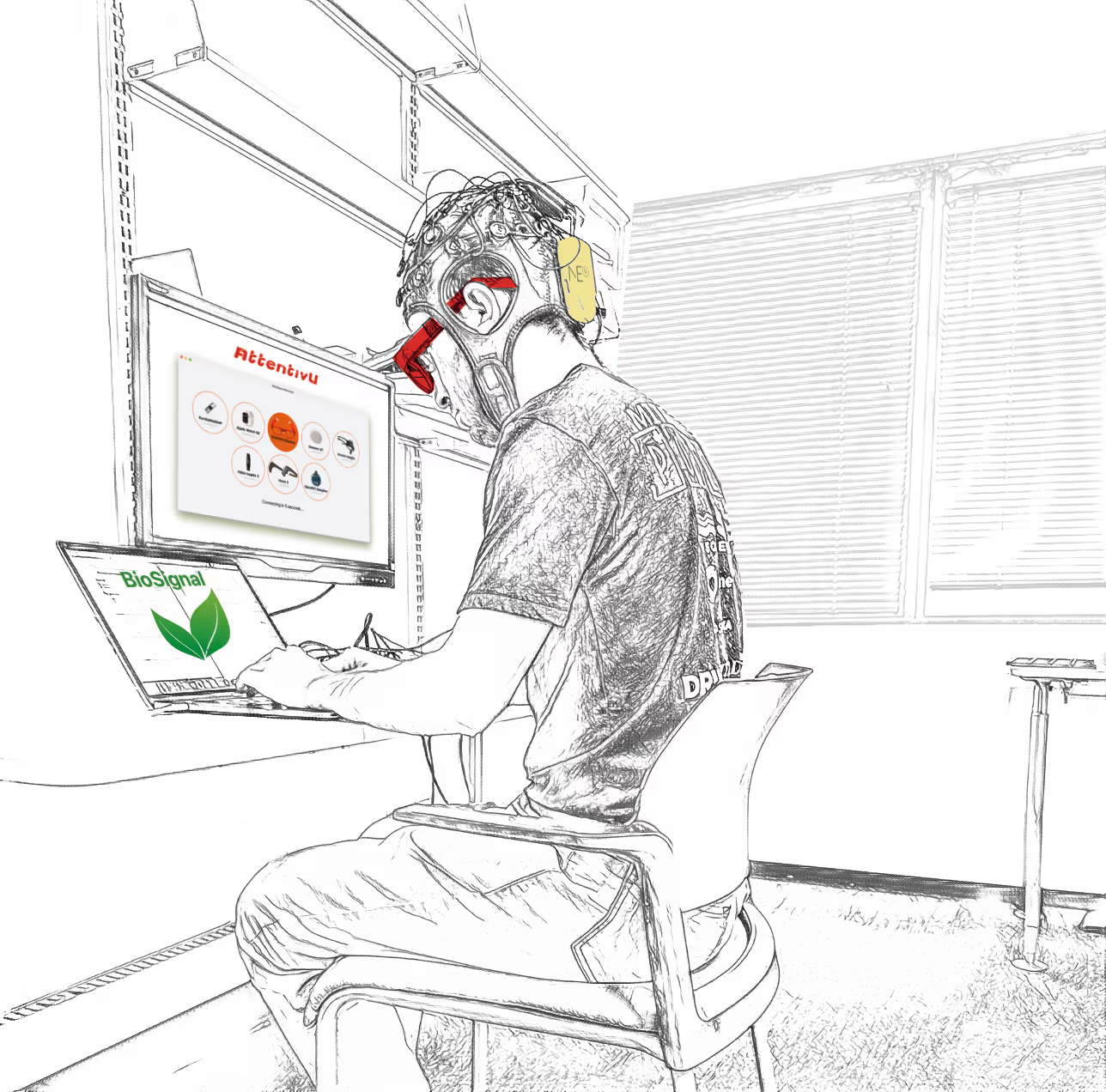
The goals of the course are to help students develop critical vocabularies for analyzing digital objects and processes, to build a collaborative space for reading, writing, and discussion, and to enact a kind of laboratory for experimenting with ideas. The class examines two contemporary issues surrounding digital media: the use of Large Language Models (sometimes called "generative AI") and the effects of digital media on attention. We will address how our everyday encounters with computational tools sometimes obscure important dimensions of those tools, how these systems create and exacerbate inequalities, and how we should think about the ways digital tools are shaping the ways we think, read, write, and build connections to one another.
No technological expertise is required, and students will be encouraged to experiment with a variety of ideas and technologies.
Image Credit: Illustration of participant in MIT Study about ChatGPT and brain activity (link)
Syllabus
Professor: Jim Brown
Meeting times: Tuesday and Thursday, 9:35am-10:55am
Meeting Place: Digital Commons, Room 102 (WWCAUD)
Prof. Brown's Office: Digital Commons, Room 104
Prof. Brown' Office Hours: Tuesday 11:00-12:00 or by appointment
Prof. Brown's Email: jim[dot]brown[at]rutgers[dot]edu
Course Website: http://courses.jamesjbrownjr.net/101_fall2025
Learning Outcomes
Upon completion of this class, students will be able to:
- demonstrate familiarity with theories of digital media and culture
- apply a critical vocabulary for analyzing digital technologies
- analyze, summarize, and compare arguments about digital media and culture
- communicate challenging concepts to an audience
Required Texts
- Students are not required to purchase any books for this class. Readings will be distributed as paper handouts.
- You are required to have a 3-ring binder devoted to this class as well as loose leaf paper and something with which to write. Your binder will be available to you during unit tests. If you require a different way of taking notes for accessibility reasons, please see me during the first week of class.
Attendance
Attendance in this class is crucial, and it is worth 10% of your grade, which makes each day's attendance worth .357 points. That seems small, but those points add up. If you arrive more than 5 minutes late for class, you will receive half-credit for that day's attendance. If you arrive more than 10 minutes late, you will be marked absent. If there is something that regularly prevents you from arriving to class on time, please speak with me during the first week of class.
Course Work and Grades
This class is comprised of 100 points. The breakdown of those points is as follows:
- 10: Attendance (28 class meetings, 0.357 points per meeting)
- 40: Student-led Classroom Discussions (8 discussions, 5 points per discussion)
- 8: Peer review of student-led discussions (peer review survey submitted at end of semester)
- 12: Lab Reports: 12 points (4 lab reports, 3 points each)
- 30: Unit Tests (2 tests, 15 points each)
Grades will be assigned on the following scale:
A 90-100
B+ 88-89
B 80-87
C+ 78-79
C 70-77
D 60-69
F 59 and below
Content Warnings
If we will be reading and discussing material that addresses sensitive topics, I will do my best to let you know in advance. If there are certain specific topics you would like me to provide warnings about, please let me know. I will do my best to flag content based on your requests.
Technology Policy
Unless otherwise stated, no one is ever permitted to use a phone during class (this includes the instructor). If you need access to your phone during class for an emergency reason, please let me know prior to class, but even in such cases the phone must be put away. During certain class sessions, we will not use computers at all. During other sessions, computers will be used for research and planning of our discussions. Please observe whatever rules are in place for that day's meeting.
Canvas and Course Website
This class will not make use of Canvas for many things. While I will use it to communicate with you, to share files, and to post grades, nearly all of our work will happen inside the classroom. The course website will have important information about assignments and policies. Pay close attention to the course schedule as we move through the semester. I reserve the right to move things around on our schedule as necessary, but I will always tell you well in advance if I am making changes.
Email
Please pay close attention to your email for course announcements. If you email me on a weekday, I will respond within 24 hours. If you email during the weekend, you will likely not receive a response before Monday morning.
AI Statement*
For certain assignments in this class, you will not be permitted to use AI technologies. In general, I would discourage you from using these tools at all. At the very least, I would encourage you to limit your use of them. When you do use AI in this class, you will be required to provide a detailed statement about why and how you used those tools.
We’ve all encountered poor AI outputs (often called AI Slop or "hallucinations"). Beyond AI's ineffectiveness for many tasks, it is important to recognize that AI use has significant social and environmental impacts. Avoiding unnecessary AI queries, generative AI (such as ChatGPT), and/or turning off AI-assist on search platforms (by typing “-ai” after a query) can help minimize environmental degradation, human exploitation, and improve your learning experiences.
Please consider the following before using AI:
- Labor and learning impacts: AI depends upon biased, incomplete, and incorrect data and is unproven in teaching and learning scenarios. Accepting AI's poor outputs can negatively impact student learning and infringes on both student and instructor intellectual property rights. For your instructors, it worsens their working conditions and creates job and wage insecurity. More broadly, digital hardware supply chains often rely on extracting rare earth minerals through exploitative mining and forced labor.
- Environmental impacts: AI depends on intense energy use, which increases greenhouse gas emissions contributing to climate change. AI requires large quantities of water to cool hard drives to optimal data processing temperatures. As AI-invested companies are focused on continual expansion, upgrades of AI software generate immense amounts of e-waste. Unlike other forms of consumption, it is particularly difficult to recycle resources associated with AI use.
*Portions of this section of the syllabus are taken from a statement written by the Rutgers AAUP-AFT Climate Justice Committee.
University policies and resources
Academic Integrity
My assumption is that any work you turn in for this course has been completed by you. Per the AI policy stated above, any use of LLMs or other AI technology must be documented in detail, explaining why and how you used it. If you ever have questions about AI use or about proper attribution or citation, please don't hesitate to ask.
Code of Conduct
Rutgers University-Camden seeks a community that is free from violence, threats, and intimidation; that is respectful of the rights, opportunities, and welfare of students, faculty, staff, and guests of the University; and that does not threaten the physical or mental health or safety of members of the University community and includes classroom space. As a student at the University, you are expected adhere to Student Code of Conduct: https://camden.rutgers.edu/deanofstudents/community-standards
Office of Disability Services
The Office of Disability Services (ODS) provides students with confidential accommodation services in order to allow students with documented physical, mental, and learning disabilities to successfully complete their course of study at Rutgers University – Camden. The ODS provides accommodation services, which can include readers, interpreters, alternate text, special equipment, and note takers. The ODS also works with students, faculty, staff and administrators to enforce the American with Disabilities Act of 1990. https://ods.rutgers.edu/
Schedule
Introductions
9/2
Syllabus review, course overview
9/4
Unit introduction by Professor Brown, group assignments
9/9
Workshop to prepare discussion of "A Student's Guide to Not Writing with ChatGPT," Perret
9/11
In-class discussion of reading
9/16
Workshop to prepare discussion of "Your Brain on ChatGPT," Kosmyna et. al.
9/18
In-class discussion of reading
9/23
Workshop to prepare discussion of "Extractive AI," Hogan and Lepage-Richer
9/25
In-class discussion of reading
9/30
Workshop to prepare discussion of "ChatGPT is Bullshit," Hicks et. al.
10/2
In-class discussion of reading
10/7
Lab Session #1: Designing a workshop about LLMs for your peers (report due at end of class)
10/9
Unit review, test preparation
10/14
Unit 1 test
Unit 2: How to pay attention
10/16
Unit introduction by Professor Brown
10/21
Workshop to prepare discussion of The Siren's Call (excerpt), Hayes
10/23
In-class discussion of reading
10/28
Workshop to prepare discussion of The Ecology of Attention (excerpt), Citton
10/30
In-class discussion of reading
11/4
Workshop to prepare discussion of The Anxious Generation (excerpt), Haidt
11/6
In-class discussion of reading
11/11
Workshop to prepare discussion of Digital Minimalism (excerpt), Newport
11/13
In-class discussion of reading
11/18
In-class discussion of "Attention Sanctuaries," Burnett and Mitchell
11/20
Lab Session #2: Attention and Place (report due at end of class)
11/25
Lab Session #3: Writing an Attention Practice (report due at end of class)
11/27 NO CLASS - THANKSGIVING
12/2
Lab Session #4: Digital Declutter - Define Your Technology Rules (report due at end of class)
12/4
Unit review, test preparation
12/9
Unit test
Descriptions of Assignments
Student-led Discussion Planning
Students will design and lead discussions about our readings. We will have 8 readings, and each discussion is worth 5 points, for a total of 40 points. Students will be divided into teams, and grades are assigned to the entire team. At the end of the semester, students will provide a peer review of those on their team, and that peer review is worth 8 points. Thus, the total point value of all these activities is 48 points (meaning that these activities account for 48% of your grade).
Learning is not the accumulation of facts or the "banking" of knowledge. It is a social process that happens best in communities. People tend to learn best in face-to-face situations when they can talk to one another and collaborate. Recognizing these facts is particularly important given that Large Language Models (LLMs), centralized corporate social media platforms, and online courses are increasingly discouraging these kinds of interactions.
This course is not a place where a professor delivers knowledge to students. It is a place where a professor works alongside students to build conversations about our readings and to design activities that allow us to actively engage with ideas. There are times when the professor has to make decisions and guide the conversation, but there are also times where students in this class will do the guiding and even some of the teaching.
During a typical week, you will be assigned a reading. I will distribute paper copies, and students are required to keep copies of those readings in the binder they have for this class. All students are responsible for reading each assigned reading, annotating that reading, and taking detailed notes. Remember that unit tests are open note, and you will only be able to consult your binder during tests. So, the work you do to prepare each week will help you develop materials that will be useful on those tests.
During our Tuesday class, we will conduct a workshop, during which groups plan Thursday's class, and you may use computers (but not phones) to do that planning. During our Thursday class, we will conduct the discussion that we planned during Tuesday's workshop. The only computers permitted during the Thursday class are those used to deliver slide presentations.
Students will be divided into four teams at the beginning of the semester, and those teams will remain the same throughout the semester. For each reading, teams will be assigned a specific task, and you will work on that task during the Tuesday workshop. Groups will rotate amongst tasks each week.
Task Descriptions
There are four teams, each with distinct tasks for each reading. All teams should plan to develop materials that students can add to their binders.
Those tasks are as follows:
Summary and Analysis of the Reading Team
This team is tasked with summarizing and analyzing the reading. This means developing slides that will be delivered to the rest of the class at the beginning of our discussion and designing a handout for the class. This team will need to do additional research about the reading and to know the reading in as much detail as possible. They should aim to be as expert in the reading as possible.
This team may not use any AI/LLM tools at any stage of the process.
The Summary and Analysis team will want to answer questions such as (this list is not exhaustive):
- Who wrote this piece, and what are their credentials?
- What disciplines do/does the author/authors or work in?
- Where was it published? What kind of publication is it?
- When was it published?
- What is the argument?
- How is the argument constructed? What are its pieces, and how do those pieces fit together?
- What kind of evidence is used to support the argument?
- Who are the likely target audiences for the argument?
- What is the significance of the argument?
- What are some counter arguments or responses to the argument?
- How does the argument fit with other things we have read or discussed in class?
Related Research Team
The pieces we read will cite other writing and will sometimes even directly link to other work. This team is responsible for following those links, citations, and footnotes and then providing some summaries of those sources. Like the Summary and Analysis team, they will deliver a slide presentation about their work and will develop a handout. This team will not be able to summarize every source cited or linked, so they will need to strategize which sources deserve the most attention.
The Related Research team will want to answer questions such as (this list is not exhaustive):
- What kinds of research does the piece cite, and why?
- What patterns do you see in those citations and/or links to other sources?
- What are the reasons for citing or linking to these sources?
- What are the most important articles, essays, videos, etc. referenced in the reading? Why are they important?
This team may use AI/LLM tools. However, if they choose to do so they will need to provide a written document that explains, in detail, which tools they used, why they chose to use them, and how they used them. That document must be no shorter than 350 words and in addition to this write-up must also provide detailed examples of how the tool was used (prompts and responses, any human edits made to the responses, etc.)
Discussion Facilitation and Activity Design Team
This team is tasked with facilitating a discussion of the reading and designing exercises for our in-class session. This means developing questions prior to our Thursday session to spark discussion, and it might also mean seeking out supplemental materials that could help keep that conversation going. This team must also be actively engaged during the Summary and Analysis and Related Research presentations, and it will likely require working with those teams during the Tuesday workshop. During the Thursday session, this group is in charge of ensuring that all students are involved in the discussion and activities, and they may design the session however they see fit. This could mean posing specific questions to individual students, creating break-out groups, or any number of other strategies.
This team's goal is to build an effective and useful way of engaging with the reading. The class session should be a learning experience for all involved. In other words, the goal here is not just to direct questions at the Summary and Analysis team but to use our precious classroom time (we only get 2.5 hours per week) as a learning space for all involved.
In addition to conducting a discussion about the text, this team will need to design some kind of activity for the group. This team will have access to two texts as they consider the kinds of activities they might want to design: The Pocket Instructor: Writing and The Pocket Instructor: Literature. Paper copies of these texts will be available during class.
This team may not use any AI/LLM tools at any stage of the process.
Writing Test Questions Team
Our unit exams will be comprised of short answer questions. These are questions that can be answered in 4-5 sentences, and they must go beyond reporting on the content of the reading. The team in charge of writing test questions will have to design questions that they think would be effective ways of getting students to demonstrate not only that they understand the reading but also that they are able to apply the concepts in the reading. Remember that tests in this course are open-note. This is why it is important that questions not mere asks students to explain the content of the reading. Our tests are not about memorizing content or explaining what we read. That kind of work happens in our notes. Test questions will have to ask students to explain the significance of concepts, to compare arguments and ideas to one another, and to apply concepts and ideas described in the reading.
This team must develop at least 5 short answer questions related to the reading, and teams can and should develop as many questions as possible. Those questions will be shared with the rest of the class, and they will be potential questions on the unit test.
This team may use AI/LLM tools. However, if they choose to do so they will need to provide a written document that explains, in detail, which tools they used, why they chose to use them, and how they used them. That document must be no shorter than 350 words and in addition to this write-up must also provide detailed examples of how the tool was used (prompts and responses, any human edits made to the responses, etc.)
Lab Reports
We will have four lab sessions during the semester, one during our "How not to automate everything" unit and three during our "How to pay attention" unit. Students will receive a handout with details of the lab session when they arrive in class, and lab reports will be handed in to Professor Brown before students leave class that day. Students must be present in class to complete the lab report.
Unit Tests
At the end of each of our two units, we will have a test during which students can consult their binder devoted to this class. Each exam is worth 15 points. Exams cover readings, labs, discussions, and anything else covered in class. Exams will be composed of student-written exam questions in addition to questions written by Professor Brown.
Extra Credit Opportunity
There is one extra credit opportunity in this class, and it is worth up to 5 points.
Students can read a book of their choosing and meet with Professor Brown for a one-hour discussion. That discussion will be about the book itself, but it will also be a discussion of your experience of reading the book in its entirety. When did you read? Where did you read? What was difficult, challenging, or rewarding about the experience? Given our discussions of attention in this class as well as media reports about the struggles of many college students to read entire books, the goal of this assignment is to provide you with space to read a book start to finish and to reflect on the book as well as on your own capacity for the deep attention often required for this kind of activity.
Students may choose the book they would like to read for this extra credit assignment, or Professor Brown can recommend a book based on the student's interests. The book has to be approved by Professor Brown by September 30. For this extra credit opportunity, the use of AI/LLM technology is not allowed
Course Bibliography
Burnett, D. Graham, and Eve Mitchell. “Attention Sanctuaries: Social Practice Guidelines and Emergent Strategies in Attention Activism.” Annals of the New York Academy of Sciences, vol. 1546, no. 1, Apr. 2025, pp. 5–10.
Citton, Yves. The Ecology of Attention. John Wiley & Sons, 2017.
Haidt, Jonathan. The Anxious Generation: How the Great Rewiring of Childhood Is Causing an Epidemic of Mental Illness. Penguin, 2024.
Hayes, Chris. The Sirens’ Call: How Attention Became the World’s Most Endangered Resource. Penguin, 2025.
Hicks, Michael Townsen, et al. “ChatGPT Is Bullshit.” Ethics and Information Technology, vol. 26, no. 2, June 2024, p. 38.
Hogan, Mél, and Théo LePage-Richer. “Extractive AI.” H. Tollefson & R. Bergmann (Eds.,) Climate Justice and Technology Essay, Series. Centre for Media, Technology, and Democracy, McGill University, 2024.
Kosmyna, Nataliya, et al. “Your Brain on ChatGPT: Accumulation of Cognitive Debt When Using an AI Assistant for Essay Writing Task.” 10 June 2025.
Newport, Cal. Digital Minimalism: Choosing a Focused Life in a Noisy World. Penguin, 2019.
Perret, Arthur. “A Student’s Guide to Not Writing with ChatGPT.” arthurperret.fr, 14 Nov. 2024, https://www.arthurperret.fr/blog/2024-11-14-student-guide-not-writing-wi....
56:209:520 Experimental Emerging Media (Fall 2024)

"Sycamore Leaves Edging the Roots of a Sycamore Tree," Andy Goldsworthy
How do artists and researchers use emerging media forms and technologies to re-imagine creative practice and research? This graduate seminar pursues this question by exploring experimental work with interactive devices, site-specific installations and sculptures, alternative social media platforms, games, zines, large language models, and more. The class will focus on how digital media can be used not only to distribute research findings or display results but also as a way to re-conceptualize scholarly inquiry and creative practice. What new questions and experiences can be constructed by experimenting with various media? How do digital media call for a reconsideration of longstanding questions across disciplines? Students will work with various media in order to produce their own experiments in/with emerging media.
Fall 2024
Tuesdays, 6:00 PM - 8:50 PM
Syllabus
Professor: Jim Brown
Class Time: Tuesday, 6:00 PM - 8:50 PM
Meeting Place: Digital Commons, Room 102
Professor Brown's Office: Digital Commons, Room 104
Office Hours: Tuesday, 5:00-6:00pm, or by appointment
Email: jim[dot]brown[at]rutgers[dot]edu
Course Website: http://courses.jamesjbrownjr.net/520_fall2024
Learning Outcomes
Upon completion of this class, students will be able to:
- Understand and deploy methods for experimenting with emerging media platforms
- Research experimental media projects and connect them to appropriate theoretical and historical contexts
- Develop research and creative projects in various modes, including writing and/or digital media arts
- Explain and justify their own writing and design processes
Required Books
Readings for this course will be made available to you either online (web pages, videos, etc.) or as PDFs on Canvas. You may also purchase hard copies of our texts. A full list of our texts is available at the course bibliography.
Course Work and Grades
In this class, the following work will be evaluated:
- Attendance: 15%
- Reading Log: 20%
- Project proposal - First submission: 25%
- Project proposal - Second submission: 25%
- Final presentation: 15%
Grades will be assigned on the following scale:
A 90-100
B+ 87-89
B 80-86
C+ 77-79
C 70-76
D 60-69
F 59 and below
Names and Pronouns
This course affirms people of all gender expressions and gender identities. I will distribute a form so that you can tell me preferred pronouns and names. If you have any questions or concerns, please do not hesitate to contact me directly.
Content Warnings
If we will be reading and discussing material that addresses sensitive topics, I will do my best to let you know in advance. If there are certain specific topics you would like me to provide warnings about, please let me know. I will do my best to flag content based on your requests.
Code of Conduct and Academic Integrity
Rutgers University-Camden seeks a community that is free from violence, threats, and intimidation; is respectful of the rights, opportunities, and welfare of students, faculty, staff, and guests of the University; and does not threaten the physical or mental health or safety of members of the University community, including in classroom space, and a community in which students respect academic integrity and the integrity of your own and others’ work.
As a student at the University you are expected adhere to the Student Code of Conduct and Academic Integrity Policy. To review the academic integrity policy, go to https://deanofstudents.camden.rutgers.edu/academic-integrity To review the code, go to: https://deanofstudents.camden.rutgers.edu/student-conduct
Please Note: The conduct code specifically addresses disruptive classroom conduct, which means "engaging in behavior that substantially or repeatedly interrupts either the instructor's ability to teach or student learning. The classroom extends to any setting where a student is engaged in work toward academic credit or satisfaction of program-based requirements or related activities." Please be aware of classroom and out-of-classroom expectations by making yourself familiar with and by following the Student Code of Conduct
The Office of Disability Services
Office of Disability Services (ODS)- Students with Disabilities
If you are in need of academic support for this course, accommodations can be provided once you share your accommodations indicated in a Letter of Accommodation issued by the Office of Disability Services (ODS). If you have already registered with ODS and have your letter of accommodations, please share this with me early in the course. If you have not registered with ODS and you have or think you have a disability (learning, sensory, physical, chronic health, mental health or attentional), please contact ODS by first visiting their website https://success.camden.rutgers.edu/disability-services.The website will further direct you who to contact and how to contact them depending on the free, confidential services you are in need of.
Please Note: Accommodations will be provided only for students with a Letter of Accommodation from ODS. Accommodation letters only provide information about the accommodation, not about the disability or diagnosis.
Computers, Smartphones, etc.
Smartphones should be silenced and put away during class discussion. Feel free to use your computer during class if that is how you take notes.
Shared Files, Course Website, and Email
You should check your email daily. Class announcements about readings and assignments will be distributed through email and on Canvas. The course website will also have important information about assignments and policies. Pay close attention to the course calendar as we move through the semester. I reserve the right to move things around if necessary.
Schedule
This schedule is subject to change, but any changes will be announced in advance. Readings are either available on Canvas as PDFs or are linked from this schedule.
Experimental Emerging Media:
Historical Examples
September 3
Reading/Watching:
- Sherrie Rabinowitz and Kit Galloway, "A Hole in Space" (video)
- Sherrie Rabinowitz and Kit Galloway, "Satellite Arts" (video)
- Annmarie Chandler, "Animating the Social: Mobile Image/Kit Galloway and Sherrie Rabinowitz"
Writing: Take notes on videos and reading to prepare for class discussion
In Class: Course introductions, course logistics, lecture and discussion about readings/videos
September 10
Reading: Glahn and Levine, The Future is Present
Writing: Reading Log
In class: Lecture/discussion, work on and discuss project proposals
September 17
Reading: Gerhard Fischer and Elisa Giaccardi, "Meta-design: A Framework for the Future of End-User Development"
Writing: Reading Log
In class: Lecture/discussion, work on and discuss project proposals
Experimental Emerging Media: Methods
September 24
Reading: Easterling, Medium Design
Writing: Reading Log
In class: Lecture/discussion, work on and discuss project proposals
October 1
Reading: Barker, "Experimental research in the digital media arts"
Writing: Reading Log
In class: Lecture/discussion, work on and discuss project proposals
October 8
Reading: Auger, "Speculative Design: Crafting the Speculation"
Writing: Reading Log
In class: Lecture/discussion, work on and discuss project proposals
October 15
Reading: Andreas Fickers and Annie van den Oever, Doing Experimental Media Archaeology
Writing: Reading Log
In class: Lecture/discussion, work on and discuss project proposals
Project Proposal Workshop
October 22
Writing: Ensure you have a completed draft of your proposal prior to class
In class: Work on project proposals, get feedback from Prof. Brown and classmates
October 25
Project Proposal - First Submission Due
Experimental Emerging Media: Contemporary Examples
October 29: Games
Reading: Jagoda, Experimental Games
Writing: Reading Log
In class: Lecture/discussion, Twine workshop, work on and discuss project proposals
November 5: Social Media
Reading:
- Darius Kazemi, "Run Your Own Social"
- Ben Grosser, Minus.social
- Ben Grosser, Stuck in the Scroll
Writing: Reading Log
In class: Lecture/discussion, work on and discuss project proposals and final presentation
November 12: The Book
Reading:
Amaranth Borsuk, The Book (Preface and Chapter 1)
Writing: Reading Log
In class: Workshop: Making ink and paper with Sophia Westfall
November 19: Large Language Models
Reading:
- Allado-McDowell, Amor Cringe
- Hannes Bajohr, "The Paradox of Anthroponormative Restriction: Artistic Artificial Intelligence and Literary Writing"
In class: Lecture/discussion, LLM workshop, work on and discuss project proposals and final presentation
November 26
NO CLASS MEETING - RUTGERS FOLLOWS THURSDAY SCHEDULE
Project Proposal and Presentation Workshop
December 3
Writing: Ensure you have a completed revision of your proposal prior and completed draft of presentation slides prior to class
In class: Work on project proposals and presentations, get feedback from Prof. Brown and classmates
Final Presentations
December 10
Project Proposal - Second Submission Due
Final Presentation Slides Due
In class: Final Presentations
Assignments
Reading Log
Each day a reading is assigned, you will complete an entry in your reading log. That entry is designed to help you organize your thoughts for that week's class meeting. Reading log entries are due by 12:00 noon on the day of our class meeting. I will grade these entries, but I will do so on a credit/no-credit basis. Students who put forth a good faith effort to complete the assignment will receive credit.
Reading Log entries are recorded in a Google Document that you share with me, and these entries provide you with your "agenda" for class meetings - they include a summary of the reading as well as questions, comments, and quotations from the reading. They will also help you think through how that week's reading might help you develop your ideas for the final project.
Each Reading Log entry has three sections:
Summary of Reading (250 words max)
You should try to write a concise summary of the reading, and you only have 250 words to do it. If we have read an extended work, like a book or a long article, this will be challenging. But the assignment is designed to get you to think about what is most important about the reading. You will not be able to cover everything the authors say, so you should be picking out what is most important about their argument, their method, and/or whatever it is they are analyzing or producing.
Questions of Clarification (no word limit)
This is the section for asking questions about things you didn't full understand or that you'd like me or your classmates to help you with? Are there terms or concepts you didn't understand? Are there portions of the argument that are unclear to you? List these kinds of questions here.
Important Quotations and Ideas (no word limit)
This section is a space for you to record what you think are the most important quotations and ideas from the reading.
How does this reading help me with my final project? (no word limit)
As we read and discuss the work of artists and theorists, your task is to consider which ideas from that week's reading and discussion can help you think about your final project. At the beginning of the semester, you may not know what that project is, or you may even have multiple ideas. This section is designed to help you think about those ideas and consider how our readings can help you refine them. Remember that even a reading that seems completely disconnected from the medium you hope to work with or the method you hope to use can be helpful as you revise and reconsider your project. What approach does the author take, and how can you learn form it? How did they conduct their research? What terms or concepts do they develop that might help you approach your own project? Think expansively and creatively about how our readings can help you hone and sharpen your thinking about your own project.
Project Proposal
The main piece of writing that you will produce in this class is a project proposal. We are completing a proposal because it's very difficult to conceive of and execute a project within the condensed, 14-week time frame off a semester. Instead of trying to rush through and complete a project, our goal is to take the semester to conceive of and plan a project, to begin to develop a justification and approach to that project. If you get to a point where you can actually complete a draft of your project (if it's a piece of writing) or a prototype of your project (if it is delivered in some other medium), that is a huge bonus. However, our primary goal is to develop a detailed proposal.
You will work on this proposal throughout the course of the semester. As you complete reading log entries, you'll write about how our readings are informing your thinking about the project, and at certain points during class I'll ask you to pull up your current draft of the proposal and work on it. We'll also have opportunities to share our proposal drafts with one another during class.
You will submit your proposal twice, once on October 25 and once on the final day of class. The goal is to continually revise the proposal throughout the semester, and when I provide feedback on it I will be focusing not only on your end product but also on your writing and design process. Are you incorporating feedback from me and others as your revise and rethink the project? This is an important thing to consider throughout the semester.
The Project Proposal is broken into the following sections.
Research Question
What do you want to ask, and why? Are you trying to solve a problem? If so, what is the problem and how are you proposing to solve it? Are you proposing to ask a question that others have asked? If so, how will your approach differ from previous approaches?
Genesis of Research Question
How did you arrive at this research project and research question? Is this an ongoing project that you have been working on for a while, or is it a new project? Is there a reading, author, or project that helped you develop this question or that helped clarify your thinking around it? Is this part of a longer creative or research trajectory in your work? Is it a break with the kind of work you usually do? These are the kinds of questions you can address in this question, but your primary goal is to give us context for the project and research question you want to pursue.
Literature Review
Who else has conducted similar research and/or creative activity? This section allows you to show how your work is part of a broader conversation. This section can be written as an annotated bibliography (a list of sources with brief summaries of each source), or it can be written in prose form where you weave together the sources and tell the story of how others have conducted work that is similar to your proposed project.
Audience
Who is the primary audience for your project? Many times, this section is linked to the previous one (Literature Review) since the people you cite in that previous section could be your audience. However, this is not always the case. Sometimes, your audience is different from those who have conducted similar research or carried out similar creative projects to yours. Regardless, your goal in this section is to explain who you're trying to address in this project. One way to think of this is in terms of publication, if this is a piece of writing. What publications would be ideal for your project? If it's a creative project, you should be thinking of venues (galleries? festivals? conferences?) and you should avoid answering this question with something like "the general public." Be as specific as possible when you think about your intended audience, even if those outside of your intended audience might encounter your work as well.
Material/Data
What material will you be working with in your analysis and/or creative activity? If this is an archival project, what archives would you be drawing upon? If this is a data analysis project, what data will you analyze and how will you get that data? If this is primarily a creative project, what material will you be working with?
Method
How do you propose to conduct your analysis and/or creative activity? Why? Are you using an existing method? If so, describe that method (citing appropriate sources) and describe how you'll use it. Are you mixing methods? If so, describe the methods you're mixing and how/why you're planning to mix them. Are you attempting to build your own method? If so, describe that method and how it's related to other existing methods. In addition to describing your method of analysis and/or production, be sure to justify your choice of method. Why have you chosen this method? What does it allow you to learn about your material, and how does it allow you to pursue your research question?
Medium/Form
What form or forms do you expect the project to take? Is it an essay or a paper? Explain why writing this is the ideal medium for your project? Is it a video? An audio project? A videogame? Something else? This section should be where you describe what you plan to write/make and why that media form is the best fit for what you're trying to accomplish.
Expected findings, conclusions, and/or results
This is just a proposal, so you don't know what you will find or what the results will be. However, this section allows you to speculate a bit about what you think you will find or perhaps even what you hope the results will be. In this section, you might even talk through what you hope the audience will take from your project.
Each submission of your proposal is worth 25% of your grade. When responding to your proposal, here are the questions I will be asking:
- Does the proposal provide a detailed account of your project?
- Is the proposal detailed and specific?
- Have you described in detail, what you propose to do, how you propose to do it, why you propose to do it?
- Are you getting the idea that the document is supposed to be detailed?
- Is each section organized and is the document as a whole organized? In other words, do the sections make sense both on their own and in relationship to one another? More specific versions of this question might be: Does your method match your goal for the project? Does your medium make sense in terms of your method and goals? Does your literature review provide the broader "conversation" that your project is trying to join?
- Are your research questions clearly articulated and justified?
- Does the proposal reflect that you have spent a great deal of time researching your project and considering work that is similar to it?
- Does the second submission reflect that you have significantly revised the proposal and incorporated feedback?
- Is the document prepared in such a way that it could be credibly used to begin work on your proposed project?
Final Presentation
During our last day of class, you will deliver a 15-minute presentation about your project proposal. I will time the presentation, and we can add up to two-minutes for Q&A (though, you may also use some of your 15 minute time slot for Q&A as well). The goal of the presentation is to describe your project in as much detail as possible. You should use the project proposal as a guide for the presentation, but you do not have to cover everything in the proposal. In fact, if you've done written an effective proposal, there will be way too much information in it to present in 15 minutes.
Your presentation should reflect careful design and rehearsal. You are designing a 15-minute experience for an audience, and this takes careful planning and consideration. We will address some strategies for building an effective presentation in class.
The presentation is worth 15% of your grade. When responding to your presentation, here are the questions I will be asking:
- Did you observe the time limit?
- Does the presentation show evidence that you have carefully planned and rehearsed?
- Is the design consistent, and does it observe the guidelines we discussed in class (such as choosing images carefully, deciding when to use text, deciding how much text to use, considering how long an audience has to absorb the information on a slide)?
- Does the presentation effectively describe your project, the logic and reasoning behind it, your research question (and the stakes of that question)?
- Did you effectively respond to questions during Q&A?
- Part of your job during this class session is also to be a good audience for other students. During other presentations, were you engaged, paying attention, and (where appropriate) asking questions?
Course Bibliography
Course Readings and Resources
This is a list of all materials students are responsible for in this course. Any resources that are not available online are available for download on our Canvas site.
Allado-McDowell, K. Amor Cringe. Deluge Books, 2022.
Auger, James. “Speculative Design: Crafting the Speculation.” Digital Creativity, vol. 24, no. 1, Mar. 2013, pp. 11–35.
Bajohr, Hannes. “The Paradox of Anthroponormative Restriction: Artistic Artificial Intelligence and Literary Writing.” CounterText, vol. 8, no. 2, Aug. 2022, pp. 262–82.
Barker, Tim. “Experimental Research in the Digital Media Arts.” Handbook of Research on Creativity, Edward Elgar Publishing, 2013, pp. 282–96.
Borsuk, Amaranth. The Book. MIT Press, 2018.
Chandler, Annmarie. “Animating the Social: Mobile Image/Kit Galloway and Sherrie Rabinowitz.” At a Distance: Precursors to Art and Activism on the Internet, edited by Annmarie Chandler and Norie Neumark, MIT Press, 2005, pp. 152–74.
Easterling, Keller. Medium Design: Knowing How to Work on the World. Verso, 2021.
Excerpts from A Hole in Space -- the Mother of All Video Chats. Directed by Larry press, 2008. YouTube, https://www.youtube.com/watch?v=QSMVtE1QjaU.
Fickers, Andreas, and Annie Oever. Doing Experimental Media Archaeology: Theory. De Gruyter, 2022.
Fischer, Gerhard, and Elisa Giaccardi. “Meta-Design: A Framework for the Future of End-User Development.” End User Development, edited by Henry Lieberman et al., vol. 9, Springer Netherlands, 2006, pp. 427–57.
Philip Glahn, and Cary Levine. The Future Is Present. MIT, 2024.
Jagoda, Patrick. Experimental Games: Critique, Play, and Design in the Age of Gamification. University of Chicago Press, 2020.
Kazemi, Darius. How to Run a Small Social Network Site for Your Friends. 31 Aug. 2019, https://runyourown.social/.
Minus. https://bengrosser.com/projects/minus/. Accessed 28 July 2022.
“NET ART ANTHOLOGY: The World in 24 Hours.” NET ART ANTHOLOGY: The World in 24 Hours, 27 Oct. 2016, https://anthology.rhizome.org/the-world-in-24-hours.
SATELLITE ARTS_ JUL-NOV 1977 - Galloway & Rabinowits - Invention of Distributed Immersive VR & Telecollaborative Performance on Vimeo. https://player.vimeo.com/video/436193481. Accessed 22 Aug. 2024.
Stuck in the Scroll. https://bengrosser.com/projects/stuck-in-the-scroll/. Accessed 22 Aug. 2024.
Supplemental Resources
This is a list of supplemental resources. Students are not responsible for these sources, but Prof. Brown will add to this list throughout the semester as he references things during lecture and discussion that are not on the list above.
Adrian, Robert. "The World in 24 Hours" (Net Art Anthology Entry)
Blow, Jonathan. Braid (Video Game). 2008
Brady, Scott. Hues and Cues (Tabletop Game). 2020
Bratton, Benjamin H. "On Speculative Design." DIS Magazine.
https://dismagazine.com/discussion/81971/on-speculative-design-benjamin-...
Cox, Geoff, and Alex McLean. Speaking Code: Coding as Aesthetic and Political Expression. MIT Press, 2012.
Emmons Jr., Robert A. & James J. Brown, Jr, "R-CADE's Ecology of Practices: An Exploded-View Diagram," Artifact & Apparatus: Journal of Media Archaeology 2 (Fall 2022): 19–40.
Galloway, Anne, and Catherine Caudwell. "Speculative design as research method: From answers to questions and “staying with the trouble”." In Undesign, pp. 85-96. Routledge, 2018.
Gidney, Eric. “Art and Telecommunications: 10 Years On.” Leonardo, 1991, pp. 147–52.
---. “The Artist’s Use of Telecommunications: A Review.” Leonardo, 1983, pp. 311–15.
Goldsworthy, Andy. Andy Goldsworthy: Rivers and tides. Roxie Releasing, 2004.
Joshi, Viraj. "World-Building Methods for Speculative Design and Fiction." 2021.
https://medium.com/world-building-methods-for-speculative-design-and/wor...
Latour, Bruno. “Sensitizing.” In Experience: Culture, Cognition, and the Common Sense, edited by Caroline A Jones, David Mather, and Rebecca Uchill. MIT Press, 2016.
Ratto, M. (2011). Critical making: Conceptual and material studies in technology and
social life. The Information Society, 27(4), 252-260.
Tarsa, Becca, and James J. Brown Jr. "Complicit interfaces." Precarious rhetorics (2018): 255-275.
Van der Heijden, Tim, and Aleksander Kolkowski. Doing experimental media archaeology: Practice. De Gruyter, 2022.
Youngblood, Gene. “Metadesigning for the Future - Gene Youngblood.” NeMe, 31 Oct. 2013, https://www.neme.org/texts/metadesigning-for-the-future.
50:209:101 Introduction to Digital Studies (Spring 2024)

Image Credit: Image generated by DALL-E
The goal of the course is to help students develop critical vocabularies for analyzing digital objects and also to provide students with a space to tinker with those objects. The class examines contemporary issues surrounding digital media and some of the historical roots of those issues. We will address how our everyday encounters with computational tools sometimes obscure important dimensions of those tools, how these systems create and exacerbate inequalities, and how our understandings of digital media are too often shaped by a white, Western, and/or masculine perspective. In addition to discussing and analyzing digital media, the course features lab sessions that will involve working directly with digital artifacts. In these lab sessions, our goal is not mastery but instead exploration.
No technological expertise is required, and students will be encouraged to experiment with a variety of ideas and technologies.
Syllabus
Professor: Jim Brown
Meeting times: Tuesday and Thursday, 9:35am-10:55am
Meeting Place: Digital Commons, Room 102 (WWCAUD)
Prof. Brown's Office: Digital Commons, Room 104
Prof. Brown' Office Hours: Tuesday 11:00-12:00, or by appointment
Prof. Brown's Email: jim[dot]brown[at]rutgers[dot]edu
Course Website: http://courses.jamesjbrownjr.net/101_spring2024
Learning Outcomes
Upon completion of this class, students will be able to:
- demonstrate familiarity with the histories and cultures that influence and shape digital technologies
- apply a critical vocabulary for analyzing digital technologies
- analyze, summarize, and compare academic arguments about digital media and culture
- experiment with the affordances and constraints of digital tools
Required Texts
- You must buy a physical copy of this text and bring it to class each day. You cannot purchase an electronic version of this book. Having a physical copy is important for class discussions:
Your Computer is on Fire, eds. Mar Hicks, Benjamin Peters, Thomas S. Mullaney, Kavita Philip - You are also required to have a notebook devoted to this class, and you must bring it to class every day. This book will be used for reading notes, lecture notes, and lab sessions. It will be available to you during quizzes and exams.
Any other readings will be distributed by me during our class sessions, and I will provide physical copies. If we have an assigned reading, you are expected to bring the physical copy of that reading to class.
Attendance
Attendance in this class is crucial, and it is worth 10% of your grade, which makes each day's attendance is worth .36 points. That seems small, but those points add up. If you arrive more than 5 minutes late for class, you will receive half-credit for that day's attendance. If you arrive more than 10 minutes late, you will be marked absent. If there is something that regularly prevents you from arriving to class on time, please speak with me during the first week of class.
Course Work and Grades
Grades will be determined based on the following course work:
- Attendance (10%)
- Reading Quizzes and Class activities (10%)
- Lab Reports (15%)
- R-CADE Report (5%)
- Midterm Exam (30%)
- Final Exam (30%)
Grades will be assigned on the following scale:
A 90-100
B+ 88-89
B 80-87
C+ 78-79
C 70-77
D 60-69
F 59 and below
Content Warnings
If we will be reading and discussing material that addresses sensitive topics, I will do my best to let you know in advance. If there are certain specific topics you would like me to provide warnings about, please let me know. I will do my best to flag content based on your requests.
Technology Policy
We will use digital technology frequently in this class. Although I am assuming that you have some basic knowledge of computers, such as how to use a keyboard and mouse, and how to use the internet and check e-mail, most things will be explained in class. If you don’t understand what we are doing, please ask for help.
Canvas, Course Website, and Email
This class will not make use of Canvas for many things. While I will use it to communicate with you, I will not post assignments to Canvas. The course website will have important information about assignments and policies. Pay close attention to the course calendar as we move through the semester. I reserve the right to move things around if necessary.
University policies and resources
Academic Integrity
My assumption is that any work you turn in for this course has been completed by you. If you ever have questions about proper attribution or citation, please don't hesitate to ask.
Code of Conduct
Rutgers University-Camden seeks a community that is free from violence, threats, and intimidation; that is respectful of the rights, opportunities, and welfare of students, faculty, staff, and guests of the University; and that does not threaten the physical or mental health or safety of members of the University community and includes classroom space. As a student at the University, you are expected adhere to Student Code of Conduct: https://deanofstudents.camden.rutgers.edu/student-conduct
RaptorCares
Rutgers-Camden has a wide range of resources to help you stay on track both personally and academically. The Raptor Cares Report (https://deanofstudents.camden.rutgers.edu/reporting) connects you to our Dean of Students Office and they can assist you with a variety of concerns: medical, financial, mental health, or any life issue that impacts your academic performance. You can share a concern for yourself, a classmate or a friend.
Office of Disability Services
The Office of Disability Services (ODS) provides students with confidential accommodation services in order to allow students with documented physical, mental, and learning disabilities to successfully complete their course of study at Rutgers University – Camden. ODS provides for the confidential documentation and verification of student accommodations, and communicates with faculty regarding disabilities and accommodations. The ODS provides accommodation services, which can include readers, interpreters, alternate text, special equipment, and note takers. The ODS also works with students, faculty, staff and administrators to enforce the American with Disabilities Act of 1990. https://learn.camden.rutgers.edu/disability-services
Office of Military and Veterans Affairs
The Office of Military and Veterans Affairs can assist our military and veteran students with benefits, deployment issues and much more. Contact: Fred Davis 856-225-2791 frdavis@camden.rutgers.edu
Support for Undocumented and Immigrant Students
In an ongoing effort to support all students on campus, Rutgers University has established two offices to support undocumented and immigrant students with questions or concerns related to immigration status. The Rutgers Immigrant Community Assistance Project (RICAP) provides free and confidential immigration legal consultations and direct representation to currently enrolled students. For more information or an appointment, contact Jason Hernandez, Esq., at 856-225-2302 or jason.c.hernandez@rutgers.edu. The Rutgers Office of Undocumented Student Services provides one-on-one case management to assist undocumented students and help them access campus resources including financial aid, career services, health services, etc.
Schedule
1/16
In Class: Syllabus review, course introduction
1/18
Read: Hicks - "When did the fire start?" (11-26)
In Class: Lecture and reading discussion
1/23
Read: Mullaney - "Your Computer is on Fire" (3-8)
In Class: Lecture and reading discussion
1/25
Read: "Skills Will Not Set You Free" (297-312)
In Class: Lecture and reading discussion
1/30
Read: "Your AI is a Human" (51-67)
In Class: Lecture and reading discussion
2/1
Lab Session: Generative AI
2/2
Lab Report due by 5:00pm
2/6
Read: "Platforms are Infrastructures on Fire" (313-326)
In Class: Lecture and reading discussion
2/8
Read: "Platforms are Infrastructures on Fire" (326-336)
In Class: Lecture and reading discussion
2/13
Read: "Source Code Isn't" (273-286)
In Class: Lecture and reading discussion
2/15
Read: "Source Code Isn't" (286-295)
In Class: Lecture and reading discussion
2/20
Read: "You can't make games about much" (231-236)
In Class: Lecture and reading discussion
2/22
Read: "You can't make games about much" (236-249)
In Class: Finish Wardrip-Fruin discussion
2/27
Lab Session: Making Games with Flick, Tiny Choice, and Bitsy
2/28
Lab Report due by 5:00pm
2/29
In Class: All students should come to class with a book, article, game, show, film, or some other object that is related to our class discussions. Students should be prepared to share what they've brought and help lead a discussion about it.
3/5
MIDTERM REVIEW SESSION
Read: Your notes
In Class: Review session
3/7
MIDTERM EXAM
3/12-3/14
NO CLASS - SPRING BREAK
3/19
Read: "Typing is Dead" (337-350)
In Class: Lecture and reading discussion
3/21
Read: "Typing is Dead" (350-360)
In Class: Lecture and reading discussion
3/26
Read: "Broken is Word" (213-230)
In Class: Lecture and reading discussion
3/28
"Universities Have a Computer-Science Problem" by Ian Bogost
reading distributed in class
4/2
Read: "Siri Disciplines" (179-197)
In Class: Lecture and reading discussion
4/4
Read: "Gender is a Corporate Tool" (159-178)
In Class: Lecture and reading discussion
4/9
Read: "The Cloud is a Factory" (29-38)
In Class: Lecture and reading discussion
4/11
Read: "The Cloud is a Factory" (38-49)
In Class: Lecture and reading discussion
4/16
NO CLASS
4/18
Listen: Prior to class, listen to this episode of Phantom Power
In Class: “"Connection + Reception: Shortwave Listening and DIY Radio Design."” (Hannah Hopkins, Trent Wintermeier, and Claire Fitch, University of Texas at Austin)
4/19
R-CADE Symposium - attendance mandatory
All students are required to attend one panel during the R-CADE symposium
4/23
In Class: Recap of R-CADE and discussion of Lab report and R-CADE report
4/24
Lab Report due by 5:00pm
4/25
Read: Your notes
In Class: Final exam review and prep
4/26
R-CADE report Due by 5:00pm
FINAL EXAM: MAY 2, 8:00-11:00AM
Assignments and Exams
Attendance (10%)
Attendance in this class is crucial, and it is worth 10% of your grade, which makes each day's attendance is worth .36 points. That seems small, but those points add up. If you arrive more than 5 minutes late for class, you will receive half-credit for that day's attendance. If you arrive more than 10 minutes late, you will be marked absent.
Reading Quizzes and In-class activities (10%)
On certain days, we will have unannounced reading quizzes. We will also have some in-class activities. These quizzes and activities will happen 10 times during the semester, and each of them is worth a point (making all quizzes and activities worth 10% of your grade in total). You can use your notebook (but not your book) during quizzes and activities.
Lab Reports (15%)
During the semester, you will complete three lab reports. Each report is worth five points, making lab reports worth 15% of your final grade.
During these lab sessions, you will investigate some digital object or tool. Primarily, these sessions will be self directed. I will be able to answer questions, but your main task during labs is to explore and tinker. This will mean successes and failures - some confusion is inevitable. That's part of the assignment!
Each person will submit their own lab report, and these will be submitted via Google Drive.
Reports will have three sections:
Part A: Initial questions (no word limit)
List the initial questions you have about the tool or object we are analyzing. You will write these down during the first 10 or 15 minutes of our lab session. The questions should be as specific as possible. In this section, we want to set up an agenda for your group's lab session. What are you most interested in? What do you want to learn?
Part B: Lab Narrative (250 words maximum)
Provide a description of your interaction with the object. What did you try? What worked? What didn't work? Why? What strategies did you use to investigate this tool or object? How did your group collaborate?
Part C: Conclusions (250 words maximum)
Describe a potential project that would either use or examine this object/tool. You might describe a project that would use this tool/object in some way to answer a research question. Alternately, you might describe a project that would attempt to analyze or examine this tool or object--this would involve conducting some kind of critical analysis of the tool or object. Your proposed project could take a number of forms. Here's a list of possibilities, but this list is not exhaustive: a historical analysis, a "remix" of this tool or object that changes its functionality, an analysis of its design, a proposed redesign of this technology, a research paper about the creator(s) of this tool or object, etc. No matter what, you should take this section to describe the potential project you have in mind. Remember that you don't have to actually complete the project. You only need to describe it, but you should be as specific as possible. In these 250 words, you should begin to describe what the proposed project is, how you would approach such a project, and what you think it might accomplish.
Each lab report is worth four points. Here are the grade criteria I will use when evaluating lab reports. If your report falls in between these descriptions, your grade will reflect that. For instance, if you fall between the description of a "5" and a "4" you could receive a grade of 4.5
5
The lab report offers a detailed and extensive list of initial questions that go beyond surface level concerns, demonstrating that the student is thinking carefully about how to best explore and understand the tool or object. The lab narrative provides a detailed account of the group's activities, describing the collaborative and exploratory strategies used by the group. The conclusions section demonstrates careful thinking about a potential project and shows an understanding of what the tool or object can do and what it can't do. This lab report is carefully written, free of grammatical errors, and observes the word limits described above.
3-4
The lab report offers a partial list of questions that is moderately detailed. There is some evidence that the student has considered the best ways to explore this tool or object. The lab narrative offers a general, rather than specific, description of the group's activities. The conclusions section begins to describe a potential project, though that project is not fully articulated and may not demonstrate an understanding of the how the object works, what it can do, and what it can't do. The report may have benefited from more revision to attend to the clarity of writing, has grammatical errors, and/or may not observe the word limits.
0-2
The lab report offers few questions and the questions it does offer are too general. There is little or no evidence that the student has carefully considered what they want to learn about the tool or object. The lab narrative is incomplete or too general and does not fully account for the group's activities. The conclusions section does not offer enough detail and does not demonstrate an understanding of the tool/object's affordances and constraints. The report may have significant issues with clarity and grammatical errors, which prevent the reader from understanding the content of the report. The lab report does not observe word limits.
R-CADE Report (5%)
In April, you will attend the Rutgers-Camden Archive of Digital Ephemera (R-CADE) Symposium, and you will be asked to write a report based on one panel or presentation at that symposium. This report is worth 5% of your final grade. The report is due April 24 by 5:00pm and will be submitted to your Google Drive folder.
Your report will have two sections.
Part A: Summary of the Panel (250 words)
In this section, you will summarize what happened at the panel. You should be as detailed as possible, given the word limit. You should explain who presented, what they presented, and any other pertinent details about the panel. Your summary should make it clear that you were present and engaged throughout the entire panel, and you should take detailed notes.
Part B: Define and Explain at Term or Concept (500 words)
In this section, you will choose a term or concept discussed during the event and then define and explain that concept. This term or concept should be one that is central to the work discussed on the panel. It does not have to be something discussed by every panelist (if there is more than one panelist), but it has to be a core idea discussed by someone on the panel. This term or concept may be new to you, though this is not a requirement. Defining this concept may require you to do some external research, and you may even examine some of the sources discussed by the panelist during their presentation. However, remember that you will need to keep the word limit in mind - 500 words is not very much space. This section should be carefully written and revised, so that you can take complete advantage of your limited space. Any sources should be cited, using MLA format (the bibliography does not count toward the word limit).
The R-CADE report is worth five (5) points. Here are the grade criteria I will use when evaluating these reports.
4-5 points
The report offers a detailed description of the panel that the student attended, demonstrating that the student was paying close attention during the presentations. The summary explains the topic of the panel, who presented, and provides details about the people who presented. Part B of the report offers a detailed description of a term or concept addressed during the panel and then explains the significance of that concept. There is evidence that the student conducted research on the topic after attending the panel. In addition, it meaningfully connects the content of the panel presentations to discussions we have had in class. The report is carefully written, free of grammatical errors, and observes the word limits described above.
2-3 points
The lab report offers a partial or incomplete description of the panel attended. There is some evidence that the student was engaged during the presentation, but the summary lacks some details. Part B of the report addresses a concept, but it does not necessarily reflect that the student has researched it, and the connections drawn between that concept and class are somewhat unclear. The report may have benefited from more revision to attend to the clarity of writing, has grammatical errors, and/or may not observe the word limits.
1 point
The report's summary of the panel is overly general and does not provide evidence that the student was attentive or engaged during presentations. There is little or no evidence that the student has researched a topic or concept addressed in the panel. Part B shows no evidence of research or of an attempt to connect the panel's content to things we have discussed in class. The report has significant issues with clarity and grammatical errors, which prevent the reader from understanding the content of the report. The lab report does not observe word limits.
Midterm Exam (30%)
The midterm exam will take place March 7 and will cover all material that we've read and discussed (readings, lectures, labs, and discussions) to that point in the course. During the exam, you are allowed to use your notebook.
Final Exam (30%)
The midterm exam will take place during our assigned final exam slot of MAY 2, 8:00-11:00AM. The exam will cover all material that we've read and discussed (readings, lectures, labs, R-CADE, and discussions) from March 18 through the end of the course. During the exam, you are allowed to use your notebook.
50:989:312 Writing Across Media (Fall 2023)
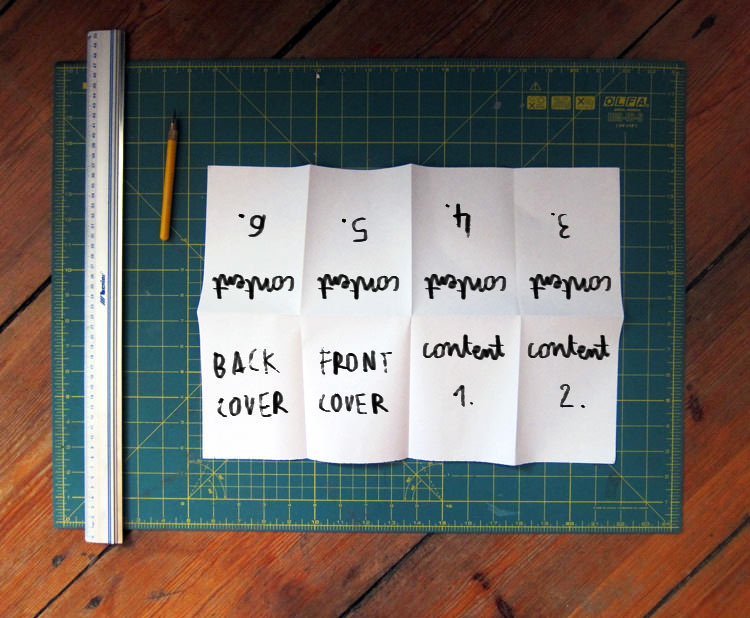 How do our writing tools shape our writing practices? Any writing medium, from clay tablets to word processors to electronic ink, actively shapes how we think about writing and how we engage in the practice of writing. This course will provide students with the ability to consider how writing changes as it moves across media, and it will engage in experimentation with an array of writing environments and tools. Potential exercises and projects will include making zines and notebooks, the use of generative artificial intelligence, making interactive narratives, and the creation of experiences for virtual and augmented reality.
Syllabus
Course Title: Writing New Media (a.k.a. Writing Across Media)
Course Code: 50:989:312
Time: Tuesday and Thursday, 9:35-10:55
Location: Digital Commons, Room 102
Professor: Dr. James Brown
Email: jim.brown@rutgers.edu
Office Location: Digital Commons, Room 104
Office Hours: Tuesday 11:00-12:30 (or by appointment)
Course Learning Outcomes
Upon completion of this class, students will be able to:
- Effectively explore and experiment with media technologies
- Understand the constraints and affordances of media technologies
- Compose with various media technologies in medium-appropriate ways
- Articulate an approach to writing and design processes
- Reflect on learning processes and strategies
Required Texts
Readings for this class will be distributed as paper copies in class.
Course Work
Our work in this class will involve in-class workshops and exercises, writing assignments that involve reflecting on those activities, and a final project and presentation during which you will expand upon something you learned during those workshops and exercises. We will also have readings and weekly writing activities. All of this work will be evaluated using the Learning Record (LR), which is detailed on the course website.
Most work in this class happens in the classroom, during class meetings. That work cannot be made up, so missing class will be a major detriment. In addition, this class will not make much use of Canvas, except as a tool for communication (I will send you messages via Canvas, but that's about it.) If you are looking for a class that provides you with a checklist of tasks that you can complete outside of class or if you plan to miss many class sessions, this is likely not the right class for you.
Evaluation
Grades in this class will be determined by the Learning Record (LR). The LR will require you to observe your own learning and construct an argument for your grade based on evidence that you accumulate throughout the semester. You will record weekly observations, you will document your work during in-class activities (by taking notes and/or taking pictures of things you are making), and you will synthesize draw upon your recorded observations and your work samples to build an argument for your grade. You will construct this argument twice - once at the midterm and once at the end of the course. We will be discussing the LR at length during the first weeks of class.
Attendance Policy
Attendance is required and is crucial for success in this class. Most of our work happens in class with workshops and exercises, and most of this kind of work can't be made up. We have workshops that are focused on specific tools, and we will also have open workshop days where you'll be able to work on your final presentations and projects. These open workshop days are mandatory.
When you complete your midterm and final portfolio, your attendance record will be part of the evidence you draw upon to make an argument for your grade. If you don't attend class regularly, you will not be able to argue for a high grade in this class (see grade criteria in the Learning Record section of the syllabus).
Content Warnings
If we will be reading and discussing material that addresses sensitive topics, I will do my best to let you know in advance. If there are certain specific topics you would like me to provide warnings about, please let me know. I will do my best to flag content based on your requests.
Cell Phone Policy
Phones must be put away during class. If you are on your phone during class, I will ask you to leave.
University policies and resources
Academic Integrity
My assumption is that any work you turn in for this course has been completed by you. If you ever have questions about proper attribution or citation, please don't hesitate to ask.
Code of Conduct
Rutgers University-Camden seeks a community that is free from violence, threats, and intimidation; that is respectful of the rights, opportunities, and welfare of students, faculty, staff, and guests of the University; and that does not threaten the physical or mental health or safety of members of the University community and includes classroom space. As a student at the University, you are expected adhere to Student Code of Conduct: https://deanofstudents.camden.rutgers.edu/student-conduct
RaptorCares
Rutgers-Camden has a wide range of resources to help you stay on track both personally and academically. The Raptor Cares Report (https://deanofstudents.camden.rutgers.edu/reporting) connects you to our Dean of Students Office and they can assist you with a variety of concerns: medical, financial, mental health, or any life issue that impacts your academic performance. You can share a concern for yourself, a classmate or a friend.
Office of Disability Services
The Office of Disability Services (ODS) provides students with confidential accommodation services in order to allow students with documented physical, mental, and learning disabilities to successfully complete their course of study at Rutgers University – Camden. ODS provides for the confidential documentation and verification of student accommodations, and communicates with faculty regarding disabilities and accommodations. The ODS provides accommodation services, which can include readers, interpreters, alternate text, special equipment, and note takers. The ODS also works with students, faculty, staff and administrators to enforce the American with Disabilities Act of 1990. https://success.camden.rutgers.edu/success-services/disability-services/
Office of Military and Veterans Affairs
The Office of Military and Veterans Affairs can assist our military and veteran students with benefits, deployment issues and much more. Contact: Fred Davis 856-225-2791 frdavis@camden.rutgers.edu
Support for Undocumented and Immigrant Students
In an ongoing effort to support all students on campus, Rutgers University has established two offices to support undocumented and immigrant students with questions or concerns related to immigration status. The Rutgers Immigrant Community Assistance Project (RICAP) provides free and confidential immigration legal consultations and direct representation to currently enrolled students. For more information or an appointment, contact Jason Hernandez, Esq., at 856-225-2302 or jason.c.hernandez@rutgers.edu. The Rutgers Office of Undocumented Student Services provides one-on-one case management to assist undocumented students and help them access campus resources including financial aid, career services, health services, etc.
https://undocumented.camden.rutgers.edu/
Schedule
schedule subject to change
Medium Thinking/Medium Design
9/5
In Class: Course Introduction, set up Google Drive folders, discuss Learning Record, preview Albers reading
9/7
Read: Anni Albers, "Work With Material"
In Class: Discuss Learning Record, Zine-making workshop led by Prof. Sayre, Director of Mid-Atlantic Regional Center for the Humanities (MARCH)
9/12
In Class: LRO discussion, log book discussion, Albers discussion, zine-making workshop (continued)
9/14
Read: Keller Easterling, "Medium Design"
In Class: Discuss Easterling, zine-making workshop (continued)
9/15
LEARNING RECORD INTERVIEW DUE BY 5:00PM
Just Following Procedure?
9/19
9/19
Read: John Cage, Foreword to Silence; Kenneth Goldsmith, "Why Conceptual Writing? Why Now?"
In Class: John Cage performance workshop
9/21
Listen: Harry Mathews, General introduction to Oulipo in 15 minutes [content warning - mention of suicide]
In Class: Oulipo constrained-writing workshop
9/26
Read: Sol Lewitt, "Paragraphs on Conceptual Art"
In Class: Sol Lewitt workshop
Writing With/Against Media
9/28
9/28
Read: Salter and Moulthrop, excerpt from Twining
In Class: Twine workshop
10/3
In Class: Twine workshop
10/5
In Class: Twine workshop
10/10
Read: Kate Compton and Michael Mateas, "Tracery: An Author-Focused Generative Text Tool"
In Class: Tracery workshop
10/12
In Class: Tracery workshop
10/17
In Class: Learning Record workshop
10/19
NO CLASS - PROF. BROWN AT A CONFERENCE
10/20
MIDTERM LEARNING RECORD DUE BY 5:00PM
10/24
Read: Weizenbaum, "Computer Power and Human Reason" (excerpt)
In Class: ELIZA chatbot workshop
10/26
Read: Chiang, "ChatGPT is a Blurry JPEG of the Web"
In Class: ChatGPT workshop
10/31
Read: McCloud, excerpt from Making Comics
In Class: Comics workshop
11/2
In Class: Comics workshop
11/7
Read: Gertz and Di Justo, excerpt from Environmental Monitoring with Arduino
In Class: Arduino workshop
11/9
In class: Arduino workshop
11/14
In class: Project proposal workshop
11/16
In class: Project proposal workshop and informal presentations
Developing Final Projects
11/21
In class: Open workshop
11/28
In class: Open Workshop
11/30
In class: Slide presentations workshop/Open workshop
12/5
In class: Student presentations
12/7
In class: Student presentations
12/12
In class: Learning Record Workshop
12/21
FINAL LEARNING RECORD DUE BY 11:00AM
Learning Record
Grades in this course will be determined by use of the Learning Record, a system which requires students to compile a portfolio of work at the midterm and at the end of the semester. When you submit assignments, I will provide written feedback, but I won't provide a grade.
LR portfolios present a selection of your work, both formal and informal, plus ongoing observations about your learning, plus an analysis of your work in terms of the five dimensions of learning and the goals for this course. You will evaluate your work in terms of the grade criteria listed on this page. I will provide written comments on your LR and determine whether you have made a convincing argument.
The LR has four main components: an interview, observations recorded regularly, work samples that document your work in the class, a midterm portfolio, and a final portfolio.
Interview
This is an informal interview with someone who is familiar with your learning processes. You can do the interview in person or not, and you can even conduct the interview via email or text message. After the interview, you will summarize it briefly and then offer your own reflections on that interview. The interview is completed only once, at the beginning of the semester.
During the interview, you should ask the following questions. However, you are free to add your own questions or to ask follow-up questions.
1) What is most interesting to you about the way I approach learning?
2) If you had to pick my greatest strength as a learner, what would it be?
3) If you had to pick something that is a challenge for me in learning situations, what would it be?
4) What is something you've observed in my learning process that you think I might not notice about myself?
Observations
At least twice per week, you will record observations about your learning. These aren't observations about the course content but are instead observations about your own learning processes.
So, an observation wouldn't be "Easterling's arguments about media offer a useful way of thinking about digital writing." Instead, an observation would be more like, "I'm having a hard time understanding Easterling's text" or "Easterling's text was challenging for me, so I decided to take some extra notes."
We will talk about observations during class and share our observations as we go. You'll have plenty of opportunities to make sure you're on the right track.
Work Samples
While we are completing in-class exercises and workshops, you'll be responsible for recording as much evidence of your learning process as possible. This means saving bits of writing or notes you're taking, taking video or pictures of your work, or any other ways you can think to record your activity. Work samples will be saved in your Google Drive folder, and they will be what you analyze and evaluate during your midterm and final portfolios.
Midterm and Final Portfolios
You'll complete two portfolios in this class, one at the midterm and one at the final. Each portfolio will consist of two sections: Analysis and Evaluation.
Analysis
You will analyze your work in class (and in other classes during this semester, if applicable) along with the observations you record throughout the semester. That analysis will look at your learning development in terms of the five dimensions of learning and the learning goals of this course.
Dimensions of Learning
The five dimensions of learning have been developed by teachers and researchers, and they represent what learners experience in any learning situation:
1) Confidence and independence
2) Knowledge and understanding
3) Skills and strategies
4) Use of prior and emerging experience
5) Reflectiveness
You can find detailed descriptions of the dimensions of learning on the Learning Record Website.
Course Goals
Your analysis will also consider the specific goals for this course:
- Effectively explore and tinker with media technologies
- Understand the constraints and affordances of media technologies
- Compose with various media technologies in medium-appropriate ways
- Articulate their approach to writing and design processes
- Reflect on their own learning process and strategies
Evaluation
In this section, you will evaluate your work in the course (assignments and observations as well as work you have completed in other courses this semester) in terms of the below criteria to make an argument for your grade. You are making an argument in this section, so you'll need to provide specific evidence that your work fits with the grade criteria you've chosen.
A
Represents outstanding participation in all course activities; all assigned work completed and submitted on time, with very high quality in all work produced for the course. Student has perfect or near perfect attendance. Evidence of significant development across the five dimensions of learning. The Learning Record at this level demonstrates activity that goes significantly beyond the required course work in one or more course goals.
B
Represents excellent participation in all course activities; all assigned work completed on time, with consistently high quality in course work. Student has near perfect attendance. Evidence of marked development across the five dimensions of learning.
C
Represents good participation in all course activities; all assigned work completed, with generally good quality overall in course work. Evidence of some development across the five dimensions of learning.
D
Represents uneven participation in course activities; some gaps in assigned work completed, with inconsistent quality in course work. Evidence of development across the five dimensions of learning is partial or unclear.
F
Represents minimal participation in course activities; serious gaps in assigned work completed, or very low quality in course work. Evidence of development is not available.
Assignments
Log Book (due Fridays at noon)
A great deal of your work for this class will happen in your log book. The log book is a Google document that you share with me in which you'll write weekly reflections on our workshops, readings, and on potential final projects that you are considering.
Log book entries are a minimum of 300 words, and you are free to write more than that. They are due every Friday at noon.
Your log book serves as a space to write about our course activities and also as a key place to see your learning development. When you put together your midterm and final Learning Record, you'll have the opportunity to re-read your log book entries and use them as evidence in your argument about your learning. In addition, this is a place to think about which technologies you might like to use in your final project.
The more effort you put in to log book entries, the more success you'll have in both your Learning Record and in your final project.
Project Proposal and Presentation (Due 11/16)
Your final project in this class will be an opportunity to take what you've learned during our various workshops and expand it into a larger project. Each workshop exposes you to a tool or technology, and our exercises with those tools are opportunities to learn how to create with that tool and also how to begin imagining a longer and larger project. Your log book will be a place to record your potential ideas for final projects, and your proposal is the document in which you commit to a final project and describe that project in detail.
Project proposals are due on November 16 by 5:00pm, uploaded to your Google Drive folder. During that class period, each person will give an informal presentation, briefly describing what they plan to do for the final project. Presentations will be very short, and they are an opportunity for students to give one another feedback and ideas about the project.
The format of your project proposal is as follows:
Title
Your project should have a title. While this can change as you continue to work on the project, you should at least have a working title. Remember that a title is an opportunity to shape your own thinking about the project. A creative title can actually help transform a project, so think of the title as more than just a description of the project.
Description of Content (500-word minimum)
In this section, you'll describe what your hoping to accomplish content-wise with your project. You should answer questions such as: What idea are you trying to express, or what argument are you trying to make? What is the goal of your project? What do you want the audience to gain from reading/interacting with/listening/watching your project? What is the significance of the idea you're trying to express or the argument you are trying to make? You have wide latitude for the content of your final project, but you have to ensure that your topic is something you have researched and that it is something that fits the medium you've chosen. In both this section and the previous one ("Description of Medium") you should be keeping in mind how your medium will shape your message. This section should be 500 words minimum, but you can write more.
Description of Medium (300-word minimum)
In this section, you'll describe which tool/medium you are choosing to use for the project and why. You should answer questions such as: How do you plan to convey the content you've chosen? Why is this medium the best fit for what you want to do? What did you learn about the tool during our workshop that you will be applying in the final project? What does this tool do well? What is it built to do, and how does that help you with your project? What are the tool's limitations, and how will that affect the way you use it? This section should be 300-words minimum, but you can write more.
Work Plan
This section is where you will lay out your plan for completing your project. Your proposal is due November 16, and your project is due December 5 prior to the start of class (on December 5 and 7, students will deliver presentations about their projects). In between the submission of your proposal and the submission of your project, you will have four in-class workshops during which you can work on your project and your final presentation, but you'll also need to complete work outside of class in order to complete everything.
This section needs to describe how you plan to get from November 16 to December 5. It should answer questions such as: What deadlines are you setting for yourself? What are the major and minor tasks you need to complete? When do you hope to have a rough draft or prototype of your project completed? How do you plan to seek feedback on your project from Prof. Brown and/or your classmates?
You can present this work plan however you'd like (as a list of dates and tasks, as a calendar, or any other format that best works for you), but it needs to make clear how you've broken the project into smaller steps, set deadlines for yourself, and made a plan for how you'll complete the project.
Final Project and Presentation (Due 12/5)
Your final project in this class will be an expansion or revision of something you began during our workshop sessions. This is the biggest and most significant task you will complete in the class, so you should be clear that this is a significant piece of work that demonstrates your learning development in the class. In addition to completing a final project, you will also complete an 5-minute presentation during which you will present and explain the project to me and your classmates.
Your proposal (due November 16) will detail what you plan to make, what medium you'll use, and how you plan to complete the project during the closing weeks of the semester. I will provide feedback on that proposal as well as on the final project.
Your project will consist of three parts: your project, a statement of goals and choices, and an 8-minute presentation.
Final Project
Your project should be uploaded to your "Work Samples" folder and/or handed in as a physical object, whichever form makes the most sense given your medium.
Statement of Goals and Choices
Title
Be creative with your title!
Content
What idea are you trying to express, or what argument are you trying to make? What is the goal of your project? What do you want the audience to gain from reading/interacting with/listening/watching your project? How have you conveyed the content you've chosen? What is the significance of the idea you're trying to express or the argument you are trying to make?
Medium
Why is this tool the best fit for what you want to do? What did you learn about the tool during our workshop that you will be applying in the final project? What does this tool do well? What is it built to do, and how does that help you with your project? What are the tool's limitations, and how will that affect the way you use it?
Writing and Design Process
Describe your writing and/or design process for the project. What drafts and revisions did you move through as you created it? Did you get feedback? Who provided it and how? What significant changes did the project undergo during this process?
Reflections
This section allows you to reflect on the process and product. What about the project are you most proud of? What might you have done differently if you repeated this project? Any other reflections are about your final project are welcome in this section.
There is no minimum or maximum number of words for this SOGC document, but it should be as detailed as possible.
Presentation
Everyone will deliver an 8-minute presentation about their project. That presentation should provide a condensed version of the Statement of Goals and choices document, explaining what your project is, what it aims to achieve, and why you've made the choices you have. In class, we will discuss approaches to slide design, and you should be attentive to those discussions. Your slides should not be lists of bullet points but should instead be designed carefully, using visuals to complement your presentation.
When providing feedback on final projects and presentations, here are the questions I will be asking:
- Is it clear to your audience what your project is trying to accomplish (i.e. what idea you're trying to convey or what argument you're trying to make)?
- Does the project show evidence that you've researched your chosen topic?
- Have you made effective use of your chosen medium? Does the medium fit what you are trying to accomplish?
- Is your project accessible? Can your audience effectively interact with/read/watch/listen to it?
- Is your presentation carefully designed? Does it reflect that you've applied what we talked about in terms of slide design and time management? Does it observe the time limit?
- Is your Statement of Goals and Choices complete, and does it offer a detailed account of your project and process?
50:209:101 Introduction to Digital Studies (Spring 2023)
Image Credit: Image generated by DALL-E
The goal of the course is to help students develop critical vocabularies for analyzing digital objects and also to provide students with a space to tinker with those objects. The class examines contemporary issues surrounding digital media and some of the historical roots of those issues. We will address how our everyday encounters with computational tools sometimes obscure important dimensions of those tools, how these systems create and exacerbate inequalities, and how our understandings of digital media are too often shaped by a white, Western, and/or masculine perspective. In addition to discussing and analyzing digital media, the course features lab sessions that will involve working directly with digital artifacts. In these lab sessions, our goal is not mastery but instead exploration.
No technological expertise is required, and students will be encouraged to experiment with a variety of ideas and technologies.
Syllabus
Professor: Jim Brown
Meeting times: Monday and Wednesday, 9:35am-10:55am
Meeting Place: Digital Commons, Room 102 (WWCAUD)
Prof. Brown's Office: Digital Commons, Room 104
Prof. Brown' Office Hours: Monday 11:00-12:30, or by appointment
Prof. Brown's Email: jim[dot]brown[at]rutgers[dot]edu
Course Website: http://courses.jamesjbrownjr.net/101_spring23
Learning Outcomes
Upon completion of this class, students will be able to:
- demonstrate familiarity with the histories and cultures that influence and shape digital technologies
- apply a critical vocabulary for analyzing digital technologies
- analyze, summarize, and compare academic arguments about digital media and culture
- experiment with the affordances and constraints of digital tools
Required Texts
- You must buy a physical copy of this text and bring it to class each day. You cannot purchase an electronic version of this book. Having a physical copy is important for class discussions:
Your Computer is on Fire, eds. Mar Hicks, Benjamin Peters, Thomas S. Mullaney, Kavita Philip - You are also required to have a notebook devoted to this class, and you must bring it to class every day. This book will be used for reading notes, lecture notes, and lab sessions. It will be available to you during quizzes and exams.
Any other readers will be distributed by my during our class sessions. If we have an assigned reading, you are expected to bring a physical copy of that reading to class.
Attendance
Attendance in this class is crucial, and it is worth 10% of your grade, which makes each day's attendance is worth .36 points. That seems small, but those points add up. If you arrive more than 5 minutes late for class, you will receive half-credit for that day's attendance. If you arrive more than 10 minutes late, you will be marked absent.
Course Work and Grades
Grades will be determined based on the following course work:
- Attendance (10%)
- Reading Quizzes and Class activities (10%)
- Lab Reports (15%)
- R-CADE Report (5%)
- Midterm Exam (30%)
- Final Exam (30%)
Grades will be assigned on the following scale:
A 90-100
B+ 88-89
B 80-87
C+ 78-79
C 70-77
D 60-69
F 59 and below
Content Warnings
If we will be reading and discussing material that addresses sensitive topics, I will do my best to let you know in advance. If there are certain specific topics you would like me to provide warnings about, please let me know. I will do my best to flag content based on your requests.
Technology Policy
We will use digital technology frequently in this class. Although I am assuming that you have some basic knowledge of computers, such as how to use a keyboard and mouse, and how to use the Web and check e-mail, most things will be explained in class. If you don’t understand what we are doing, please ask for help.
Canvas, Course Website, and Email
You should check your email daily, and you should regularly check our Canvs page. Class announcements and assignments may be distributed through email. The course website and our Canvas site will also have important information about assignments and policies. Pay close attention to the course calendar as we move through the semester. I reserve the right to move things around if necessary.
University policies and resources
Academic Integrity
My assumption is that any work you turn in for this course has been completed by you. If you ever have questions about proper attribution or citation, please don't hesitate to ask.
Code of Conduct
Rutgers University-Camden seeks a community that is free from violence, threats, and intimidation; that is respectful of the rights, opportunities, and welfare of students, faculty, staff, and guests of the University; and that does not threaten the physical or mental health or safety of members of the University community and includes classroom space. As a student at the University, you are expected adhere to Student Code of Conduct: https://deanofstudents.camden.rutgers.edu/student-conduct
RaptorCares
Rutgers-Camden has a wide range of resources to help you stay on track both personally and academically. The Raptor Cares Report (https://deanofstudents.camden.rutgers.edu/reporting) connects you to our Dean of Students Office and they can assist you with a variety of concerns: medical, financial, mental health, or any life issue that impacts your academic performance. You can share a concern for yourself, a classmate or a friend.
Office of Disability Services
The Office of Disability Services (ODS) provides students with confidential accommodation services in order to allow students with documented physical, mental, and learning disabilities to successfully complete their course of study at Rutgers University – Camden. ODS provides for the confidential documentation and verification of student accommodations, and communicates with faculty regarding disabilities and accommodations. The ODS provides accommodation services, which can include readers, interpreters, alternate text, special equipment, and note takers. The ODS also works with students, faculty, staff and administrators to enforce the American with Disabilities Act of 1990. https://learn.camden.rutgers.edu/disability-services
Office of Military and Veterans Affairs
The Office of Military and Veterans Affairs can assist our military and veteran students with benefits, deployment issues and much more. Contact: Fred Davis 856-225-2791 frdavis@camden.rutgers.edu
Support for Undocumented and Immigrant Students
In an ongoing effort to support all students on campus, Rutgers University has established two offices to support undocumented and immigrant students with questions or concerns related to immigration status. The Rutgers Immigrant Community Assistance Project (RICAP) provides free and confidential immigration legal consultations and direct representation to currently enrolled students. For more information or an appointment, contact Jason Hernandez, Esq., at 856-225-2302 or jason.c.hernandez@rutgers.edu. The Rutgers Office of Undocumented Student Services provides one-on-one case management to assist undocumented students and help them access campus resources including financial aid, career services, health services, etc.
Schedule
UNIT 1: WHEN DID THE FIRE START?
1/18
In Class: Syllabus review, course introduction
1/23
Read: Hicks - "When did the fire start?" (11-26)
In Class: Lecture and reading discussion
1/25
Read: Weizenbaum, Introduction of Computer Power and Human Reason
In Class: ELIZA lab session
1/26
ELIZA lab report due
UNIT 2: IT'S NOT WHAT YOU THINK
1/30
Read: "Platforms are Infrastructures on Fire" (313-326)
In Class: Lecture and reading discussion
2/1
Read: "Platforms are Infrastructures on Fire" (326-336)
In Class: Lecture and reading discussion
2/6
Read: "Source Code Isn't" (273-286)
In Class: Lecture and reading discussion
2/8
Read: "Source Code Isn't" (286-295)
In Class: Lecture and reading discussion
2/13
CATCH-UP DAY
Prof. Brown will be on zoom to talk to anyone who needs to catch up on labs, lectures, notes, etc
(See Canvas message for Zoom link)
2/15
Read: "Your AI is a Human" (51-67)
In Class: Lecture and reading discussion
2/20
In Class: All students should come to class with a book, article, game, show, film, or some other object that is related to our class discussions. Students should be prepared to share what they've brought and help lead a discussion about it.
2/22
Read: "Your Robot isn't Neutral" (199-212)
In Class: Lecture and reading discussion
2/27
Read: "You can't make games about much" (231-236)
In Class: Lecture and reading discussion
3/1
Read: "You can't make games about much" (236-249)
In Class: Finish Wardrip-Fruin discussion, ChatGPT Lab Session
3/2
ChatGPT lab report due
3/6
MIDTERM REVIEW SESSION
Read: Your notes
In Class: Review session
3/8
MIDTERM EXAM
3/13-3/15
NO CLASS - SPRING BREAK
UNIT 3: DIGITAL INEQUALITIES
3/20
Read: "The Internet will be Decolonized" (91-101)
In Class: Lecture and reading discussion
3/22
Read: "The Internet will be Decolonized" (101-115)
In Class: Lecture and reading discussion
3/27
Read: "Broken is Word" (213-230)
In Class: Lecture and reading discussion
3/29
NO CLASS MEETING
Two Assignments Due:
- Post to the "Stuff We Found" forum on Canvas. Remember that you can post a book, article, game, show, film, or some other object that is related to our class discussions. Students should provide a detailed explanation of what they posted and how it relates to our class discussions.
- Follow-a-Footnote assignment for the Stanton reading. Details for this assignment can be found on Canvas.
4/3
Read: "Siri Disciplines" (179-197)
In Class: Lecture and reading discussion
4/5
Read: "Gender is a Corporate Tool" (159-170)
In Class: Lecture and reading discussion
4/10
strike
4/12
strike
4/17
In Class: Discussion of strike, planning the rest of the semester
UNIT 4: HANDS-ON DIGITAL STUDIES
4/19
Workshop by Guest Speaker Brandee Easter (York University, Toronto)
Extra Credit Opportunity
Guest Lecture on 4/19 at 3:30 in the Digital Commons
4/21
R-CADE Symposium
All students are required to attend one panel during the R-CADE symposium
4/24
In Class: Discussion of R-CADE reports
R-CADE Report Due by 5:00pm
4/26
Circuit-Bending lab session
4/27
Circuit-Bending Lab report due
5/1
Read: Your notes
In Class: Final exam review and prep
5/10
FINAL EXAM 8:00am-11:00am
Assignments and Exams
Attendance (10%)
Attendance in this class is crucial, and it is worth 10% of your grade, which makes each day's attendance is worth .36 points. That seems small, but those points add up. If you arrive more than 5 minutes late for class, you will receive half-credit for that day's attendance. If you arrive more than 10 minutes late, you will be marked absent.
Reading Quizzes and In-class activities (10%)
On certain days, we will have unannounced reading quizzes. We will also have some in-class activities. These quizzes and activities will happen 10 times during the semester, and each of them is worth a point (making all quizzes and activities worth 10% of your grade in total). You can use your notes (but not your book) during quizzes and activities.
Lab Reports (15%)
During the semester, you will complete three lab reports. Each report is worth five points, making lab reports worth 15% of your final grade.
During these lab sessions, you will investigate some digital object or tool. Primarily, these sessions will be self directed. I will be able to answer questions, but your main task during labs is to explore and tinker. This will mean successes and failures - some confusion is inevitable. That's part of the assignment!
Each person will submit their own lab report, and these will be submitted on Canvas.
Reports will have three sections:
Part A: Initial questions (no word limit)
List the initial questions you have about the tool or object we are analyzing. You will write these down during the first 10 or 15 minutes of our lab session. The questions should be as specific as possible. In this section, we want to set up an agenda for your group's lab session. What are you most interested in? What do you want to learn?
Part B: Lab Narrative (250 words maximum)
Provide a description of your interaction with the object. What did you try? What worked? What didn't work? Why? What strategies did you use to investigate this tool or object? How did your group collaborate?
Part C: Conclusions (250 words maximum)
Describe a potential project that would either use or examine this object/tool. You might describe a project that would use this tool/object in some way to answer a research question. Alternately, you might describe a project that would attempt to analyze or examine this tool or object--this would involve conducting some kind of critical analysis of the tool or object. Your proposed project could take a number of forms. Here's a list of possibilities, but this list is not exhaustive: a historical analysis, a "remix" of this tool or object that changes its functionality, an analysis of its design, a proposed redesign of this technology, a research paper about the creator(s) of this tool or object, etc. No matter what, you should take this section to describe the potential project you have in mind. Remember that you don't have to actually complete the project. You only need to describe it, but you should be as specific as possible. In these 250 words, you should begin to describe what the proposed project is, how you would approach such a project, and what you think it might accomplish.
Each lab report is worth four points. Here are the grade criteria I will use when evaluating lab reports. If your report falls in between these descriptions, your grade will reflect that. For instance, if you fall between the description of a "5" and a "4" you could receive a grade of 4.5
5
The lab report offers a detailed and extensive list of initial questions that go beyond surface level concerns, demonstrating that the student is thinking carefully about how to best explore and understand the tool or object. The lab narrative provides a detailed account of the group's activities, describing the collaborative and exploratory strategies used by the group. The conclusions section demonstrates careful thinking about a potential project and shows an understanding of what the tool or object can do and what it can't do. This lab report is carefully written, free of grammatical errors, and observes the word limits described above.
3-4
The lab report offers a partial list of questions that is moderately detailed. There is some evidence that the student has considered the best ways to explore this tool or object. The lab narrative offers a general, rather than specific, description of the group's activities. The conclusions section begins to describe a potential project, though that project is not fully articulated and may not demonstrate an understanding of the how the object works, what it can do, and what it can't do. The report may have benefited from more revision to attend to the clarity of writing, has grammatical errors, and/or may not observe the word limits.
0-2
The lab report offers few questions and the questions it does offer are too general. There is little or no evidence that the student has carefully considered what they want to learn about the tool or object. The lab narrative is incomplete or too general and does not fully account for the group's activities. The conclusions section does not offer enough detail and does not demonstrate an understanding of the tool/object's affordances and constraints. The report may have significant issues with clarity and grammatical errors, which prevent the reader from understanding the content of the report. The lab report does not observe word limits.
R-CADE Report (5%)
In April, you will attend the Rutgers-Camden Archive of Digital Ephemera (R-CADE) Symposium, and you will be asked to write a report based on one panel or presentation at that symposium. This report is worth 5% of your final grade. The report is due April 24 by 5:00pm
Your report will have two sections.
Part A: Summary of the Panel (250 words)
In this section, you will summarize what happened at the panel. You should be as detailed as possible, given the word limit. You should explain who presented, what they presented, and any other pertinent details about the panel. Your summary should make it clear that you were present and engaged throughout the entire panel, and you should take detailed notes.
Part B: Define and Explain at Term or Concept (500 words)
In this section, you will choose a term or concept discussed during the event and then define and explain that concept. This term or concept may be new to you, though this is not a requirement. Defining this concept may require you to do some external research, though you will need to keep the word limit in mind - 500 words is not very much space. This section should be carefully written and revised, so that you can take complete advantage of your limited space. Any sources should be cited, using MLA format (the bibliography does not count toward the word limit).
The R-CADE report is worth five (5) points. Here are the grade criteria I will use when evaluating these reports.
4-5 points
The report offers a detailed description of the panel that the student attended, demonstrating that the student was paying close attention during the presentations. The summary explains the topic of the panel, who presented, and provides details about the people who presented. Part B of the report offers a detailed description of a term or concept addressed during the panel and then explains the significance of that concept. There is evidence that the student conducted research on the topic after attending the panel. In addition, it meaningfully connects the content of the panel presentations to discussions we have had in class. The report is carefully written, free of grammatical errors, and observes the word limits described above.
2-3 points
The lab report offers a partial or incomplete description of the panel attended. There is some evidence that the student was engaged during the presentation, but the summary lacks some details. Part B of the report addresses a concept, but it does not necessarily reflect that the student has researched it, and the connections drawn between that concept and class are somewhat unclear. The report may have benefited from more revision to attend to the clarity of writing, has grammatical errors, and/or may not observe the word limits.
1 point
The report's summary of the panel is overly general and does not provide evidence that the student was attentive or engaged during presentations. There is little or no evidence that the student has researched a topic or concept addressed in the panel. Part B shows no evidence of research or of an attempt to connect the panel's content to things we have discussed in class. The report has significant issues with clarity and grammatical errors, which prevent the reader from understanding the content of the report. The lab report does not observe word limits.
Midterm Exam (30%)
The midterm exam will take place March 8 and will cover all material that we've read and discussed (readings, lectures, labs, and discussions) to that point in the course. During the exam, you are allowed to use your notebook.
Final Exam (30%)
The midterm exam will take place during our assigned final exam slot (May 10, 8:00am) and will cover all material that we've read and discussed (readings, lectures, labs, and discussions) from March 9 through the end of the course. During the exam, you are allowed to use your notebook.
50:209:110 Truth and Lies in the Digital World (Fall 2022)

This course addresses the problems of misinformation, propaganda, and verifying truth in digital environments. It introduces students to the use of rhetorical analysis to approach these ethical problems, examines the unique challenges introduced by digital environments, and uses both creative and critical approaches for understanding this set of problems. The course addresses the ethical obligations of those who create and distribute information as well as the obligations of those consuming and sharing information. The course addresses these questions and problems through the examination of literary texts, scholarly research, and online spaces.
Students of this class also enroll in a learning community that is linked to the English course "Young Adult Literature. The learning community will include combined meetings of both courses and other off campus events.
Syllabus
Course Title: Truth and Lies in the Digital World
Course Code: 50:209:110
Time: Tuesday and Thursday, 9:35-10:55
Location: Digital Commons, Room 102
Professor: Dr. James Brown
Email: jim.brown@rutgers.edu
Office Location: Digital Commons, Room 104
Office Hours: Tuesday 11:00-12:30 (or by appointment)
Course Learning Outcomes
Upon completion of this class, students will be able to:
- Use the tools of rhetorical analysis to analyze the problems of misinformation, propaganda, and verifying truth in digital environments
- Recognize the complex ethical obligations of the producers and consumers of information
- Explain the roles certain digital technologies play in the problems of misinformation, propaganda, and verifying truth
- Create digital works that to express arguments about misinformation, propaganda, and verification of truth
Ethics and Values Outcomes
This course fulfills the Ethics and Values general education requirement. Upon completion of this EAV course, students will be able to:
- Analyze ethical debates in terms of their underlying assumptions and implications.
- Recognize the ethical values at stake in practical, concrete, and/or everyday situations.
- Apply ethical reasoning toward solving practical problems.
- Formulate, communicate, and evaluate effective ethical arguments.
Required Texts
Most of our texts will be available as PDFs on Canvas. For this class, you are required to purchase:
Ender's Game, Orson Scott Card (ISBN: 9781250773029)
Little Brother, Cory Doctorow (ISBN: 9780765323118)
Evaluation
Grades in this class will be determined by the Learning Record Online (LR). The LR will require you to observe your own learning and construct an argument for your grade based on evidence that you accumulate throughout the semester. You will record weekly observations, and you will synthesize your work into an argument for your grade. You will construct this argument twice - once at the midterm and once at the end of the course. We will be discussing the LR at length during the first week of class. We will discuss the LRO in detail throughout the semester.
Attendance Policy
Attendance will be crucial for success in this class. When you complete your midterm and final portfolio, your attendance record will be part of the evidence you will draw upon to make an argument for your grade.
Content Warnings
If we will be reading and discussing material that addresses sensitive topics, I will do my best to let you know in advance. If there are certain specific topics you would like me to provide warnings about, please let me know. I will do my best to flag content based on your requests.
Technology Policy
If possible, I ask that you please silence and put away your phone during class. If you absolutely need to have access to your phone during class on a regular basis, please see me during the first week of class to discuss. You are free to use devices that aid your participation in class, such as accessing readings or taking notes.
University policies and resources
Academic Integrity
My assumption is that any work you turn in for this course has been completed by you. If you ever have questions about proper attribution or citation, please don't hesitate to ask.
Code of Conduct
Rutgers University-Camden seeks a community that is free from violence, threats, and intimidation; that is respectful of the rights, opportunities, and welfare of students, faculty, staff, and guests of the University; and that does not threaten the physical or mental health or safety of members of the University community and includes classroom space. As a student at the University, you are expected adhere to Student Code of Conduct: https://deanofstudents.camden.rutgers.edu/student-conduct
RaptorCares
Rutgers-Camden has a wide range of resources to help you stay on track both personally and academically. The Raptor Cares Report (https://deanofstudents.camden.rutgers.edu/reporting) connects you to our Dean of Students Office and they can assist you with a variety of concerns: medical, financial, mental health, or any life issue that impacts your academic performance. You can share a concern for yourself, a classmate or a friend.
Office of Disability Services
The Office of Disability Services (ODS) provides students with confidential accommodation services in order to allow students with documented physical, mental, and learning disabilities to successfully complete their course of study at Rutgers University – Camden. ODS provides for the confidential documentation and verification of student accommodations, and communicates with faculty regarding disabilities and accommodations. The ODS provides accommodation services, which can include readers, interpreters, alternate text, special equipment, and note takers. The ODS also works with students, faculty, staff and administrators to enforce the American with Disabilities Act of 1990. https://learn.camden.rutgers.edu/disability-services
Office of Military and Veterans Affairs
The Office of Military and Veterans Affairs can assist our military and veteran students with benefits, deployment issues and much more. Contact: Fred Davis 856-225-2791 frdavis@camden.rutgers.edu
Support for Undocumented and Immigrant Students
In an ongoing effort to support all students on campus, Rutgers University has established two offices to support undocumented and immigrant students with questions or concerns related to immigration status. The Rutgers Immigrant Community Assistance Project (RICAP) provides free and confidential immigration legal consultations and direct representation to currently enrolled students. For more information or an appointment, contact Jason Hernandez, Esq., at 856-225-2302 or jason.c.hernandez@rutgers.edu. The Rutgers Office of Undocumented Student Services provides one-on-one case management to assist undocumented students and help them access campus resources including financial aid, career services, health services, etc.
Schedule
Rhetoric, Not Just for Liars Anymore
9/6
In class: Introductions: How does this class work? What is this class about? What is Rhetoric?
9/8
Reading and Annotation: Booth - "How Many 'Rhetorics'?"
In class: Discuss reading and practice Hypothesis annotations, discuss Learning Record
9/13
Reading and Annotation: Booth - "Judging Rhetoric"
In class: Discuss reading and annotations, discus Learning Record
9/15
Reading and Annotation: Booth - "Media Rhetrickery"
In class: Discuss reading and Hypothesis annotations
9/16
Learning Record Part A Due by 5:00pm (interview and reflection)
Literature and/as Propaganda
9/20
Reading: 1/3 of Ender's game and annotate passages in Hypothesis
In class: Discuss reading and annotations, combined meeting with Prof. Brown and Prof. Humes
9/22
Reading: 2/3 Ender's game
In class: Discuss reading, respond to in-class writing prompt
9/27
Reading: Finish Ender's game
In class: Discuss reading, respond to in-class writing prompt
9/29
Reading: Response paper workshop
10/1
Ender's Game Response paper due by 5:00pm
10/4
Reading: 1/2 Little Brother and annotate passage in Hypothesis
In class: Discuss reading and annotations, introduction to Twine
10/6
- No Class - Prof. Brown at a Conference
Reading: 3/4 Little Brother
10/11
Reading: Finish Little Brother
In class: Discuss reading, Twine workshop
10/13
Twine workshop
10/18
Twine Workshop and Learning Record Discussion
10/19
Twine Game Due by 5:00pm
Studies in Rhetrickery
10/20
Trip to the Philadelphia Museum of Art to see "Martine Syms: Neural Swamp / The Future Fields Commission"
10/22
Midterm Learning Record Due by 5:00pm
10/25
Reading and Annotation: "Digital Propaganda: The Power of Influencers"
In class: Discuss reading and annotations
10/27
Reading and Annotation: "Art Museum employees return to work with a union contract. But bad blood still lingers for some."
In class: Guest Speaker - Philly Museum Worker
11/1
Film screening
Feels Good Man
11/3
Reading and Annotation: "Lexicon of Lies"
In class: Discuss reading
11/8
Reading and Annotation: "Exposing Russia’s Effort to Sow Discord Online: The Internet Research Agency and Advertisements"
In class: Discuss reading and evidence linked in the report
11/10
Reading and Annotation: "Media Forensics and DeepFakes: An Overview"
In class: Discuss reading and experiment with DALL-E
11/15
"Well Played" session of Headliner
Using Rhetrickery for Good?
11/17
In class: Lorenz, "Birds Aren’t Real, or Are They? Inside a Gen Z Conspiracy Theory"
Listen and Watch NYTimes Podcast - The Daily: "A Movement to Fight Misinformation...With Misinformation", Birds Aren't Real YouTube Channel: "THE TRUTH REPORT EP 1: EXPOSING TAYLOR LORENZ"
In class: Discuss and analyze "Birds Aren't Real"
11/22
In class: No class meeting, "Birds Aren't Real" response paper due by 5:00pm
11/24
Holiday - No class meeting
11/29
Reading and Annotation: "A.I. Is Mastering Language. Should We Trust What It Says?"
In class: Discuss reading, experiment with GPT-3
12/1
In class: Final Project Workshop
12/6
In class: Final Project Workshop
12/8
Final Project Presentations
12/13
Learning Record Workshop
12/22
Final Learning Record Due by 11:00am
Learning Record
Grades in this course will be determined by use of the Learning Record, a system which requires students to compile a portfolio of work at the midterm and at the end of the semester. When you submit assignments, I will provide written feedback, but I won't provide a grade.
LR portfolios present a selection of your work, both formal and informal, plus ongoing observations about your learning, plus an analysis of your work in terms of the five dimensions of learning and the goals for this course. You will evaluate your work in terms of the grade criteria listed on this page. I will provide written comments on your LR and determine whether you have made a convincing argument.
The LR has four main components:
Part A: Interview
This is an informal interview with someone who is familiar with your learning processes. After the interview, you will summarize it briefly and then offer your own reflections on that interview. Part A is only completed once, at the beginning of the semester.
Observations
At least twice per week, you will record observations about your learning. These aren't observations about the course content but are instead observations about your own learning processes. So, an observation wouldn't be "Booth's arguments about rhetoric are useful for understanding propaganda." Instead, an observation would be more like, "I'm having a hard time understanding Booth's explanation of rhetoric" or "I'm finding myself more interested in the Booth reading than I expected to be."
Part B: Analysis
Part B is completed twice, once at the midterm and once at the end of the course. This is an analysis of your learning processes in terms of five dimensions of learning and the learning goals of this course.
Dimensions of Learning
The five dimensions of learning have been developed by teachers and researchers, and they represent what learners experience in any learning situation:
1) Confidence and independence
2) Knowledge and understanding
3) Skills and strategies
4) Use of prior and emerging experience
5) Reflectiveness
You can find detailed descriptions of the dimensions of learning on the Learning Record Website.
Course Goals
Your analysis will also consider the specific goals for this course:
1) Rhetorical Analysis Use the tools of rhetorical analysis to analyze the problems of misinformation, propaganda, and verifying truth in digital environments
2) Ethical Analysis Recognize the complex ethical obligations of the producers and consumers of information
3) Analysis of digital technologiesExplain the roles certain digital technologies play in the problems of misinformation, propaganda, and verifying truth
4) User of digital media to express ideas Create digital works that to express arguments about misinformation, propaganda, and verification of truth
Your work in class (and in other classes during this semester) along with the observations you record throughout the semester will help you build an argument that shows learning development across the dimensions of learning and course goals.
Part C: Evaluation
Part C is completed twice, once at the midterm and once at the end of the course. You will evaluate your work in the course (assignments and observations as well as work you have completed in other courses this semester) in terms of the below criteria to make an argument for your grade.
A
Represents outstanding participation in all course activities; all assigned work completed and submitted on time, with very high quality in all work produced for the course. Student has perfect or near perfect attendance. Evidence of significant development across the five dimensions of learning. The Learning Record at this level demonstrates activity that goes significantly beyond the required course work in one or more course goals.
B
Represents excellent participation in all course activities; all assigned work completed on time, with consistently high quality in course work. Student has near perfect attendance. Evidence of marked development across the five dimensions of learning.
C
Represents good participation in all course activities; all assigned work completed, with generally good quality overall in course work. Evidence of some development across the five dimensions of learning.
D
Represents uneven participation in course activities; some gaps in assigned work completed, with inconsistent quality in course work. Evidence of development across the five dimensions of learning is partial or unclear.
F
Represents minimal participation in course activities; serious gaps in assigned work completed, or very low quality in course work. Evidence of development is not available.
Assignments
Hypothesis Annotations
For some of our readings, you will be using a tool called Hypothesis to highlight significant passages and to record observations about those passages. The goal here is to read together, to try to make sense of what we are reading in a collective way. Annotations are due by 8:00pm on the day before we meet to discuss the reading.This provides me with an opportunity to review your annotations before our class meeting.
These assignments will be important material for your LR. Hypothesis allows you to annotate certain passages and to record "page notes" (notes that apply to the entire reading). You may also find that you want to reply to another student's annotations. While I do not require any specific number of annotations or notes, I will be looking to see that you have put forth a good faith effort to complete the assignment.
There are many ways to approach this method of collective annotation. Here's a guide developed by Dr. Nathaniel Rivers at St. Louis University, which presents some "do's" and "don'ts" of collaborative annotation. Annotations to our readings might do a number of things, including asking questions, pointing to another related source, connecting a reading to other readings in the class, or any other approach that you think might be useful to you and your classmates.
There's only one strict rule when it comes to these annotations: You can't say "I agree" or "I disagree." This may seem counter intuitive, but the goal of our readings isn't to agree or disagree with the author or even with one another. The goal is to ask questions, to figure out why the author is making certain arguments, and to consider what is most important about the argument we're reading.
Ender's Game Response Paper
During our class discussions of Ender's Game, we have been applying Booth's terms to scenes in the novel in order to analyze various moments of persuasion. Our goal is to use Booth's terms to either shed new light on the novel or, potentially, to help us understand Booth's terms and theories in a new way.
You will do this same thing in your response paper, analyzing some moment in the novel with Booth's terms.
1) Identify and summarize a moment in Ender's Game that you would like to analyze using Booth's terms. You do not need to explain every component of the scene you're analyzing, but you do need to describe in detail the most important components of it and provide some context of how the scene fits into the rest of the novel.
2) Identify and summarize the terms or concepts from Booth that you would like to use to analyze the moment you have identified. This section should be detailed and should serve to show that you understand Booth's term and can explain it to someone who may not be familiar with his theories.
3) Conduct your analysis by explaining how Booth's terms apply to the moment you have chosen. You should be citing specific moments and passages when you do this and not just speaking in general terms about the scene you have chosen. You should be choosing multiple examples to support your analysis.
4) Explain how your analysis can help us understand the novel in a new way or how your analysis might help us understand Booth's concepts in a new way.
Your paper can be no more than 1,000 words, and it must do all four of the things listed above.
When providing comments on these papers, I will be looking to see that the paper does the following things:
- Responds to the prompt above.
- Provides a detailed response to the prompt, using specific examples from the book to support your claims.
- Shows evidence that you have incorporated feedback from me and your classmates as you have expanded and revised the paper. (You'll have opportunities to get feedback during class discussion and during our writing workshop day.)
- Demonstrates a careful writing and revision process.
- Is carefully written, generally free of grammatical errors, and observes the word limits described above.
Little Brother Twine Game
As we read Little Brother, we'll be learning some of the basics of making games and interactive stories using the Twine platform. You'll be making your own game in response to Little Brother. While Twine allows us to make complex games, your game will be a "mini-game" and will not require you to use all of the complex possibilities afforded by the Twine platform.
In Little Brother, Doctorow is using fiction to teach the reader about technology, surveillance, hacking, and a range of technological concepts. Your mini-game should take this same approach, but instead of using only narrative to teach these lessons, you can use the features of a game or interactive narrative. By presenting your player with choices, you can teach them in a way that is similar to what Doctorow is attempting.
Your game must be completable in about three minutes, must offer multiple possibilities (each play through should yield somewhat different results), and must teach the player something from Little Brother. Doctorow gives us multiple moments when he's teaching the reader about technology, and you should choose one of these examples as the basis for your game.
"Birds Aren't Real" Response Paper
Birds Aren't Real is a project that attempts to raise awareness about conspiracy theories, but it does so in a unique way - it tries to use rhetrickery for good.
As we have discussed all semester, Booth defines rhetrickery as the "whole range of shoddy dishonest communicative arts producing misunderstanding - along with other harmful results. [It is] the arts of making the worse seem the better course." In his book, Booth does not really allow for the fact that rhetrickery can be used in ethical ways. He argues that rhetrickery is always bad. But Birds Aren't Real does attempt to do this. It is not trying to put forward a conspiracy theory but is instead trying to offer a critique of conspiracy theories.
We then have to ask if the project succeeds in using rhetrickery for good. Is Birds Aren't Real a project that engages in ethical persuasion? If so, why? If not, why not? In your 750-word response paper, you will be taking up this question. You will need to provide specific examples both from Birds Aren't Real and from Booth's discussion of rhetrickery to answer this question.
Your goals in this brief response paper will be to use detailed examples from "Birds Aren't Real" (their website, the New York Times article and podcast, or any other materials you can find) to make an argument as to whether or not the project is an ethical attempt to persuade people. You will need to be clear about how you are defining what it means to "ethically persuade" and how that definition does or does not apply to the Birds Aren't Real project.
When providing feedback on this project, I will be asking the following:
- Have you answered the question of whether Birds Aren't Real engages in ethical persuasion and explained why you are arguing that this is or is not so?
- Have you made clear how you are defining the concept of ethical persuasion?
- Have you cited relevant passages from Wayne Booth where necessary?
- Have you applied your definition of ethical persuasion to the Birds Aren't Real project by using specific evidence and examples from Birds Aren't Real materials and practices?
- Does the paper observe the word limit, and does it show evidence that you have carefully revised prior to submission?
Using Rhetrickery for Good, an AI-generated essay
You've read about (and now written about) about Birds Aren't Real, which attempts to use the tools of rhetrickery (lying, deceit, etc.) to critique and poke fun at disinformation, misinformation, conspiracy theories, and more. In your final project, your job is to write an essay based on our "studies in rhetrickery" readings that describes your own version of this same approach.
What is another kind of project that can we imagine that would use rhetrickery for good? What technologies or practices would be used in such a project? What would the goals of that project be? What audience would the project hope to reach, and why? Your job in this paper is to describe such a project by answering these questions.
When describing your own "rhetrickery for good" project, you can draw upon these readings and resources:
- "Digital Propaganda: The Power of Influencers"
- Philadelphia Art Museum Workers' use of memes during their strike
- Feels Good Man (film)
- "Lexicon of Lies"
- "Exposing Russia’s Effort to Sow Discord Online: The Internet Research Agency and Advertisements"
- "Media Forensics and DeepFakes: An Overview"
- Headliner (videogame)
Your paper must be 1000 words. But there's one more twist for this project: You have to use the AI text-generation tool GPT-3 to write your paper. This paper will be written by an AI, and any changes you make to the text will have to be indicated in boldface. The goal of the project is to edit the text generated by the AI as little as possible and to use GPT-3 to generate a paper that responds to the paper prompt.
In addition to generating the paper using GPT-3, you will be responsible for a brief 3-minute presentation during which you will reflect on your experience using GPT-3 to write a paper. Each student will present on their experience of using this tool and will share slides during that presentation. This will mean documenting your process as you use the tool with screenshots and notes.
When I provide feedback on the paper, I will comment on it the same way I normally would, commenting on areas where the paper does or does not meet the assignment, or commenting on areas that require revision. In other words, I will be responding as if a human wrote the paper. In those remarks, I will be asking if your paper:
- Is 1000 words long.
- Provides a detailed description of your "rhetrickery for good" project.
- Provides a detailed description of what technologies or practices would be used in your project.
- Describes the goals of your rhetrickery project.
- Describes the audience for your proposed project.
- Uses specific examples from the readings to describe your proposed project.
- Is carefully written, generally free of grammatical errors, and observes the word limit.
Your presentation will be made in Google Slides and will be no more than three minutes long. It will be a reflection on your experience using GPT-3 technology to generate your paper. When providing feedback, I will be asking if your presentation:
- Provides a detailed reflection on how you used GPT-3 to generate your paper, including screenshots and any other documentation of your process.
- Describes your struggles and discoveries using the tool.
- Offers a discussion of the advantages and/or disadvantages of using the tool in this way.
- Demonstrates that you have carefully designed your slides following the approach we've covered in class.
- Observes the time limit.
50:209:101 Introduction to Digital Studies (Spring 2022)
 The goal of the course is to help students develop critical vocabularies for analyzing digital objects and also to provide students with a space to tinker with those objects. The class examines contemporary issues surrounding digital media and some of the historical roots of those issues. We will address how our everyday encounters with computational tools sometimes obscure important dimensions of those tools, how these systems create and exacerbate inequalities, and how our understandings of digital media are too often shaped by a white, Western, and/or masculine perspective. In addition to discussing and analyzing digital media, the course features lab sessions that will involve working directly with digital artifacts. In these lab sessions, our goal is not mastery but instead exploration.
No technological expertise is required, and students will be encouraged to experiment with a variety of ideas and technologies.
Syllabus
Professor: Jim Brown
Synchronous Meetings: Wednesday, 9:35am-10:55am
Meeting Place: While Rutgers is doing remote learning, class meetings will happen on Zoom. When the university returns to in-person learning, we will meet in Armitage 113.
Prof. Brown's Office: Zoom (Jim's "personal meeting room" on Canvas)
Prof. Brown' Office Hours: Monday 11:00-12:30, or by appointment
Prof. Brown's Email: jim[dot]brown[at]rutgers[dot]edu
Course Website: http://courses.jamesjbrownjr.net/101_spring22
Learning Outcomes
Upon completion of this class, students will be able to:
- demonstrate familiarity with the histories and cultures that influence and shape digital technologies
- apply a critical vocabulary for analyzing digital technologies
- analyze, summarize, and compare academic arguments about digital media and culture
- experiment with the affordances and constraints of digital tools
Required Texts
Your Computer is on Fire, eds. Mar Hicks, Benjamin Peters, Thomas S. Mullaney, Kavita Philip
Course Work and Grades
Grades will be determined based on the following course work:
- Lab Reports (20%)
- Google Doc Reading Notes, checked weekly (20%)
- Midterm Exam (30%)
- Final Exam (30%)
Grades will be assigned on the following scale:
A 90-100
B+ 88-89
B 80-86
C+ 78-79
C 70-77
D 60-69
F 59 and below
Content Warnings
If we will be reading and discussing material that addresses sensitive topics, I will do my best to let you know in advance. If there are certain specific topics you would like me to provide warnings about, please let me know. I will do my best to flag content based on your requests.
Attendance
Attendance is crucial for your success in this class. If attendance at our meetings will be a problem, please let me know. During meetings, we will discuss readings and assignments, and some class meetings will be devoted to lab activities.
Technology Policy
We will use digital technology frequently in this class. Although I am assuming that you have some basic knowledge of computers, such as how to use a keyboard and mouse, and how to use the Web and check e-mail, most things will be explained in class. If you don’t understand what we are doing, please ask for help.
Canvas, Course Website, and Email
You should check your email daily, and you should regularly check our Canvs page. Class announcements and assignments may be distributed through email. The course website and our Canvas site will also have important information about assignments and policies. Pay close attention to the course calendar as we move through the semester. I reserve the right to move things around if necessary.
University policies and resources
Academic Integrity
My assumption is that any work you turn in for this course has been completed by you. If you ever have questions about proper attribution or citation, please don't hesitate to ask.
Code of Conduct
Rutgers University-Camden seeks a community that is free from violence, threats, and intimidation; that is respectful of the rights, opportunities, and welfare of students, faculty, staff, and guests of the University; and that does not threaten the physical or mental health or safety of members of the University community and includes classroom space. As a student at the University, you are expected adhere to Student Code of Conduct: https://deanofstudents.camden.rutgers.edu/student-conduct
RaptorCares
Rutgers-Camden has a wide range of resources to help you stay on track both personally and academically. The Raptor Cares Report (https://deanofstudents.camden.rutgers.edu/reporting) connects you to our Dean of Students Office and they can assist you with a variety of concerns: medical, financial, mental health, or any life issue that impacts your academic performance. You can share a concern for yourself, a classmate or a friend.
Office of Disability Services
The Office of Disability Services (ODS) provides students with confidential accommodation services in order to allow students with documented physical, mental, and learning disabilities to successfully complete their course of study at Rutgers University – Camden. ODS provides for the confidential documentation and verification of student accommodations, and communicates with faculty regarding disabilities and accommodations. The ODS provides accommodation services, which can include readers, interpreters, alternate text, special equipment, and note takers. The ODS also works with students, faculty, staff and administrators to enforce the American with Disabilities Act of 1990. https://learn.camden.rutgers.edu/disability-services
Office of Military and Veterans Affairs
The Office of Military and Veterans Affairs can assist our military and veteran students with benefits, deployment issues and much more. Contact: Fred Davis 856-225-2791 frdavis@camden.rutgers.edu
Support for Undocumented and Immigrant Students
In an ongoing effort to support all students on campus, Rutgers University has established two offices to support undocumented and immigrant students with questions or concerns related to immigration status. The Rutgers Immigrant Community Assistance Project (RICAP) provides free and confidential immigration legal consultations and direct representation to currently enrolled students. For more information or an appointment, contact Jason Hernandez, Esq., at 856-225-2302 or jason.c.hernandez@rutgers.edu. The Rutgers Office of Undocumented Student Services provides one-on-one case management to assist undocumented students and help them access campus resources including financial aid, career services, health services, etc.
Schedule
UNIT 1: WHEN DID THE FIRE START?
1/19
In Class: Syllabus review, course introduction
1/24
Read: Hicks - "When did the fire start?" (11-26)
In Class: Lecture and reading discussion
1/26
Read: "ELIZA" Wikipedia article
In Class: Lab Session, ELIZA
1/27
ELIZA lab report due
UNIT 2: IT'S NOT WHAT YOU THINK
1/31
Read: "Platforms are Infrastructures on Fire" (313-326)
In Class: Lecture and reading discussion
2/2
Read: "Platforms are Infrastructures on Fire" (326-336)
In Class: Lecture and reading discussion
2/7
Read: "Source Code Isn't" (273-286)
In Class: Lecture and reading discussion
2/9 no class meeting
Read: "Source Code Isn't" (286-295)
Watch: Lecture slides video on Canvas
2/14 no class meeting
Read: "Your AI is a Human" (51-67)
Extra Credit Exam Question Due by 5:00pm
2/16
Re-read: "Your AI is a Human" (51-67)
In Class: Lecture and reading discussion
2/21
Read: "Your Robot isn't Neutral" (199-212)
In Class: Lecture and reading discussion
2/23
Read: "You can't make games about much" (231-236)
In Class: Lecture and reading discussion
2/28
Read: "You can't make games about much" (236-249)
In Class: Lecture and reading discussion
3/2
Read: "Howling Dogs"
In Class: Lab session, Twine
3/3
Twine lab report due
3/7
MIDTERM REVIEW SESSION
Read: Your notes
In Class: Review session
3/9
MIDTERM EXAM
3/14-3/16. NO CLASS - SPRING BREAK
UNIT 3: GLOBAL DIGITAL STUDIES
3/21
Read: "The Internet will be Decolonized" (91-101)
In Class: Lecture and reading discussion
3/23
Read: "The Internet will be Decolonized" (101-115)
In Class: Lecture and reading discussion
3/28
Read: "Typing is Dead" (337-350)
In Class: Lecture and reading discussion
3/30
Read: "Typing is Dead" (350-360)
In Class: Lecture and reading discussion
4/4
No assigned reading
In Class: Lab Session - Taroko Gorge
4/6
Read: "Broken is Word" (213-230)
In Class: Lecture and reading discussion
4/7
Taroko Gorge lab report due
UNIT 4: DIGITAL INEQUALITY
4/11
Read: "Sexism is a feature, not a bug" (135-147)
In Class: Lecture and reading discussion
4/13
Read: "Sexism is a feature, not a bug" (147-158)
In Class: Lecture and reading discussion
4/18
Read: "Gender is a Corporate Tool" (159-170)
In Class: Lecture and reading discussion
4/20
Read: "Gender is a Corporate Tool" (170-178)
In Class: Lecture and reading discussion
4/25
Read: "Siri Disciplines" (179-197)
In Class: Lecture and reading discussion
4/27
Read: TBA
In Class: Lab Session, Joyce Weisbecker Paper Prototyping Lab
4/28
Joyce Weisbecker Paper Prototyping Lab Report Due
5/2
Read: Your notes
In Class: Final exam review and prep
5/11, 8:00am
FINAL EXAM
Assignments and Exams
Lab Reports (20%)
During the semester, you will complete four lab reports. Each report is worth five points, making lab reports worth 20% of your final grade.
During these lab sessions, you will work in groups to investigate some digital object or tool. Primarily, these sessions will be self directed. I will be able to answer questions, but your main task during labs is to explore and tinker. This will mean successes and failures - some confusion is inevitable. That's part of the assignment!
Each person will submit their own lab report, and these will be submitted on Canvas.
Reports will have three sections:
Part A: Initial questions (no word limit)
List the initial questions you have about the tool or object we are analyzing. You will write these down during the first 10 or 15 minutes of our lab session. The questions should be as specific as possible. In this section, we want to set up an agenda for your group's lab session. What are you most interested in? What do you want to learn?
Part B: Lab Narrative (250 words maximum)
Provide a description of your group's interaction with the object. What did you try? What worked? What didn't work? Why? What strategies did you use to investigate this tool or object? How did your group collaborate?
Part C: Conclusions (250 words maximum)
Describe a potential project that would either use or examine this object/tool. You might describe a project that would use this tool/object in some way to answer a research question. Alternately, you might describe a project that would attempt to analyze or examine this tool or object--this would involve conducting some kind of critical analysis of the tool or object. Your proposed project could take a number of forms. Here's a list of possibilities, but this list is not exhaustive: a historical analysis, a "remix" of this tool or object that changes its functionality, an analysis of its design, a proposed redesign of this technology, a research paper about the creator(s) of this tool or object, etc. No matter what, you should take this section to describe the potential project you have in mind. Remember that you don't have to actually complete the project. You only need to describe it, but you should be as specific as possible. In these 250 words, you should begin to describe what the proposed project is, how you would approach such a project, and what you think it might accomplish.
Each lab report is worth five points. Here are the grade criteria I will use when evaluating lab reports. If your report falls in between these descriptions, your grade will reflect that. For instance, if you fall between the description of a "5" and a "3-4" you could receive a grade of 4.5
5
The lab report offers a detailed and extensive list of initial questions that go beyond surface level concerns, demonstrating that the student is thinking carefully about how to best explore and understand the tool or object. The lab narrative provides a detailed account of the group's activities, describing the collaborative and exploratory strategies used by the group. The conclusions section demonstrates careful thinking about a potential project and shows an understanding of what the tool or object can do and what it can't do. This lab report is carefully written, free of grammatical errors, and observes the word limits described above.
3-4
The lab report offers a partial list of questions that is moderately detailed. There is some evidence that the student has considered the best ways to explore this tool or object. The lab narrative offers a general, rather than specific, description of the group's activities. The conclusions section begins to describe a potential project, though that project is not fully articulated and may not demonstrate an understanding of the how the object works, what it can do, and what it can't do. The report may have benefited from more revision to attend to the clarity of writing, has grammatical errors, and/or may not observe the word limits.
0-2
The lab report offers few questions and the questions it does offer are too general. There is little or no evidence that the student has carefully considered what they want to learn about the tool or object. The lab narrative is incomplete or too general and does not fully account for the group's activities. The conclusions section does not offer enough detail and does not demonstrate an understanding of the tool/object's affordances and constraints. The report may have significant issues with clarity and grammatical errors, which prevent the reader from understanding the content of the report. The lab report does not observe word limits.
Google Doc Reading Notes (20%)
We will do a good bit of reading in this class, and I will ask you to take notes on those readings. Each student will maintain a Google document for reading notes. These documents will serve multiple purposes. First, they provide you with a space to take notes on the readings and mark places where you have questions to ask during class. Second, these documents will demonstrate to me that you are keeping up with and engaging with the readings. Finally, you will be able to use a printed version of this document during the midterm and final exams. For all of these reasons, it is to your benefit to take detailed reading notes.
Every Friday at 9:00am, I will check in on your Google doc to ensure that you have taken notes on that week's reading.
Each of these weekly "check ins" is worth 1.5 points, and they cannot be made up at a later date.
I am not grading you on the quality of your notes, but I am checking to see that you've made a good faith effort to take detailed notes on each chapter. Again, these check ins are primarily to make sure that you are keeping up with the reading, and the grading is credit/no credit. However, keep in mind that it is to your benefit to keep detailed reading notes as this will help you immensely on the exams.
Midterm Exam (30%)
The midterm exam will take place March 2 and will cover all material that we've read and discussed to that point in the course. During the exam, you are allowed to use your reading notes. To use those notes, you must print out your Google document and bring it to the exam.
Final Exam (30%)
The midterm exam will take place May 11 at 8:00am and will cover all material that we've read and discussed from March 9 through May 2. During the exam, you are allowed to use your reading notes. To use those notes, you must print out your Google document and bring it to the exam.
56:350:595 Digital Inequality (Fall 2021)
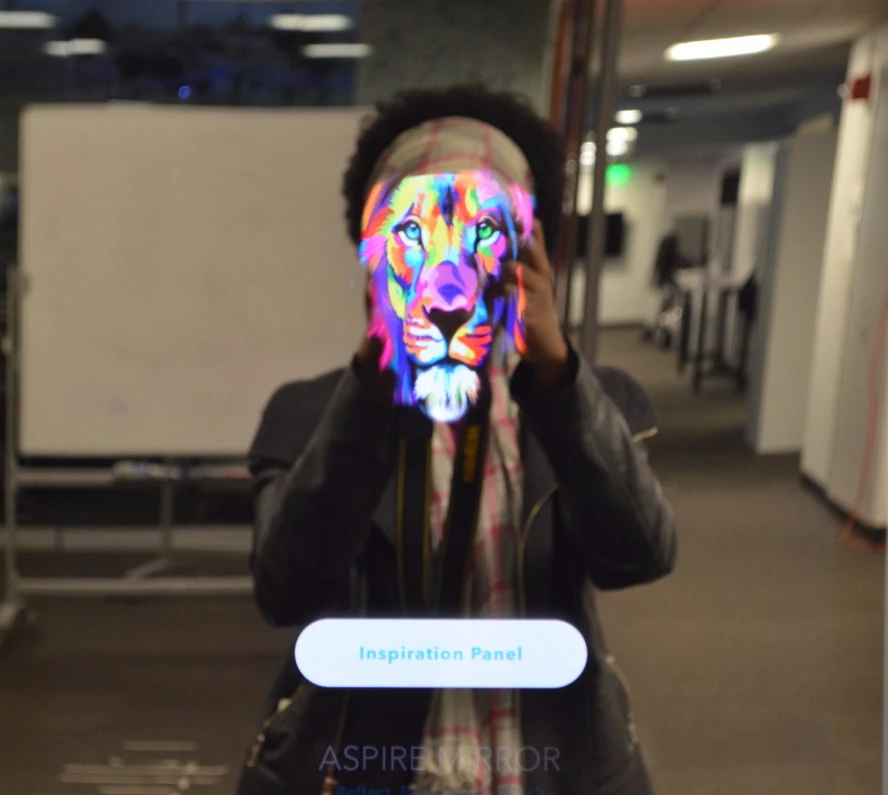
[Image Credit: Joy Buolamwini, "Aspire Mirror"]
Algorithmic inequality and digital profiling. Disinformation. Cyberbullying and online harassment. Dark patterns. Sexist apps. Toxic online communities. Gendered Artificial Intelligence. Multimodal orientalism. Digital divides, digital redlining, and the New Jim Code. Dissemination of racialized media and yellow peril rhetoric in the coverage of COVID-19.
While technologies have created and exacerbated inequalities for millennia, the expansiveness contemporary digital systems call for sustained attention to such matters in digital studies, cultural studies, and rhetorical theory. This course will address these systems of digital inequality and exclusion. In doing so, we will address their wide ranging impacts and the various ways communities respond to digital exclusions.
Through a series of writing prompts and provocations, the course will ask students to rethink, reimagine, redesign, and develop strategies for living within unjust, unequal, and exclusionary digital infrastructures.
Rules of Engagement
What is the purpose of a graduate seminar, and how does one use such a space to engage with texts? This document offers some answers to these questions and serves as a kind of constitution for our class.
The military root of the phrase "rules of engagement" is unfortunate because we are actually interested in something as nonviolent as possible. Of course, any interpretation of a text will do violence to it. This is the nature of interpretation. We fit a text or a set of ideas into a pre-existing framework that we already have. This is unavoidable. But we can try our best to forestall that violence or to at least soften the blow. In the interest of this kind of approach, this class will observe the following rules:
1. Disagreement and agreement are immaterial.
Our primary task is to understand, and this does not require agreement or disagreement. This seminar only asks that you agree to read, consider, analyze, and ask questions about the texts and objects we will address.
In his essay "The Rhetoric of Hitler's Battle," Kenneth Burke presents us with a succinct encapsulation of this first rule of engagement:
The appearance of Mein Kampf in unexpurgated translation has called for far too many vandalistic comments. There are other ways of burning books than on the pyre - and the favorite method of the hasty reviewer is to deprive himself and his readers by inattention. I maintain that it is thoroughly vandalistic for the reviewer to content himself with the mere inflicting of a few symbolic wounds upon this book and its author, of an intensity varying with the resources of the reviewer and the time at his disposal. Hitler's "Battle" is exasperating, even nauseating; yet the fact remains: If the reviewer but knocks off a few adverse attitudinizings and calls it a day, with a guaranty in advance that his article will have a favorable reception among the decent members of our population, he is contributing more to our gratification than to our enlightenment" (The Philosophy of Literary Form, 191)
We are more interested in enlightenment than gratification.
2. An argument is a machine to think with.
This is another version of I.A. Richards's claim that “a book is a machine to think with." The "with" here should be read in two different ways. We read "with" an argument by reading alongside it. We "tarry" with it. We get very close to it and join it during a long walk. Notice that this requires that we stay with the author rather than diverging down a different path, questioning the route, or pulling out our own map. But "with" here also means that the argument is a tool that we must first understand before using. Our job is to learn how this tool works. It has multiple moving parts and purposes. It has multiple audiences. We need to understand all of this before we make any attempt to use the argument, and we certainly need to do all of this before we can even think about disagreeing with it.
3. Ask that question sincerely, or the principle of "generous reading."
Why the hell would s/he argue that? If you find yourself asking this question, then take the next step by answering your own question. Why would s/he argue that? If I am indignant about the argument, does this suggest that I am not the audience? If the argument seems ridiculous, is it relying on definitions that I find foreign? If I think the argument is brilliant, is it because I am in fact the target audience, so much so that I am having a difficult time gaining any kind of critical distance?
The principle of "generous reading" has little to do with being "nice." Instead, it is more about reading in a generative way, in a way that opens the text up rather than closes it down. This requires that we read a text on its own terms, understanding how an argument is deploying certain concepts and ideas (see Rule #2).
Syllabus
Professor: Jim Brown
Class Time: Monday, 6:00-8:50pm
Meeting Place: Armitage 219
Professor Brown's Office: Digital Commons, Room 104
Office Hours: Monday, 4:30-6:00pm, or by appointment (via Zoom)
Email: jim[dot]brown[at]rutgers[dot]edu
Course Website: http://courses.jamesjbrownjr.net/595_fall2021
Learning Outcomes
Upon completion of this class, students will be able to:
- Effectively summarize and analyze arguments in digital studies, rhetorical studies, and related fields
- Apply sustainable reading and writing methods to a range of academic arguments, allowing them to effectively prepare for future projects or comprehensive exams
- Understand and extend research questions and projects related to the topic of digital inequality in a way that allows them to understand its stakes, impacts, and potential responses to it.
- Develop research projects in various modes, including writing and/or digital media arts.
Required Books
Most readings for this course will be made available to you as PDFs. Check Canvas for details. You may also purchase hard copies of our texts. A full list of our texts is available at the course bibliography
Texts to purchase:
Glitch Feminism: A Manifesto, Legacy Russell
Course Work and Grades
In this class, the following work will be evaluated:
- Weekly Talking Points (15%)
- Collaborative Annotations (25%)
- Weekly writing prompts(30%)
- Final Project (30%)
Grades will be assigned on the following scale:
A 90-100
B+ 87-89
B 80-86
C+ 77-79
C 70-76
D 60-69
F 59 and below
Pronouns
This course affirms people of all gender expressions and gender identities. If you have a preferred gender pronoun, feel free to correct me. If you have any questions or concerns, please do not hesitate to contact me directly.
Code of Conduct and Academic Integrity
Rutgers University-Camden seeks a community that is free from violence, threats, and intimidation; is respectful of the rights, opportunities, and welfare of students, faculty, staff, and guests of the University; and does not threaten the physical or mental health or safety of members of the University community, including in classroom space, and a community in which students respect academic integrity and the integrity of your own and others’ work.
As a student at the University you are expected adhere to the Student Code of Conduct and Academic Integrity Policy. To review the academic integrity policy, go to https://deanofstudents.camden.rutgers.edu/academic-integrity To review the code, go to: https://deanofstudents.camden.rutgers.edu/student-conduct
Please Note: The conduct code specifically addresses disruptive classroom conduct, which means "engaging in behavior that substantially or repeatedly interrupts either the instructor's ability to teach or student learning. The classroom extends to any setting where a student is engaged in work toward academic credit or satisfaction of program-based requirements or related activities." Please be aware of classroom and out-of-classroom expectations by making yourself familiar with and by following the Student Code of Conduct
The Office of Disability Services
Office of Disability Services (ODS)- Students with Disabilities
If you are in need of academic support for this course, accommodations can be provided once you share your accommodations indicated in a Letter of Accommodation issued by the Office of Disability Services (ODS). If you have already registered with ODS and have your letter of accommodations, please share this with me early in the course. If you have not registered with ODS and you have or think you have a disability (learning, sensory, physical, chronic health, mental health or attentional), please contact ODS by first visiting their website https://success.camden.rutgers.edu/disability-services.The website will further direct you who to contact and how to contact them depending on the free, confidential services you are in need of.
Please Note: Accommodations will be provided only for students with a Letter of Accommodation from ODS. Accommodation letters only provide information about the accommodation, not about the disability or diagnosis.
Computers, Smartphones, etc.
Please feel free to use your computer or any other device during class, provided that your use of it is related to what we are working on in class. Please silence cell phones during class.
Shared Files, Course Website, and Email
You should check your email daily. Class announcements about readings and assignments will be distributed through email and on Canvas. The course website will also have important information about assignments and policies. Pay close attention to the course calendar as we move through the semester. I reserve the right to move things around if necessary.
Schedule
This course uses a method I call "drilling down." We start with a contemporary work of research (what I call a "keystone text"), and then we read a selection of texts cited in the keystone texts.
For each of the six keystone texts, we will have a short writing assignment. These are due (uploaded to Canvas) before you come to class.
Every week, regardless of what type of texts we are reading, we will complete collaborative annotations in Canvas using Hypothesis software. These annotations are due the day before class, which gives me a chance to read your responses prior to our discussion.
Finally, each day a reading is assigned, you should bring a set of "talking points" to class. These are informal notes, but they should provide a kind of "agenda" for you during our class meetings - they can include questions, comments, quotations from the reading, or any other information that you would find helpful during lectures and discussions.
September 8
Reading: Darius Kazemi, "Run Your Own Social"
September 13
Reading: Keystone Text - Halcyon Lawrence, "Siri Disciplines"
Writing: Hypothesis annotations completed by Sunday (9/12); Short Writing Assignment #1 due by 6:00pm; Bring talking points to class
September 20
Reading: Drill Down Texts - Ramsey Nasser, "Command Lines: performing Identity and Embedding Bias" (video); Meryl Alper, Giving Voice Mobile Communication, Disability, and Inequality
Writing: Hypothesis annotations completed by Sunday; Bring talking points to class
September 27
Reading: Keystone Text - Graham and Hopkins, "AI for Social Justice: New Methodological Horizons in Technical Communication"
Writing: Hypothesis annotations completed by Sunday; Short Writing Assignment #2 due by 6:00pm; Bring talking points to class
October 4
Reading: Drill Down Texts - Ruha Benjamin, Race After Technology; Edenfield et. al., "Queering tactical technical communication: DIY HRT."
Writing: Hypothesis annotations completed by Sunday; Bring talking points to class
October 11
Reading: Keystone Text - Steele, Digital Black Feminism
Writing: Hypothesis annotations completed by Sunday; Short Writing Assignment #3 due by 6:00pm; Bring talking points to class
October 18
Reading: Drill Down Texts - Fouché "Say it loud, I’m Black and I’m proud: African Americans, American artifactual culture, and Black vernacular technological creativity; Baraka, A. "Technology and ethos"; Tonia Sutherland, "Archival Amnesty: In search of Black American transitional and restorative justice"
Writing: Hypothesis annotations completed by Sunday; Bring talking points to class
October 25
Reading: Keystone Text - Louise Amoore, Cloud Ethics, Introduction and Chapter 3; Foucault, "What is an Author?"
Writing: Hypothesis annotations completed by Sunday; Bring talking points to class
November 1
NO CLASS MEETING
November 3
Writing: Short Writing Assignment #4 due by 6:00pm
November 8
Reading: Keystone Text - Amaro, "As If"
Writing: Hypothesis annotations completed by Sunday; Bring talking points to class
November 10
Writing: Short Writing Assignment #5 due by 6:00pm
November 15
Reading: Drill Down Texts - Joy Buolamwini, "Aspire Mirror"; Fanon, Black Skin, White Masks, Chapter 6: The Negro and Psychopathology, pp109-162; Harney and Moten, The Undercommons, Chapter 3: Blackness and Governance, pp44-57
Writing: Hypothesis annotations completed by Sunday; Bring talking points to class
November 22
Reading: Legacy Russell, Glitch Feminism
Writing: No hypothesis annotations due; Bring talking points to class
November 29
No Class - Rutgers Observes Wednesday Schedule
Writing: Short Writing Assignment #6 due by 6:00pm
December 6
Optional Reading: Drill Down Texts - Cárdenas, “Trans of Color Poetics: Stitching Bodies, Concepts, and Algorithms"; Halberstam, "The Wild Beyond," Zach Blas (video)"Facial Weaponization Suite"
Writing: No hypothesis annotations due; Most of class will be devoted to workshopping final project and presentation
December 13
Final project due, presentations during class
Assignments
Weekly Talking Points (15%)
For each day that a reading is assigned, you should bring a set of "talking points" to class. These are informal notes, but they should provide a kind of "agenda" for you during our class meetings - they can include questions, comments, quotations from the reading, or any other information that you would find helpful during lectures and discussions. These will be collected at the end of class, and you may make notes on them during class meetings.
These are graded on a Credit/No Credit basis and are each worth 1 point. As long as you put forth a good faith effort, you will receive credit.
Collaborative Annotations (25%)
For our readings, you will be using a tool called Hypothesis to highlight significant passages and to record observations about those passages. The goal here is to read together, to try to make sense of what we are reading in a collective way. Annotations are due by Sunday.This provides me with an opportunity to review your annotations before our class meeting.
We will annotate nearly every reading through the November 15 meeting, and each annotation assignment is worth 1.5 points. These assignments are graded on a credit/no-credit basis. Hypothesis allows you to annotate certain passages and to record "page notes" (notes that apply to the entire reading). You may also find that you want to reply to another student's annotations. While I do not require any specific number of annotations or notes, I will be looking to see that you have put forth a good faith effort to complete the assignment.
There are many ways to approach this method of collective annotation. Here's a guide developed by Dr. Nathaniel Rivers at St. Louis University, which presents some "do's" and "don'ts" of collaborative annotation. Annotations to our readings might do a number of things, including asking questions, pointing to another related source, connecting a reading to other readings in the class, or any other approach that you think might be useful to you and your classmates.
There's only one strict rule when it comes to these annotations: You can't say "I agree" or "I disagree." This may seem counter intuitive, but the goal of our readings isn't to agree or disagree with the author or even with one another. The goal is to ask questions, to figure out why the author is making certain arguments, and to consider what is most important about the argument we're reading.
As I look at your annotations and consider whether or not they deserve credit, I will be asking the following questions:
- Does your annotation demonstrate that you have read the entire assigned reading?
- Does your annotation demonstrate that you are considering what was posted previously and engaging in a conversation with the rest of the group?
- Does your annotation provide evidence that you've thought carefully about the reading and its relationship to our class discussions?
- Does your annotation demonstrate that you have put forth a good faith effort at completing the assignment?
Short Writing Assignments (30%)
For each of our keystone texts, you will complete a short response to a writing prompt. There will be six of these assignments, and each is worth five points.
These short papers should be between 750-1500 words (with the exception of paper #6, which follows a slightly different format), and they should demonstrate that you've thought carefully about the prompt and about the reading. The prose in these papers should reflect some level of revision, but they do not have to be perfectly polished. I am primarily interested in the ideas generated by the practice of writing these papers. Show me careful thinking, and I'll be willing to let sloppy sentences slide.
The aim of the prompts is to provoke new ways of thinking about the reading and about the topic of the class, and I may ask you to think about things you're not accustomed to thinking about in ways that might also be new. Consider these papers as opportunities to take risks in your thinking. These are low stakes assignments meant to provide some space for creativity.
For your final project, you will choose one of the short responses and expand it to propose a larger project. This means you should consider each of these short writing assignments as potential rough drafts for that final project.
When providing feedback on these, I will focus on how you might expand on the ideas in the paper for the final project. I will also be asking the following questions:
- Does the paper fall within the word count range?
- Have you responded to the prompt?
- Is there evidence that you have carefully read and engaged with the assigned reading?
- Does the paper demonstrate an attempt at engaging with the theories and concepts in the reading?
Prompt #1: Lawrence
In "Siri Disciplines," Lawrence argues that speech technologies like Siri operate in a disciplinary mode - they force nonstandard speakers of English to assimilate, and they exclude any speech practices to don't fit the narrow conception of what counts as "understandable." We could extend this critique to other technologies as well, even the keyboards we use discipline us and shape the way we write and think.
What approaches to design might help us create technologies that avoid this disciplinary mode? How might we create technologies that aren't rooted in discipline and exclusion? If technologies like Siri discipline, are there ways we might redesign them? Or we could even think beyond particular technologies: Are there general approaches to design that could result in technologies that do not force users to assimilate? Lawrence provides one possible answer to this question when she says that developers "on the periphery" are most likely to offer a way out of this bind. Where else might we look, and what approaches could show the most promise?
Prompt #2: Graham and Hopkins
Choose one of the approaches to sML-based text classification described by Graham and Hopkins and use it to propose a potential "AI for Social Justice" project. Be as detailed as you can: What is the research question you would pursue? Why is that question important? How would you carry out the study? What data would you analyze? What would you expect to find and why? What might you need (including, but not limited to certain expertise with machine learning) to complete the study? Who might you collaborate with?
Prompt #3: Steele
Steele argues that Black women are technically savvy but that technoculture has defined technology in a narrow (Western, white) way that excludes that savvy or that understands it as not *real* technology: "Black women have always engaged with technology; it is the definition of technology and technical expertise that shifted." Steele is asking us to reconsider what the term "technology" really means.
What is a practice that is deemed by many to be "not technical" or at least "not technical enough," and how does redefining that practice as "technical" or "technological" change our orientation to the practice. Think here of the spaces you interact with on a regular basis. Are there practices that are seen by many as frivolous, silly, non-serious, simple, or easily executed by anyone? Why are they seen that way? How could you reframe them as technical and as the result of craft, technique, or expertise? How does such a reframing help us see these practices in a new way?
Prompt #4: Amoore
Amoore argues that an algorithm's single output is too often seen as rooted in certainty and correctness and that even critiques of algorithms fall prey to this problem. If a predictive policing algorithm determines that a certain neighborhood should be patrolled due to the data fed to it, police departments tend to treat this result as a truth, and they act accordingly. Critics, on the other hand, aim to correct the racist, classist assumptions that led to that result, trying to uncover the algorithm's embedded biases. Amoore argues for a different approach altogether, offering a "cloud ethics" that does not accept algorithmic determinations as true or certain but also does not call for an approach that would break open the "black box" and aim to correct its biases.
So, what does a cloud ethics look like? In chapter 6, Amoore suggests that algorithmic results are "fabulations" and that a cloud ethics should not seek to correct those fantastical stories or point out the "real story" but should rather "confront the specific fabulatory functions of today's algorithms with a kind of fabulation of our own" (158). By creating other fabulations and stories, "the single output of the algorithm is reopened and reimagined as an already ethicopolitical being in the world." We create more stories to highlight that the algorithm is tellings stories and not offering solid truths.
Can you imagine an example of this cloud ethics in practice? What would it look like? How would it work? What algorithm could we engage with as we create "fabulations of our own"?
Prompt #5: Amaro
Computer vision technologies routinely misclassify or fail to recognize nonwhite faces, and many have argued that this indicates a lack of diversity in the datasets used to train these technologies as well as a lack of diversity in computer programming teams. But Amaro offers a different kind of critique, one aimed at the very nature of computer vision technologies. Amaro argues that the inclusion of black faces in datasets, and thus the creation of systems that recognize black faces, is not the only response to this problem. In fact, he argues that it is a response that might make many problems worse.
Given that computer vision technologies are based on a logic of "coherence," such technologies constantly aim to make sense of that which they see as incoherent. If whiteness is the norm, blackness is seen as incoherent, as a problem to be solved. But for Amaro, blackness is coherent in that it is "continually taking shape." If an algorithmic system perceives this as incoherence and thus tries to either make it cohere (by comparing it against a norm) or excludes it altogether (further solidifying the norm), then the answer is not to incorporate blackness into that system. Instead, it is to imagine an entirely new system.
In this short writing assignment, your task is to imagine a technology inspired by Amaro's framework. What technology can you imagine that is not rooted in "coherence and detectability"? This does not have to be a computer vision technology, though it can be. Your job is to invent, to treat this as a thought experiment: What other possibilities can we imagine if we take Amaro's argument as our starting point? What other futures are possible if the "black technical object" is not understood as needing to conform to the algorithm but is instead understood as an invitation to think differently about technology and design?
Prompt #6: Russell
You have now completed 5 of these short papers, responding to the prompts that I have provided. Your task in this final assignment is to write a prompt for readers of Legacy Russell's Glitch Feminism.
The length of this paper will obviously not be 750-1000 words. In fact, depending on how you write this prompt, it could be as short as a single sentence or as long as multiple paragraphs. Regardless of its length, your job is to create a prompt that would allow someone reading Glitch Feminism to engage with its ideas in an inventive way.
Final Project (30%)
For your final project, you will choose one of the short responses and expand it to propose a larger project. This means that you should consider each of these short writing assignments as potential rough drafts for that final project.
Your final project is not actually a completed project but is instead a proposed project. The proposal will be submitted as a written document, and you will also deliver a brief, informal presentation that explains your proposal to the class.
There is no minimum or maximum length for the written proposal. However, your in-class presentation cannot be longer than 10 minutes.
Here is what your final proposal and presentation should contain:
1) Explain how you came to a research question that you would like to pursue. Which text, question, or issue in class provoked this line of thinking for you? Which writing prompt was the "start" of this idea?
2) What is your research question? What do you want to ask, and why?
3) Who is the audience you imagine for this project? Who has tried to ask and answer a similar research question? Here is the section you can imagine to be the bibliography for the project. Which of the authors that we have read do you think would be the target audience for this research? Which authors that we haven't read might be in that audience? Look at who our texts cite and drill down into other potential works that we haven't directly addressed in class.
4) What method would you use to do this research? How would you carry out the research, and what would your "stuff" or "data" be for this project? Would it be an archival project? A project that examines some data set? A close analysis of some specific digital system? Something else? You do not have to know all the details of your research method, but you should at least explain the kind of research you would hope to do and the kinds of texts or artifacts you'd examine.
5) What would you expect to find in this study and why?
6) What form would the final product take? Is it a piece of writing? A video? An audio project? Something else? Explain and justify your choice of medium.
Course Bibliography
Alper, Meryl. 2017. Giving Voice: Mobile Communication, Disability, and Inequality. MIT Press.
Amaro, Ramon. n.d. “As If.” E-Flux. Accessed August 26, 2021. https://www.e-flux.com/architecture/becoming-digital/248073/as-if/.
Amoore, Louise. 2020. Cloud Ethics. Duke University Press.
“Aspire Mirror.” n.d. Accessed August 26, 2021. http://www.aspiremirror.com/.
Baraka, Amiri. 1971. “Technology and Ethos.” In Raise Rage Rays Raze: Essays Since 1965. New York: Random House.
Benjamin, Ruha. 2019. Race after Technology: Abolitionist Tools for the New Jim Code. John Wiley & Sons.
Cárdenas, Micha. n.d. “Trans of Color Poetics: Stitching Bodies, Concepts, and Algorithms.” S&F Online. Accessed December 5, 2016. http://sfonline.barnard.edu/traversing-technologies/micha-cardenas-trans....
Computer History Museum. n.d. "Command Lines: Performing Identity and Embedding Bias." Accessed August 26, 2021. https://www.youtube.com/watch?v=vIvJ4czF118&ab_channel=ComputerHistoryMu....
Edenfield, Avery C., Steve Holmes, and Jared S. Colton. 2019. “Queering Tactical Technical Communication: DIY HRT.” Technical Communication Quarterly 28 (3): 177–91.
“Facial Weaponization Suite.” n.d. Zach Blas (blog). Accessed August 26, 2021. https://zachblas.info/works/facial-weaponization-suite/.
Fanon, Frantz. 2008. Black Skin, White Masks. Grove press.
Foucault, Michel. 1994. “What Is an Author?” In Aesthetics, Method, and Epistemology, edited by James D Faubion. The New Press.
Fouché, Rayvon. 2006. “Say It Loud, I’m Black and I’m Proud: African Americans, American Artifactual Culture, and Black Vernacular Technological Creativity.” American Quarterly 58 (3): 639–61.
Russell, Legacy. Glitch Feminism. 2020. Penguin Random House.
Graham, S. Scott, and Hannah R. Hopkins. 2021. “AI for Social Justice: New Methodological Horizons in Technical Communication.” Technical Communication Quarterly, no. just-accepted.
Haraway, Donna. 1988. “Situated Knowledges: The Science Question in Feminism and the Privilege of Partial Perspective.” Feminist Studies 14 (3): 575–99.
Harney, Stefano, and Fred Moten. 2013. The Undercommons: Fugitive Planning and Black Study.
Mullaney, Thomas S., Benjamin Peters, Mar Hicks, and Kavita Philip. 2021. Your Computer Is on Fire. MIT Press.
Steele, Catherine Knight. 2021. Digital Black Feminism. New York University Press.
Sutherland, Tonia. n.d. “Archival Amnesty.”
50:989:312 Writing New Media (Fall 2020)

A projection of George Floyd on the Robert E. Lee statue in Richmond on June 10. (John McDonnell/The Washington Post)
Digital writing is more than words on screens, and this course will ask: How does digital writing make, transform, and reconfigure space? How are digital spaces maintained by writing? How does digital writing transform physical space? From words projected on a statue to the rules that shape how we interact with one another online, digital writing plays a vital role in our everyday lives. This course will provide an opportunity to both think about and engage in these digital writing practices.
Code of Conduct
The goal of this code of conduct:
The goal of the code of conduct is to create a safe and secure environment for community members, and to protect them from discriminatory statements or actions, such as but not limited to offensive comments or actions that are racist, sexist, ageist, classist, homophobic, transphobic, ableist, etc.
Unacceptable behaviors:
- Foul language directed at another member of the community
- Threatening others
- Bullying or insulting others, or enabling the bullying or insulting of others
- Discriminatory behavior and language that is homophobic, ableist, racist, transphobic, ageist, and classist
- Non-consensual sharing of content outside the community
- Selling or marketing services or products
- Posting potentially offensive media including photos, language, and news stories without using a content warning (cw:)
Where this code of conduct applies:
- Applies to the following community spaces: Mastodon, Hypothesis, Twine, Zoom Meetings/Meeting Chat, Google Drive, Email (private and group), and Canvas. In other words, any software where multiple students and/or the instructor are interacting, in reference to the class.
- In addition, any possible in-person meetings and sessions.
A list of potential consequences for violating this code of conduct:
- A verbal or written warning
- Suspension from commenting on others’ posts on Mastodon or posting on Mastodon (Professor Brown provides an alternate activity)
- Suspension from Zoom meetings
- In extreme cases, a meeting with the Dean of Students
Detailed, specific, simple instructions for reporting a code of conduct violation:
- Any code of conduct violation should be reported to Professor Brown
- Report should include as much detail as possible and should reference which portion of the code of conduct has been violated
People who will handle the code of conduct report:
- Prof. Brown
- Dean of Students office (if violation involves Prof. Brown)
A promise that anyone directly involved in a report will recuse themselves:
- If the violation involves Prof. Brown, he will recuse himself from the process of reviewing said violation.
Contact information for emergency services
- Mary Flaherty, Assistant Dean: mary.flaherty@rutgers.edu
- Irene Ulrich, Director of Student Care & Student Advocacy: ipulrich@camden.rutgers.edu
- Janae Tucker, Community Standards Coordinator: janae.tucker@rutgers.edu
Links to related documents
https://frameshiftconsulting.com/code-of-conduct-book/
https://en.wikipedia.org/wiki/Code_of_conduct
https://www.websitepolicies.com/blog/code-of-conduct-ethics
https://bizfluent.com/about-5044074-definition-code-conduct.html
Syllabus
Professor: Jim Brown
Synchronous Meetings: Wednesday, 9:30am-10:30am
Meeting Place: Zoom (via Canvas)
Prof. Brown's Office: Zoom (Jim's "personal meeting room" on Canvas)
Prof. Brown' Office Hours: Wednesday, 10:30-11:30, or by appointment
Prof. Brown's Email: jim[dot]brown[at]rutgers[dot]edu
Course Website: http://courses.jamesjbrownjr.net/312_fall2020
A typical week...
With some exceptions, a typical week in this course will look like this:
Monday: Prof. Brown posts a short video to Canvas about our topic for the week
Tuesday: Students read and annotate using Hypothesis by 5:00pm (also posted on Canvas)
Wednesday: We meet via Zoom 9:30am-10:30am to discuss the readings and assignments
Beyond this schedule, you will also have assignments due throughout the semester (see our course schedule on this page) and you will also be sharing content and interacting on Mastodon, which is kind of like Twitter but is a small social networking site designed just for our class. Mastodon interactions will happen throughout the week, and you decide when to post there and respond to your classmates' posts.
Course Learning Outcomes
Upon completion of this class, students will be able to:
- Execute and reflect on a writing and design process
In this class, we'll be doing traditional writing assignments while also designing new media objects. While both writing and design result in products, it is important to realize that writing and design are processes. We will draft, experiment, and tinker during these processes, and we will attempt to learn what process works best for us. Throughout our work in this class, you should consider how your writing and design processes are changing, and how you are developing practices that work best for you as a thinker, writer, and designer. - Use digital media tools to make arguments and tell stories
This class will focus on how we can take advantage of the affordances of a media environment to make arguments and tell stories. The tool shapes the writing, and each time we take up a writing task in this class, we'll think carefully about the best tool for the job. - Collaborate and provide feedback to others
We will be collaborating throughout this class. One of our goals will be to develop skills and strategies for working with others. This means understanding the dynamics of a team and taking on various roles depending on the situation. - Critically read and analyze arguments
We will be reading the work of various scholars , and this reading will call for careful and critical reading. This means paying close attention to how the argument is constructed, considering what kinds of evidence the author is using, theorizing who might be the target audience of the text, developing questions about the implications of the author's argument, and demonstrating the ability to clearly and concisely summarize the text.
Required Texts
All required texts will be shared on Canvas and/or the course website.
Course Work and Grades
Grades will be determined based on the following course work:
- Code of Conduct (10%)
- Hypothesis Annotations (15%)
- Mastodon Posts (15%)
- Mastodon Reports (10%)
- Twine Project (25%)
- Digital Writing in Johnson Park (25%)
Grades will be assigned on the following scale:
A 90-100
B+ 88-89
B 80-86
C+ 78-79
C 70-77
D 60-69
F 59 and below
Content Warnings
If we will be reading and discussing material that addresses sensitive topics, I will do my best to let you know in advance. If there are certain specific topics you would like me to provide warnings about, please let me know. I will do my best to flag content based on your requests.
Attendance
We will meet once per week for one hour - on Wednesdays at 9:30am. If attendance at these meetings will be a problem, please let me know. During meetings, we will discuss readings and assignments, and some class meetings will be devoted to peer review sessions.
Technology Policy
We will use digital technology frequently in this class. Although I am assuming that you have some basic knowledge of computers, such as how to use a keyboard and mouse, and how to use the Web and check e-mail, most things will be explained in class. You will not have to download any software, but we will be using platforms other than Canvas throughout the course. If you don’t understand what we are doing, please ask for help.
Canvas, Mastodon, Course Website, and Email
You should check your email daily, and you should regularly check our Mastodon page (a social media space built just for our class). Class announcements and assignments may be distributed through email. The course website and our Canvas site will also have important information about assignments and policies. Pay close attention to the course calendar as we move through the semester. I reserve the right to move things around if necessary.
University policies and resources
Academic Integrity
My assumption is that any work you turn in for this course has been completed by you. If you ever have questions about proper attribution or citation, please don't hesitate to ask.
Code of Conduct
Rutgers University-Camden seeks a community that is free from violence, threats, and intimidation; that is respectful of the rights, opportunities, and welfare of students, faculty, staff, and guests of the University; and that does not threaten the physical or mental health or safety of members of the University community and includes classroom space. As a student at the University, you are expected adhere to Student Code of Conduct: https://deanofstudents.camden.rutgers.edu/student-conduct
We will be discussing codes of conduct during this class and how they help shape the expectations of a community's interactions. If you have questions about the CoC for this class or of Rutgers-Camden, please don't hesitate to contact me.
RaptorCares
Rutgers-Camden has a wide range of resources to help you stay on track both personally and academically. The Raptor Cares Report (https://deanofstudents.camden.rutgers.edu/reporting) connects you to our Dean of Students Office and they can assist you with a variety of concerns: medical, financial, mental health, or any life issue that impacts your academic performance. You can share a concern for yourself, a classmate or a friend.
Office of Disability Services
The Office of Disability Services (ODS) provides students with confidential accommodation services in order to allow students with documented physical, mental, and learning disabilities to successfully complete their course of study at Rutgers University – Camden. ODS provides for the confidential documentation and verification of student accommodations, and communicates with faculty regarding disabilities and accommodations. The ODS provides accommodation services, which can include readers, interpreters, alternate text, special equipment, and note takers. The ODS also works with students, faculty, staff and administrators to enforce the American with Disabilities Act of 1990. https://learn.camden.rutgers.edu/disability-services
Office of Military and Veterans Affairs
The Office of Military and Veterans Affairs can assist our military and veteran students with benefits, deployment issues and much more. Contact: Fred Davis 856-225-2791 frdavis@camden.rutgers.edu
Support for Undocumented and Immigrant Students
In an ongoing effort to support all students on campus, Rutgers University has established two offices to support undocumented and immigrant students with questions or concerns related to immigration status. The Rutgers Immigrant Community Assistance Project (RICAP) provides free and confidential immigration legal consultations and direct representation to currently enrolled students. For more information or an appointment, contact Jason Hernandez, Esq., at 856-225-2302 or jason.c.hernandez@rutgers.edu. The Rutgers Office of Undocumented Student Services provides one-on-one case management to assist undocumented students and help them access campus resources including financial aid, career services, health services, etc.
Schedule
Week of August 31: Course introduction
Live Meeting (Wednesday 9/2, 9:30am): Syllabus review, discussion of course and assignments
Week of September 7: What is this course about?
Lecture video: Making Spaces, Rewriting Spaces
Reading and Hypothesis Annotation (due 9/8, 5:00pm): Syllabus annotation, continued
Live meeting (9/9, 9:30am): Clearing up syllabus questions, What is this course about?, Introduction to Mastodon
Week of September 14: Codes of Conduct
Lecture video: Codes of Conduct
Reading and Hypothesis Annotation (due 9/15, 5:00pm): Aurora and Gardiner, "How to Respond to Code of Conduct Reports"
Live meeting (9/16, 9:30am): Writing our Code of Conduct
Mastodon: Set up Mastodon Account, post five Mastodon engagements
Week of September 21: Small Networks
Lecture video: Small Networks
Reading and Hypothesis Annotation (due 9/22, 5:00pm): Kazemi, "Run Your Own Social"
Live meeting (9/23, 9:30am): Building your own network, Mastodon
Mastodon: Post five Mastodon engagements
Week of September 28: Rules vs. Values
Lecture video: Rules vs. Values
Live meeting (9/30, 9:30am): Rules, Values, and our Code of Conduct
Reading and Hypothesis Annotation: Trice et. al, "Values versus Rules in Social Media Communities"
Mastodon: Post five Mastodon engagements
Week of October 5: Design Justice and Introducing Twine (continued)
Lecture videos: "Design Justice" and "Introducing Twine"
Reading and Hypothesis Annotation (due 10/6, 5:00pm): Costanza-Chock, "Design Justice"
Live meeting (10/7, 9:30am): Design Justice, Twine
Mastodon: Post five Mastodon engagements
Week of October 12: Filter Bubbles and Introducing Twine (continued)
Lecture videos: "What is a filter bubble?"" and "What can we make with Twine?""
Reading and Hypothesis Annotation (due 10/13, 5:00pm): Pariser, "Filter Bubbles"; Bruns, "It's Not the Technology Stupid"
Live meeting (10/14, 9:30am): Filter Bubbles, Twine
Mastodon: Post five Mastodon engagements, First Mastodon Report due 10/18, 5:00pm
Week of October 19: Twine
Lecture videos: "Using if-then-else statements in Twine"
Reading and Hypothesis Annotation (due 10/20, 5:00pm): Harlowe 3.1.0 Manual
Live meeting (10/21, 9:30am): Pitching your Twine project
Mastodon: Post five Mastodon engagements
Week of October 26: Twine
Lecture video: Answering your Twine Questions
Live meeting (10/28, 9:30am): Twine peer review session
Assignment Deadlines: Post five Mastodon engagements, Twine project Version 1 due October 27, 5:00pm
Week of November 2: Twine
Lecture video: Answering your Twine Questions
Live meeting (11/4, 9:30am): Twine peer review session
Assignment Deadlines: Post five Mastodon engagements, Written Peer Review Due November 6, Twine project Version 2 due November 9, 5:00pm
Week of November 9: Digital Writing in Johnson Park
Lecture video: Reimagining Johnson Park
Reading and Hypothesis Annotation (due 11/10, 5:00pm): Millhiser, "The night they’ll tear old Dixie down"
Live meeting (11/11, 9:30am): Discuss Lee Statue, Johnson Park, and the final project
Assignment Deadlines: Post five Mastodon engagements
Week of November 16: Digital Writing, Public Space, and Protest
Lecture video: Instead of a video from Jim this week, we'll be watching Grayson Earle's "Hacking the Urban Landscape"
Live meeting (11/18, 9:30am): "The Illuminator," discussion of final project
Assignment Deadlines: Post five Mastodon engagements
Week of November 23: Project proposals
Lecture video: "Preparing your project proposal"
Live meeting: NO LIVE MEETING DUE TO THANKSGIVING BREAK
Assignment Deadlines: Post five Mastodon engagements, Project proposal due 11/25, 5:00pm
Week of November 30: Preparing our final projects
Lecture video: "Preparing your final project"
Live meeting (12/2, 9:30am): Final project workshop
Assignment Deadlines: Post five Mastodon engagements
Week of December 7: Sharing our final projects
Lecture video: "Preparing your mini-presentation"
Live meeting (12/9, 9:30am): Mini-presentations of final project
Assignment Deadlines: Final Project due 12/8, 5:00pm, Final Mastodon Report due 12/11, 5:00pm
Assignments
Code of Conduct (10%)
As a class, we will author a code of conduct for our course. In How to Respond to Code of Conduct Reports, Aurora and Gardiner say that a Code of Conduct should contain the following (in roughly this order):
- Optionally, a short statement describing the goal of the code of conduct
- A list of unacceptable behaviors
- A description of where the code of conduct applies
- A list of potential consequences for violating the code of conduct
- Detailed, specific, simple instructions for reporting a code of conduct violation
- A list of the people who will handle the code of conduct report
- A promise that anyone directly involved in a report will recuse themselves
- Optionally, contact information for emergency services
- Optionally, links to related documents
Using this as a roadmap as well as anything else we've learned from Aurora and Gardiner's text, we will be collaboratively writing a write a code of conduct for our "Writing New Media" class. This code should be thought of as a document that "protects members of our community from harm."
The CoC will be authored collaboratively in Google Docs, and all students will receive full credit for the assignment upon completion of this assignment.
Hypothesis Annotations (15%)
For our readings, you will be required to use a tool called Hypothesis to highlight significant passages and to record observations about those passages. The goal here is to read together, to try to make sense of what we are reading in a collective way. If there is an assigned reading for the week, annotations are due by 5:00pm on Tuesday.This provides me with an opportunity to review your annotations before our class meeting.
Each annotation assignment is worth 2% of your grade, and these assignments are graded on a credit/no-credit basis. Hypothesis allows you to annotate certain passages and to record "page notes" (notes that apply to the entire reading). You may also find that you want to reply to another student's annotations. While I do not require any specific number of annotations or notes, I will be looking to see that you have put forth a good-faith effort to complete the assignment.
There are many ways to approach this method of collective annotation. Here's a guide developed by Dr. Nathaniel Rivers at St. Louis University, which presents some "do's" and "don'ts" of collaborative annotation. Annotations to our readings might do a number of things, including asking questions, pointing to another related source, connecting a reading to other readings in the class, or any other approach that you think might be useful to you and your classmates.
There's only one strict rule when it comes to these annotations: You can't say "I agree" or "I disagree". This may seem counter intuitive, but the goal of our readings isn't to agree or disagree with the author or even with one another. The goal is to ask questions, to figure out why the author is making certain arguments, and to consider what is most important about the argument we're reading.
As I look at your annotations and consider whether or not they deserve credit, I will be asking the following questions:
- Does your annotation demonstrate that you have read the entire assigned reading?
- Does your annotation demonstrate that you are considering what was posted previously and engaging in a conversation with the rest of the group?
- Does your annotation provide evidence that you've thought carefully about the reading and its relationship to our class discussions?
- Does your annotation demonstrate that you have put forth a good faith effort at completing the assignment?
Mastodon Posts (15%)
In this class, we will be using an open source social networking platform called Mastodon to share observations with one another. My hope is that you can use this space to discuss course readings or to share things that you find outside of class that are relevant to our discussions. Mastodon allows us to have a conversation amongst the members of our class conversation, but we are also able to follow users who are in other Mastodon communities.
Each week, I'll ask you complete at least five Mastodon "engagements." This means posting your own content, or interacting with a classmate. You may also "boost" someone else's post, but this won't count as an "engagement."
Twice during the semester, you will also complete a piece of writing (Mastodon reports) that offers you space to reflect on your Mastodon posts. The more active you are on Mastodon and the more seriously you take these posts, the easier it will be to write those reflections.
When determining whether or not you get credit for your Mastodon posts, I will be asking
- Does your post demonstrate that you are thinking carefully about our readings and discussions?
- Does your post demonstrate that you are considering what was posted previously by others in class and engaging in a conversation with the rest of the group?
- Does your post provide evidence that you've tried to make connections between class discussions and readings and things you've encountered outside of class?
- Does your post demonstrate that you have put forth a good faith effort at completing the assignment?
Mastodon Reports (10%)
Twice during the semester, you will submit a report that summarizes and reflects on what you have been posting to Mastodon. This is an opportunity to look for patterns in your posts and to explain how you've been using Mastodon to help you understand the course content and connect that content to our discussions as well as your projects. Your first report is due October 18 and your second is due December 9. Each report is worth 5% of your grade.
Mastodon reports are a maximum of 500 words and are uploaded to Canvas as a Word documents. Remember that 500 words is not much! So, you'll want to make the best use of this limited amount of space. Reports should identify patterns in your posts, discuss how you've interacted with other students in the class on Mastodon, and explain how your posts connect with your other work in the course (hypothesis annotations, live discussions, papers, projects, etc.). The goal here is to reflect on how you've used Mastodon and how it's helped you navigate the course. The more attention you pay to posting on Mastodon, the easier these papers will be to write. You should cite specific posts from Mastodon in this report (no works cited page needed), and this might mean directly quoting yourself.
When responding to and grading Mastodon reports, I will be asking
- Does the report demonstrate careful attention to finding patterns in your Mastodon posts?
- Have you reflected on your interactions with other students on Mastodon and how those interactions demonstrate an attempt to engage with the course material?
- Does the report show connections between your posts and your other work in the course?
- Have you observed the 500 word limit?
Twine Project (25%)
During the first portion of the semester, the readings focus on how communities manage themselves and how we think about "small networks." You will be using Twine to build a story or game that addresses some issue related to this topic.
Some people think of Twine as a way of making games, and others consider Twine projects more like stories. Others think of them as a mix between the two. What you make with Twine is up to you, as long as you take advantage of the capabilities of the platform. Most importantly, your task is to use Twine in a way that gives readers/players choices and making clear that those choices matter, and you will create a scenario that somehow sheds light on or questions our readings and discussions to this point in the course.
Altogether, the project is worth 25% of your grade, and it is broken down into four different components:
1) A one-minute "pitch" delivered to the rest of the class (5%)
During class on October 21, everyone will deliver a one-minute pitch to the rest of the class. This is an informal presentation - no slides, just you talking. However, the #1 rule is that you cannot go longer than one minute. So, you'll have to plan this out carefully, making sure that you tell us as much as you can about the project in that one minute.
2) Version 1 of your project (5%)
Version 1 of your project is due October 27 at 5:00pm. You will upload the HTML version of your game to Canvas. This doesn't have to be the complete project, but it should be a playable version of the project. That means that someone else should be able to navigate through it, read/watch/listen to content, and get a general sense for what the project is about.
3) Peer review of another student's Twine Project (5%)
We will have two peer review sessions during which you will get feedback from a partner. During the second of these sessions, you will complete a written response to your partner's game and upload that response to Canvas. This feedback should be as detailed as possible, and it must go beyond things like "This is great!" Giving detailed feedback will help your partner make the project better, and it will also help you work through your own project since it will get you thinking critically about what works well and what doesn't work well in Twine.
4) Version 2 of your project (10%)
Version 2 of your project due November 8, 5:00pm. This version of the project should demonstrate that you've revised and changed the game during the peer review process, and it should be free of bugs, typos, or other errors.
When responding to the different parts of the Twine project, I will be asking
- Does your pitch concisely present your idea for the project, and did it observe the time limit?
- Does version 1 represent a playable version of the game, even if it might have some gaps, bugs or errors? Is it possible for a player to see where the project is headed, even if it isn't yet complete? Does the project address some topic we have addressed in class?
- Does your written feedback to a peer represent careful attention, providing detailed feedback about ways to make the project better?
- Does version 2 represent a significant revision, incorporating feedback from peers, and is it free of bugs, typos, and other errors?
Digital Writing in Johnson Park (25%)
Johnson Park and the Cooper Branch Library (now housing the Digital Studies Center) have been contested spaces for many years, sitting in between the City of Camden and Rutgers University. Recently, the university and the city have had to come to terms with racist imagery in a mosaic that sits on the front of the Library building.
As we think about Johnson Park, we can be inspired by some of the work we've discussed in class that has opened up a national conversation about racism, monuments, public art, and public space. Think about the Lee statue in Richmond or the various street murals that have emerged in cities across the country. How might we take the lessons of those projects and apply them to this space in Camden? Specifically, we are concerned with how digital writing might be used to help raise important questions and provoke conversations about Johnson Park and the Cooper Branch Library building and about power, racisms, and monuments more broadly.
In this assignment, you will consider how digital writing might help us to rethink this space and place. Your task is to plan a digital writing project that takes place in the space of the park and building. Using any technology you might imagine (audio, video, projection, drones, physical computing devices, just to name a few), your job is to describe that project. We won't have time to enact your projects, but it's possible that the Digital Studies Center could help you realize some of these projects in the future.
This project is worth 25% of your grade, and it's broken down into three different components:
1) Project Proposal (5%)
Your project proposal is a 500-word document that describes, in as much detail as possible, a digital writing project that takes place in Johnson Park. The proposal should be clear about the technologies you would plan to use, when you would imagine it taking place (Is this a long term installation? Why? Does it take place at a specific time? Why?), how it would work, and what message you would hope to convey with this digital writing project. The proposal is due November 25 at 5:00pm.
2) Project Description Document (15%)
Your project description is a maximum of 1500 words, and it should is describe, in as much detail as possible what your project would look, sound, and feel like (the document may also incorporate any other media that might help us understand how the project works). The key for this project is that you incorporate digital writing in some way, and the final project description should be as detailed as possible in terms of describing the project and what it would hope to accomplish. Who is the audience for this project, and what is the argument the project would try to make? The final project description document is due December 8 at 5:00pm
3) 2-minute presentation (5%)
On our last day of class (December 9, 9:30am), each student will deliver a 2-minute presentation about their project. This is an informal presentation, and it is an opportunity to share your work with the other students in the class. All presentations must observe the 2-minute time limit.
When responding to the different parts of the final project, I will be asking
- Does your proposal provide a detailed description of your project, and did it observe the word limit? Have you made clear what technologies would be used and what you hope to achieve with the project?
- Does the final project description document explain the technical details of your proposed project, and does it provide a rationale for what you hope the project accomplishes?
- Does your mini-presentation effectively explain to your peers the details of the project, its aims and goals, and does it observe the time limit?
56:350:594 The Internet of Garbage (Spring 2020)

[Image Credit: Chris Jordan, "Cell phones #2, Atlanta 2005"]
"The Internet is garbage." This is how Sarah Jeong begins her book, The Internet of Garbage. She shows us that so much content on the Internet must be sifted and sorted, moderated and trashed. Spam, harassment, racism, and misogyny. All of this is commonplace on the Internet, which is no longer even a space separate from "offline" life. But the problem goes beyond this, since the Internet also produces other kinds of garbage too, from the mobile devices tossed into landfills to the carbon spewed into the environment by Google's servers. This course addresses these issues by examining theoretical texts, literary artifacts, digital art, and games that take seriously what we normally dismiss as the waste of our digital interactions. This course will cover a broad range of theoretical approaches, including but not limited to critical race theory, intersectional feminism, game studies, and media archaeology. Course assignments will be flexible and will allow students to pursue both critical and creative projects. No digital skills are required.
Rules of Engagement
What is the purpose of a graduate seminar, and how does one use such a space to engage with texts? This document offers some answers to these questions and serves as a kind of constitution for our class.
The military root of the phrase "rules of engagement" is unfortunate because we are actually interested in something as nonviolent as possible. Of course, any interpretation of a text will do violence to it. This is the nature of interpretation. We fit a text or a set of ideas into a pre-existing framework that we already have. This is unavoidable. But we can try our best to forestall that violence or to at least soften the blow. In the interest of this kind of approach, this class will observe the following rules:
1. Disagreement and agreement are immaterial.
Our primary task is to understand, and this does not require agreement or disagreement. This seminar only asks that you agree to read, consider, analyze, and ask questions about the texts and objects we will address.
In his essay "The Rhetoric of Hitler's Battle," Kenneth Burke presents us with a succinct encapsulation of this first rule of engagement:
The appearance of Mein Kampf in unexpurgated translation has called for far too many vandalistic comments. There are other ways of burning books than on the pyre - and the favorite method of the hasty reviewer is to deprive himself and his readers by inattention. I maintain that it is thoroughly vandalistic for the reviewer to content himself with the mere inflicting of a few symbolic wounds upon this book and its author, of an intensity varying with the resources of the reviewer and the time at his disposal. Hitler's "Battle" is exasperating, even nauseating; yet the fact remains: If the reviewer but knocks off a few adverse attitudinizings and calls it a day, with a guaranty in advance that his article will have a favorable reception among the decent members of our population, he is contributing more to our gratification than to our enlightenment" (The Philosophy of Literary Form, 191)
We are more interested in enlightenment than gratification.
2. An argument is a machine to think with.
This is another version of I.A. Richards's claim that “a book is a machine to think with." The "with" here should be read in two different ways. We read "with" an argument by reading alongside it. We "tarry" with it. We get very close to it and join it during a long walk. Notice that this requires that we stay with the author rather than diverging down a different path, questioning the route, or pulling out our own map. But "with" here also means that the argument is a tool that we must first understand before using. Our job is to learn how this tool works. It has multiple moving parts and purposes. It has multiple audiences. We need to understand all of this before we make any attempt to use the argument, and we certainly need to do all of this before we can even think about disagreeing with it.
3. Ask that question sincerely, or the principle of "generous reading."
Why the hell would s/he argue that? If you find yourself asking this question, then take the next step by answering your own question. Why would s/he argue that? If I am indignant about the argument, does this suggest that I am not the audience? If the argument seems ridiculous, is it relying on definitions that I find foreign? If I think the argument is brilliant, is it because I am in fact the target audience, so much so that I am having a difficult time gaining any kind of critical distance?
The principle of "generous reading" has little to do with being "nice." Instead, it is more about reading in a generative way, in a way that opens the text up rather than closes it down. This requires that we read a text on its own terms, understanding how an argument is deploying certain concepts and ideas (see Rule #2).
Syllabus
Professor: Jim Brown
Class Time: Monday, 6:00-8:50pm
Meeting Place: BSB 108
Professor Brown's Office: Digital Commons, Room 104
Office Hours: Monday, 4:30-6:00pm
Email: jim[dot]brown[at]rutgers[dot]edu
Course Website: http://courses.jamesjbrownjr.net/594_spring2020
Learning Outcomes
Upon completion of this class, students will be able to:
- Interpret and create arguments about the cultural and environmental impacts of digital technologies
- Effectively summarize and analyze academic arguments
- Apply critical concepts to a range of texts and technologies
- Design, plan, and execute research and creative projects
Required Books
Most readings for this course will be made available to you as PDFs; however, you should plan to purchase the following texts or secure them through the Library during the weeks we are reading them. I am currently working with the Robeson Library to make these texts available in the Course Reserves:
- Race After Technology, Ruha Benjamin
- Soft Science, Franny Choi
- Finite Media, Sean Cubitt
- Beyond Hashtags, Sarah Florini
Other readings will be made available for download (articles and excerpts of books). Please see our shared folder for details (link distributed via email). A full list of our texts is available at the course bibliography
Course Work and Grades
In this class, the following work will be evaluated:
- Attendance (15%)
- Collaborative Annotations (15%)
- Book/Article Review (20%)
- Final Project (50%)
Grades will be assigned on the following scale:
A 90-100
B+ 87-89
B 80-86
C+ 77-79
C 70-76
D 60-69
F 59 and below
Attendance
Success in this class will require regular attendance, and I will take attendance at each class meeting. You are required to attend class daily, arrive on time, do assigned reading and writing, and participate in all in-class work. Please save absences for when you are sick or have a personal emergency. If you find that an unavoidable problem prevents you from attending class or from arriving on time, please discuss the problem with me.
Lateness
If you are more than 10 minutes late for class, you will be considered absent. If there is something keeping you from getting to class on time or that requires that you leave class a few minutes early (i.e., bus or train schedules), please let me know during the first week of class.
Computers, Smartphones, etc.
Please feel free to use your computer or any other device during class, provided that your use of it is related to what we are working on in class. Please silence cell phones during class.
Intellectual Property
Using the work of others without attribution, having another student complete an assignment for you, or any other violations of the university's Academic Integrity Policy will result in a failing grade. If you have questions about the that policy, please see the Dean of Student Affairs website.
The Office of Disability Services
From the The Office of Disability Services (ODS):
"The ODS provides students with confidential advising and accommodation services in order to allow students with documented physical, mental, and learning disabilities to successfully complete their course of study at Rutgers University – Camden. The ODS provides for the confidential documentation and verification of student accommodations, and communicates with faculty regarding disabilities and accommodations. The ODS provides accommodation services, which can include readers, interpreters, alternate text, special equipment, and note takers. The ODS acts as a signatory for special waivers. The ODS also works with students, faculty, staff and administrators to enforce the American with Disabilities Act of 1990."
If you believe you might require an accommodation, please contact the ODS early in the semester.
Shared Files, Course Website, and Email
You should check your email daily. Class announcements about readings and assignments will be distributed through email. The course website will also have important information about assignments and policies. Pay close attention to the course calendar as we move through the semester. I reserve the right to move things around if necessary.
Remote Learning Schedule (March 30 - May 11)
Regrouping
Week of March 23
Optional Video Chat: Monday, March 23 7:00-8:00pm
Reading: None
Task
- Reassessing and Planning for the Final Project (Uploaded to Canvas by March 28)
E-Waste
Week of March 30
Video Lecture will be posted by Friday, March 27
Optional Video Chat: Monday, March 30 7:00-8:00pm
Reading: Gabrys (Preface, Introduction, Conclusion)
Tasks (if possible, complete all tasks by 7:00pm on the assigned date
- Monday, March 30 - Watch Lecture Video and Annotate Reading in Hypothesis
- Tuesday, March 31 - Revisit annotations and post responses to your classmates' annotations
- Wednesday, April 1 - Reviewers upload reviews (reviewers only)
- Thursday, April 2 - Non-reviewers post one question to reviewer
- Friday, April 3 - Reviewers respond to at least two questions
Reviews:
- Miller, "The Art of Waste" (Bridget)
- Roberts, "Digital Refuse" (Megan)
Carbon
Week of April 6
Video Lecture will be posted by Friday, April 3
Optional Video Chat: Monday, April 6 7:00-8:00pm
Reading: Pasek, "Managing Carbon and Data Flows"
Tasks (if possible, complete all tasks by 7:00pm on the assigned date
- Monday, April 6 - Watch Lecture Video and Annotate Reading in Hypothesis
- Tuesday, April 7 - Revisit annotations and post responses to your classmates' annotations
- Wednesday, April 8 - Reviewers upload reviews (reviewers only)
- Thursday, April 9 - Non-reviewers post one question to reviewer
- Friday, April 10 - Reviewers respond to at least two questions
Reviews:
- Hogan, "Facebook Data Storage Centers as the Archive’s Underbelly" (Haley)
- Vonderau, "Storing Data, Infrastructuring the Air" (Kate)
Living in a World of Garbage
Repair
Week of April 13
Video Lecture will be posted by Friday, April 10
Optional Video Chat: Monday, April 13 7:00-8:00pm
Reading: Jackson, "Rethinking Repair"
Tasks (if possible, complete all tasks by 7:00pm on the assigned date
- Monday, April 13 - Watch Lecture Video and Annotate Reading in Hypothesis
- Tuesday, April 14 - Revisit annotations and post responses to your classmates' annotations
- Wednesday, April 15 - Reviewers upload reviews (reviewers only)
- Thursday, April 16 - Non-reviewers post one question to reviewer
- Friday, April 17 - Reviewers respond to at least two questions
Reviews:
- Burrell, What environmentalists get wrong about e-waste in West Africa (Chuck)
- Pink et. al., "Broken Data" (Erin)
Maintenance
Week of April 20
Video Lecture will be posted by Friday, April 17
Reading: Florini, Beyond Hashtags (Introduction and Methodological Appendix)
Optional Video Chat: Monday, April 20 7:00-8:00pm
Tasks (if possible, complete all tasks by 7:00pm on the assigned date
- Monday, April 20- Watch Lecture Video and post questions in Discussion forum
- Wednesday, April 22 - Reviewers upload reviews (reviewers only)
- Thursday, April 23 - Non-reviewers post one question to reviewer
- Friday, April 24 - Reviewers respond to at least two questions
Reviews:
- "‘Joy is resistance’: cross-platform resilience and (re)invention of Black oral culture online" by Jessica Lu and Catherine Knight Steele (George)
- Trice, Potts, and Small, "Values versus Rules in Social Media Communities" (Mike)
Aesthetics
Week of April 27
Video Lecture will be posted by Friday, April 24
Reading: Cubitt, Finite Media (Introduction)
Optional Video Chat: Monday, April 27 7:00-8:00pm
Lecture will be posted, but you have NO TASKS for this week. You can use this time to work on your projects.
Project Workshopping
Week of 5/4
Consultation with Jim about projects via email or Google Hangouts
5/11: Projects Due, Optional Virtual Symposium
For those interested, we'll do a video chat at 7:00pm on May 11 to share our final projects. This is optional.
Assignments
Collaborative Annotations
Throughout the semester, we will be using Hypothesis, a collaborative annotation tool, to annotate certain readings. These are credit/no-credit assignments, so I will not be grading annotations. I will merely be tracking that you have completed the annotations and have put forth a good-faith effort while doing so.
Article/Chapter Review
Once during the semester, each student will write a one-page review of an article or chapter that is related to our discussion for the week. These are readings that the rest of the class is not required to read (though all students are encouraged to read the review texts), so the person reviewing the text will serve as the resident expert on that text.
Reviewers will upload their one-page review to Canvas. The rest of the class will post comments, and the reviewer will respond to at least two of those questions.
Articles and chapters to be reviewed are listed on the schedule. Students interested in a particular reading that is not listed on the schedule are free to speak with me about reviewing an alternate text, though the review does need to fit with the topic for that week.
Reviews are limited to a single side of a sheet of paper. When providing feedback on reviews, I will be asking the following:
- Does the review follow the "rules of engagement" established for this class?
- Does the review offer a detailed summary of the argument that includes discussion of the author's field of study, the methods and theories they deploy, and a description of the evidence they use to support the argument?
- Does the review provide a discussion of how the author's argument relates to the topic of the class, other readings from class, and our discussions?
- Does the review observe the page limit?
- Is there evidence that the author has carefully written and revised?
- Did the reviewer observe the time limit during the informal presentation in class?
- Is there evidence that the reviewer planned their informal presentation?
Final Project
One-page Project Proposal: Due February 24
Final Project: Due May 11
Final projects may be individual or collaborative, and they can take two forms:
- A conference paper, written for a specific scholarly conference, that somehow addresses the content of this course. Conference papers are typically 15-20 minute presentations. Should you choose this option, you will submit a 2000-3000 word paper as well as a 250-word abstract. You will also need to include either a CFP that you are responding to or a description of the conference that you have in mind.
- A creative work, using any medium you choose, that somehow addresses the content of this course. This means you might submit short fiction, poetry, a video, a sound project, or any other medium you feel best allows you to achieve your goals.
The project proposal that is due February 24 should be no more than one page and should do the following:
- Describe the project and its goals
- Provide a roadmap for completion, including deadlines and benchmarks for drafts and revision
All final projects must be accompanied by a Statement of Goals and Choices (SOGC). This is an assignment that comes from Jody Shipka's book Toward a Composition Made Whole, and it asks you to reflect on why you built, wrote, and/or designed your project the way you did. There is no minimum or maximum number of words for the SOGC - it takes as many words as you think it takes to explain why you made certain choices and what you were trying to accomplish with the project.
The SOGC should answer the following questions:
- What, specifically, is this project trying to accomplish - above and beyond satisfying the basic requirements of the assignment? In other words, what work does, or might, this work do? For whom? In what contexts?
- What specific, rhetorical, material, methodological, and technological choices did you make in service of accomplishing the goal(s) articulated above? Catalog, as well, choices that you might not have consciously made, those that were made for you when you opted to work with certain genres, materials, and technologies.
- Why did you end up pursuing this plan as opposed to other possibilities? How did the various choices listed above allow you to accomplish things that other sets or combinations of choices would not have?
When providing feedback on your project and SOGC, I will be looking for the following:
- Does your project demonstrate detailed and in-depth research and engagement with the course material?
- Have you carefully considered the affordances and constraints of your method and/or medium?
- Is your project effectively designed? Is there evidence that you've carefully chosen your medium and that the medium is appropriate for what you're trying to communicate?
- Does your SOGC address all of the questions listed above?
- Is your SOGC (and your project, if it uses written language) generally well-written and free of grammatical errors?
Course Bibliography
Benjamin, Ruha. Race after Technology: Abolitionist Tools for the New Jim Code. John Wiley & Sons, 2019.
Benkler, Yochai, et al. Network Propaganda: Manipulation, Disinformation, and Radicalization in American Politics. Oxford University Press, 2018.
Bessi, Alessandro, and Emilio Ferrara. “Social Bots Distort the 2016 US Presidential Election Online Discussion.” First Monday, vol. 21, no. 11–7, 2016.
Bratton, Benjamin. “On Speculative Design.” Dis Magazine. The Time Complex: Postcontemporary Issue, 2016.
Brock, André. Distributed Blackness: African American Cybercultures. NYU Press, 2020.
Brown Jr, James J., and Gregory Hennis. “Hateware and the Outsourcing of Responsibility.” Digital Ethics: Rhetoric and Responsibility in Online Aggression, 2019.
Brunton, Finn. Spam: A Shadow History of the Internet. MIT Press, 2013.
Burrell, Jenna. “What Environmentalists Get Wrong about E-Waste in West Africa.” The Berkeley Blog, 1 Sept. 2016, https://blogs.berkeley.edu/2016/09/01/what-environmentalists-get-wrong-a....
Carpenter, J. R. The Gathering Cloud. Uniformbooks, 2017.
Chiang, Ted. The Lifecycle of Software Objects. Deluxe Hardcover edition, Subterranean, 2010.
Choi, Franny. Soft Science. Alice James, 2019.
Chun, Wendy Hui Kyong. Updating to Remain the Same: Habitual New Media. MIT press, 2016.
Coleman, Beth. “Race as Technology.” Camera Obscura: Feminism, Culture, and Media Studies, vol. 24, no. 1 (70), 2009, pp. 177–207.
Costanza-Chock, Sasha. “Design Justice: Towards an Intersectional Feminist Framework for Design Theory and Practice.” Proceedings of the Design Research Society, 2018.
Cubitt, Sean. Finite Media: Environmental Implications of Digital Technologies. Duke University Press, 2016.
Dibbell, Julian. “A Rape in Cyberspace or How an Evil Clown, a Haitian Trickster Spirit, Two Wizards, and a Cast of Dozens Turned a Database into a Society.” Ann. Surv. Am. L., 1994, p. 471.
Florini, Sarah. Beyond Hashtags: Racial Politics and Black Digital Networks. NYU Press, 2019.
Gabrys, Jennifer. Digital Rubbish: A Natural History of Electronics. University of Michigan Press, 2011.
Graziano, Valeria, and Kim Trogal. “Repair Matters.” Ephemera: Theory and Politics in Organization, 2016.
Haimson, Oliver L., et al. “Tumblr Was a Trans Technology: The Meaning, Importance, History, and Future of Trans Technologies.” Feminist Media Studies, 2019, pp. 1–17.
Harsin, Jayson. “Attention! Rumor Bombs, Affect, Managed Democracy.” Propaganda and Rhetoric in Democracy: History, Theory, Analysis, edited by Gae Lyn Henderson and M. J. Braun, SIU Press, 2016.
Hertz, Garnet, and Jussi Parikka. “Zombie Media: Circuit Bending Media Archaeology into an Art Method.” Leonardo, vol. 45, no. 5, 2012, pp. 424–430.
Hogan, Mél. “Facebook Data Storage Centers as the Archive’s Underbelly.” Television & New Media, vol. 16, no. 1, 2015, pp. 3–18.
Houston, Lara. “The Timeliness of Repair.” Continent, vol. 6, no. 1, 2017, pp. 51–55.
Jackson, Steven J. “Rethinking Repair.” Media Technologies: Essays on Communication, Materiality, and Society, 2014, pp. 221–39.
Jeong, Sarah. The Internet Of Garbage. Forbes Media, 2015.
Lu, Jessica H., and Catherine Knight Steele. “‘Joy Is Resistance’: Cross-Platform Resilience and (Re) Invention of Black Oral Culture Online.” Information, Communication & Society, vol. 22, no. 6, 2019, pp. 823–837.
Massanari, Adrienne. “# Gamergate and The Fappening: How Reddit’s Algorithm, Governance, and Culture Support Toxic Technocultures.” New Media & Society, vol. 19, no. 3, 2017, pp. 329–346.
Menkman, Rosa. “Glitch Studies Manifesto.” Video Vortex Reader II: Moving Images beyond YouTube, 2011, pp. 336–347.
Miller, T. “The Art of Waste: Contemporary Culture and Unsustainable Energy Use.” Signal Traffic: Critical Studies of Media Infrastructures, edited by L. Parks and N. Starosielski, University of Illinois Press, 2015, pp. 137–56.
Nakamura, Lisa. Digitizing Race: Visual Cultures of the Internet. U of Minnesota Press, 2008.
Paasonen, Susanna. “Irregular Fantasies, Anomalous Uses: Pornography Spam as Boundary Work.” The Spam Book: On Viruses, Porn, and Other Anomalies from the Dark Side of Digital Culture, 2009, pp. 161–79.
Parikka, Jussi, and Tony D. Sampson. "On Anomolous Objects." The Spam Book: On Viruses, Porn, and Other Anomalies from the Dark Side of Digital Culture. Hampton Press, 2009.
Pasek, Anne. “Managing Carbon and Data Flows: Fungible Forms of Mediation in the Cloud.” Culture Machine, vol. 18, https://culturemachine.net/vol-18-the-nature-of-data-centers/managing-ca.... Accessed 22 Jan. 2020.
Pink, Sarah, et al. “Broken Data: Conceptualising Data in an Emerging World.” Big Data & Society, vol. 5, no. 1, 2018, p. 2053951717753228.
Roberts, Sarah T. “Digital Refuse: Canadian Garbage, Commercial Content Moderation and the Global Circulation of Social Media’s Waste.” Wi: Journal of Mobile Media, 2016.
Sundén, Jenny. “On Trans-, Glitch, and Gender as Machinery of Failure.” First Monday, vol. 20, no. 4, 2015.
Tolentino, Jia. Trick Mirror: Reflections on Self-Delusion. Random House, 2019, https://www.amazon.com/Trick-Mirror-Self-Delusion-Jia-Tolentino/dp/05255....
Trice, Michael, et al. “Values Versus Rules in Social Media Communities: How Platforms Generate Amorality on Reddit and Facebook.” Digital Ethics, Routledge, 2019, pp. 33–50.
Vonderau, Asta. “Storing Data, Infrastructuring the Air: Thermocultures of the Cloud” Culture Machine, vol. 18, https://culturemachine.net/vol-18-the-nature-of-data-centers/storing-data/. Accessed 22 Jan. 2020.
Woolley, Samuel C. “Automating Power: Social Bot Interference in Global Politics.” First Monday, vol. 21, no. 4, 2016.
Zimmer, Zac. “Bitcoin and Potosí Silver: Historical Perspectives on Cryptocurrency.” Technology and Culture, vol. 58, no. 2, 2017, pp. 307–334.
Zuckerberg, Donna. Not All Dead White Men: Classics and Misogyny in the Digital Age. Harvard University Press, 2018.
50:209:110 Truth and Lies in the Digital World (Fall 2019)

[Photo Credit: "Ceci est une fake news" by Hrag Vartanian]
This course addresses the problems of misinformation, propaganda, and verifying truth in digital environments. It introduces students to how multiple fields and disciplines approach these ethical problems, the historical roots of these questions, the unique challenges introduced by digital environments, and strategies for evaluating information and its sources. The course will address the ethical obligations of those who create and distribute information as well as the obligations of those consuming and sharing information. While the course addresses the challenges of verifying information in digital environments, it also aims to provide historical context for this set of problems.
Syllabus
Course Title: Truth and Lies in the Digital World
Course Code: 50:209:110
Time: Tuesday and Thursday, 11:10-12:30
Location: Nursing and Science Building, Room 202
Professor: Dr. James Brown
Email: jim.brown@rutgers.edu
Office Location: Digital Commons, Room 104
Office Hours: Tuesday 9:30am-11:00am (or by appointment)
Course Learning Outcomes
Upon completion of this class, students will be able to:
- Understand how different disciplines address questions of misinformation, propaganda, and verifying truth in digital environments
- Articulate the problems of misinformation, propaganda, and verifying truth in historical context
Analyze the ethical obligations of the producers and consumers of information - Explain the roles certain digital technologies play in the problems of misinformation, propaganda, and verifying truth
Ethics and Values Outcomes
This course fulfills the Ethics and Values general education requirement. Upon completion of this EAV course, students will be able to:
- Analyze ethical debates in terms of their underlying assumptions and implications.
- Recognize the ethical values at stake in practical, concrete, and/or everyday situations.
- Apply ethical reasoning toward solving practical problems.
- Formulate, communicate, and evaluate effective ethical arguments.
Required Purchases
All students will need to purchase a minimum of two pocket-sized notebooks to be used as commonplace books (details will be discussed in class). You will be able to consult these notebooks during exams, but they must be pocket-sized. If you have questions about whether your notebook is too big, please ask. You may end up needing more than two of these notebooks, depending on how much you decide to write in them. However, everyone will need at least two.
Required Texts
Everything we are reading in this class will be provided as PDFs or links. You do not need to purchase any books.
Evaluation
All assignments and exams in class are assigned a point value. If an assignment is worth 1 point, then it is worth 1% of your grade. If an exam is worth 20 points, it is worth 20% of your grade. You will be evaluated on the following work:
-
Attendance: 15%
-
If you show up to class on time (by 11:15am) and remain in class until it ends, you will receive credit for that class day. Attendance for one class period is worth .5% of your grade.
-
Hypothesis Annotations: 15%
-
For each reading in this class, we will be using a tool called Hypothesis to collaboratively annotate and discuss the reading. Each annotation assignment is worth 1 point, and these assignments are graded on a credit/no-credit basis. Grades are provided based on whether you have put forth a good-faith effort at completing the assignment.
-
Commonplace Books: 15%
-
Throughout the course, you will record notes, thoughts, and ideas in pocket-sized commonplace books. We will discuss how you can approach this activity during class. You will be able to consult these commonplace books during exams, so it will benefit you to put as much effort into these as possible. You will submit these commonplace books for a grade after each of the two exams, and they will be graded based on whether you have put forth a good-faith effort at completing the assignment. Each commonplace book is worth 7.5% of your grade.
- Exam 1: 20%
- Exam 2: 20%
-
We will have two exams in this class, each covering a separate unit of material. Exams will ask you to identify and define key terms from the reading, answer some fill in the blank questions, and answer short answer questions (answers are typicall around 4 sentences). Please consult the course schedule for exam dates.
- Group Project: Collaborative Research on Truth and Lies in the Digital World 15%
-
You will complete group project and presentation. Groups will identify a research question that they would like to pursue and then find a scholarly article that is related to that research question. Groups will be comprised of approximately 4 students. If members of a group inform me that any group members are not participating in the project, I will meet with those people and issue a warning. If the problem persists, those not participating in the project will receive no credit for the assignment.
Grading Scale
A 90-100
B+88-89
B 80-87
C+78-79
C 70-77
D 60-69
F 59 and below
Attendance Policy
At the beginning of each class, I will provide a sign-in sheet. In order to receive credit for attending class, you must sign that sheet before 11:15. If something will routinely prevent you from arriving at class by 11:15, please see me during the first week of class.
Technology Policy
I ask that you please silence and put away your phone during class. If you absolutely need to have access to your phone during class on a regular basis, please see me during the first week of class to discuss. You are free to use devices that aid your participation in class, such as accessing readings or taking notes.
Accessibility Policy
Rutgers University welcomes students with disabilities into all of the its educational programs, and I am committed to making this class as accessible as possible to as many students as possible. In order to receive consideration for reasonable accommodations, a student with a disability must contact the Learning Center, participate in an intake interview, and provide documentation:
https://ods.rutgers.edu/students/documentation-guidelines.
If the documentation supports your request for reasonable accommodations, the Learning Center will provide you with a Letter of Accommodations. Please share this letter with me as early in the semester as possible so that we can discuss the accommodations. To begin this process, please complete the Registration form at https://webapps.rutgers.edu/student-ods/forms/registration.
Schedule
This schedule describes both what you are responsible for completing prior to class and what we will be doing each day during class. Annotations are due by 9:00pm on the evening prior to the class meeting. This provides me with an opportunity to review your annotations before we meet.
Though I will make every effort to keep to this schedule, it is subject to change. Any changes will be announced in class.
Introductions
9/3
- In class: Introductions - What is this class about, and what kind of work will we be doing?
9/5
- Reading and Annotation: Arendt
- In class: Commonplace book sharing, discuss reading and practice Hypothesis annotations
Defining the Problem
Lexicon of Lies
9/10
- Reading and Annotation: Lexicon of Lies pp1-10
- In class: Commonplace book sharing, discuss reading and Hypothesis annotations
9/12
- Reading and Annotation: Lexicon of Lies pp11-20
- In class: Commonplace book sharing, discuss reading and Hypothesis annotations
Bullshit
9/17
- Reading and Annotation: Frankfurt
- In class: Commonplace book sharing, discuss reading and Hypothesis annotations
9/19
- Reading and Annotation: Frankfurt (re-read and re-annotate)
- In class: Commonplace book sharing, discuss reading and Hypothesis annotations
Post-Truth
9/24
- Reading and Annotation: McIntyre pp1-62
- In class: Commonplace book sharing, discuss reading and Hypothesis annotations
9/26
- Reading and Annotation: McIntyre pp63-88
- In class: Commonplace book sharing, discuss reading and Hypothesis annotations
10/1
- Reading and Annotation: McIntyre pp89-150
- In class: Commonplace book sharing, discuss reading and Hypothesis annotations
10/3
- Reading and Annotation: McIntyre pp151-172
- In class: Commonplace book sharing, discuss reading and Hypothesis annotations
Review and Exam
10/8
- Exam review session
10/10
- Exam 1 (Commonplace books submitted with exam)
Responses to the Problem
Media Literacy
10/15
- Reading and Annotation: CJR Special Report, "Making Media Literacy Great Again"
- In class: Commonplace book sharing, discuss reading and Hypothesis annotations
10/17
- Reading and Annotation: danah boyd, "Did Media Literacy Backfire?"
- In class: Commonplace book sharing, discuss reading and Hypothesis annotations
Debunking
10/22
- Reading and Annotation: Nyhan and Reifler
- In class: Commonplace book sharing, discuss reading and Hypothesis annotations
10/24
- Reading and Annotation: Wood and Porter
- In class: Commonplace book sharing, discuss reading and Hypothesis annotations
Demagoguery
10/29
- Reading and Annotation: Roberts-Miller, "Characteristics of Demagoguery"
- In class: Commonplace book sharing, discuss reading and Hypothesis annotations
10/31
- Reading and Annotation: Hahl et al
- In class: Commonplace book sharing, discuss reading and Hypothesis annotations
Information Warfare
11/5
- Reading and Annotation: CBInsights - Memes that Kill: The Future of Information Warfare
- In class: Commonplace book sharing, discuss reading and Hypothesis annotations
11/7
- Reading and Annotation: Jared Prier - Commanding the Trend: Social Media as Information Warfare
- In class: Commonplace book sharing, discuss reading and Hypothesis annotations
Review and Exam
11/12
- Exam review session
11/14
- Exam 2 (Commonplace books submitted with exam)
Collaborative Research on Truth and Lies in the Digital World
11/19
- Group meetings for planning presentations and creating handout
11/21
11/26
- Dry run of presentations (all groups must participate and all group members must be present)
11/28
- NO CLASS, THANKSGIVING HOLIDAY
12/3
- Course evaluations
- Group meetings for planning presentations and creating handout
12/5
- Presentations
12/10
- Presentations
Assignments and Exams
Hypothesis Annotations
For each of our readings, you will be required to use a tool called Hypothesis to highlight significant passages and to record observations about those passages. The goal here is to read together, to try to make sense of what we are reading in a collective way. Annotations are due by 9:00pm on the evening prior to the class meeting.This provides me with an opportunity to review your annotations before we meet.
Each annotation assignment is worth 1% of your grade, and these assignments are graded on a credit/no-credit basis. Hypothesis allows you to annotate certain passages and to record "page notes" (notes that apply to the entire reading). You may also find that you want to reply to another student's annotations. While I do not require any specific number of annotations or notes, I will be looking to see that you have put forth a good-faith effort to complete the assignment.
There are many ways to approach this method of collective annotation. Here's a guide developed by Dr. Nathaniel Rivers at St. Louis University, which presents some "do's" and "don'ts" of collaborative annotation. Annotations to our readings might do a number of things, including asking questions, pointing to another related source, connecting a reading to other readings in the class, or any other approach that you think might be useful to you and your classmates. Our goal is to read and think together, and we will also be discussing everyone's annotations together during class meetings.
As I look at your annotations and consider whether or not they deserve credit, I will be asking the following questions:
- Does your annotation demonstrate that you have read the entire assigned reading?
- Does your annotation demonstrate that you are considering what was posted previously and engaging in a conversation with the rest of the group?
- Does your annotation provide evidence that you've thought carefully about the reading and its relationship to our class discussions?
- Does your annotation demonstrate that you have put forth a good faith effort at completing the assignment?
Commonplace Books
Commonplace books are worth 15% of your grade. You will submit these twice, turning in your commonplace books with each exam (each commonplace book is worth 7.5% of your grade). Commonplace books for this class must be pocket-sized. I use Field Notes 3-1/2" × 5-1/2" notebooks, but you are free to use whatever brand you like. If you have questions about what counts as "pocket-sized," please bring your notebook to class and ask. If your notebook is too big, you will not receive credit, and you will not be able to use it on the exam.
Commonplace books are not necessarily just collections of your notes. They are more like catalogs of ideas, though the way this catalog is organized is up to you. In her article "Humanist Methods in Natural Philosophy: The Commonplace Book," Ann Blair describes commonplace books in this way:
"One selects passages of interest for the rhetorical turns of phrase, the dialectical arguments, or the factual information they contain; one then copies them out in a notebook, the commonplace book, kept handy for the purpose, grouping them under appropriate headings to facilitate later retrieval and use." (541)
Commonplace books are used to gather phrases that we find interesting, either for what they say or how they say it, as well as factual information we find important. They also involve some kind of system for sorting information, and that system is developed by the person keeping the commonplace book (this means everyone's system of sorting will be different).
In this class, you will keep your own commonplace book to record things you find important or interesting about our readings and to record things you encounter outside of class that are relevant to our discussions. These commonplace books are meant to be a useful tool for you, so how you approach them is largely up to you. You will be able to consult these books during exams, and we will also discuss their contents during our class discussions. If you run out of space in your commonplace book, you may start a new one. You may bring as many notebooks as you fill to the exam.
When evaluating commonplace books, I will be asking the following questions:
- Have you recorded observations about the readings
- Have you made note of things you encountered outside of class that are relevant to our class discussions?
- Have you developed (or are you in the process of developing) a way of sorting the information in your commonplace book? In other words, does the commonplace book show that you are working on a system for sorting the information that you are recording?
- Have you made a good faith effort to complete this assignment?
Exams
There will be two exams, and each exam will cover one unit of course material. The dates for exams are on the schedule, and we will spend one class reviewing prior to each exam.
Exams will consist of fill-in-the-blank questions, questions that ask you to identify and explain key terms from class, and short answer questions (questions that ask you to write about 4 sentences in response).
Throughout the semester, you will record notes and observations in commonplace books, and you are free to use these commonplace books during the exam. Some questions may ask you to reflect on observations in the commonplace books (observations about things you've encountered in your everyday life that are relevant to the course material), but commonplace books can also be used to record notes about reading and lectures. You will submit your commonplace book with your exam, and it will be graded (see Commonplace Books assignment sheet).
Group Project: Collaborative Research on Truth and Lies in the Digital World
Your final project in this class will be a group project. Groups will be comprised of approximately 4 students, and each group will develop a research question related to the topic of our class. Throughout this semester, we have read how researchers in different disciplines approach questions of disinformation, misinformation, progaganda, and much more. Your group will formulate a research question related to this work, identify a scholarly article related to that research question, and then present that article to the rest of the class. Groups will develop a presentation that follows the pecha kucha format and will also create a one-page handout that explains the article that the group read.
All members of the group will receive the same grade for the assignment. If members of a group inform me that any group members are not participating in the project, I will meet with those people and issue a warning. If the problem persists, those not participating in the project receive no credit for the assignment.
This project is worth 15% of your grade. When evaluating your one-page guide and presentation, I will be asking the following questions:
- Have you identified a worthwhile research question that relates to the conversations we have had in class?
- Have you identified a scholarly article that relates to that research question?
- Does your one-page handout explaining the article show evidence of careful attention to detail and design? (If you have questions about how to best approach document design, I recommend that your group make an appointment with the Writing and Design Lab.)
- Do your guide and presentation explain your research question, explain its relationship to our discussions in class, effectively summarize your chosen article (given the time constraints), and explain the significance of this research?
- Did everyone in your group speak during the presentation?
- Does your slide presentation reflect careful attention to design? (Again, consider visiting the WDL for consultation on your slides.)
- Does your slide presentation follow the pecha kucha rules of 20 slides, 20 seconds per slide? Is there evidence that you have carefully practiced and choreographed the presentation?
- Are your slides and one-page handout carefully written and free of grammatical errors?
50:209:303 Digital Trash (Fall 2018)

It’s easy to consider digital life in terms of abundance. Photos are immediately saved to the cloud, and even spam is archived in our Gmail accounts. The “Trash” icon on our desktop is left over from a time when hard drive space was a concern. But the notion that the digital offers infinite resources is a fiction. The Internet is not an unlimited space of pure virtuality; it is a collection of server farms gobbling up energy spewing carbon dioxide. Digital devices are constructed from mined materials that exploit workers and economies, and those same devices are dumped without much concern for environmental impact. And the content we produce on various social media platforms attracts attention, which is itself a precious commodity. We produce a lot of digital trash. This course will ask students to consider the cultural, ecological, and political consequences of that trash. What kind of trash are we producing, and should we be considering more sustainable approaches to the digital devices that end up in landfills and the text, images, sound, and video we distribute online?
This is an Engaged Civic Learning (ECL) course, meaning that the course is concerned with linking what we do in the classroom with the Camden community and thinking critically about responsible citizenship and community engagement. One of the key learning goals for this course is that students should leave the class with the ability to "clearly articulate the concerns discussed in this class to a public audience." You will be developing this skill during a final project: You will design and execute a "Sustainable Digital Practices" workshop with high school students from Camden.
Photo Credit: "e-Waste" by Curtis Palmer
Syllabus
Professor: Jim Brown
Class Time: MW, 9:35am-10:55am
Meeting Place: Whitman Digital Commons, Room 102
Jim's Office: Whitman Center 104
Jim's Office Hours: Wednesday, 11:00am-12:30pm, or by appointment
Jim's Email: jim[dot]brown[at]rutgers[dot]edu
Course Website: http://courses.jamesjbrownjr.net/303_fall2018
Course Learning Outcomes
Upon completion of this class, students will be able to:
- Understand the economic, political, and environmental impacts of digital trash
- Critically analyze and create arguments about digital trash
- Apply the vocabulary and concepts of sustainability to their own digital lives and habits
- Clearly communicate the ideas and concepts discussed in this class to a public audience
Engaged Civic Learning Outcomes
This course fulfills the Engaged Civic Learning general education requirement. Upon completion of this ECL course, students will be able to:
- Communicate effectively with community members by developing a workshop for high school students that address the challenges of digital trash.
- Work constructively with local high school students to address the public challenges of sustainability in our digital lives.
Required Books
- Greening the Media, Maxwell and Miller (available at bookstore)
Other readings will be posted to Sakai as PDFs
Course Work and Grades
Undergraduate student grades will be determined based on:
- Attendance (10%)
- In-class writing activities (10%)
- Response Papers (10%)
- Digital Trash Autobiography (20%)
- Digital Life Cycle Project (20%)
- Sustainable Digital Practices Workshop (30%)
Grades will be assigned on the following scale:
A 90-100
B+ 88-89
B 80-86
C+ 78-79
C 70-77
D 60-69
F 59 and below
Content Warnings
We will be reading and discussing material that addresses online harassment and abuse, and some of that material may contain references that you will want to know about in advance. I will do my best to provide detailed content warnings prior to each course reading. However, if you have concerns about encountering anything specific in the course material, please contact me via email or make an appointment to see me. I will do my best to flag content based on your requests.
Attendance
Success in this class will require regular attendance, and I will take attendance at each class meeting. In addition, we will often complete graded work in class that cannot be made up. You are required to attend class daily, arrive on time, do assigned reading and writing, and participate in all in-class work. Please save absences for when you are sick or have a personal emergency. If you find that an unavoidable problem prevents you from attending class or from arriving on time, please discuss the problem with me.
Lateness
If you are more than 5 minutes late for class, you will be considered absent. If there is something keeping you from getting to class on time (i.e., bus or train schedules), please let me know during the first week of class.
Computers, Smartphones, etc.
Please feel free to use your computer or tablet during class. However, I ask that you put away smartphones. If you have a specific reason for using your phone for class related activities, please meet with me to discuss.
Late Assignments
Due dates for assignments are posted on the course website. Late assignments are not accepted.
Technology Policy
We will use digital technology frequently in this class. Although I am assuming that you have some basic knowledge of computers, such as how to use a keyboard and mouse, and how to use the Web and check e-mail, most things will be explained in class. If you don’t understand what we are doing, please ask for help. If you are familiar with the technology we are using please lend a helping hand to your classmates.
Sakai, Course Website, and Email
You should check your email daily. Class announcements and assignments may be distributed through email. The course website will also have important information about assignments and policies. Pay close attention to the course calendar as we move through the semester. I reserve the right to move things around if necessary.
University policies and resources
Academic Integrity
By enrolling in this course, each student assumes the accountability and the responsibility to be an active participant in Rutgers Camden’s community of scholars in which everyone’s academic work and behavior are held to the highest academic integrity standards. Cheating, fabrication, plagiarism, unauthorized collaboration, and helping or allowing others commit these acts are examples of academic misconduct, which can result in disciplinary action. This includes but is not limited to failure on the assignment/course, disciplinary probation, or suspension. All cases of academic misconduct will be forwarded to the Office of Community Standards for additional review. https://deanofstudents.camden.rutgers.edu/academic-integrity
Code of Conduct
Rutgers University-Camden seeks a community that is free from violence, threats, and intimidation; that is respectful of the rights, opportunities, and welfare of students, faculty, staff, and guests of the University; and that does not threaten the physical or mental health or safety of members of the University community and includes classroom space. As a student at the University, you are expected adhere to Student Code of Conduct: https://deanofstudents.camden.rutgers.edu/student-conduct
RaptorCares
Rutgers-Camden has a wide range of resources to help you stay on track both personally and academically. The Raptor Cares Report (https://deanofstudents.camden.rutgers.edu/reporting) connects you to our Dean of Students Office and they can assist you with a variety of concerns: medical, financial, mental health, or any life issue that impacts your academic performance. You can share a concern for yourself, a classmate or a friend.
Office of Disability Services
The Office of Disability Services (ODS) provides students with confidential accommodation services in order to allow students with documented physical, mental, and learning disabilities to successfully complete their course of study at Rutgers University – Camden. ODS provides for the confidential documentation and verification of student accommodations, and communicates with faculty regarding disabilities and accommodations. The ODS provides accommodation services, which can include readers, interpreters, alternate text, special equipment, and note takers. The ODS also works with students, faculty, staff and administrators to enforce the American with Disabilities Act of 1990. https://learn.camden.rutgers.edu/disability-services
Office of Military and Veterans Affairs
The Office of Military and Veterans Affairs can assist our military and veteran students with benefits, deployment issues and much more. Contact: Fred Davis 856-225-2791 frdavis@camden.rutgers.edu
Support for Undocumented and Immigrant Students
In an ongoing effort to support all students on campus, Rutgers University has established two offices to support undocumented and immigrant students with questions or concerns related to immigration status. The Rutgers Immigrant Community Assistance Project (RICAP) provides free and confidential immigration legal consultations and direct representation to currently enrolled students. For more information or an appointment, contact Jason Hernandez, Esq., at 856-225-2302 or jason.c.hernandez@rutgers.edu. The Rutgers Office of Undocumented Student Services provides one-on-one case management to assist undocumented students and help them access campus resources including financial aid, career services, health services, etc. For more information or an appointment, please contact Yuriana García Tellez at y.garcia@rutgers.edu.
Schedule
September 5
Introductions and syllabus review
The Internet of Garbage
September 10
Jeong, parts 1, 2, and 3 (available on Sakai)
Response Paper Due
September 12
Jeong, parts 4 and 5
September 17
Phillips, "LOLing at Tragedy"
Response Paper Due
September 19
Massanari, "#Gamergate and The Fappening: How Reddit's algorithm, governance, and culture support toxic technocultures" (available on Sakai)
September 24
Alcott and Gentzkow, Social Media and Fake News in the 2016 Election
Response Paper Due
September 26
Parikka and Sampson, "On Anomalous Objects of Digital Culture" (available on Sakai)
Response Paper Due
October 1
Sindorf, "Symbolic violence in the online field: Calls for ‘civility’ in online discussion"
Response Paper Due
October 3
Menkman, The Glitch Moment (um), focusing on pages 1-33 (available on Sakai)
Response Paper Due
October 8
Class cancelled
Into the Dump
October 10
Gillespie, Custodians of the Internet (available on Sakai)
Roberts, "Digital Refuse"
Response Papers Due for Gillespie and Roberts
October 15
Visit Temple University Computer Recycling Center
Maxwell and Miller, Introduction
Response Paper Due
October 17
Maxwell and Miller, Chapter 1
Optional Response Paper Due (complete for extra credit)
Digital Trash Autobiography Writing Workshop
October 22
Skype visit by J.R. Carpenter
The Gathering Cloud, by J.R. Carpenter
Response Paper Due
October 24
Maxwell and Miller, Chapter 2
Digital Trash Autobiography Writing Workshop
Friday, October 26
Completed Draft of Digital Trash Autobiography Due by 5:00pm
October 29
Maxwell and Miller, Chapter 3
Digital Trash Autobiography Writing Workshop
October 31
Preparation for group presentations
Digital Trash Autobiography Paper Due
November 5
Skype visit by Joana Moll
Gabrys, Introduction
November 7
Group presentations on Chapters 4, 5, 6
November 12
Maxwell and Miller, Conclusion
Response Paper Due
Writing Workshop for Digital Life Cycle Project
November 14
***Prior to this guest lecture, you must visit the gallery and spend time with the LAMENT installation. Email me a picture of the end of the piece (Bing Crosby singing)***
Jennifer Scappettone guest lecture
November 19
Writing Workshop for Digital Life Cycle Project
November 21
Digital Life Cycle Project Proposal Due by 5:00pm
NO CLASS--OBSERVE FRIDAY SCHEDULE
Sustainable Digital Practices
November 26
Digital Life Cycle Project Check-in
Sustainable Digital Practices Workshop planning
November 28
Sustainable Digital Practices Workshop planning
Friday, November 30
Digital Life Cycle Project Due
December 3
Sustainable Digital Practices Workshop planning (Jim will not be present in class)
December 5
Sustainable Digital Practices Workshop planning
December 10
"Dress Rehearsal" of workshop
Tuesday, December 11, 4:00-5:30pm
Sustainable Digital Practices Workshop, Digital Commons
December 12
Workshop debrief, course wrap-up
course evaluations
December 14
Workshop Reflection Paper Due
Assignments
In-class writing activities (10%)
At various points throughout the semester, you will be asked to respond to writing prompts at the beginning of class. I will not announce these exercises in advance. These will be informal exercises, and they will be designed to spark your thinking and get you ready for class discussion. You will have roughly 10-15 minutes to complete these assignments, and they can take many forms: free writing, notes, mind maps, drawings, and more. They can be completed on paper or electronically, as long as you can show me something that demonstrates you have completed the assignment and addressed the prompt.
There will be 10 of these activities, and they are worth 1 point each (meaning that each paper represents one percentage point of your grade). Papers will be are graded on a credit/no credit basis. You will receive a grade of either 1 point or 0 points on each paper. There are no word minimums or limits on these assignments, but what you produce should demonstrate that you've taken time to thoughtfully respond to the prompt.
If you are not present in class on the day we complete these exercises, you will not be able to earn credit for these assignments.
Response Papers (10%)
Throughout the semester, we'll be reading a number of essays and chapters, and we'll be discussing these readings in class. In order to effectively participate in class, you'll need to complete these readings. But beyond just reading them, you'll also need to arrive in class with a clear sense of what you want to talk about. What questions do you have? What was confusing? What did you find particularly interesting? What connections do you see between this week's reading and last week's? These are the kinds of things we'll address in response papers.
There will be 10 response papers, and they are worth 1 point each (meaning that each paper represents one percentage point of your grade). Papers will be are graded on a credit/no credit basis. You will receive a grade of either 1 point or 0 points on each paper. Papers follow a very specific format and have word count restrictions. Failure to follow these guidelines will result in a grade of zero.
Please bring a copy of these papers to class, since we'll refer to them during discussion. You will submit paper copies of these to me.
Outline of Reading (one-page maximum)
Using no more than one page, provide an outline of the reading. You can do this with roman numerals, with bullet points, or in some other format, but your outline should reflect that you understand how the argument is put together and how its different pieces fit together. This outline should be useful to you (providing you with notes for class discussion) while also demonstrating that you've read and understood.
Explanation of why we're reading this in a class called "Digital Trash" (100 words maximum)
Each of our readings addresses the concept of digital trash in some way, though it may not engage that question directly. This means it may not be completely obvious why we're reading certain things in this class. In this section, your job is to briefly explain how this reading fits in this class.
Potential ideas for your final project (100 words maximum)
Your final project will involve constructing a "sustainable digital practices" workshop for local high school students. As a class, you will build this workshop to get these students thinking about how their everyday digital practices produce or come into contact with "digital trash"? How did this reading help you think about that project and how you will approach it?
What were the most confusing parts of this reading? (no limit)
Were there ideas, terms, or concepts that you didn't understand? Ask those questions here, and be ready to ask these questions in class. The more questions you list in this section, the better evidence you're providing that you've productively engaged with the reading. Don't be afraid to ask a lot of questions of clarification.
What were the most interesting parts of this reading? (no limit)
While the previous section focuses on things you didn't understand or that you'd like us to clarify, this section is about questions that will help us discuss the reading. What struck you as especially interesting? Why? Also, consider these questions: How is this reading related to other things we've ready and discussed? What is unique about the chapter's argument or method? How did it help you think about the idea of digital trash in a new way? These are just a few examples of how you might approach this section. Again, try to ask as many questions as possible.
Digital Trash Autobiography (20%)
What kind of digital trash do you produce? In a 1000-word paper, describe your own digital practices and what kind of waste is produced by them. Remember that we are thinking about "digital trash" broadly. We are interested in the devices that end up in landfills, but we are also interested in your social media posts, email, word processor documents, and more. What do you produce digitally, and how much of it could we considered to be trash? How sustainable are your digital practices? What impact do they have on those around you, on the environment, and on the broader technological environment?
These essays will be modeled on those published by the "Speculative Historiographies of Techno-Trash" project. While writing and revising, you should read the essays published there, which should provide inspiration and with a sense for the range of approaches you can take in this project.
In this 1000-word essay, you will reflect on one or more of the following questions:
- What counts as "trash" in your everyday digital practices?
- How do your digital practices affect the environment, whether we consider that term to describe the natural environment or the digital spaces in which you interact?
- Do you approach your digital life in a sustainable way? How or how not? How could you change your practices?
- What portions of your life are most rife with trash?
This list is not exhaustive, but it should at least indicate the kinds of things you should address in this paper. The paper does not need to address all aspects of your digital life. It may make more sense to narrow things and choose a specific aspect of your interactions with digital technology. In addition, you should plan to research the technology or technologies that you plan to write about.
When grading these papers, I will be asking the following questions:
- Does your paper coherently and concisely address your own production of or interaction with digital trash?
- Do you support claims with evidence?
- Does the paper show evidence that you've conducted careful research?
- Does the paper provide evidence that you've carefully written and revised?
- Have you observed the word limits?
- Is your paper clearly written with few grammatical errors?
Digital Life Cycle Project (20%)
Our readings have demonstrated that digital devices are made of a range of chemicals and components, and in this project you will trace the creation, use, disposal, and reuse of a single digital device. You will choose the device and then conduct research on the product's life cycle. What goes into making it? Who sells it? Who uses it? Is it reused or resold? How is it disposed of, and where? These are some of the questions you'll be asking during this research project.
This project should be seen as preparation for your final project. The research you do in this project will help you design a workshop for local high school students, and your work should help you consider the best ways to get those students to reflect on their own approaches to digital trash.
The project has three components:
Project Proposal (5%)
Your proposal is a one-page document that explains which device you've chosen to research, your plan for what kinds of sources you plan to use in your research, and a detailed timeline of tasks that you'll need to complete. The proposal is not a contract, and things will certainly change as you pursue the project. But this document will get you thinking about what needs to be accomplished during the project.
Life Cycle Map (5%)
You will produce a map that visualizes the life cycle you're researching using icons from the noun project. This map should be as detailed as possible and should provide your audience with a rich snapshot of the digital lifecycle you have researched.
1000-word essay (10%)
You will write an essay that reports on the results of your research and that explains how your research speaks to the issues we've read about in this class. Your essay is short, so you can't take on every issue we've read about, but you should explain how your research extends the work that other scholars do. What have you found in your research that calls into question, confirms, or perhaps updates their findings? This essay should be written in MLA Format (see the Purdue OWL for details).
When grading these projects, I will be asking the following questions:
- Does your project reflect careful research into your chosen object?
- Do your map reflect careful attention to design and provide us with a detailed picture of this object's life cycle?
- Do you support claims with evidence?
- Does the paper provide evidence that you've carefully written and revised?
- Have you observed the word limits and other requirements of listed above?
- Is your paper written in MLA format with few grammatical errors?
[This assignment is based on Grant Wythoff's Supply Chain Project]
Sustainable Digital Practices Workshop (30%)
This is an Engaged Civic Learning (ECL) course, meaning that the course is concerned with linking what we do in the classroom with the Camden community and thinking critically about responsible citizenship and community engagement. One of the key learning goals for this course is that students should leave the class with the ability to "clearly articulate the concerns discussed in this class to a public audience." You will be developing this skill during your final project. You will design and execute a "Sustainable Digital Practices" workshop with high school students from Camden.
By applying some of what we have discussed in class, you will design a hands-on workshop for students. You have already reflected on your own digital practices and have mapped the life cycle of a digital object. You will now apply what you've learned to create an experience for local high school students. In partnership with the Rutgers-Camden Center for the Arts and the "Digital Trash" exhibition running in the Stedman Gallery, you will will guide students through activities that allow them to think critically about what information they share and what kind of "digital trash" they produce. The workshop should, just as we have throughout the semester, address both physical devices and digital content.
You are tasked with planning and designing the workshop based on the readings and activities in the first two units of this semester. While the exact activities of the workshop are up to you, you might consider replicating some of your own assignments on a smaller scale (for instance, having students do some of the supply chain research you carried out for your own projects), or you might design entirely new activities. You will run this workshop for students in the Ignite program on December 11 at 4:00pm in the Digital Commons.
The project will account for 30% of your grade, and here are the different components of the project:
Planning Document (15%)
Think of this as a "lesson plan" of sorts. It should lay out the learning goals of your workshop, the key concepts you want attendees to understand, and a detailed plan for how you will use your time. This document should be very detailed and should account for various contingencies. What if technology falters? What if an activity is falling flat? What if you don't have as many students as you planned for? What if you have too many? This list is not exhaustive, but it reflects the kinds of questions you should be asking.
Presentation Materials and Documentation (10%)
Your workshop will likely involve some slide presentations, materials to hand out to students, instructions, and more. All of this should be carefully designed, keeping in mind your target audience (junior high and/or high school students), your time constraints, and your learning goals. Remember that you are trying to convey what you've learned about "digital trash" to this group of students in a workshop format. There should be an experiential component to your workshop - this is something more than just a presentation. So, your materials should plan for hands-on, engaged learning activities.
During the workshop, members of your team will be tasked with recording observations. What's working, what isn't? What would you do differently next time? Which activities were a poor fit for your audience? Which activities seemed to work particularly well? These are just some of the questions you'll be reflecting on during the workshop. Based on these observations, members of your team will generate a document that discusses the strengths and weaknesses of your workshop and what you might do differently if you delivered it again.
Reflections and Discussion of Your Contributions (5%)
All members of the class will receive the same grade for the planning document and the presentation materials, since all of you will work together on this project. However, in this paper of 500 words, you will reflect on the workshop, what you might do differently if given the opportunity to run this workshop again, and discuss (in detail) your own contributions to the project.
Note: If members of the class indicate to me that someone is not completing work, I will meet individually with that student. Students found to be not participating in the project will not receive credit for the project.
When grading these projects, I will be asking the following questions:
- Does your plan carefully lay out the workshop and consider as many contingencies as possible?
- Do your presentation materials reflect careful attention to design?
- Does your workshop make good use of the time and directly involve students with hands-on activities?
- Does the final presentation represent thoughtful critical reflection about what you did and what you might have done differently?
56:842:565/50:209:303 Comparative Textual Media (Fall 2017)

What comes after print? In their edited collection Comparative Textual Media, Katherine Hayles and Jessica Pressman argue that “as the era of print is passing, it is possible once again to see print in a comparative context with other textual media.” What does it mean to rethink the work of the humanities through the lens of comparative textual media? What should we be comparing, and how? What methods of arguing, writing, and critique are available in such an approach? Which existing methods are useful, and which should be remixed and augmented? In this class, we will both make and critique digital objects as we consider how our research methods should shift in the waning days of print.
Photo Credit: "Fine Print" by CJ Sorg
Syllabus
Professor: Jim Brown
Class Time: Tuesday, 6:00-8:50pm
Meeting Place: Fine Arts 217
Jim's Office: Fine Arts 213
Jim's Office Hours: Tuesdays, 4:30-6:00pm
Jim's Email: jim[dot]brown[at]rutgers[dot]edu
Course Website: http://courses.jamesjbrownjr.net/303_fall2017
Learning Outcomes
Upon completion of this class, students will be able to:
- Summarize and interpret complex academic arguments.
- Work collaboratively to study technologies from a comparative textual media perspective
- Understand and apply various theoretical and methodological approaches
- Conduct hands-on humanities research on media technologies
Required Books
- Hayles, N. Katherine and Jessica Pressman, eds. Comparative Textual Media: Transforming the Humanities in the Postprint Era
Course Work and Grades
Undergraduate student grades will be determined based on:
- Attendance (15%)
- Quizzes (15%)
- Response Papers (20%)
- R-CADE Project (50%)
Graduate student grades will be determined based on:
- Quizzes (15%)
- Response Papers (20%)
- Subfield Profile (15%)
- R-CADE Project (50%)
Grades will be assigned on the following scale:
A 90-100
B+ 87-89
B 80-86
C+ 77-79
C 70-76
D 60-69
F 59 and below
Attendance
Success in this class will require regular attendance, and I will take attendance at each class meeting. You are required to attend class daily, arrive on time, do assigned reading and writing, and participate in all in-class work. Please save absences for when you are sick or have a personal emergency. If you find that an unavoidable problem prevents you from attending class or from arriving on time, please discuss the problem with me.
Lateness
If you are more than 10 minutes late for class, you will be considered absent. If there is something keeping you from getting to class on time (i.e., bus or train schedules), please let me know during the first week of class.
Class Sessions
During the first seven weeks of the semester, the class will focus on reading and understanding the Hayles and Pressman edited collection. Prior to these class meetings, students will watch a video that contextualizes the readings and will complete a quiz based on that video. During class sessions, we will meet to discuss the readings further and also to conduct research on Rutgers-Camden Archive of Digital Ephemera (R-CADE) materials (more details on this in the assignments section).
During the second seven weeks of the semester, each of the R-CADE project groups will be tasked with leading a class session that addresses their research project. This will mean assigning readings (if necessary) and enlisting the group in both a discussion about the technology in question as well as collaborative research session about that technology. I will work with groups to help plan these sessions.
Computers, Smartphones, etc.
Please feel free to use your computer or any other device during class, provided that your use of it is related to what we are working on in class.
Late Assignments
Due dates for assignments are posted on the course website. Late assignments are not accepted.
Intellectual Property
Using the work of others without attribution, having another student complete an assignment for you, or any other violations of the university's Academic Integrity Policy will result in a failing grade. If you have questions about the that policy, please see the Dean of Student Affairs website.
The Office of Disability Services
From the The Office of Disability Services (ODS):
"The ODS provides students with confidential advising and accommodation services in order to allow students with documented physical, mental, and learning disabilities to successfully complete their course of study at Rutgers University – Camden. The ODS provides for the confidential documentation and verification of student accommodations, and communicates with faculty regarding disabilities and accommodations. The ODS provides accommodation services, which can include readers, interpreters, alternate text, special equipment, and note takers. The ODS acts as a signatory for special waivers. The ODS also works with students, faculty, staff and administrators to enforce the American with Disabilities Act of 1990."
If you believe you might require an accommodation, please contact the ODS early in the semester.
Technology Policy
We will use digital technology frequently in this class. Although I am assuming that you have some basic knowledge of computers, such as how to use a keyboard and mouse, and how to use the Web and check e-mail, most things will be explained in class. If you don’t understand what we are doing, please ask for help. If you are familiar with the technology we are using please lend a helping hand to your classmates.
Sakai, Course Website, and Email
You should check your email daily. Class announcements and assignments may be distributed through email. The course website will also have important information about assignments and policies. Pay close attention to the course calendar as we move through the semester. I reserve the right to move things around if necessary.
Schedule
September 5
Reading: Hayles and Pressman, "Making, Critique: A Media Framework"
September 12
Reading: Raley, de Souza e Silva
September 19
Reading: Kirschenbaum, Drucker
September 26
Reading: Johnson, Boluk and LeMieux
October 3
Reading: Crain, Gitelman
October 10
(Class Meets with Professor Hostetter's class in the Campus Center - Viewing Room)
Reading: Brantley
October 17
Guest Speaker: Digital Studies Fellow Amber Davisson, Keen State College
Reading: "Mashing up, remixing, and contesting the popular memory of Hillary Clinton", by Amber Davisson; Excerpt of Enterprising Women by Camille Bacon-Smith (available for download in the Sakai resources section)
October 24
Reading: Fulton
October 31
Reading: Zuern, Marino
November 7 Check Sakai assignments for special instructions regarding this week's response papers.
Readings (available in Resources section of Sakai)
Page, "Women Writers and the Restive Text," for It's Name Was Penelope
Bernstein, "Toys Are Good for Us: Why We Should Embrace the Historical
Integration of Children’s Literature, Material Culture,
and Play" for Think-a-tron
November 14 Check Sakai assignments for special instructions regarding this week's response papers.
Videogame Controllers
Uncle Buddy's Phantom Funhouse
November 21
HOLIDAY-NO CLASS
November 28
R-CADE Lab Session
December 5
R-CADE Lab Session
December 12
Final R-CADE Project Presentations
November 7, November 14, November 28, December 5 sessions will be planned by groups working on R-CADE projects. See the syllabus and the R-CADE project assignment sheet for more details.
Assignments
Lecture Quizzes (15%)
Prior to each class during the first seven weeks of the course, I will distribute a short video that contextualizes our readings as well as a quiz based on the video and readings. You must complete the quiz prior to our class meeting, but you can retake the quiz as many times as you'd like. Videos and quizzes are meant to provide an introduction to the reading and to frame our class discussion, and the videos will be designed so that we won't need to take up class time with lectures. This also means that you should arrive in class ready to discuss the readings and ready to ask questions (for more details on the kinds of questions you should prepare, see the assignment sheet for response papers).
Response Papers (20%)
In response to each of our readings, you will compose a brief response paper. These papers are short, and they are meant to help you prepare for class discussions. On most days, we will be covering two readings, and this means you will compose two response papers. Each paper is worth 2 points. You should upload papers to Sakai before you come to class.
Please bring a printed copy of these papers to class. As a way to start discussion each day, I will ask you to share these papers with a partner. This will help us begin thinking about the readings for the day and how others in the class interpreted them.
Each response paper must include the following sections:
Outline of Chapter
Using no more than one page, provide an outline the chapter. You can do this with roman numerals, with bullet points, or in some other format, but your outline should reflect that you understand how the argument is put together and how its different pieces fit together. This outline should be useful to you (providing you with notes for class discussion) while also demonstrating that you've read and understood.
Explanation of how the chapter connects to the concept of comparative textual media (150 words maximum)
Each chapter in this book relates to the idea of comparative textual media in some way. This section should explain that relationship. How does the chapter engage with the ideas, methods, and theories of comparative textual media?
Potential links to your R-CADE project (150 words maximum)
Throughout the semester, one of your tasks is to link our readings to your R-CADE project. In this section, you should be trying to consider how the chapter relates to your project. Are there ideas that you can apply to your group's R-CADE research? What are those ideas, and how might you apply them? Note that some chapters will be more closely related to your project than others. The purpose of this section is to try as hard as possible to seek out links between the chapter and your group's project.
Questions of Clarification (no limit)
Were there ideas, terms, or concepts that you didn't understand? Ask those questions here, and be ready to ask these questions in class. The more questions you list in this section, the better evidence you're providing that you've productively engaged with the reading. Don't be afraid to ask a lot of questions of clarification.
Questions for Discussion (no limit)
While the previous section focuses on things you didn't understand or that you'd like us to clarify, this section is about questions that will help us discuss the reading. How is this reading related to other things we've ready and discussed? What is unique about the chapter's argument or method? How did it help you think about the idea of comparative textual media in a new way? These are just a few examples of how you might approach this section. Again, try to ask as many questions as possible.
When grading response papers, I will be asking the following questions:
- Is each section complete?
- Does your outline reflect that you have carefully read the chapter and attempted to understand its content and structure?
- Does the paper provide evidence that you've carefully written and revised?
- Does the paper provide evidence that you've carefully read and considered the readings?
- Have you observed the word and page limits?
Group R-CADE Project (50%)
The R-CADE research project is a group project, meaning that the assigned grade is the grade that all group members receive. However, if all members of a group approach me with complaints about a member of the group who is not contributing, I reserve the right to remove that person from the group and to then assign that person an individual R-CADE project. To be clear: This means that if you are unable to effectively collaborate with others, you will be required to complete the work of an entire group by yourself. In addition, you would receive a grade of 0 for any previous portions of the assignment submitted by your group, and you will not be permitted to make up those assignments.
Group-led Class Session (10%)
Each R-CADE group will lead a class session on the subject of their research project. This session should provide the rest of the class for some context for the technology the group is studying, but it should also be used as a way for the rest of the class to help the group conduct their research. This means that groups leading these sessions should be both teaching their peers things and learning new things from their peers.
Groups are responsible for running a one hour and thirty minute session that includes discussion, activities, and collaborative research. All group members should be involved in the planning and execution of this session, and grades for this portion of the project will be based on the following questions:
- Has the group demonstrated that they have conducted preliminary research on their R-CADE artifact?
- Has the group provided context to the rest for the rest of the class regarding the object of study?
- Is the class sessions well-designed, demonstrating that the group has thought carefully about how to best make use of class time?
- Has the group designed activities that engage the rest of the class in collaborative research?
R-CADE Project (30%)
Due December 12
Your project can make use of any medium you choose (print, video, audio, some combination of these, or something else entirely), but the medium you choose needs to be chosen purposefully. Your task is the share the results of your semester-long research project in the most effective way possible. For each project, this may mean using different media, and your group's decision may also be shaped by the strengths and experience of group members.
R-CADE projects should make use of the theories and methods discussed in the Hayles and Pressman collection in order to make some kind of argument about your R-CADE artifact. In other words, you are using the tools of a comparative textual media framework in order to make sense of your artifact.
When grading these final projects, I will be asking the following questions:
- Does the project reflect detailed and sustained research on the part of the group?
- Has the group thought carefully about the medium they have chosen to deliver the project?
- Does the project reflect a comparative textual media approach, citing relevant research when necessary and demonstrating a familiarity with the Hayles and Pressman edited collection?
- Is the project carefully designed and/or written, demonstrating an attention to detail?
Final Presentation (10%)
During the last class session, each group will make a 20-minute presentation on their R-CADE research project. That presentation should provide a detailed account of the group's research into their chosen artifact, and it should make clear that the group has applied the methods and theories of comparative textual media. In addition, the presentation should demonstrate that the group has incorporated feedback from the class session it organized. Group presentations should be 20 minutes in length, and they should carefully composed and choreographed.
When grading presentations, I will be asking the following questions:
- Does the presentation demonstrate that the group has carefully researched the object?
- Does the research project demonstrate that the group has applied the theories and methods of comparative textual media?
- Does the presentation provide evidence that the group has carefully planned and choreographed the presentation?
- Does the presentation observe the time limit?
Comparative Textual Media Subfield Profile *Graduate Students Only* (15%)
Graduate students in this class will complete a paper that describes a subfield that is part of or related to comparative textual media. This paper will lay out the key texts in this subfield, the research questions that define it, the key figures in the field, and how it relates to a comparative textual media approach to research.
Annotated Bibliography (5%)
Due October 24
The first step in your profile will be a detailed annotated bibliography. Each entry in the bibliography should include an MLA formatted citation (I'd recommend using citation software like Zotero to generate these) as well as a brief paragraph that summarizes the source and describes its significance. These bibliographies should have at least 20 sources, but their length will likely differ based on the subfield you are profiling.
When grading bibliographies, I will be asking the following questions:
- Does the bibliography show evidence of extensive research?
- Does the bibliography include the key research in the subfield being researched?
- Do the entries include a properly formatted citation and a succinct summary of the citation and its significance?
Profile of the Subfield (5%)
Due November 14
In a 1500-2500 word paper, you will profile your assigned subfield by discussing its history, key figures, major research questions, and methods. This should offer a detailed account of what kind of research is conducted in this area or subfield. While this profile will certainly draw upon the work you've done in the annotated bibliography, it should also extend that work. Rather than just cataloging sources, this profile should be identifying trends and key research questions.
When grading these papers, I will be asking:
- Does the paper provide a detailed account of the subfield's history, key figures, major research questions, and methods?
- Does the paper gesture toward the key trends and research questions in the subfield?
- After reading the paper, is it clear to the audience what it means to conduct research in this area?
- Is the paper well-written, carefully revised, and within the word limits?
Comparative Textual Media Paper (5%)
Due December 5
In a 1500-2500 word paper, you will explain how your subfield is related to a comparative textual media approach. Hayles and Pressman argue that the CTM approach can and should be the way forward for humanities research, and some of the fields and subfields have more obvious connections to that approach than others. Some are already making the shift, and others are not. Your task in this paper is to lay out how the subfield you have researched and profiled is related to CTM. For some, this paper will document the research already happening in the area and how we might classify it as CTM, and for others this may mean describing how research in the area could more explicitly take up a CTM approach.
When grading these papers, I will be asking the following questions:
- Does the paper demonstrate detailed research into the subfield?
- Does the paper provide evidence that the author understands how this subfield is related to the comparative textual media approach?
- Does the paper demonstrate that the author understands the comparative textual media approach and its significance?
- Is the paper carefully written, and does it observer the word requirements?
Rules of Engagement
What is the purpose of a graduate seminar, and how does one use such a space to usefully engage with texts? I offer this document as an answer to that question and as a kind of constitution for our class.
The military root of the phrase "rules of engagement" is unfortunate because we are actually interested in something as nonviolent as possible. Of course, any interpretation of a text will do violence to it. This is the nature of interpretation. We fit a text or a set of ideas into a pre-existing framework that we already have. This is unavoidable. But we can try our best to forestall that violence or to at least soften the blow. In the interest of this kind of approach, I offer the following rules:
1. Disagreement and agreement are immaterial.
Our primary task is to understand, and this does not require agreement or disagreement. The only agreement the seminar asks of you is this: I agree to read, consider, analyze, and ask questions about these texts.
In his essay "The Rhetoric of Hitler's Battle," Kenneth Burke presents us with a succinct encapsulation of this first rule of engagement:
The appearance of Mein Kampf in unexpurgated translation has called for far too many vandalistic comments. There are other ways of burning books than on the pyre - and the favorite method of the hasty reviewer is to deprive himself and his readers by inattention. I maintain that it is thoroughly vandalistic for the reviewer to content himself with the mere inflicting of a few symbolic wounds upon this book and its author, of an intensity varying with the resources of the reviewer and the time at his disposal. Hitler's "Battle" is exasperating, even nauseating; yet the fact remains: If the reviewer but knocks off a few adverse attitudinizings and calls it a day, with a guaranty in advance that his article will have a favorable reception among the decent members of our population, he is contributing more to our gratification than to our enlightenment" (The Philosophy of Literary Form, 191)
Of course, we will not be reading anything like Mein Kampf, but the principle still stands. We are more interested in enlightenment than gratification.
2. An argument is a machine to think with.
This is another version of I.A. Richards's claim that “a book is a machine to think with." The "with" here should be read in two different ways simultaneously. We read "with" an argument by reading alongside it. We "tarry" with it. We get very close to it and join it during a long walk. Notice that this requires that we stay with the author rather than diverging down a different path, questioning the route, or pulling out our own map. But "with" here also means that the argument is a tool that we must first understand before using. Our job is to learn how this tool works. It has multiple moving parts and purposes. It has multiple audiences. We need to understand all of this before we make any attempt to use the argument, and we certainly need to do all of this before we can even think about disagreeing with it.
3. Ask that question sincerely, or the principle of "generous reading."
Why the hell would s/he argue that? If you find yourself asking this question, then take the next step by answering your own question. Why would s/he argue that? If I am indignant about the argument, does this suggest that I am not the audience? If the argument seems ridiculous, is it relying on definitions that I find foreign? If I think the argument is brilliant, is it because I am in fact the target audience, so much so that I am having a difficult time gaining any kind of critical distance?
The principle of "generous reading" has little to do with being "nice." Instead, it is more about reading in a generative way, in a way that opens the text up rather than closes it down. This requires that we read a text on its own terms, understanding how an argument is deploying certain concepts and ideas (see Rule #2).
50:192:101 Introduction to Digital Studies (Spring 2017)

The goal of the course is to provide students with a space to tinker with digital tools and also to develop critical vocabularies for analyzing digital objects. The class begins by examining some of the historical roots of digital technologies and then moves on to some key terms in digital studies: networks, code, digital narrative, and physical computing. We will approach these key terms by way of readings and hands-on lab activities. In the words of rhetorician Richard Lanham, we will learn to look both "at" and "through" digital tools. By looking "at" tools, we learn how to analyze them and understand what they can or cannot do. We examine their histories and their cultural significance. When we look "through" tools, we begin to use them to compose and create. This course aims to allow students to move back and forth between these two ways of approaching digital technologies.
No technological expertise is required, and students will be encouraged to experiment with a variety of platforms.
Syllabus
Professor: Jim Brown
Class Time: Monday and Wednesday, 1:20-2:40
Meeting Places
Lecture and Discussion: Fine Arts 219
Labs: Digital Studies Center CoLab (Fine Arts 217) and ModLab (Fine Arts 215)
Jim's Office: Fine Arts 213
Jim's Office Hours: Monday and Wednesday 11:00-12:15 (or by appointment)
Jim's Email: jim[dot]brown[at]rutgers[dot]edu
Course Website: http://courses.jamesjbrownjr.net/101_spring2017
Learning Outcomes
Upon completion of this class, students will be able to:
- demonstrate familiarity with the histories and cultures that influence and shape digital technologies
- apply a critical vocabulary for analyzing digital technologies
- experiment with the affordances and constraints of digital tools
- apply the terms, concepts, and theories learned in class in extracurricular settings
Required Texts
All readings will be uploaded to Sakai.
Course Work and Grades
In this class, the following work will be evaluated:
- Attendance 15%
- Lab Reports 15% (5 reports, 3 points each)
- Reading Quizzes 20% (20 quizzes, 1 point each)
- R-CADE Panel Report 10%
- Midterm Exam 20%
- Final Exam 20%
Grades will be assigned on the following scale:
A 90-100
B+ 87-89
B 80-86
C+ 77-79
C 70-76
D 60-69
F 59 and below
Attendance
Success in this class will require regular attendance. I will take attendance at each class meeting, and attendance will comprise 15% of your grade. You are required to attend class daily, arrive on time, do assigned reading and writing, and participate in all in-class work. Please save absences for when you are sick or have a personal emergency. If you find that an unavoidable problem prevents you from attending class or from arriving on time, please discuss the problem with me.
Attendance at lab sessions is required in order to complete the lab work. Students not attending the lab session will not be able to submit the lab report and will receive a grade of zero for the report.
Lateness
If you are more than 5 minutes late for class, you will be considered absent. If there is something keeping you from getting to class on time (i.e., bus or train schedules), please let me know during the first week of class.
Computers, Smartphones, etc.
Please feel free to use your computer or any other device during class, provided that your use of it is related to what we are working on in class. Please silence cell phones during class.
Late Assignments
Due dates for assignments are posted on the course schedule. I do not accept late work.
Intellectual Property
Using the work of others without attribution, having another student complete an assignment for you, or any other violations of the university's Academic Integrity Policy will result in a failing grade. If you have questions about the that policy, please see the Dean of Student Affairs website.
The Office of Disability Services
From the The Office of Disability Services (ODS):
"The ODS provides students with confidential advising and accommodation services in order to allow students with documented physical, mental, and learning disabilities to successfully complete their course of study at Rutgers University – Camden. The ODS provides for the confidential documentation and verification of student accommodations, and communicates with faculty regarding disabilities and accommodations. The ODS provides accommodation services, which can include readers, interpreters, alternate text, special equipment, and note takers. The ODS acts as a signatory for special waivers. The ODS also works with students, faculty, staff and administrators to enforce the American with Disabilities Act of 1990."
If you believe you might require an accommodation, please contact the ODS early in the semester.
Technology Policy
We will use technology frequently in this class. Although I am assuming that you have some basic knowledge of computers, such as how to use a keyboard and mouse, and how to use the Web and check e-mail, most things will be explained in class. If you don’t understand what we are doing, please ask for help. If you are familiar with the technology we are using please lend a helping hand to your classmates.
Sakai, Course Website, and Email
You should check your email daily. Class announcements and assignments may be distributed through email or Sakai announcements. The course website will also have important information about assignments and policies. Pay close attention to the course calendar as we move through the semester. I reserve the right to move things around if necessary.
How (not) to email me
Emails to me should come from your Rutgers email address. Your email should include a title explaining the email, a salutation (for example, "Dear Professor Brown"), a clear explanation of what the email is about, and a signature.
Here's just one example of an email you shouldn't send to me (or anyone else, really):
========================
To: Jim
From: student2193840@hotmail.com
Title: class
whens the paper due
========================
You might also find this useful: How to Email Your Professor (without being annoying AF)
Schedule
Readings available on Sakai
Introduction
1/18
In Class: Syllabus review, Lauren Paer guest presentation
Some early roots
1/23
Read: Lanham, "Digital Rhetoric and the Digital Arts"
In Class: Lecture, write midterm/final questions, reading discussion
1/25
Read: Isaacson, "Ada, Countess of Lovelace"
optional reading: "Sketch of the Analytical Engine (Notes by the Translator)"
In Class: Lecture, write midterm/final questions, reading discussion
1/30
Read: Turing, "Computing Machinery and Intelligence"
In Class: Lecture, write midterm/final questions, reading discussion
2/1
Read: Tara McPherson, "U.S. Operating Systems at Mid-Century: The Intertwining of Race and UNIX"
In Class: Guest presentation about Jumpstart, lecture, write midterm/final questions, reading discussion
2/6
Read: Joseph Weizenbaum, "ELIZA - A Computer Program For the Study of Natural Language Communication between Man and Machine"
In Class: Lecture, write midterm/final questions, reading discussion
2/8 [Lab Day]
Read: Review Weizenbaum
In Class: ELIZA lab
2/10
ELIZA lab report due by 5:00pm
Networks 1
2/13
Read: Mark Newman, "Networks: An Introduction"
In Class: Lecture, write midterm/final questions, reading discussion, visit from Rutgers-Camden Career Services
2/15
Read: Watts, Six Degrees, "The Origins of a "New" Science"
In Class: Lecture, write midterm/final questions, reading discussion, midterm exam prep
2/20
Read: Richard Granovetter, "The Strength of Weak Ties"
In Class: Lecture, write midterm/final questions, reading discussion, midterm exam prep
2/22 [Lab Day]
Read: Google Fusion Tables
In Class: Google Fusion Tables Lab
2/24
Google Fusion Tables lab report due by 5:00pm
2/27
MIDTERM EXAM
Networks 2
3/1
Alexander Galloway, Protocol (excerpt)
In Class: Lecture, write midterm/final questions, reading discussion
3/6
danah boyd, "White Flight in Networked Publics"
In Class: Lecture, write midterm/final questions, reading discussion
3/8
danah boyd, "Hacking the Attention Economy"
Nsikan Akpan, "The very real consequences of fake news stories and why your brain can’t ignore them"
Filippo Menczer, Fake Online News Spreads Through Social Echo Chambers
In Class: Lecture, write midterm/final questions, reading discussion
3/13-3/15
SPRING BREAK
Code
3/20
Read: Six Selections by the Oulipo
In Class: Lecture, write midterm/final questions, reading discussion
3/22
Read: 10 PRINT, "Introduction", "REM Variations in BASIC"
In Class: Lecture, write midterm/final questions, reading discussion
3/27
Read: Levy, "The Hacker Ethic," Parrish "Programming is Forgetting: Toward a New Hacker Ethic"
In Class: Lecture, write midterm/final questions, reading discussion
3/29 [Lab Day]
Read: Montfort, Exploratory Programming for the Arts and Humanities, "Introduction" and "Appendix: Why Program"
In Class: Exploratory Programming Lab
3/31
Montfort lab report due by 5:00pm
Digital Narrative
4/3
Read: Bogost, Procedural Rhetoric
In Class: Lecture, write midterm/final questions, reading discussion
4/5
Read: Brenda Laurel, "Computers as Theatre"
In Class: Lecture, write midterm/final questions, reading discussion
4/10
Read: Wardrip-Fruin, Expressive Processing
In Class: Lecture, write midterm/final questions, reading discussion
4/12[Lab Day]
Read: Twine 2 Guide
In Class: Twine lab
4/14
Twine lab report due by 5:00pm
Physical Computing
4/17
Read: Krueger, "Responsive Environments"
In Class: Lecture, write midterm/final questions, reading discussion
4/19
No Class: Students are required to attend an R-CADE panel on 4/21 instead
(Students must notify Professor Brown by February 15 if they cannot attend the R-CADE Symposium)
4/24
Read: Igoe, Physical Computing: Sensing and Controlling the Physical World with Computers, "Introduction"
In Class: Lecture, write midterm/final questions, reading discussion
4/25
R-CADE Panel Report Due by 5:00pm
4/26 [Lab Day]
Read: "Really Getting Started with Arduino"
In Class: Arduino lab [LAB MATERIALS]
4/28
Arduino lab report due by 5:00pm
Final Exam Review
May 1
Read: Your notes
In Class: Review and exam prep
Final Exam
Monday, May 8
2:45pm-5:45pm
Assignments, Quizzes, and Exams
Reading Quizzes
There will be 20 quizzes throughout the course of the semester, and each one will be worth one point (meaning that quizzes account for 20% of your final grade).
For each reading assignment, students will complete a quiz on Sakai. Quizzes will remain open until class begins at 1:20, and students may retake a quiz as many times as they'd like until it closes.
There will be no quizzes on lab days.
Lab Reports
During the semester, you will complete five lab reports. Each report is worth three points, making lab reports worth 15% of your final grade.
Five different times during the semester, we will meet in the Digital Studies Center for lab sessions. During these sessions, you will work in groups to investigate some digital object or tool. Primarily, these sessions will be self directed. I will be present to answer questions, but your main task during labs is to explore and tinker. This will mean successes and failures - some confusion is inevitable. That's part of the assignment!
These five lab sessions will take place on Wednesdays, and you must be present to complete the work. Lab materials will be distributed during the lab session, and those missing class will not be able to make up the work. On the Friday following the lab session, you will submit a lab report. Lab reports will be submitted on Sakai.
Reports will have three sections:
Part A: Initial questions (no word limit)
List the initial questions you have about the tool or object we are analyzing. You will write these down during the first 10 or 15 minutes of our lab session. The questions should be as specific as possible. In this section, we want to set up an agenda for your group's lab session. What are you most interested in? What do you want to learn?
Part B: Lab Narrative (250 words maximum)
Description of your group's interaction with the object. What did you try? What worked? What didn't work? Why? What strategies did you use to investigate this tool or object? How did your group collaborate?
Part C: Conclusions (250 words maximum)
Describe a potential project that would either use or examine this object/tool. We've discussed looking AT and THROUGH technology this semester, and your Part C can take either approach. You might describe a project that would use this tool/object in some way to answer a question--this would involve looking THROUGH the tool or object and using it toward some end.. Alternately, you might describe a project that would attempt to analyze or examine this tool or object--this would involve looking AT the tool or object and examining it. Your proposed project could take a number of forms. Here's a list of possibilities, but this list is not exhaustive: a historical analysis, a "remix" of this tool or object that changes its functionality, an analysis of its design, a proposed redesign of this technology, a research paper about the creator(s) of this tool or object, etc.
Either way, you should take this section to describe the potential project you have in mind. Remember that you don't have to actually complete the project. You only need to describe it, but you should be as specific as possible. In these 250 words, you should begin to describe what the proposed project is, how you would approach such a project, and what you think it might accomplish.
Each lab report is worth three points. Here are the grade criteria I will use when evaluating lab reports. If your report falls in between these descriptions, your grade will reflect that. For instance, if you fall between the description of a "3" and a "2" you will receive a grade of 2.5
3/3
The lab report offers a detailed and extensive list of initial questions that go beyond surface level concerns, demonstrating that the student is thinking carefully about how to best explore and understand the tool or object. The lab narrative provides a detailed account of the group's activities, describing the collaborative and exploratory strategies used by the group. The conclusions section demonstrates careful thinking about a potential project and shows an understanding of what the affordances and constraints of tool or object in question. This lab report is carefully written, free of grammatical errors, and observes the word limits described above.
2/3
The lab report offers a partial list of questions that is moderately detailed. There is some evidence that the student has considered the best ways to explore this tool or object. The lab narrative offers a general description of the group's activities. The conclusions section begins to describe a potential project, though that project is not fully articulated and may not demonstrate an understanding of the object's affordances and constraints. The report may have benefited from more revision to attend to the clarity of writing, has grammatical errors, and/or may not observe the word limits.
1/3
The lab report offers few questions and the questions it does offer are too general. There is little or no evidence that the student has carefully considered what they want to learn about the tool or object. The lab narrative is incomplete or too general and does not fully account for the group's activities. The conclusions section does not offer enough detail and does not demonstrate an understanding of the tool/object's affordances and constraints. The report may have significant issues with clarity and grammatical errors, which prevent the reader from understanding the content of the report. The lab report does not observe word limits.
R-CADE Panel Report
In April, you will attend the Rutgers-Camden Archive of Digital Ephemera (R-CADE) Symposium, and you will be asked to write a report based on one panel at that symposium. This report is worth 10% of your final grade. The report is due April 25 by 5:00pm
Your report will have two sections.
Part A: Summary of the Panel (500 words)
In this section, you will summarize what happened at the panel. You should be as detailed as possible, given the word limit. You should explain who presented, what they presented, and any other pertinent details about the panel. Your summary should make it clear that you were present and engaged throughout the entire panel, and you should take detailed notes.
Part B: Define and Explain at Term or Concept (750 words)
In this section, you will choose a term or concept discussed during the event and then define and explain that concept. This term or concept may be new to you, though this is not a requirement. Defining this concept may require you to do some external research, though you will need to keep the word limit in mind - 750 words is not very much space. This section should be carefully written and revised, so that you can take complete advantage of your limited space. Any sources should be cited, using MLA format (the bibliography does not count toward the word limit).
The R-CADE report is worth ten (10) points. Here are the grade criteria I will use when evaluating these reports.
8-10 points
The report offers a detailed description of the panel that the student attended, demonstrating that the student was paying close attention during the presentations. The summary explains the topic of the panel, who presented, and provides details about the people who presented. Part B of the report offers a detailed description of a term or concept addressed during the panel and then explains the significance of that concept. There is evidence that the student conducted research on the topic after attending the panel. In addition, it meaningfully connects the content of the panel presentations to discussions we have had in class. The report is carefully written, free of grammatical errors, and observes the word limits described above.
5-7 points
The lab report offers a partial or incomplete description of the panel attended. There is some evidence that the student was engaged during the presentation, but the summary lacks some details. Part B of the report addresses a concept, but it does not necessarily reflect that the student has researched it, and the connections drawn between that concept and class are somewhat unclear. The report may have benefited from more revision to attend to the clarity of writing, has grammatical errors, and/or may not observe the word limits.
6 points and below
The report's summary of the panel is overly general and does not provide evidence that the student was attentive or engaged during presentations. There is little or no evidence that the student has researched a topic or concept addressed in the panel. Part B shows no evidence of research or of an attempt to connect the panel's content to things we have discussed in class. The report has significant issues with clarity and grammatical errors, which prevent the reader from understanding the content of the report. The lab report does not observe word limits.
Midterm Exam
The midterm exam will take place February 27, and it will cover all material in readings, lectures, and labs. It is worth 20% of your grade.
During class sessions, students will write questions, and exam material will be drawn from these student-authored questions. The best way to prepare for the exam is to do the readings, take notes on the readings, attend class, take notes during class, attend labs, and submit lab reports.
Final Exam
The midterm exam will take place [TBA], and it will cover all material in readings, lectures, and labs throughout the entirety of the course. The final is comprehensive. It is worth 20% of your grade.
During class sessions, students will write questions, and exam material will be drawn from these student-authored questions. The best way to prepare for the exam is to do the readings, take notes on the readings, attend class, take notes during class, attend labs, and submit lab reports.
56:842:554 Writing Machines (Fall 2016)

What does it mean to write with machines? We have long used machines to write, and those machines have always actively shaped how writing happens. Today, this question is extended even further, since we are writing alongside computational machines. From algorithms that generate news stories to bots that edit Wikipedia to the various "autocomplete" functions on our devices, computational machines are doing a great deal of writing. This course will ask how such machines force us to reconsider what we mean when we say we write "with" machines. More than mere tools, machines are collaborating with us and, in some cases, writing with very little human intervention. Students will both read about and experiment with various computational technologies. No technological expertise is required.
[Cross-Listed with 56:606:611]
Photo Credit: "Machine Kills Fascism" by Jordi Bernabeu Farrús
Syllabus
Professor: Jim Brown
Class Time: Wednesday, 6:00-8:50pm
Meeting Place: Fine Arts 217
Jim's Office: Fine Arts 213
Jim's Office Hours: TBA
Jim's Email: jim[dot]brown[at]rutgers[dot]edu
Course Website: http://courses.jamesjbrownjr.net/554_fall2016
Learning Outcomes
Upon completion of this class, students in this class will be able to:
- Summarize and analyze academic arguments about how digital technology affects writing
- Apply critical concepts to a range of texts and technologies
- Create computational objects in Python and Processing
Required Books
- Montfort, Exploratory Programming for the Arts and Humanities
- Kirschenbaum, Track Changes: A Literary History of Word Processing
Texts Available for Download (Sakai)
Flusser, Vilém. "The Gesture of Writing."
Liu, Lydia. "Writing." Critical Terms for Media Studies
Wellbery, David. Foreword to Friedrich Kittler's Discourse Networks
Kittler, Friedrich. Gramophone, Film, Typewriter. (excerpt)
McLuhan, Marshall. Understanding Media. (excerpt)
Rotman, Brian. Becoming Beside Ourselves. (excerpt)
Hayles, N. Katherine. My Mother Was a Computer. (excerpt)
Frabetti, Frederica. Software Theory
Vee, Annette. "Understanding Computer Programming as Literacy." Literacy in Composition Studies
Bogost, Ian. "Procedural Rhetoric." Persuasive Games
Brock, Kevin. "One Hundred Thousand Billion Processes: Oulipian Computation and the Composition of Digital Cybertexts." Technoculture
Rieder, David. "Snowballs and Other Numerate Acts of Textuality." Computers and Composition Online
Van Ittersum, Derek. "Computing Attachments: Engelbart’s Controversial Writing Technology." Computers and Composition
Chun, Wendy. Updating to Remain the Same. (excerpt)
Jones, John. "Network* Writing." Kairos
Carlson, Matt. "The Robotic Reporter." Digital Journalism
Maher, Jennifer. "Artificial Rhetorical Agents and the Computing of Phronesis." Computational Culture
Course Work and Grades
In this class, the following work will be evaluated:
- Talking Points (10%)
- Lab Materials (15%)
- Short Paper and Presentation (25%)
- Final Project (50%)
Grades will be assigned on the following scale:
A 90-100
B+ 87-89
B 80-86
C+ 77-79
C 70-76
D 60-69
F 59 and below
Attendance
Success in this class will require regular attendance, and I will take attendance at each class meeting. You are required to attend class daily, arrive on time, do assigned reading and writing, and participate in all in-class work. Please save absences for when you are sick or have a personal emergency. If you find that an unavoidable problem prevents you from attending class or from arriving on time, please discuss the problem with me.
Lateness
If you are more than 10 minutes late for class, you will be considered absent. If there is something keeping you from getting to class on time (i.e., bus or train schedules), please let me know during the first week of class.
Computers, Smartphones, etc.
Please feel free to use your computer or any other device during class, provided that your use of it is related to what we are working on in class. Please silence cell phones during class.
Late Assignments
Due dates for assignments are posted on the course website. Late assignments are not accepted.
Intellectual Property
Using the work of others without attribution, having another student complete an assignment for you, or any other violations of the university's Academic Integrity Policy will result in a failing grade. If you have questions about the that policy, please see the Dean of Student Affairs website.
The Office of Disability Services
From the The Office of Disability Services (ODS):
"The ODS provides students with confidential advising and accommodation services in order to allow students with documented physical, mental, and learning disabilities to successfully complete their course of study at Rutgers University – Camden. The ODS provides for the confidential documentation and verification of student accommodations, and communicates with faculty regarding disabilities and accommodations. The ODS provides accommodation services, which can include readers, interpreters, alternate text, special equipment, and note takers. The ODS acts as a signatory for special waivers. The ODS also works with students, faculty, staff and administrators to enforce the American with Disabilities Act of 1990."
If you believe you might require an accommodation, please contact the ODS early in the semester.
Technology Policy
We will use digital technology frequently in this class. Although I am assuming that you have some basic knowledge of computers, such as how to use a keyboard and mouse, and how to use the Web and check e-mail, most things will be explained in class. If you don’t understand what we are doing, please ask for help. If you are familiar with the technology we are using please lend a helping hand to your classmates.
Sakai, Course Website, and Email
You should check your email daily. Class announcements and assignments may be distributed through email. The course website will also have important information about assignments and policies. Pay close attention to the course calendar as we move through the semester. I reserve the right to move things around if necessary.
Schedule
The Gesture of Writing
September 7
Reading: Flusser, Liu
Lab: Montfort, Ch. 1 and Appendix A
(How) Do Media Determine Our Situation?
September 14
Reading: Wellbery, Kittler (Introduction pp. 1-21)
Lab: Montfort, Ch. 2-3
September 21
Reading: McLuhan (pp. 4-21), Rotman (through page 56)
Lab: Montfort, Ch. 4
Writing and Code
September 28
Reading: Hayles (Prologue, Chapter 1, Chapter 2), Frabetti (Chapter 2)
Lab: Montfort, Ch. 5
October 5
NO CLASS MEETING - Please complete reading and we will discuss electronically
Reading: Vee, Bogost
Lab: Montfort, Ch. 6
October 12
Reading: Rieder, Snowballs and other Numerate Acts of Textuality, Sample, Vee, et. al. "The Role of Computational Literacy in Computers and Writing"
Lab: Montfort, Ch. 7
Writing In/With Machines
October 19
Reading: Kirschenbaum (through chapter 5, page 118)
Lab: Montfort, Ch. 8
October 26
Reading: Kirschenbaum, Van Ittersum
Lab: Montfort, Ch. 9
November 2
Reading: Chun "Inhabiting Writing," Jones "Network* Writing"
Lab: Montfort - Complete a "Free Project" from chapters 1-9, be ready to share the project in class.
Writing Without Humans
November 9
Reading: Carlson, Maher
Lab: Montfort, Ch. 10
November 16
Lab: Montfort, Ch. 11
November 23
HOLIDAY-NO CLASS
Writing Machines
November 30
ELC Presentations
Lab: Montfort, 12
December 7
Lab: Ch. 13-14
December 14
Final Project Presentations
Assignments
Talking Points (10%)
Each class day, we'll discuss a reading assigment, and you should arrive with a set of questions and ideas that you'd like to pose during that discussion. In preparation, you should prepare 1-2 typed pages of "talking points." The format of this document is entirely up to you, but it should be a way for you to organize your thoughts in preparation for our discussion.
You'll use your talking points during discussion and then turn them in at the end of class. I will only be checking to make sure that you're completing these assignments and that you're doing the readings. Talking points are graded on a credit/no-credit basis, and if you do not receive credit for a talking points assignment I'll ask that you come speak with me.
Weekly Labs (15%)
Each week, we will work through a portion of Nick Montfort's Exploratory Programming for the Arts and Humanities. The book guides non-programmers through some programming basics and demonstrates how we can use computer programming to explore a range of questions in the arts and humanities. The book is written for those with little or no programming experience, though if you happen to be an experienced programmer you will also have an opportunity to extend that knowledge.
Chapters in this book include small programming activities, and Montfort guides us through how to complete them. Your task is to attempt to complete the assigned chapter prior to our class meeting that week; however, we will also work together on the chapter during an in-class lab session.
Regardless of whether or not you complete the chapter, you must come to class with some piece of working code. This can be a program that Montfort gives us directly (meaning that it only requires you to type a program straight from the book), a program you've adapted from something in the book or a program that you've written entirely by yourself.
The only requirement to receive credit for the weekly lab session is that you show me an example of working code. At the beginning of the lab session, you will have time to get the code up and running either on your own machine or on one of the machines in the classroom. I will walk around the room and confirm that you've completed the assignment.
Short Paper and Presentation (25%)
Once during the semester, each student will complete a short paper and presentation that analyzes a work from the Electronic Literature Collection, Volume 3. Students will turn in a paper and deliver a presentation on the work they've decided to analyze. Students must tell me in advance which work they will analyze, and we will schedule due dates during week five of the course.
Paper (15%)
Papers are to be a maximum of 1500 words (papers exceeding this limit will not be accepted), broken into two sections. First, the paper must describe the artifact in question in 500 words or less. That description should address things such as: What is it? How does it work? Who created it? What tools were used to create it? If there is a narrative component, what are the basics of that narrative? If it is a work of poetry, what does the poetry evoke? The second section of the paper will be a close analysis of the object that makes use of at least one theorist we have read. This section must be no longer than 1000 words. The analysis section can take one of two directions: 1) It can use the artifact you're analyzing to help us understand a theory we've read in a new way; 2) It can use a theory we've read to understand the artifact in a new way. Regardless, you should make clear what your argument is, and you should use evidence to support that argument. Remember that 1000 words is not a great deal of space, and the scope of your argument should relatively small. This may require you to focus on a single portion of a text we've read or on a small piece of the object you are analyzing. The key here is to understand what can be accomplished in 1000 words.
When grading papers, I will be looking for the following:
- Have you followed the guidelines described above?
- Have you effectively described the artifact?
- Have you effectively incorporated one of the theories we've read during class?
- Have you clearly stated your own analytic argument of the object?
- Have you supported your argument with evidence?
Presentation (10%)
On the day you submit your paper, you will also deliver a presentation to the class in the Pecha Kucha format. We will discuss this format in class, and I will deliver a sample presentation in this format. The basics are as follows: Each presentation must have exactly 20 slides and each of those slides must be displayed for exactly 20 seconds (you must use the autoplay function of whichever presentation software you choose to ensure this timing). The result will be a presentation that is just under 7 minutes and that encapsulates your paper (both the summary and analysis sections).
When grading presentations, I will be looking for the following:
- Have you followed the pecha kucha format?
- Have you effectively summarized and describe your artifact?
- Have you effectively communicated your analysis of your artifact?
- Have you made effective use of visuals?
Final Project (50%)
Your final project will be some sort of computational object, and it will be developed with the help of Montfort's Exploratory Programming. The project can take any form, as long as it is rooted in the lessons of Montfort's text, and students are free to work either individually or in groups. The scope and scale of the project is up to you, though you should keep in mind that you are limited by time and by your skills (and the skills of those in your group).
While the final project accounts for 50% of your grade, the project actually has three components:
Project Proposal (10%)
Your project proposal is a one-page document that describes your goals for the project. The document should do three things: 1) Describe the project in detail; 2) Explain how the project will make use of the approaches and lessons from the Montfort text; 3) Provide a description of your work plan and timeline.
When grading proposals, I will be asking the following:
- Does the document effectively describe the project?
- Is the project rooted in the approaches in the Montfort text?
- Is the work plan feasible?
Final Project (30%)
The project itself will be some kind of computational object, which you will submit on the last day of class. You should submit something that someone else can execute and view (and, if applicable, interact with), and your project should include instructions for users/readers/interactors.
When grading projects, I will be asking the following:
- Does the project work, and is it clear to a user/reader/interactor how it works?
- Does the project enact the approach provided by Montfort?
- Does the project use computation in an effective and compelling way?
Project Presentation (10%)
The last day of class will feature presentations for each final project. Presentations should provide some context for the project, explain its inspiration, describe the development process, and lay out what it hopes to achieve. Presentations must be no longer than 10 minutes and must include a demonstration of the project.
- Does the presentation effectively describe the project, its development, its inspirations, and its goals?
- Does the presentation make effective use of visuals?
- Does the presentation effectively demonstrate how the project works?
- Does the presentation observe the 10-minute time limit?
Rules of Engagement
What is the purpose of a graduate seminar, and how does one use such a space to usefully engage with texts? I offer this document as an answer to that question and as a kind of constitution for our class.
The military root of the phrase "rules of engagement" is unfortunate because we are actually interested in something as nonviolent as possible. Of course, any interpretation of a text will do violence to it. This is the nature of interpretation. We fit a text or a set of ideas into a pre-existing framework that we already have. This is unavoidable. But we can try our best to forestall that violence or to at least soften the blow. In the interest of this kind of approach, I offer the following rules:
1. Disagreement and agreement are immaterial.
Our primary task is to understand, and this does not require agreement or disagreement. The only agreement the seminar asks of you is this: I agree to read, consider, analyze, and ask questions about these texts.
In his essay "The Rhetoric of Hitler's Battle," Kenneth Burke presents us with a succinct encapsulation of this first rule of engagement:
The appearance of Mein Kampf in unexpurgated translation has called for far too many vandalistic comments. There are other ways of burning books than on the pyre - and the favorite method of the hasty reviewer is to deprive himself and his readers by inattention. I maintain that it is thoroughly vandalistic for the reviewer to content himself with the mere inflicting of a few symbolic wounds upon this book and its author, of an intensity varying with the resources of the reviewer and the time at his disposal. Hitler's "Battle" is exasperating, even nauseating; yet the fact remains: If the reviewer but knocks off a few adverse attitudinizings and calls it a day, with a guaranty in advance that his article will have a favorable reception among the decent members of our population, he is contributing more to our gratification than to our enlightenment" (The Philosophy of Literary Form, 191)
Of course, we will not be reading anything like Mein Kampf, but the principle still stands. We are more interested in enlightenment than gratification.
2. An argument is a machine to think with.
This is another version of I.A. Richards's claim that “a book is a machine to think with." The "with" here should be read in two different ways simultaneously. We read "with" an argument by reading alongside it. We "tarry" with it. We get very close to it and join it during a long walk. Notice that this requires that we stay with the author rather than diverging down a different path, questioning the route, or pulling out our own map. But "with" here also means that the argument is a tool that we must first understand before using. Our job is to learn how this tool works. It has multiple moving parts and purposes. It has multiple audiences. We need to understand all of this before we make any attempt to use the argument, and we certainly need to do all of this before we can even think about disagreeing with it.
3. Ask that question sincerely; or the principle of "generous reading."
Why the hell would s/he argue that? If you find yourself asking this question, then take the next step by answering your own question. Why would s/he argue that? If I am indignant about the argument, does this suggest that I am not the audience? If the argument seems ridiculous, is it relying on definitions that I find foreign? If I think the argument is brilliant, is it because I am in fact the target audience, so much so that I am having a difficult time gaining any kind of critical distance?
The principle of "generous reading" has little to do with being "nice." Instead, it is more about reading in a generative way, in a way that opens the text up rather than closes it down. This requires that we read a text on its own terms, understanding how an argument is deploying certain concepts and ideas (see Rule #2).
50:192:101 Introduction to Digital Studies (Spring 2016)
The goal of the course is to provide students with a space to tinker with digital tools and also to develop critical vocabularies for analyzing digital objects. The class begins by examining some of the historical roots of digital technologies and then moves on to some key terms in digital studies: networks, interfaces, code, digital narratives, and physical computing. We will approach these key terms by way of readings and hands-on lab activities. In the words of rhetorician Richard Lanham, we will learn to look both "at" and "through" digital tools. By looking "at" tools, we learn how to analyze them and understand what they can or cannot do. We examine their histories and their cultural significance. When we look "through" tools, we begin to use them to compose and create. This course aims to allow students to move back and forth between these two ways of approaching digital technologies.
No technological expertise is required, and students will be encouraged to experiment and tinker with a variety of platforms.
Syllabus
Professor: Jim Brown
Class Time: Monday and Wednesday, 1:20-2:40
Meeting Places
Lecture and Discussion: Fine Arts 219
Labs: Digital Studies Center CoLab (Fine Arts 217) and ModLab (Fine Arts 215)
Jim's Office: Fine Arts 213
Jim's Office Hours: Monday and Wednesday 11:00-12:30
Jim's Email: jim[dot]brown[at]rutgers[dot]edu
Course Website: http://courses.jamesjbrownjr.net/101_spring2016
Learning Outcomes
Upon completion of this class, students in this class will be able to:
- demonstrate familiarity with the histories and cultures that influence and shape digital technologies
- apply a critical vocabulary for analyzing digital technologies
- experiment with the affordances and constraints of digital tools
- apply the terms, concepts, and theories learned in class in extracurricular settings
Required Texts
The Internet of Garbage, Sara Jeong [Kindle ebook]
All other readings will be uploaded to Sakai.
Course Work and Grades
In this class, the following work will be evaluated:
- Attendance 15%
- Lab Reports 15% (5 reports, 3 points each)
- Reading Quizzes 20% (20 quizzes, 1 point each)
- DSC Event Reports 10% (2 reports, 5 points each)
- Midterm Exam 20%
- Final Exam 20%
Grades will be assigned on the following scale:
A 90-100
B+ 87-89
B 80-86
C+ 77-79
C 70-76
D 60-69
F 59 and below
Attendance
Success in this class will require regular attendance. I will take attendance at each class meeting, and attendance will comprise 15% of your grade. You are required to attend class daily, arrive on time, do assigned reading and writing, and participate in all in-class work. Please save absences for when you are sick or have a personal emergency. If you find that an unavoidable problem prevents you from attending class or from arriving on time, please discuss the problem with me.
Lateness
If you are more than 5 minutes late for class, you will be considered absent. If there is something keeping you from getting to class on time (i.e., bus or train schedules), please let me know during the first week of class.
Computers, Smartphones, etc.
Please feel free to use your computer or any other device during class, provided that your use of it is related to what we are working on in class. Please silence cell phones during class.
Late Assignments
Due dates for assignments are posted on the course schedule. While I will not be grading your assignments, I will be providing comments and feedback. I will not provide feedback on late assignments. Also, late assignments will be factored into your argument in the LR (see the grade criteria for more details).
Intellectual Property
Using the work of others without attribution, having another student complete an assignment for you, or any other violations of the university's Academic Integrity Policy will result in a failing grade. If you have questions about the that policy, please see the Dean of Student Affairs website.
The Office of Disability Services
From the The Office of Disability Services (ODS):
"The ODS provides students with confidential advising and accommodation services in order to allow students with documented physical, mental, and learning disabilities to successfully complete their course of study at Rutgers University – Camden. The ODS provides for the confidential documentation and verification of student accommodations, and communicates with faculty regarding disabilities and accommodations. The ODS provides accommodation services, which can include readers, interpreters, alternate text, special equipment, and note takers. The ODS acts as a signatory for special waivers. The ODS also works with students, faculty, staff and administrators to enforce the American with Disabilities Act of 1990."
If you believe you might require an accommodation, please contact the ODS early in the semester.
Technology Policy
We will use technology frequently in this class. Although I am assuming that you have some basic knowledge of computers, such as how to use a keyboard and mouse, and how to use the Web and check e-mail, most things will be explained in class. If you don’t understand what we are doing, please ask for help. If you are familiar with the technology we are using please lend a helping hand to your classmates.
Sakai, Course Website, and Email
You should check your email daily. Class announcements and assignments may be distributed through email. The course website will also have important information about assignments and policies. Pay close attention to the course calendar as we move through the semester. I reserve the right to move things around if necessary.
How (not) to email me
Emails to me should come from your Rutgers email address. Your email should include a title explaining the email, a salutation (for example, "Dear Professor Brown"), a clear explanation of what the email is about, and a signature.
Here's just one example of an email you shouldn't send to me (or anyone else, really):
========================
To: Jim
From: student2193840@hotmail.com
Title: class
when's the paper due
========================
Schedule
Readings available on Sakai.
Introduction
1/20
In Class: Syllabus review, digital tool analysis
Some early roots
1/25
Read: E.M. Forster, "The Machine Stops"
In Class: Lecture, write midterm/final questions, reading discussion
1/27
Read: Isaacson, "Ada, Countess of Lovelace"
In Class: Lecture, write midterm/final questions, reading discussion
2/1
Read: Turing, "Computing Machinery and Intelligence"
In Class: Lecture, write midterm/final questions, reading discussion
2/3
Read: Grace Hopper, "The Education of a Computer"; Isaacson, "Programming"
In Class: Lecture, write midterm/final questions, reading discussion
2/8
Read: Vannevar Bush, "As We May Think"
In Class: Lecture, write midterm/final questions, reading discussion
2/10 [Lab Day]
Read: Weizenbaum
In Class: ELIZA lab
2/12
ELIZA lab report due by 5:00pm
Networks
2/15
Read: Richard Granovetter, "The Strength of Weak Ties."
In Class: Lecture, write midterm/final questions, reading discussion
2/17
Read: Watts, Six Degrees, The Origins of a "New" Science
In Class: Lecture, write midterm/final questions, reading discussion
2/22
Read: Jeong, The Internet of Garbage, Parts I and II
In Class: Lecture, write midterm/final questions, reading discussion
2/24 [Lab Day]
Read: Google Fusion Tables
In Class: Google Fusion Tables Lab
2/16
Google Fusion Tables lab report due by 5:00pm
2/29
MIDTERM EXAM
Interfaces
3/2 [NO CLASS MEETING]
Read: Krueger, "Responsive Environments"
In Class: No Class.
3/4
Complete Krueger Quiz on Sakai by 5:00pm
3/7
Read: Kay and Goldberg, "Personal Dynamic Media"
In Class: Lecture, write midterm/final questions, reading discussion
3/9
Read: Engelbart, "A Research Center for Augmenting Human Intellect"
In Class: Lecture, write midterm/final questions, reading discussion
3/14
SPRING BREAK
3/16
SPRING BREAK
Code
3/21
Read: Six Selections by the Oulipo
In Class: Lecture, write midterm/final questions, reading discussion
3/23
Read: Marino, "Critical Code Studies"
In Class: Lecture, write midterm/final questions, reading discussion
3/28
Read: 10 PRINT, "Introduction"
In Class: Lecture, write midterm/final questions, reading discussion
3/30 [Lab Day] - 10 PRINT
Read: 10 PRINT, "REM Variations in Basic"
In Class: 10 PRINT lab
4/1
10 PRINT lab report due by 5:00pm
Digital Narrative
4/4
Read: Bogost, Procedural Rhetoric
In Class: Lecture, write midterm/final questions, reading discussion
4/6
Read: Brenda Laurel, "Computers as Theatre"
In Class: Lecture, write midterm/final questions, reading discussion
4/11
Read: John Branch, "Snowfall"; Rebecca Greenfield, "What the New York Times's 'Snow Fall' Means to Online Journalism's Future"
In Class: Lecture, write midterm/final questions, reading discussion
4/13 [Lab Day] - Twine
Read: Twine 2 Guide
In Class: Twine lab
4/15
Twine lab report due by 5:00pm
Physical Computing
4/18
Read: Igoe, Physical Computing: Sensing and Controlling the Physical World with Computers, "Introduction"
In Class: Lecture, write midterm/final questions, reading discussion
4/20
Read: Mark Weisser, "The Computer for the 21st Century"
In Class: Lecture, write midterm/final questions, reading discussion
4/25
Read: "Really Getting Started with Arduino"
In Class: Lecture, write midterm/final questions, reading discussion
4/27 [Lab Day] - Arduino
Read:Re-read "Really Getting Started with Arduino"
In Class: Arduino lab [LAB MATERIALS]
4/15
Arduino lab report due by 5:00pm
Final Exam Review
May 2
Read: Your notes
In Class: Review and exam prep
Final Exam
May 9
| Attachment | Size |
|---|---|
 Arduino lab.html Arduino lab.html | 23.5 KB |
Assignments, Quizzes, and Exams
Reading Quizzes
There will be 20 quizzes throughout the course of the semester, and each one will be worth one point (meaning that quizzes account for 20% of your final grade).
For each reading assignment, students will complete a quiz on Sakai. Quizzes will remain open until class begins at 1:20, and students may retake a quiz as many times as they'd like until it closes.
There will be no quizzes on lab days.
Lab Reports
During the semester, you will complete five lab reports. Each report is worth three points, making lab reports worth 15% of your final grade.
Five different times during the semester, we will meet in the Digital Studies Center for lab sessions. During these sessions, you will work in groups to investigate some digital object or tool. Primarily, these sessions will be self directed. I will be present to answer questions, but your main task during labs is to explore and tinker. This will mean successes and failures - some confusion is inevitable. That's part of the assignment!
These five lab sessions will take place on Wednesdays. On the Friday following the lab session, you will submit a lab report. Lab reports will be submitted on Sakai.
Reports will have three sections:
Part A: Initial questions (no word limit)
List the initial questions you have about the tool or object we are analyzing. You will write these down during the first 10 or 15 minutes of our lab session. The questions should be as specific as possible. In this section, we want to set up an agenda for your group's lab session. What are you most interested in? What do you want to learn?
Part B: Lab Narrative (250 words maximum)
Description of your group's interaction with the object. What did you try? What worked? What didn't work? Why? What strategies did you use to investigate this tool or object? How did your group collaborate?
Part C: Conclusions (250 words maximum)
Describe a potential project that would either use or examine this object/tool. We've discussed looking AT and THROUGH technology this semester, and your Part C can take either approach. You might describe a project that would use this tool/object in some way to answer a question--this would involve looking THROUGH the tool or object and using it toward some end.. Alternately, you might describe a project that would attempt to analyze or examine this tool or object--this would involve looking AT the tool or object and examining it. Your proposed project could take a number of forms. Here's a list of possibilities, but this list is not exhaustive: a historical analysis, a "remix" of this tool or object that changes its functionality, an analysis of its design, a proposed redesign of, a research paper about the creator(s) of this tool or object, etc.
Either way, you should take this section to describe the potential project you have in mind. Remember that you don't have to actually complete the project. You only need to describe it. In these 250 words, you should begin to describe what the proposed project is, how you would approach such a project, and what you think it might accomplish.
Each lab report is worth three points. Here are the grade criteria I will use when evaluating lab reports. If your report falls in between these descriptions, your grade will reflect that. For instance, if you fall between the description of a "3" and a "2" you will receive a grade of 2.5
3/3
The lab report offers a detailed and extensive list of initial questions that go beyond surface level concerns, demonstrating that the student is thinking carefully about how to best explore and understand the tool or object. The lab narrative provides a detailed account of the group's activities, describing the collaborative and exploratory strategies used by the group. The conclusions section demonstrates careful thinking about a potential project and shows an understanding of what the affordances and constraints of tool or object in question. This lab report is carefully written, mostly free of grammatical errors, and observes the word limits described above.
2/3
The lab report offers a partial list of questions that is moderately detailed. There is some evidence that the student has considered the best ways to explore this tool or object. The lab narrative offers a general description of the group's activities. The conclusions section begins to describe a potential project, though that project is not fully articulated and may not demonstrate an understanding of the object's affordances and constraints. The report may have benefited from more revision to attend to the clarity of writing, has grammatical errors, and/or may not observe the word limits.
1/3
The lab report offers few questions and the questions it does offer are too general. There is little or no evidence that the student has carefully considered what they want to learn about the tool or object. The lab narrative is incomplete or too general and does not fully account for the group's activities. The conclusions section does not offer enough detail and does not demonstrate an understanding of the tool/object's affordances and constraints. The report may have significant issues with clarity and grammatical errors, which prevent the reader from understanding the content of the report. The lab report does not observe word limits.
Digital Studies Event Reports
Twice during the semester, you will attend Digital Studies events and provide a brief report on that event. I will provide a list of eligible events, but if you find something that's not on the list and would like to attend, you can ask for approval. Each Digital Studies Event Report is worth 5 points, making these reports worth 10% of your final grade.
Your Digital Studies Event Report will have two sections.
Part A: Summary of the Event (200 words maximum)
In this section, you will summarize what happened at the event. You should be as detailed as possible, given the word limit. You should explain who presented, what they presented, and any other pertinent details about the event. Your summary should make it clear that you were present and engaged throughout the entire event, and you should take detailed notes.
Part B: Define and Explain at Term or Concept (400 words maximum)
In this section, you will choose a term or concept discussed during the event and then define and explain that concept. This term or concept may be new to you, though this is not a requirement. Defining this concept may require you to do some external research, though you will need to keep the word limit in mind - 400 words is not very much space. This section should be carefully written and revised, so that you can take complete advantage of your limited space. Any sources should be cited, using MLA format (the bibliography does not count toward the word limit).
Midterm Exam
The midterm exam will take place February 29, and it will cover all material in readings, lectures, and labs. It is worth 20% of your grade.
During class sessions, students will write questions, and some of the exam material will be drawn from these student-authored questions. The best way to prepare for the exam is to do the readings, take notes on the readings, attend lectures, take notes on the lectures, attend labs, and submit lab reports.
Final Exam
The midterm exam will take place May 9, and it will cover all material in readings, lectures, and labs throughout the entirety of the course. It is worth 20% of your grade.
During class sessions, students will write questions, and as with the midterm some of the exam material will be drawn from these student-authored questions. The best way to prepare for the exam is to do the readings, take notes on the readings, attend lectures, take notes on the lectures, attend labs, and submit lab reports.
Extra Credit
Once during the semester, you can earn two extra credit points by attending a Digital Studies Center event. This means that you can earn two percentage points toward your final grade.
Unlike the events that require you to write a report, the extra credit opportunity only requires that you attend the event, check in with me to prove that you were there, and stay for the duration of the event.
50:192:301 Arguing With Computers (Fall 2015)
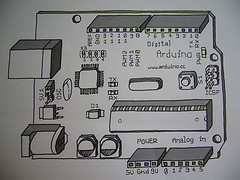
The discipline of rhetoric is often associated with speech or writing, but how can we use computational machines to persuade? More than this, how do computers persuade us? In this class, we will practice digital rhetoric by arguing with computers. This means that we will build computational objects (using the Arduino and Processing platforms) in attempts to persuade others. However, we will also consider how we often find ourselves in conversations with computers. We argue with computers just as we argue with a keyboard or a pencil. But we also argue with computers much the same way we argue with a debate opponent. Throughout the course, we will explore how we might use computer hardware and software to get audiences to think differently about physical space. We will examine how computational machines cut across most any contemporary environment, and we will compose and design our own machines in an attempt to shape environments and persuade others.
This class meets with Elizabeth Demeray's Kinetic Sculpture class, and students in both classes will collaborate on physical computing projects. No programming expertise is required for this course, and students will be offered the opportunity to learn and tinker with various platforms.
Possible Texts Include:
Getting Started with Arduino, Massimo Banzi
Getting Started with Processing, Casey Reas and Ben Fry
Suasive Iterations: Rhetoric, Writing, and Physical Computing
[Image Credit: "Arduino Sketches" by Massimo Banzi]
50:350:394 Introduction to the Digital Humanities (Spring 2015)
 What does the artist, historian, or literary scholar have to say about the computational platforms and formats that shape our digital lives? This course will address that question by treating digital technologies as both expressive media and as objects worthy of humanistic study. The goal of the course is to provide students with a space to use digital tools to create things (such as art, electronic literature, and games) and also to develop critical vocabularies for analyzing digital objects. We will examine a number of digital formats and platforms, from the MP3 to the Atari 2600 videogame system. Students will also examine a number of videogames, works of electronic literature, and a range of other digital objects. No technological expertise is required, and students will be encouraged to experiment and tinker with a variety of platforms. The class will take place in the brand new Digital Studies Center CoLab, a collaborative learning space in the Fine Arts building.
Syllabus
Professor: Jim Brown
Class Meeting Place: Digital Studies Center CoLab (Fine Arts 217)
Class Time: Tuesday/Thursday, 9:30-10:50
Jim's Office: Fine Arts 213
Jim's Office Hours: Tuesday/Thursday 11:00-12:00 [Make an Appointment]
Jim's Email: jim[dot]brown[at]rutgers[dot]edu
Course Website: http://courses.jamesjbrownjr.net/394_spring2015
Learning Outcomes
Students in this class will learn to:
- analyze and synthesize academic arguments.
- identify and then apply research methods in the digital humanities.
- develop effective writing and design processes by creating drafts and prototypes and incorporating feedback from peers and instructors.
- cultivate strategies for collaborating with others on writing and design projects.
Required Texts:
Racing the Beam: The Atari Video Computer System, Nick Montfort and Ian Bogost
MP3: The Meaning of a Format, Jonathan Sterne
Flash: Building the Interactive Web, Anastasia Salter and John Murray
We will also read excerpts of other texts, and these will be provided as PDFs on Sakai.
Course Work
In this class, the following work will be evaluated:
- Attendance and Participation
- Reading Quizzes
- "Follow-a-footnote" Presentation
- Extended research project on a digital platform or format
- Learning Record
Learning Record
Grades in this class will be determined by the Learning Record Online (LR). The LRO will require you to observe your own learning and construct an argument for your grade based on evidence that you accumulate throughout the semester. You will record weekly observations, and you will synthesize your work into an argument for your grade. You will construct this argument twice - once at the midterm and once at the end of the course. We will be discussing the LRO at length during the first week of class. See below for more details.
Attendance
Success in this class will require regular attendance. I will take attendance at each class meeting, and your Learning Record will include a discussion of attendance. You are required to attend class daily, arrive on time, do assigned reading and writing, and participate in all in-class work. Please save absences for when you are sick or have a personal emergency. If you find that an unavoidable problem prevents you from attending class or from arriving on time, please discuss the problem with me.
Lateness
If you are more than 5 minutes late for class, you will be considered absent. If there is something keeping you from getting to class on time (i.e., you have a long trek across campus right before our class), please let me know during the first week of class.
Computers, Smartphones, etc.
Please feel free to use your computer or any other device during class, provided that your use of it is related to what we are working on in class. Please silence cell phones during class.
Grades
Grades in this course will be determined by use of the Learning Record, a system which requires students to compile a portfolio of work at the midterm and at the end of the semester. These portfolios present a selection of your work, both formal and informal, plus ongoing observations about your learning, plus an analysis of your work in terms of the five dimensions of learning and the goals for this course. You will evaluate your work in terms of the grade criteria posted on the LRO site, and you will provide a grade estimate at the midterm and final.
The dimensions of learning have been developed by teachers and researchers, and they represent what learners experience in any learning situation:
1) Confidence and independence
2) Knowledge and understanding
3) Skills and strategies
4) Use of prior and emerging experience
5) Reflectiveness
In addition to analyzing your work in terms of these dimensions of learning, your argument will also consider the specific goals for this course. These goals are called Course Strands (these are also listed above in the "Course Objectives" section):
1) Analysis and synthesis of academic arguments
2) Identification and application of digital humanities research methods.
3) Writing and design process
4) Collaboration strategies
The LRO website provides detailed descriptions of the Course Strands and the Dimensions of Learning.
Your work in class (and in other classes during this semester) along with the observations you record throughout the semester will help you build an argument in terms of the dimensions of learning and the course strands. We will discuss the LRO in detail at the beginning of the semester, and we will have various conversations about compiling the LRO as the semester progresses.
Late Assignments
Due dates for assignments are posted on the course schedule. While I will not be grading your assignments, I will be providing comments and feedback. I will not provide feedback on late assignments. Also, late assignments will be factored into your argument in the LR (see the grade criteria for more details).
Intellectual Property
All writing and design involves some level of appropriation - we cite the work of others and in some cases we even imitate that work. However, copying and pasting existing texts, having another student complete an assignment for you, or any other violations of the university's Academic Integrity Policy will result in a failing grade. If you have questions about the that policy, please see the Dean of Student Affairs website.
The Office of Disability Services
From the The Office of Disability Services (ODS):
"The ODS provides students with confidential advising and accommodation services in order to allow students with documented physical, mental, and learning disabilities to successfully complete their course of study at Rutgers University – Camden. The ODS provides for the confidential documentation and verification of student accommodations, and communicates with faculty regarding disabilities and accommodations. The ODS provides accommodation services, which can include readers, interpreters, alternate text, special equipment, and note takers. The ODS acts as a signatory for special waivers. The ODS also works with students, faculty, staff and administrators to enforce the American with Disabilities Act of 1990."
If you believe you might require an accommodation, please contact the ODS early in the semester.
Technology Policy
We will use technology frequently in this class. Although I am assuming that you have some basic knowledge of computers, such as how to use a keyboard and mouse, and how to use the Web and check e-mail, most things will be explained in class. If you don’t understand what we are doing, please ask for help. If you are familiar with the technology we are using please lend a helping hand to your classmates.
Sakai, Course Website, and Email
You should check your email daily. Class announcements and assignments may be distributed through email. The course website will also have important information about assignments and policies. Pay close attention to the course calendar as we move through the semester. We reserve the right to move things around if necessary.
Emails to me must come from your wisc.edu email address. They must include a title explaining the email, a salutation (for example, "Dear Jim"), a clear explanation of what the email is about, and a signature.
Schedule
** Denotes due dates that are not class meeting days
Students should be prepared for reading quizzes on any day that reading is assigned
Introductions
1/20
In Class: Syllabus Review, discuss Learning Record, What do we mean by the term "digital humanities"?
1/22
Read: Kirschenbaum's "What is digital humanities and what is it doing in English departments? (Download on Sakai), Bartscherer and Coover's Switching Codes Introduction (Download on Sakai)
In Class: Discuss readings, discuss Learning Record
1/27
No Class--Weather Emergency
1/29
Read: Burdick et. al.'s Digital_Humanities Introduction (Download on Sakai), Berry's Understanding Digital Humanities Introduction (Download on Sakai), Ian Bogost's "Getting Real"
In Class: Discuss readings, discuss Learning Record
1/30**
LRO Part A Due at midnight
2/3
Read: Emerson's Reading Writing Interfaces, excerpt (Download on Sakai)
In Class: Discuss reading, schedule Pecha Kucha presentations
2/5
Read: Kirschenbaum Track Changes, excerpt (Download on Sakai)
In Class: Discuss reading
Racing the Beam
2/10
Read: Front Matter and Chapter 1
In Class: Skimming and Outlining
2/12
Read: Chapter 2
In Class: Discuss readings
2/17
Read: Chapter 3-5
In Class: Discuss readings
2/19
Write: Preliminary research on at least two platforms
In Class: Share findings
2/24
Read: Chapter 6-8, Afterword
In Class: Research Method Debriefing
Flash: Building the Interactive Web
2/26
Read: Front Matter and Chapter 1
In Class: Skimming and Outlining
3/1**
Project Proposal Due by midnight
3/3
Read: Chapters 2-3
In Class: Discuss readings
3/5
In Class: LRO Workshop
3/8**
Midterm LRO Due by midnight
3/10
Read: Chapters 4-5
In Class: Discuss readingsLRO Workshop
3/12
Class meets during free period in Fine Arts 215 for Charlotte Markey's presentation
3/24
Read: Chapter 6-7
In Class: Research Method Debriefing
MP3: The Meaning of a Format
3/26
Read: Introduction, "Format Theory"
In Class: Skimming and Outlining
3/31
Read: Chapter 1
In Class: Discuss readings
4/2
Read: Chapter 2
In Class: Discuss readings
4/6**
Research Method Paper Due
4/7
Read: Chapter 4
In Class: Discuss readings
4/9
Read: Chapter 5
In Class: Discuss readings, Project Status Reports
4/14
Read: Conclusion, "The End of MP3"
In Class: Research Method Debriefing
Workshop
4/16
In Class: Project Status Reports, Workshop
4/21
In Class: Project Status Reports, Workshop
4/23
In Class: Workshop
4/27**
Final Project and SOGC Due
4/28
In Class: Final Presentations
4/30
In Class: Final Presentations
May 6**
Final LRO Due by midnight
Rules of Engagement
What is the purpose of a graduate seminar, and how does one use such a space to usefully engage with texts? I offer this document as an answer to that question and as a kind of constitution for our class.
The military root of the phrase "rules of engagement" is unfortunate because we are actually interested in something as nonviolent as possible. Of course, any interpretation of a text will do violence to it. This is the nature of interpretation. We fit a text or a set of ideas into a pre-existing framework that we already have. This is unavoidable. But we can try our best to forestall that violence or to at least soften the blow. In the interest of this kind of approach, I offer the following rules:
1. Disagreement and agreement are immaterial.
Our primary task is to understand, and this does not require agreement or disagreement. The only agreement the seminar asks of you is this: I agree to read, consider, analyze, and ask questions about these texts.
In his essay "The Rhetoric of Hitler's Battle," Kenneth Burke presents us with a succinct encapsulation of this first rule of engagement:
The appearance of Mein Kampf in unexpurgated translation has called for far too many vandalistic comments. There are other ways of burning books than on the pyre - and the favorite method of the hasty reviewer is to deprive himself and his readers by inattention. I maintain that it is thoroughly vandalistic for the reviewer to content himself with the mere inflicting of a few symbolic wounds upon this book and its author, of an intensity varying with the resources of the reviewer and the time at his disposal. Hitler's "Battle" is exasperating, even nauseating; yet the fact remains: If the reviewer but knocks off a few adverse attitudinizings and calls it a day, with a guaranty in advance that his article will have a favorable reception among the decent members of our population, he is contributing more to our gratification than to our enlightenment" (The Philosophy of Literary Form, 191)
Of course, we will not be reading anything like Mein Kampf, but the principle still stands. We are more interested in enlightenment than gratification.
2. An argument is a machine to think with.
This is another version of I.A. Richards's claim that “a book is a machine to think with." The "with" here should be read in two different ways simultaneously. We read "with" an argument by reading alongside it. We "tarry" with it. We get very close to it and join it during a long walk. Notice that this requires that we stay with the author rather than diverging down a different path, questioning the route, or pulling out our own map. But "with" here also means that the argument is a tool that we must first understand before using. Our job is to learn how this tool works. It has multiple moving parts and purposes. It has multiple audiences. We need to understand all of this before we make any attempt to use the argument, and we certainly need to do all of this before we can even think about disagreeing with it.
3. Ask that question sincerely, or the principle of "generous reading."
Why the hell would s/he argue that? If you find yourself asking this question, then take the next step by answering your own question. Why would s/he argue that? If I am indignant about the argument, does this suggest that I am not the audience? If the argument seems ridiculous, is it relying on definitions that I find foreign? If I think the argument is brilliant, is it because I am in fact the target audience, so much so that I am having a difficult time gaining any kind of critical distance?
The principle of "generous reading" has little to do with being "nice." Instead, it is more about reading in a generative way, in a way that opens the text up rather than closes it down. This requires that we read a text on its own terms, understanding how an argument is deploying certain concepts and ideas (see Rule #2).
Assignments
Reading Quizzes
We will have quizzes throughout the semester. These quizzes will be timed, and they will be based on the reading assignments. While we won't have a quiz for every reading assignment, students should be prepared for quizzes each day reading is assigned. You will be allowed to use the texts themselves as well as reading notes for those quizzes, and these notes can come in any form you'd like.
Reading notes as well as quiz results will be used as work samples for the Learning Record. If you take notes on paper and would like to use those as work samples, you will need to provide me with photocopies or scans.
Feedback on quizzes will be in the following form:
✔+ (Check plus)
Answers demonstrate a command of the material. It is clear from the answers that you've carefully read the material and have successfully understood the text's argument, evidence, and methods.
✔ (Check)
Answers demonstrate that you have read but that there are gaps in understanding. You have made some attempt to understand the text's argument, evidence, and methods, but those attempts have fallen short.
✔- (Check minus)
Answers demonstrate that you have not read the assignment or made any attempt to understand the text's argument, evidence, and methods.
Pecha Kucha Presentation
Once during the semester, each student will review a chapter from an edited collection about the digital humanities. You can choose a chapter from these collections: Digital_Humanities, Debates in the Digital Humanities, Understanding Digital Humanities, Switching Codes, Rhetoric and the Digital Humanities.
Reviews will take the form of a Pecha Kucha presentation - a presentation of 20 slides, each shown for 20 seconds (6 minutes and 40 seconds total). For more information on this presentation format, visit PechaKucha.org.
I will help students choose appropriate texts for review, and you should see me for approval before reading the text and preparing your presentation. Your primary task in this presentation is to explain how the argument works and how it relates to the books we are reading as a class. You should not focus your efforts on an evaluation of the argument or on whether or not you disagree with the author. See the grading criteria below for some tips about how to approach these reviews.
When providing feedback on these presentations, I will be looking for the following:
- Does your presentation adequately summarize the text and its argument?
- Do you explain the text's significance, its most important features, and its contributions to a scholarly conversation?
- Have you explained how this text connects with the texts we're reading for this class?
- Have you avoided a discussion of whether or not you disagree with the author? Have you avoided a discussion of flaws or shortcomings in the argument?
- Have you followed the rules of engagement
- Have you paid close attention to the design of your slides? Remember that you should probably use very little text (20 seconds isn't a long time for your audience to read through long lists of bullet points) and make effective use of images.
- Is there evidence that you've practiced the presentation? This presentation doesn't require memorization, but the strict format requires that you rehearse and choreograph your performance.
- Have you followed the Pecha Kucha rules (20 slides, shown for 20 seconds each)
Platform or Format Research Project
The texts we're reading in this class take up various digital platforms and formats from the perspective of the humanities. They examine the histories and cultures embedded in platforms in formats. Throughout the semester, you will be conducting your own detailed research project on a digital platform or format. Your task is the emulate the scholars we're reading and to put into practice some of the research methods you see them using.
This project is broken into multiple components. Follow the links below for more details.
Research Proposal
Due Date: February 27
Your research proposal is a 750-word document that describes what digital platform or format you would like to study. Your proposal should address the following questions:
- What do you want to study and why?
- Who else has studied this platform or format? How have they done so? If you have been unable to find any existing research, why do you think that is?
- What kinds of materials do you plan to examine?
- How do you plan to approach these materials? We have read research (Racing the Beam and Flash) that gives you some clues about research methodology, and you should cite those texts when discussing the method you plan to use.
- You can make your argument using various media (words, sound, image, video, and so on). What medium are you planning to use for this project, and why?
While this document is not a contract and your project might shift as you do research, your proposal should demonstrate that you've done preliminary research and have carefully considered how you will approach this semester-long project.
When providing feedback on these proposals, I will be looking for the following:
- Have you provided adequate and detailed answers to the questions listed above?
- Have you cited our readings when discussing how you'll approach this research?
- Is your proposal effectively designed? Can I easily follow your arguments and answers to these questions? The design of the document is up to you (subheadings, diagrams, etc.), but that design should demonstrate that you've designed it with a purpose.
- Is your proposal generally well-written and free of grammatical errors?
Research Method Paper
Due Date: April 6
Throughout the semester, we've been reading the work of scholars who study platforms and formats, and we have been playing close attention to their research methods. Do they study certain kinds of documents? Do they study circuit boards or software? What methods do they use to approach these materials? Do they close read snippets of code, or do they conduct historical analysis of technologies?
In this 750-word research method paper, you will describe your own research method for your Platform/Format project. Your method might be nearly identical to one of the scholars we have read this semester, or it might be an amalgamation of these methods. In this paper, you should describe that method and why it will help you to study the object you've chosen.
When providing feedback on these proposals, I will be looking for the following:
- Does your paper demonstrate that you understand the methods of the scholars we've read?
- Have you carefully described your research method?
- Have you justified your research method, explaining why it is the best fit for the evidence that you've found during the research project?
- Have you described the materials you will analyze and how you plan to approach them?
Is the document effectively designed? Can I easily follow your arguments? The design of the document is up to you (subheadings, diagrams, etc.), but that design should demonstrate that you've designed it with a purpose. - Is your proposal generally well-written and free of grammatical errors?
Final Project & Statement of Goals and Choices
Due Date: April 27
Your final project will show us the results of your platform or format research. The project can take any form and use any medium you choose, but you should choose that form or medium with a purpose. If you chose to make a short film, what is it about moving images that allows you to make your argument? If you choose to use sound, what does it afford you as you present the material? If you decide to write a paper, what is it about words on a page that make it the most useful medium for your project? These are just three examples, but the idea is to choose a medium and design your project with a purpose.
In addition to the project itself, you will compose a Statement of Goals and Choices (SOGC). This is an assignment that comes from Jody Shipka's book Toward a Composition Made Whole, and it asks you to reflect on why you built your project the way you did. There is no minimum or maximum number of words for the SOGC - it takes as many words as you think it takes to explain why you made certain choices and what you were trying to accomplish with the project.
The SOGC should answer the following questions:
- What, specifically, is this piece trying to accomplish - above and beyond satisfying the basic requirements outlined in the task description? In other words, what work does, or might, this piece do? For whom? In what contexts?
- What specific, rhetorical, material, methodological, and technological choices did you make in service of accomplishing the goal(s) articulated above? Catalog, as well, choices that you might not have consciously made, those that were made for you when you opted to work with certain genres, materials, and technologies.
- Why did you end up pursuing this plan as opposed to the others you came up with? How did the various choices listed above allow you to accomplish things that other sets or combinations of choices would not have?
When providing feedback on your project and SOGC, I will be looking for the following:
- Does your project demonstrate detailed and in-depth research of your platform or format?
- Have you carefully considered your research method and made that method clear to the audience?
Is your project effectively designed? Is there evidence that you've carefully chosen your medium and that the medium is appropriate for what you're trying to communicate? - Does your SOGC address all of the questions listed above?
- Is your SOGC (or your project, if it uses written language) generally well-written and free of grammatical errors?
Final Presentation
Due Date: Presentations will happend during class on April 28 and 30
Your final presentation will be your opportunity to show off the work you've done during the semester-long research project. The format of these presentations will be the same as the Follow-a-Footnote presentations. They will be Pecha Kucha presentations (20 slides, 20 seconds per slide), and they will walk the class through your project, your research method, your findings, and the reflections you offered in your SOGC. Each presentation will be followed by a brief Q&A.
When providing feedback on these presentations, I will be looking for the following:
- Does your presentation adequately describe your project, its findings, and its research method?
- Does your presentation provide the highlights of your SOGC?
- Have you paid close attention to the design of your slides? Remember that you should probably use very little text (20 seconds isn't a long time for your audience to read through long lists of bullet points) and make effective use of images.
- Is there evidence that you've practiced the presentation? This presentation doesn't require memorization, but the strict format requires that you rehearse and choreograph your performance.
- Have you followed the Pecha Kucha rules (20 slides, shown for 20 seconds each)
50:350:225 Literature and Videogames (Fall 2014)
Sean Duncan's "Infocom Shelf"
This class examines the relationship between literature and videogames by looking at a range of artifacts: novels about videogames, works of interactive fiction, electronic literature, and modern digital games that take on certain literary qualities. The goal of this class is not necessarily to equate videogames with novels or poems but to instead consider how videogames intersect with and complicate the category of "literature." Students in this class will read novels, play games, and make games. No technical expertise is required.
[Image Credit: "Infocom Shelf" by Sean Duncan]
Syllabus
Professor: Jim Brown
Teaching Assistant: Michael Russo
Meeting Place: Paul Robeson Library, Room 401
Meeting Time
Tuesday/Thursday, 9:30am-10:50am
Jim's Office: 213 Fine Arts
Jim's Office Hours: Tuesday/Thursday, 11:00am-12:00pm [Make an Appointment]
Jim's Email: jim[dot]brown[at]rutgers[dot]edu
Michael's Office: 467 Armitage
Michael's Office Hours: Tuesday/Thursday, 2:00pm-3:00pm [Please email in advance]
Michael's Email: russo[dot]ink[at]rutgers[dot]edu
Course Website: http://courses.jamesjbrownjr.net/225_fall2014
Prerequisites
"English Composition II" or "Critical Methods in English"
Learning Outcomes
- Students will learn strategies for conducting close analysis of both videogames and literature, determining which critical tools are best suited for different kinds of expressive artifacts.
- Students will learn how to compose and design texts and games with digital tools.
- Students will develop effective writing and design processes by creating multiple drafts and incorporating feedback from peers and instructors.
- Students will learn strategies for collaborating with others on writing and design projects.
Required Texts and Games
Available at the University District Bookstore
- Ready Player One, by Ernest Cline
- First Person: New Media as Story, Performance, and Game, edited by Noah Wardrip-Fruin and Pat Harrigan
Available at Amazon:
- Lucky Wander Boy (Kindle Version), by D.B. Weiss
Available at various websites for various platforms:
Optional Equipment
Available at various websites and stores:
- USB Flash Drive
Course Work
Course work will be uploaded to Sakai, and Michael will inform you of the proper procedures for doing so. The grade breakdown for work in this class is as follows (see the Assignments page for details):
- 15% Attendance
- 10% Twitter
- 15% Storify of one week's tweets
- 25% Catalogue of Obsolete Entertainments Essay
- 25% OASIS Twine Game (Group Project)
- 20% Videogame Storify (Group Project)
Attendance
Success in this class will require regular attendance. With adequate notice, absences resulting from religious observances and university-endorsed extracurricular activities will be excused. Michael will take attendance at the beginning class meetings. You are required to attend class daily, arrive on time, do assigned reading and writing, and participate in all in-class work. Please save absences for when you are sick or have a personal emergency. If you find that an unavoidable problem prevents you from attending class or from arriving on time, please discuss the problem with me and Michael.
Lateness
If you are more than 5 minutes late for class, you will be considered absent. If there is something keeping you from getting to class on time (i.e., you have a long trek across campus right before our class), please let me and Michael know during the first week of class.
Computers, Smartphones, etc.
Please feel free to use your computer or any other device during class, provided that your use of it is related to what we are working on in class. Please silence cell phones during class.
Late Assignments
Due dates for assignments are posted on the course schedule. We will not accept late work, and anything submitted after the deadline will receive a grade of zero.
Intellectual Property
All writing and design involves some level of appropriation - we cite the work of others and in some cases we even imitate that work. However, copying and pasting existing texts, having another student complete an assignment for you, or any other violations of the university's Academic Integrity Policy will result in a failing grade. If you have questions about the that policy, please see the Dean of Student Affairs website.
Technology Policy
We will use technology frequently in this class. Although we are assuming that you have some basic knowledge of computers, such as how to use a keyboard and mouse, and how to use the Web and check email, our use of technology will be explained in class. If you don’t understand what we are doing, please ask for help. If you are familiar with the technology we are using, please lend a helping hand to your classmates.
Sakai, Course Website, and Email
You should check your email daily. Class announcements and assignments may be distributed through email. The course website will also have important information about assignments and policies. Pay close attention to the course calendar as we move through the semester. We reserve the right to move things around if necessary.
The Office of Disability Services
From the The Office of Disability Services (ODS):
"The ODS provides students with confidential advising and accommodation services in order to allow students with documented physical, mental, and learning disabilities to successfully complete their course of study at Rutgers University – Camden. The ODS provides for the confidential documentation and verification of student accommodations, and communicates with faculty regarding disabilities and accommodations. The ODS provides accommodation services, which can include readers, interpreters, alternate text, special equipment, and note takers. The ODS acts as a signatory for special waivers. The ODS also works with students, faculty, staff and administrators to enforce the American with Disabilities Act of 1990."
If you believe you might require an accommodation, please contact the ODS early in the semester.
Contacting Instructors
If you have questions, you should first contact Michael either in person or via email. If Michael cannot answer the question, he will put you in touch with Jim. Emails to Jim and Michael must come from your Rutgers email address. They must include a title describing the purpose of the email, a salutation (for example, "Dear Jim"), a clear explanation of what the email is about, and a signature.
Schedule
LWB = Lucky Wander Boy
RP1 = Ready Player One
First-Person = First-Person: New Media as Story, Performance, and Game
9/2
Introductions
Unit 1: The Catalogue of Obsolete Entertainments
9/4
Read: LWB, through location #1192
In class: LWB Lecture, introduction to Storify
9/9
Read: LWB, through location #2179
In class: LWB Lecture
9/11
Read: LWB, through location #3148
In Class: Play games from Catalogue of Obsolete Entertainments
9/16
Read: First-Person, “Cyberdrama” (1-33)
In Class: First-Person Lecture
9/18
Read: LWB, finish novel
In Class: LWB Lecture
9/23
Read: First Person, “Ludology” (35-69)
In Class: First-Person Lecture, discuss paper assignment
9/25
[Class Meets in Robeson Library Computer Classroom]
In Class: Collaborative Research
9/30
Read: Chapter on Imitation from Crowley and Hawhee (PDF)
In Class: Lecture on imitation
10/2
Write: Complete Draft of Catalogue Paper (due prior to class)
In Class: Writing Workshop - Peer Review
10/7
In Class: Writing Workshop - Peer Review
10/8
Paper due at midnight
Unit 2: Easter Eggs
10/9
Read: RP1, through page 60
NO CLASS MEETING
WATCH VIDEO LECTURE AND COMPLETE QUIZ BY 10/12 AT MIDNIGHT
10/14
Read: RP1, through page 115
In Class: RP1 Lecture
10/16
Read: First Person, “Critical Simulation” (71-116)
In Class: Lecture on “Critical Simulation"
10/21
Read: RP1, through page 179
Play: "Even Cowgirls Bleed"
In Class: Lecture on RP1 and "Even Cowgirls Bleed"
10/23
Read: RP1, through page 294
In Class: RP1 Lecture
10/28
Play: “Depression Quest”
In Class: Twine Lecture (Michael)
10/30
Read: RP1, finish novel
In Class: RP1 Lecture, Twine Lecture-recap (Michael), replay “Depression Quest”
11/4
[Class Meets in Robeson Library Computer Classroom]
In Class: Twine workshop
11/6
[Class Meets in Robeson Library Computer Classroom]
In Class: Twine workshop
11/11
In Class: Twine workshop
11/13
In Class: Twine workshop and 30-minute guest lecture - "Globalization and Modernity: Jules Verne’s 80 Days," Jean-Louis Hippolyte (Department of Foreign Languages)
11/15
Twine game due at midnight
Unit 3: Untangling Games and Stories
11/18
Play: Braid
In Class: Braid Lecture and Walk-Through
11/20
Play: Braid
In Class: Braid Lecture and Walk-Through
11/25
Play: Braid
In Class: Braid Lecture and Walk-Through
11/26
Braid Storify Due by Noon
11/27
NO CLASS MEETING-THANKSGIVING
12/2
Play: Gone Home
In Class: Gone Home Lecture and Walk-Through
12/4
Play: Gone Home
In Class: Gone Home Lecture and Walk-Through
12/9
Play: Gone Home
In Class: Storify Workshop
12/10: Gone Home Storify Due by Noon
12/16: Revised Storify Due by Noon
Assignments
During this class, students will be using Twitter to share thoughts and questions about course material. This will serve as a way for students to engage with the lecture material and even to interact with each other during lecture or while completing assignments.
You are required to tweet at least 10 time per week (tweets will be counted on Fridays), and you must use the lecture hashtag #litgames in order to get credit for your tweets. You are encouraged to retweet anything you find interesting or worthy of passing along, but a retweet does not count toward your 10 tweets. While you will not be graded on the content of your tweets, Michael will be tracking the Twitter conversation during class to make sure that your posts pertain to lecture. In addition, he will be ensuring that each student meets the minimum number of required tweets.
If you already have a Twitter account, you may use that account during lecture. You may also choose to set up a separate Twitter account for this class. Regardless, the Twitter account you use for this class cannot be "protected," and you will have to share your Twitter username with Michael.
While there are any number of ways to approach the use of Twitter in this class, here are a few suggestions for how you might approach this assignment:
- Summary: A summary of a point or argument made during lecture. This kind of tweet might summarize an argument made by the person lecturing, or it might summarize an argument that the lecturer is citing.
- Link: A link to something mentioned during lecture or to something relevant to the course material.
- Question: A question you have about material covered in class or in the readings. Michael will keep an eye on the Twitter stream, and we will try to answer your questions before, during, or after class.
- Answer: An answer to a classmate's question. Maybe you know the answer to a question asked during lecture. Why not answer it?
Weekly Wrap-up Storify
Due Date: The Tuesday after the week for which you are creating a Storify. Michael will schedule these with you at the beginning of the semester. Storifies must be submitted before class begins
Once during the semester, you will compose a summary of the week's tweets using Storify, a web service that allows you to synthesize a collection of tweets and text. Michael will provide you with a signup sheet for scheduling which week you will cover with your Storify. We'll cover how to use Storify in class.
Your lecture Storify will be worth 15% of your grade. Your job in this assignment is to identify some pattern or trend during the Twitter conversation and to synthesize some of the tweets from that week into a coherent story. You'll use Storify to embed tweets, and you'll write text that explains the trends and patterns that you've noticed. We'll use these Storifies to recap the previous week prior to starting a new week's worth of material.
When creating this Storify, keep in mind that you'll be using this tool for your final project (a Storify that documents how you and a partner traversed one of the games we're playing in class). So, this assignment offers you a chance to synthesize one week's discussion as well as a chance to become familiar with Storify. Take advantage of this opportunity as it will help you during that final project.
When evaluating this assignment, we'll be considering the following:
- Have you included at least 20 tweets from the lecture week that you're summarizing?
- Have you located some pattern (or set of patterns) from the Twitter conversation, linking together tweets into a coherent story?
- Have you used your own words to synthesize the conversation? (Your Storify should include text written by you in addition to embedded tweets, images, video, and links.)
- Have you created a Storify that is generally well written and free of grammatical errors?
The Catalogue of Obsolete Entertainments
Due Date: 10/7 at midnight
In D.B. Weiss' Lucky Wander Boy, Adam Pennyman is working to create what he calls The Catalogue of Obsolete Entertainments, a collection of videogame reviews that analyze old games such as Pac-Man and Micro-Surgeon. The reviews are written in a very particular style, and D.B. Weiss seems to want to show us that Pennyman takes these games and their cultural implications very seriously (perhaps too seriously). Your task during this 750-1000 word paper (double-spaced, 12-point Times New Roman) is to write your own entry for The Catalogue of Obsolete Entertainments, imitating Pennyman's style.
You will choose which game to write about, but it must be a game that could conceivably be in Pennyman's catalog. Our cutoff date for Adam's "classical" period is any game made up to and including 1983 (the year of the videogame crash). This means that you can't write about a contemporary videogame and that you'll have to do some research on older games. In addition, you can't write about any of the games that Pennyman writes about in Lucky Wander Boy. In addition to finding a game to review, you'll need to play that game (using any number of emulators online for old game systems) and conduct some research on it.
Your entry into the Catalogue should mimic Pennyman's style in terms of both how the review looks (providing technical specifications at the beginning, etc.) and his writing style. In class, we'll discuss some strategies for imitation.
This paper will represent 25% of your grade. When grading these papers, we will be asking the following questions:
- Have you chosen an appropriate game?
- Does your catalogue entry demonstrate that you've researched and played the game?
- Does your entry look like those composed by Pennyman? Is it formatted similarly?
- Have you effectively imitated Pennyman's style and approach to reviewing games?
- Is your entry generally well written and free of grammatical errors?
OASIS Twine Game
Due Date: 11/11 at midnight
In Ernest Cline's Ready Player One, the characters move through a massive online game world called the OASIS, and the central plot focuses on an easter egg embedded in the OASIS by its creator, James Halliday. Halliday is obsessed with 1980s popular culture, and each of the puzzles he creates for the easter egg are focused on that obsession. In this project, you'll be using a platform called Twine to create your own puzzle game inspired by Halliday's various puzzles in the OASIS.
For this project, you'll work in groups of three or four, and you'll create an easter egg puzzle based not on 1980s culture but instead on contemporary popular culture. So, while Halliday was obsessed with anything from The Breakfast Club to Family Ties, you should feel free to pursue your own interests and obsessions from contemporary culture.
Regardless of what inspires your puzzle game, the goal is to create a game that calls for the player to solve puzzles in order to reach some "win" state. In addition to submitting your Twine game, you'll submit a walk-through document. This will serve as the "key" to your game. While we will be evaluating your game by playing it, these documents will help us if we get stuck.
This project will represent 25% of your grade. When grading these projects, Michael and I will be asking the following questions:
- Does your game make use of the affordances of Twine, using code to create a dynamic reading and playing experience?
- Does your game ask the player to solve puzzles in ways similar to Halliday's easter egg?
- Is the game coherent and clear? Do all of its pieces hold together? Does the player leave the experience with a clear sense of what you are trying to communicate?
- Are your project and walk-through document generally well written and free of grammatical errors?
Game Storify
Due Date for Braid Storify: 11/26 at noon
Due Date for Gone Home Storify: 12/10 at noon
Due Date for Final Revised Storify and Cover Letter: 12/16 at noon
Our final unit has included the games Braid and Gone Home, each of which use the videogame medium differently to tell stories. In this project, you'll pair up with one person from class "livetweet" the process of playing the game and then to create a Storify that synthesizes all of those tweets. Together with your partner, you will be creating Storifies for both of these games, but only one will be submitted for the final project. This will give you an opportunity to choose which Storify you'd like to submit for credit, and it will also mean that you'll have an opportunity to revise the Storify that you decide to submit. When you submit your revised Storify, you will also submit a 250-word cover letter explaining your revision. This document should explain what you changed and why you changed it.
You should plan several gameplay sessions with your partner. One group member should be playing the game, while the other is livetweeting the action. Members should change roles often. The tweets are an opportunity to record your progress and insights about the game, note when you are stuck or how you solved certain puzzles or problems, point out "light bulb moments" during gameplay, and connect the game to class readings. You should also link to other texts or resources (for example, texts, songs, or films alluded to during the game or pieces others have written about the game). Much like lecture tweets, you should use Twitter in whatever way works best for you and in ways that shed light on your group's experience of playing the game.
After completing the game, your group will create a Storify that synthesizes all of your game tweets and tells the story of how you finished or "solved" the game. The Storify does not have to encompass the entire game--you can choose a section of the game to focus on as you compile tweets and other resources for the Storify.
Your Storify should also incorporate relevant sections from First-Person, and it can also incorporate sources you discover on your own. All group members should contribute to all portions of the project (playing the game, livetweeting, composing the Storify).
This project will represent 20% of your grade. The breakdown is as follows:
Braid Storify: 5% (Credit/No Credit)
Gone Home Storify: 5% (Credit/No Credit)
Final Revised Storify and Cover Letter: 10%
When grading these projects, Michael will be asking the following questions:
- Does your Storify identify a central theme that arose during gameplay?
- Does the Storify include what your group discovered and struggled with while playing the game?
- Does your Storify incorporate various media to tell your story, including Tweets, images, and video?
- Does your Storify demonstrate that you've conducted research by connected the game to sources we have read in class and sources that you've discovered on your own?
- Is your Storify generally well written and free of grammatical errors?
University of Wisconsin-Madison Courses
English 177: Literature and Videogames (Spring 2014)
Sean Duncan's "Infocom Shelf"
This class will examine the relationship between literature and videogames by looking at a range of artifacts: novels about videogames, works of interactive fiction, electronic literature, and modern digital games that take on certain literary qualities. The goal of this class is not necessarily to equate videogames with novels or poems but to instead consider how videogames intersect with and complicate the category of "literature." Students in this class will read novels, play games, and make games. No technical expertise is required. The course will take place in one of UW-Madison's WisCEL classrooms and will use a "lecture lab" format. Students will register for both a lecture section and a discussion section, but the latter will be used both for discussing and making. Students will learn how to make works of interactive fiction and games with platforms such as Twine.
[Image Credit: "Infocom Shelf" by Sean Duncan]
Syllabus
Professor: Jim Brown
Teaching Assistants: Brandee Easter, Rick Ness, Becca Tarsa
Meeting Place: 3250 Helen C. White
Lecture Meeting Time
Monday, 12:05pm-12:55pm
Lab Meeting Times
Section 301: Monday, 1:20pm-2:10pm (Becca Tarsa)
Section 302: Monday, 1:20pm-2:10pm (Becca Tarsa)
Section 303: Monday, 1:20pm-2:10pm (Rick Ness)
Section 304: Wednesday, 1:20pm-2:10pm (Rick Ness)
Section 305: Wednesday, 1:20pm-2:10pm (Becca Tarsa)
Section 306: Wednesday, 1:20pm-2:10pm (Rick Ness)
Jim's Office: 6187E Helen C. White
Jim's Office Hours: M/W, 1:15pm-2:30pm [Make an Appointment]
Jim's Email: brownjr[at]wisc[dot]edu
Brandee's Office Hours: R 12:30pm-2:30pm
Office Hours Location: 7153 Helen C. White
Brandee's Email: bdeaster[at]wisc[dot]edu
Becca's Office Hours: W, 2:10pm-3:30pm
Office Hours Location: 3251 Helen C. White
Becca's Email: tarsa[at]wisc[dot]edu
Rick's Office Hours: M, 2:10pm-3:30pm
Office Hours Location: 3251 Helen C. White
Rick's Email: rness2[at]wisc[dot]edu
Course Website: http://courses.jamesjbrownjr.net/177_spring2014
Course Objectives
- Learn strategies for conducting close analysis of videogames and literature
- Develop effective writing and design processes
- Collaborate with others on writing and design projects
Required Texts, Games, and Equipment
Available at Rainbow Bookstore
- Ready Player One, by Ernest Cline
- First Person: New Media as Story, Performance, and Game, edited by Noah Wardrip-Fruin and Pat Harrigan
Available at Amazon:
- Lucky Wander Boy (Kindle Version), by D.B. Weiss
Available at various websites for various platforms:
Available at various websites and stores:
- USB Flash Drive (at least 16GB)
Course Work
All course work will be uploaded to Learn@UW, and TAs will inform you of the proper procedures for doing so. The grade breakdown for work in this class is as follows (see the Assignments page for details):
- 15% Attendance
- 10% Livetweeting lectures
- 10% Storify of one day's Lecture Tweets
- 20% Catalogue of Obsolete Entertainments Entry
- 25% OASIS Twine Game (Group Project)
- 20% Videogame Storify (Group Project)
Attendance
Success in this class will require regular attendance. With adequate notice, absences resulting from religious observances and university-endorsed extracurricular activities will be excused. TAs will take attendance at the beginning of both lecture and lab meetings. You are required to attend class daily, arrive on time, do assigned reading and writing, and participate in all in-class work. Please save absences for when you are sick or have a personal emergency. If you find that an unavoidable problem prevents you from attending class or from arriving on time, please discuss the problem with your TA.
Lateness
If you are more than 5 minutes late for class, you will be considered absent. If there is something keeping you from getting to class on time (i.e., you have a long trek across campus right before our class), please let your TA know during the first week of class.
Computers, Smartphones, etc.
Please feel free to use your computer or any other device during class, provided that your use of it is related to what we are working on in class. Please silence cell phones during class.
Late Assignments
Due dates for assignments are posted on the course schedule. TAs will not accept late work, and anything submitted after the deadline will receive a grade of zero.
Intellectual Property
All writing and design involves some level of appropriation - we cite the work of others and in some cases we even imitate that work. However, copying and pasting existing texts, having another student complete an assignment for you, or any other violations of UW's academic misconduct policy will result in a failing grade. If you have questions about the University of Wisconsin's Academic Misconduct policy, please see the Student Assistance and Judicial Affairs website.
Technology Policy
We will use technology frequently in this class. Although we are assuming that you have some basic knowledge of computers, such as how to use a keyboard and mouse, and how to use the Web and check email, our use of technology will be explained in class. If you don’t understand what we are doing, please ask for help. If you are familiar with the technology we are using, please lend a helping hand to your classmates.
Course Website and Email
You should check your email daily. Class announcements and assignments may be distributed through email. The course website will also have important information about assignments and policies. Pay close attention to the course calendar as we move through the semester. We reserve the right to move things around if necessary.
Contacting Instructors
If you have questions, you should first contact the TA assigned to your Lab section either in person or via email. If your TA cannot answer the question, s/he will contact Brandee or Jim for help. Emails to Jim, Brandee, Becca, or Rick must come from your wisc.edu email address. They must include a title explaining the email, a salutation (for example, "Dear Jim"), a clear explanation of what the email is about, and a signature.
Schedule
LWB = Lucky Wander Boy
RP1 = Ready Player One
First-Person = First-Person: New Media as Story, Performance, and Game
1/22
Introductions
Week 1 Lab: No meeting
Unit 1: The Catalogue of Obsolete Entertainments
1/27
Read: LWB, through location #1192
In class: LWB Lecture, introduction to Storify, practice livetweeting lectures
1/29
Read: LWB, through location #2179
In class: LWB Lecture, livetweeting
Week 2 Lab: Reading discussion
2/3
Read: LWB, through location #3148
In Class: Play games from Catalogue of Obsolete Entertainments
2/5
Read: First-Person, “Cyberdrama” (1-33)
In Class: First-Person Lecture, livetweeting
Week 3 Lab: Reading discussion
2/10
Read: LWB, finish novel
In Class: LWB Lecture, livetweeting
2/12
Read: First Person, “Ludology” (35-69)
In Class: First-Person Lecture, livetweeting, discuss paper assignment
Week 4 Lab: Reading discussion
2/17
Read: Chapter on Imitation from Crowley and Hawhee (PDF)
In Class: Lecture on imitation, livetweeting
2/19
In Class: Collaborative Research
Week 5 Lab: Writing Workshop
2/24
Write: Complete Draft of Catalogue Paper (due prior to class)
In Class: Writing Workshop - Peer Review
2/26
In Class: Writing Workshop - Peer Review
Week 6 Lab: Writing Workshop
2/28: Paper due at noon
Unit 2: Easter Eggs
3/3
Read: RP1, through page 60
In Class: RP1 Lecture, livetweeting
3/5
Read: RP1, through page 115
In Class: RP1 Lecture, livetweeting
Week 7 Lab: Discuss RP1
3/10
Read: First Person, “Critical Simulation” (71-116)
In Class: Lecture on “Critical Simulation," livetweeting
3/12
Read: RP1, through page 179
In Class: Twine Lecture (Brandee), play “Cyberqueen”
Week 8 Lab: Discuss RP1
SPRING BREAK
3/24
In Class: Twine Lecture-recap (Brandee), replay “Cyberqueen”
3/26
Read: RP1, through page 294
In class: Guest Lecture - Porpentine
Week 9 Lab: Brainstorm Twine Projects, discuss “Cyberqueen”
3/28
Watch streaming lecture, complete quiz by midnight
3/31
Read: RP1, finish novel
In Class: RP1 Lecture, livetweeting
4/2
In Class: Twine workshop
Week 10 Lab: Twine Workshop
4/7
In Class: Twine workshop
4/9
In Class: Twine workshop
Week 11 Lab: Twine Workshop
4/11 Twine game due at noon
Unit 3: Untangling Games and Stories
4/14
Play: Braid
In Class: Braid Lecture, livetweeting
4/16
Play: Braid
In Class: Braid Walk-Through
Week 12 Lab: Play/discuss Braid
4/21
Play: Braid as Spatial Storytelling
Read: First-Person, “Game Theories” (117-164)
In Class: "Game Theories" Lecture, livetweeting
4/23
In Class: Braid and Game Time
Week 13 Lab: Play/discuss Braid, discuss reading
4/28
Play: Gone Home
In Class: Gone Home Guest Lecture, livetweeting
4/30
Play: Gone Home
In Class: Gone Home Walk-Through
Week 14 Lab: Play/Discuss Gone Home
5/5
Play: Gone Home
Read: First-Person, “Hypertexts & Interactives” (165-206)
In Class: "Hypertexts & Interactives" Lecture, livetweeting
5/7
In Class: Storify Workshop
Week 15 Lab: Play/discuss Gone Home, discuss reading
5/13: Storify Due at 7:25pm
Assignments
Livetweeting Lectures
During lectures in this class, students will be using Twitter to "livetweet." This will serve as a way for students to engage with the lecture material, ask questions about that material, and even to interact with each other during lecture.
You are required to tweet at least five times during class discussion, and you must use the lecture hashtag #eng177 in order to get credit for your tweets. You are encouraged to retweet anything you find interesting or worthy of passing along, but a retweet does not count toward your five tweets. While you will not be graded on the content of your tweets, your TAs will be tracking the Twitter conversation during class to make sure that your posts pertain to lecture. In addition, TAs will be ensuring that each student meets the minimum number of required tweets.
If you already have a Twitter account, you may use that account during lecture. You may also choose to set up a separate Twitter account for this class. Regardless, the Twitter account you use for this class cannot be "protected," and you will have to share your Twitter username with your TA.
While there are any number of ways to approach livetweeting during lecture, here are a few suggestions for how you might approach these posts:
- Summary: A summary of a point or argument made during lecture. This kind of tweet might summarize an argument made by the person lecturing, or it might summarize an argument that the lecturer is citing.
- Link: A link to something mentioned during lecture or to something relevant to the discussion.
- Question: A question you have about material covered in the lecture. TAs will keep an eye on the Twitter stream, and we will try to answer your questions either during the lecture period or during Labs.
- Answer: An answer to a classmate's question. Maybe you know the answer to a question asked during lecture. Why not answer it?
Lecture Storify
Due Date: Due one week after the lecture day that you are discussing in your Storify. TAs will schedule these with you at the beginning of the semester.
Once during the semester, you will compose a summary of a day's tweets using Storify, a web service that allows you to synthesize a collection of tweets and text. Your TA will provide you with a signup sheet for scheduling which Lecture day you will cover with your Storify. We'll cover how to use Storify in lecture and lab.
Your lecture Storify will be graded on a credit/no credit basis, and it will be worth 10% of your grade. Your job in this assignment is to identify some pattern or trend during the Twitter conversation and to synthesize some of the tweets from that day into a coherent story. You'll use Storify to embed tweets, and you'll write text that explains the trends and patterns that you've noticed.
When creating this Storify, keep in mind that you'll be using this tool for your final project (a Storify that documents how you and a partner traversed one of the games we're playing in class). So, this assignment offers you a chance to synthesize one day's discussion as well as a chance to become familiar with Storify. Take advantage of this opportunity as it will help you during that final project.
In order to get credit for this assignment, you'll need to do the following:
- Include at least 20 tweets from the lecture day that you're analyzing.
- Locate some pattern (or set of patterns) from the Twitter conversation, linking together tweets into a coherent story.
- Use your own words to synthesize the conversation. Your Storify should include text written by you in addition to embedded tweets, images, video, and links.
- Create a Storify that is generally well written and free of grammatical errors.
The Catalogue of Obsolete Entertainments
Due Date: 2/28 at noon
In D.B. Weiss' Lucky Wander Boy, Adam Pennyman is working to create what he calls The Catalogue of Obsolete Entertainments, a collection of videogame reviews that analyze old games such as Pac-Man and Micro-Surgeon. The reviews are written in a very particular style, and D.B. Weiss seems to want to show us that Pennyman takes these games and their cultural implications very seriously (perhaps too seriously). Your task during this 750-1000 word paper (3-4 pages, double-spaced, 12-point Times New Roman) is to write your own entry for The Catalogue of Obsolete Entertainments, imitating Pennyman's style.
You will choose which game to write about, but it must be a game that could conceivably be in Pennyman's catalog. Our cutoff date for Adam's "classical" period is any game made up to and including 1983 (the year of the videogame crash). This means that you can't write about a contemporary videogame and that you'll have to do some research on older games. In addition, you can't write about any of the games that Pennyman writes about in Lucky Wander Boy. In addition to finding a game to review, you'll need to play that game (using any number of emulators online for old game systems) and conduct some research on it.
Your entry into the Catalogue should mimic Pennyman's style in terms of both how the review looks (providing technical specifications at the beginning, etc.) and his writing style. In class, we'll discuss some strategies for imitation.
This paper will represent 20% of your grade. When grading these papers, your TAs will be asking the following questions:
- Have you chosen an appropriate game?
- Does your catalogue entry demonstrate that you've researched and played the game?
- Does your entry look like those composed by Pennyman? Is is formatted similarly?
- Have you effectively imitated Pennyman's style and approach to reviewing games?
- Is your entry generally well written and free of grammatical errors?
OASIS Twine Game
Due Date: 4/11 at noon
In Ernest Cline's Ready Player One, the characters move through a massive online game world called the OASIS, and the central plot focuses on an easter egg embedded in the OASIS by its creator, James Halliday. Halliday is obsessed with 1980s popular culture, and each of the puzzles he creates for the easter egg are focused on that obsession. In this project, you'll be using a platform called Twine to create your own puzzle game inspired by Halliday's various puzzles in the OASIS.
For this project, you'll work in groups of three or four, and you'll create an easter egg puzzle based not on 1980s culture but instead on contemporary popular culture. So, while Halliday was obsessed with anything from The Breakfast Club to Family Ties, you should feel free to pursue your own interests and obsessions from contemporary culture.
Regardless of what inspires your puzzle game, the goal is to create a game that calls for the player to solve puzzles in order to reach some "win" state. In addition to submitting your Twine game, you'll submit a walk-through document. This will serve as the "key" to your game. While your TAs will be evaluating your game by playing it, these documents will help them if they get stuck.
This project will represent 25% of your grade. When grading these projects, your TAs will be asking the following questions:
- Does your game make use of the affordances of Twine, using code to create a dynamic reading and playing experience?
- Does your game ask the player to solve puzzles in ways similar to Halliday's easter egg?
- Is the game coherent and clear? Do all of its pieces hold together? Does the player leave the experience with a clear sense of what you are trying to communicate?
- Are your project and walk-through document generally well written and free of grammatical errors?
Game Storify
Due Date for Braid Storify: 4/25 at Noon
Due Date for Gone Home Storify: 5/6 at Noon
Due Date for Final Revised Storify: 5/13 at 7:25pm
Our final unit has included the games Braid and Gone Home, each of which use the videogame medium differently to tell stories. In this project, you'll pair up with one person from your Lab section to "livetweet" the process of playing the game and then to create a Storify that synthesizes all of those tweets. Together with your partner, you will be creating Storifies for both of these games, but only one will be submitted for the final project. This will give you an opportunity to choose which Storify you'd like to submit for credit, and it will also mean that you'll have an opportunity to revise the Storify that you decide to submit.
You should plan several gameplay sessions with your partner. One group member should be playing the game, while the other is livetweeting the action. Members should change roles often. The tweets are an opportunity to record your progress and insights about the game, note when you are stuck or how you solved certain puzzles or problems, point out "light bulb moments" during gameplay, and connect the game to class readings. You should also link to other texts or resources (for example, texts, songs, or films alluded to during the game or pieces others have written about the game). Much like lecture livetweets, you should use Twitter in whatever way works best for you and in ways that shed light on your group's experience of playing the game.
After completing the game, your group will create a Storify that synthesizes all of your game tweets and tells the story of how you finished or "solved" the game. The Storify does not have to encompass the entire game--you can choose a section of the game to focus on as you compile tweets and other resources for the STorify.
Your Storify should also incorporate relevant sections from First-Person, and it can also incorporate sources you discover on your own. All group members should contribute to all portions of the project (playing the game, livetweeting, composing the Storify).
This project will represent 20% of your grade. The breakdown is as follows:
Braid Storify: 5% (Credit/No Credit)
Gone Home Storify: 5% (Credit/No Credit)
Finale Revised Storify: 10%
When grading these projects, your TAs will be asking the following questions:
- Does your Storify identify a central theme that arose during gameplay?
- Does the Storify include what your group discovered and struggled with while playing the game?
- Does your Storify incorporate various media to tell your story, including Tweets, images, and video?
- Does your Storify demonstrate that you've conducted research by connected the game to sources we have read in class and sources that you've discovered on your own?
- Is your Storify generally well written and free of grammatical errors?
English 236: Writing And The Electronic Literary (Spring 2014)

Photo Credit: "Turmoil" by Clonny
In her influential volume Electronic Literature: New Horizons for the Literary, Katherine Hayles explains that "writing is again in turmoil." The spread of mechanical type allowed for more writers and more texts, troubling those who were accustomed to a manuscript culture in which texts were copied by hand. In a similar way, Hayles explains that electronic literature opens up difficult questions about writing in our current moment: "Will the dissemination mechanisms of the internet and the Web, by opening publication to everyone, result in a flood of worthless drivel?...What large-scale social and cultural changes are bound up with the spread of digital culture, and what do they portend for the future of writing?" But Hayles also argues that electronic literature encompasses a broad range of digital writing practices, from video games to interactive fiction to hypertext. She proposes that we shift from a discussion of "literature" to the "literary," which she defines as "creative artworks that interrogate the histories, contexts, and productions of literature, including as well the verbal art of literature proper." This course will use Hayles' definition of the literary in order to read, play with, and create digital objects.
Syllabus
Professor: Jim Brown
Class Meeting Place: 2252A Helen C. White
Class Time: Monday, 2:30pm-5:00pm
Jim's Office: 6187E Helen C. White
Jim's Office Hours: M/W, 1:15pm-2:30pm [Make an Appointment]
Jim's Email: brownjr [at] wisc [dot] edu
Course Website: http://courses.jamesjbrownjr.net/236_spring2014
Course Objectives
In this course, we will develop the following skills and strategies:
- Conduct Medium-Specific Analyses of Digital Objects and Environments
- Develop a Writing/Design Process
- Use New Media Technology to Express Ideas
- Collaborate on Creative Projects
- Practice Critical Reading Skills
Required Texts
Electronic Literature, N. Katherine Hayles
Making Comics, Scott McCloud
The Private Eye, issues 1-5 and "The Making of The Private Eye" [available for as a pay-what-you-want download at panelsyndicate.com
Course Work
In this class, the following work will be evaluated:
- Attendance and Participation
- Short Writing Assignments
- Collaborative Interactive Fiction Project
- Collaborative Comic Project
Learning Record
Grades in this class will be determined by the Learning Record Online (LRO). The LRO will require you to observe your own learning and construct an argument for your grade based on evidence that you accumulate throughout the semester. You will record weekly observations and you will synthesize your work into an argument for your grade. You will construct this argument twice - once at the midterm and once at the end of the course. We will be discussing the LR) at length during the first week of class. See below for more details.
Attendance
Success in this class will require regular attendance. I will take attendance at each class meeting, and your Learning Record will include a discussion of attendance. You are required to attend class daily, arrive on time, do assigned reading and writing, and participate in all in-class work. Please save absences for when you are sick or have a personal emergency. If you find that an unavoidable problem prevents you from attending class or from arriving on time, please discuss the problem with me.
Lateness
If you are more than 10 minutes late for class, you will be considered absent. If there is something keeping you from getting to class on time (i.e., you have a long trek across campus right before our class), please let me know during the first week of class.
Computers, Smartphones, etc.
Please feel free to use your computer or any other device during class, provided that your use of it is related to what we are working on in class. Please silence cell phones during class.
Grades
Grades in this course will be determined by use of the Learning Record, a system which requires students to compile a portfolio of work at the midterm and at the end of the semester. These portfolios present a selection of your work, both formal and informal, plus ongoing observations about your learning, plus an analysis of your work in terms of the five dimensions of learning and the goals for this course. You will evaluate your work in terms of the grade criteria posted on the LRO site, and you will provide a grade estimate at the midterm and final.
The dimensions of learning have been developed by teachers and researchers, and they represent what learners experience in any learning situation:
1) Confidence and independence
2) Knowledge and understanding
3) Skills and strategies
4) Use of prior and emerging experience
5) Reflectiveness
In addition to analyzing your work in terms of these dimensions of learning, your argument will also consider the specific goals for this course. These goals are called Course Strands (these are also listed above in the "Course Objectives" section):
1) Medium Specific Analysis
2) Writing/Design Process
3) Digital Expression
4) Collaboration
5) Critical Reading
The LRO website provides detailed descriptions of the Course Strands and the Dimensions of Learning.
Your work in class (and in other classes during this semester) along with the observations you record throughout the semester will help you build an argument in terms of the dimensions of learning and the course strands. We will discuss the LRO in detail at the beginning of the semester, and we will have various conversations about compiling the LRO as the semester progresses.
Late Assignments
Due dates for assignments are posted on the course schedule. While I will not be grading your assignments, I will be providing comments and feedback. I will not provide feedback on late assignments. Also, late assignments will be factored into your argument in the LR (see the grade criteria for more details).
Intellectual Property
Much of what we'll be working on this semester involves the appropriation of existing texts. This is no different than any other type of writing - all writing involves appropriation. The key will be to make new meaning with the texts that you appropriate. Copying and pasting existing texts without attribution does not make new meaning. Some of your work will make use of different materials (text, video, audio, image), and you will have to be mindful of intellectual property issues as you create texts for this class. If you have questions about the University of Wisconsin's Academic Misconduct policy, please see the Student Assistance and Judicial Affairs website.
Technology Policy
We will use technology frequently in this class. Although I am assuming that you have some basic knowledge of computers, such as how to use a keyboard and mouse, and how to use the Web and check e-mail, most things will be explained in class. If you don’t understand what we are doing, please ask for help. If you are familiar with the technology we are using please lend a helping hand to your classmates.
Course Website and Email
You should check your email daily. Class announcements and assignments may be distributed through email. The course website will also have important information about assignments and policies. Pay close attention to the course calendar as we move through the semester. I reserve the right to move things around if necessary.
Emails to me must come from your wisc.edu email address. They must include a title explaining the email, a salutation (for example, "Dear Jim"), a clear explanation of what the email is about, and a signature.
Schedule
Unit 1: Computational Writing
January 27
Read: Hayles, pp1-30; Gillespie, Letter to Linus
Presentations:
["The Electronic Literary"]
[Introducing "Intermediation"]
February 3
Read: Hayles pp43-70; Moulthrop, Reagan Library, Browse Learning Record
Write: Summary/Analysis Paper 1 Due
In Class: Discuss learning record, readings, and Summary/Analysis papers
Presentations:
[Intermediation]
[Introducing "The Body and the Machine"]
February 10
Read: Hayles, pp87-126; For a Change, by Dan Schmidt
In Class: Discuss readings
Presentations:
["The Body and the Machine"]
[Introducing "How E-Lit Revalues Computational Practice"]
Friday, February 14
LRO PART A DUE AT NOON
February 17
Read: Hayles, pp131-157; Glass, by Emily Short
Write: Summary/Analysis Paper 2 Due
In Class: Discuss readings, Twine Workshop
[How Electronic Literature Revalues Computational Practice]
February 24
Read: Montfort, pp. 1-36; Adventure (Crowther and Woods)
In class: Twine Workshop
March 3
Read: Montfort, pp. 37-64
In Class: Twine Workshop
Interactive Fiction Project 1.0 due by end of class
March 9
MIDTERM LRO DUE AT MIDNIGHT
March 10
Interactive Fiction Project 2.0 Due prior to class
In class: Twine Workshop
March 14
IF FINAL PROJECT DUE AT NOON
Unit 2: Networked Writing
March 24
Read: Private Eye 1-3, McCloud "Writing With Pictures"
In Class: ComicLife workshop
March 31
Read: Private Eye 4-5, "The Making of Private Eye," McCloud "The Power of Words"
In Class: Comics Project Workshop-Storyboarding, Layout, Art
April 7
Read: McCloud "Stories for Humans"
In Class: Comics Project Workshop-Storyboarding, Layout, Art
April 14
Read: McCloud "World Building"
In Class: Comics Project Workshop-Revisions
April 21
In Class: Comics Project Workshop-final revisions, beginning building website
April 28
In Class: Comics Project Workshop-continue work on website
May 5
In Class: Comics Project Workshop-complete and roll-out website
May 12
FINAL LRO DUE AT NOON
Assignments
Summary-Analysis Papers
Due Dates
February 3
February 17
S-A papers due prior to the beginning of class, submitted to your Dropbox folders.
As we read Hayles' Electronic Literature, we will be learning new theoretical concepts that help us make sense of works of electronic literature. In an attempt to apply those concepts, we will write three short Summary Analysis (S-A) papers.
Paper Assignments
Paper 1 (2/3)
Define Hayles' concept of "intermediation," and use it to conduct an analysis of Stuart Moulthrop's Reagan Library.
Paper 2 (2/17)
Hayles says that electronic literature "revalues computational practice." Summarize what she means by this phrase and use this idea to analyze Emily Short's Glass
Keep the following things in mind as you write your S-A papers:
Summary
The summary section can be no longer than 250 words in the three short papers. Fairly and adequately summarizing a theoretical concept is a difficult task, especially when space is limited. The summary section of S-A papers should very concisely and carefully provide a summary of Hayles' theoretical concept. Please note that you are providing a summary of a particular concept and not the entire chapter. Because your summaries are limited to 250 words, you won't be able to mention every single point the author makes. Your job is to decide what's important and to provide a reader with a clear, readable, fair summary of the concept. While you may decide to provide direct quotations of the author, you will need to focus on summarizing the author's argument in your own words.
Analysis
The analysis section can be no longer than 500 words in the three short papers. In the analysis sections of these papers, you will focus on applying the theoretical concept described in the summary section. You will use the concept you've summarized to explain how a piece of electronic literature works, and you will explain how one of Hayles' concepts allows us to make sense of this piece of literature. Just as Hayles does throughout the book, you will provide a close reading of a piece of literature (we will study examples in class).
Grade Criteria
While I will not be grading your papers, I will be providing feedback. Here is what I will be looking for:
* Is your paper formatted correctly (double-spaced, observes the word limit, name in upper-left-hand corner)?
* Does your summary fairly and concisely summarize Hayles' theoretical concept?
* Have you used your own words to summarize the concept?
* Does your analysis use Hayles' theoretical concept to explain and interpret the assigned work of electronic literature?
* Have you devoted the appropriate amount of space to the two sections of the paper? Remember that the word counts I provide are just guides (not strict word limits), but also remember that both summary and analysis have to be adequately addressed in the paper.
* Is your paper written effectively and coherently with very few grammatical errors?
* Was the paper turned in on time? (Reminder: I do not accept late work.)
Interactive Fiction Project
Due Dates:
March 3
Project 1.0 (due by the end of class)
March 10
Project 2.0; Paper, first draft (both saved to Dropbox prior to class)
March 12 (noon)
Final Project and Paper Due (both saved to Dropbox prior to class)
Description
We've read about the history of Interactive Fiction (IF) and have played with/read some works of IF. Using Twine, you will work with one other person to design your own work of IF. Your project should be inspired by a previous work of IF and should also incorporate some of the ideas from Nick Montfort's Twisty Little Passages. Your goal is to create a meaningful and relatively complex experience for the interactor.
In addition to designing this piece of interactive fiction, each pair of students will write a paper describing and explaining what you've created. Your paper will be no more than 1000 words (four pages double-spaced) and will do the following:
- Explain the inspiration for your project. Remember that you should be drawing on both Montfort's text and on the games we've been playing to develop ideas for your work of IF.
- Explain your project in the terms laid out by Montfort in Twisty Little Passages. You may choose to describe your game in terms of the basic components of IF (laid out in Chapter 1), or in terms of Montfort's discussion of riddles, or you might compare your game to one of the examples of IF he discusses in the text.
- Explain how you incorporated feedback that you received during the testing phase. Your classmates will play the various versions of your game, and you will incorporate the feedback you receive during these "user tests." Your paper should explain what changes you made and how you addressed this feedback.
Grade Criteria
When responding to these projects, Eric and I will be asking:
- Does your project show evidence that you have understood and made use Montfort's discussion of IF in Twisty Little Passages?
- Does your project take advantage of the Twine system? Does it provide a meaningful and relatively complex experience for the interactor?
- Does your paper explain the inspiration for your project, and does it draw on the works of IF that we've discussed and played?
- Does your paper explain how your piece of IF works, and how you've incorporated feedback?
- Was your project submitted on time? (I do not accept late work.)
- Does your paper observe the word limit?
- Does your paper have minimal grammatical and/or structural problems?
Comics Project
Our final project will be to create a comic in collaboration with a class at the University of Utah. We will model our process on the one that Marcos Martin and Brian K. Vaughan use in the creation of The Private Eye, and our class will focus on artwork while the Utah class focuses on writing. However, these roles will inevitably bleed into one another.
This project will mean collaboration amongst all members of our class and with members of the Utah class, and this means that individual roles will be determined as we go depending on each person's interests. If you are interested in drawing, you will have an opportunity to contribute to that portion of the project. If you'd rather focus on page layout, then you can do that. At times, people will likely move between roles and subgroups.
Given the fluid structure of this collaboration, you will have two primary sets of tasks during the course of the project:
1) Get involved! This can take many forms, but your job is to find a place where you can contribute to the project.
2) Document your contributions. In order to discuss this project during your final LRO, you'll need evidence to analyze and evaluate. This means that you'll want to document your participation by saving copies of drafts, planning documents, sketches, meeting notes, or any other artifacts that emerge out of the collaboration.
You'll be receiving feedback on this project from me and your peers throughout this project, and you'll receive feedback on the final results as well. However, as with everything in this class, you won't be getting a letter grade on any individual portion of the project or on the final product. This is why it's imperative that you document your various processes and products - such documentation will be important during the composition of your final LRO.
English 706: New Media Interfaces and Infrastructures (Fall 2013)
 New media scholarship is pushing beyond the study of texts or artifacts and attempting to study the systems, infrastructures, codes, and platforms that produce those artifacts. By examining and tinkering with the interfaces and infrastructures of new media, scholars across various disciplines and subdisciplines are looking to develop research methods that account for how interfaces are shaped by computational and networked infrastructures.
In this course, we will examine and enter this conversation, exploring how new media technologies expand the available means of persuasion and shape writing and expression. We will read and apply theories that link our interface experiences with texts, images, and sounds to the computational infrastructures that help to shape those experiences. We will also work in various digital environments to produce digital artifacts and scholarship. No technological expertise is required for this course, and students will have the freedom to tinker in platforms with which they have little or no experience.
Syllabus
English 706: New Media Interfaces and Infrastructures
Professor: Jim Brown
Class Meeting Place: 2252 Helen C. White
Class Time: Wednesday, 9:00am-11:30am
Office: 6187E Helen C. White
Office Hours: Monday 12:30-2:30 [Make an Appointment]
Email: brownjr [at] wisc [dot] edu
Website: http://courses.jamesjbrownjr.net/706_fall2013
Course Goals:
- Analyze and synthesize recent scholarship on digital media
- Research various hardware and software platforms
- Collaborate on digital media projects
Required Texts:
These texts are available for purchase at Rainbow Bookstore
- Brooke, Collin. Lingua Fracta: Towards a Rhetoric of New Media
- Chun, Wendy. Programmed Visions: Software and Memory
- Galloway, Alexander and Eugene Thacker. The Exploit
- Jones, Steven and George K. Thiruvathukal. Codename Revolution: The Nintendo Wii Platform
- Kirschenbaum, Matthew. Mechanisms: New Media and the Forensic Imagination
- Ramsay, Stephen. Reading Machines: Toward an Algorithmic Criticism
- Wardrip-Fruin, Noah. Expressive Processing: Expressive Processing: Digital Fictions, Computer Games, and Software Studies
Other Readings (available for download):
- Banks, Adam. Race, Rhetoric, and Technology: Searching for Higher Ground (excerpt)
- Bogost, Ian. Persuasive Games (excerpt)
- Brock, Kevin. "Critical Essay—One Hundred Thousand Billion Processes: Oulipian Computation and the Composition of Digital Cybertexts"
- Brown Jr., James J. Ethical Programs (excerpt)
- Losh, Elizabeth. Virtualpolitik: An Electronic History of Government Media-Making in a Time of War, Scandal, Disaster, Miscommunication, and Mistakes (excerpt)
- Manovich, Lev. The Language of New Media (excerpt)
- Montfort, Nick. "Continuous Paper: The Early Materiality and Workings of Electronic Literature."
- Montfort, Nick and Ian Bogost. Racing the Beam (excerpt)
- Rieder, David. "Snowballs and Other Numerate Acts of Textuality."
- Rieder, David. "From GUI to NUI: Microsoft’s Kinect and the Politics of the (Body as) Interface"
- Selfe, Cynthia and Richard Self. "The Politics of the Interface."
Learning Record
Grades in this class will be determined by the Learning Record Online (LRO). The LRO will require you to observe your own learning and construct an argument for your grade based on evidence that you accumulate throughout the semester. You will record weekly observations and you will synthesize your work into an argument for your grade. You will construct this argument twice - once at the midterm and once at the end of the course. We will be discussing the LR) at length during the first week of class. See below for more details.
Course Work (More details available in Assignments section of the website)
- Attendance
Success in this class will require regular attendance as we discuss the readings and share work. - Questions for Discussion
For each assigned reading, I will create a Google Document in which you should post questions for discussion. See the Assignments section for more details. - Group Lab Projects
- Final Project (group or individual)
Grades
Grades in this course will be determined by use of the Learning Record, a system which requires students to compile a portfolio of work at the midterm and at the end of the semester. These portfolios present a selection of your work, both formal and informal, plus ongoing observations about your learning, plus an analysis of your work in terms of the five dimensions of learning and the goals for this course. You will evaluate your work in terms of the grade criteria posted on the LRO site, and you will provide a grade estimate at the midterm and final.
The dimensions of learning have been developed by teachers and researchers, and they represent what learners experience in any learning situation:
1) Confidence and independence
2) Knowledge and understanding
3) Skills and strategies
4) Use of prior and emerging experience
5) Reflectiveness
In addition to analyzing your work in terms of these dimensions of learning, your argument will also consider the specific goals for this course. These goals are called Course Strands (these are also listed above in the "Course Objectives" section):
1) Analysis and synthesis of scholarly arguments
2) Digital Media Research
3) Collaboration
The LRO website provides detailed descriptions of the Course Strands and the Dimensions of Learning.
Your work in class (and in other classes during this semester) along with the observations you record throughout the semester will help you build an argument in terms of the dimensions of learning and the course strands. We will discuss the LRO in detail at the beginning of the semester, and we will have various conversations about compiling the LRO as the semester progresses.
Schedule
Introduction: Beyond Screen Essentialism
September 4
Read: Kirschenbaum (through page 158), Montfort
September 11
Read: Kirschenbaum, Burgess (Dropbox)
Software
September 18
Read: Wardrip Fruin (through page 168), Bogost (Dropbox)
September 25
Lab Day
October 2
Read: Wardrip-Fruin, Rieder "Snowballs"
Book Review: Lauren
October 9
Software Studies Presentations
Read: Chun, Losh (Dropbox)
Hardware
October 16
Read: Jones and Thiruvathukal, Montfort and Bogost (Dropbox)
Book Review: Jenna
October 19
Midterm Learning Record due at noon
October 23
Lab Day
Book Review: Jim
October 30
Read: Banks, Prologue and Introduction, (Dropbox), Rieder "Gui to Nui," Selfe and Selfe (Dropbox)
Book Review: Rick
November 6
Open Lab
Book Review: Kathleen
Algorithm
November 13
Platform Studies Presentations
Book Review: Neil
November 20
Proposals for Final Project Due
Read: Galloway and Thacker
Book Review: Deidre and Anthony
November 27
Read: Brooke, Manovich (Dropbox)
Book Review: Maggie
December 4
Read: Ramsey, Brock "One Hundred Thousand Billion Processes: Oulipian Computation and the Composition of Digital Cybertexts"
Lab Day (Eric Alexander visits)
Book Review: Andrew
December 11
Final Presentations
December 17
Final Learning Record due at 9:00pm
Assignments
Questions for Discussion (Google Docs)
For each reading, we will have a shared Google Document in which you will post questions prior to class. These contributions will not be graded, but participation is required.
By midnight on Monday, you should post two different kinds of questions to our Google Document:
1) Questions of Clarification
These questions should be about terms or concepts you didn't understand or about moments in the argument you found unclear. These questions are, for the most part, focused on understanding the reading, and we will address these first during class discussion.
2) Questions for Discussion
These questions are more geared toward opening up class discussion, and they can be focused on connections you see to other readings, the implications of the argument we've read, or ways that you think the argument might be applied to research questions.
This document will be open during class discussion, and it will serve as a collaborative note-taking space.
Book Review Pecha Kucha
Once during the semester, each student will review a book that is cited by one of the texts we've read as a class (you cannot review a text that is on the syllabus). Reviews will take the form of a Pecha Kucha presentation - a presentation of 20 slides, each shown for 20 seconds (6 minutes and 40 seconds total).
Your primary task in this review is to explain how the argument works and how it engages with other scholarship. You should not focus your efforts on an evaluation of the argument or on whether or not you disagree with the author. See the grading criteria below for some tips about how to approach these reviews, and please feel free to ask me questions.
When providing feedback on these presentations, I will be looking for the following:
- Does your presentation adequately summarize the text and its argument?
- Do you explain the text's significance, its most important features, and its contributions to a scholarly conversation?
- Have you explained how this text connects with the texts we're reading for this class?
- Have you avoided a discussion of whether or not you disagree with the author? Have you avoided a discussion of flaws or shortcomings in the argument?
- Have you followed the rules of engagement
- Have you paid close attention to the design of your slides?
- Have you followed the Pecha Kucha rules (20 slides, shown for 20 seconds each)
Software Studies Presentation
During our unit on software, we will be reading about different approaches to analyzing new media objects at the level of code and computation. In groups, you will testing out these approaches and analyzing computational objects. The objects we will be analyzing are:
Reagan Library, a work of electronic literature by Stuart Moulthrop
Taroko Gorge, a poetry generator by Nick Montfort
ELIZA, a version of the famous ELIZA chatbot created by Michael Wallace
Each of these objects is written in Javascript, but you do not need to be an expert in Javascript to conduct an analysis of them. As you examine the code, you might find the W3Schools documentation on Javascript useful. Each group will be assigned one of these objects and will be tasked with doing three things:
1) Providing a detailed explanation of how the program works. This explanation should be accessible to non-programmers, but it can and should contain snippets of code along with explanations of that code. The key here is to provide a detailed account of how the software is doing what it is doing.
2) Providing an interpretation of the object's use of computational processes using some of the theories and approaches we are examining in class (including, but not limited to, concepts such as expressive processing, procedural rhetoric, invisible code, etc.)
3) Create a "remix" of your assigned work.
The first two tasks will be completed as part of a collaboratively authored paper, but the third will most likely take the form of a web page. In class, we will discuss some ways of approaching the remix portion of the assignment.
You will share your papers with me and classmates using Dropbox, but you can use Google Documents to collaboratively author those papers. In addition, you will have the opportunity to present your work in class. This presentation will be a somewhat informal one, in which you will walk us through how your object works and how you've chosen to remix it.
When responding to these projects, here are the questions I'll be asking:
- Have you provided an accessible and accurate account of how this object works
- Does your interpretation of the work link computational mechanism to surface effects, explaining how computation is being used as an express and/or rhetorical medium?
- Does your remix transform the work, taking the existing data and processes in a new direction to make new arguments and express new ideas?
- Is your paper clearly written and generally free of grammatical errors?
- Does the project show evidence that the group has effectively collaborated on both the paper and the remix?
Platform Studies Presentation
In Racing the Beam, Bogost and Montfort try to draw attention to an area of new media research that has been neglected - platform. Offering a description of the various levels of new media studies - reception/operation, interface, form/function, code, platform - they suggest that a platform is "a cultural artifact that is shaped by values and forces and which expresses views bout the world, ranging from 'games are typically played by two players who may be of different ages and skill levels' to 'the wireless service provider, not the owner of the phone, determines what programs may be run" (148). A study of platform is a study of what shapes and constrains the design and use of certain new media artifacts.
While Bogost and Montfort say that platform studies need not focus on hardware (as their study of the Atari 2600 does), we will be undertaking a platform study by way of hardware. While the software studies project focused on the code and form/function levels (along with some attention to reception/operation and interface), this project moves to platforms.
The class will be divided into two groups. One group will study the Nintendo Entertainment System, and the other will study the Macintosh Classic. Our focus is not only on these pieces of hardware (though, we will look at them closely) but also on the platforms out of which they emerged. We will study the NES console as a window into the NES platform and the Macintosh Classic as a window into the Macintosh platform.
One goal is to examine how "hardware and software platforms influences, facilitates, or constrains particular forms of computational expression" (Bogost and Montfort). While this is a focus on how platforms affect design and designers, we will also be interested in how that platform shapes the end user experience.
The aim is to use these two pieces of hardware to ask broader questions about the platforms out of which they emerged, and this approach is one more way of paying close attention to the "guts" of our various new media interfaces and infrastructures.
Just as we did with the software studies project, you will produce both a paper and an informal presentation. You will share your papers with me and classmates using Dropbox, but you can use Google Documents to collaboratively author those papers. In addition, you will have the opportunity to present your work in class. Again, this presentation will be a somewhat informal one, in which you will walk us through the system you are studying (both at the level of the particular piece of hardware and its platform).
When responding to these projects, here are the questions I'll be asking:
- Have you provided an accessible and accurate account of the technical details of your object of study and its platform?
- Does your study demonstrate how the platform shapes or constrains the activities of both designers and end users?
- Does your study shed light on the particularities of this platform, the cultures out of which it emerged, and its various idiosyncracies?
- Is your paper clearly written and generally free of grammatical errors?
- Does the project show evidence that the group has effectively collaborated on both the paper and the presentation?
Final Projects
The final project for this course will be a paper and/or a digital object that accounts for new media at the level of both interface and infrastructure. Throughout the semester, we have talked about theories and approaches to new media that move beyond reception or surface effects. We have attempted to link these surface affects to various computational mechanisms and infrastructures. You will continue this work in the final project.
The final project can be a continuation or expansion of one of the group projects (software studies or platform studies), but it does not have to be. You can collaborate with other students, or you can choose to work on your own project.
If the final project is a piece of writing, it should be the length of a typical journal article (roughly 6000-8000 words), and you should have a particular journal in mind while writing it. If your project includes both writing and a digital component, the writing can be shorter than this. If your project is a purely digital composition, it should (on its own) demonstrate a significant scholarly intervention.
Projects are due on December 11, and we will do informal presentations of projects on this same day. The possibilities for this project are pretty much wide open, but you will need to complete a project proposal (500-1000 words) by November 20. That proposal should include the following:
- Abstract: 250 words that explains the project, its argument(s), and its intervention(s)
- Research Question(s): What question or questions are you asking? This should be a clearly articulated question or set of questions that engage with existing research.
- Method/Approach: We've covered approaches and methods such as software studies and platform studies. While you are not confined to these methods for your project, your proposal should lay out what method or approach you plan to use. That might be a qualitative research method, rhetorical analysis, any of the approaches we've covered in class, or any other method that is appropriate for what you hope to accomplish.
- Work Plan: What will you accomplish between November 20 and December 11, and how will you accomplish it? This should be as detailed as possible, and it should provide a realistic timeline for your work.
I will provide written feedback on these proposals that addresses the feasibility of the project and that helps you further refine your research questions and approaches.
Rules of Engagement
What is the purpose of a graduate seminar, and how does one use such a space to usefully engage with texts? I offer this document as an answer to that question and as a kind of constitution for our class.
The military root of the phrase "rules of engagement" is unfortunate because we are actually interested in something as nonviolent as possible. Of course, any interpretation of a text will do violence to it. This is the nature of interpretation. We fit a text or a set of ideas into a pre-existing framework that we already have. This is unavoidable. But we can try our best to forestall that violence or to at least soften the blow. In the interest of this kind of approach, I offer the following rules:
1. Disagreement and agreement are immaterial.
Our primary task is to understand, and this does not require agreement or disagreement. The only agreement the seminar asks of you is this: I agree to read, consider, analyze, and ask questions about these texts.
In his essay "The Rhetoric of Hitler's Battle," Kenneth Burke presents us with a succinct encapsulation of this first rule of engagement:
The appearance of Mein Kampf in unexpurgated translation has called for far too many vandalistic comments. There are other ways of burning books than on the pyre - and the favorite method of the hasty reviewer is to deprive himself and his readers by inattention. I maintain that it is thoroughly vandalistic for the reviewer to content himself with the mere inflicting of a few symbolic wounds upon this book and its author, of an intensity varying with the resources of the reviewer and the time at his disposal. Hitler's "Battle" is exasperating, even nauseating; yet the fact remains: If the reviewer but knocks off a few adverse attitudinizings and calls it a day, with a guaranty in advance that his article will have a favorable reception among the decent members of our population, he is contributing more to our gratification than to our enlightenment" (The Philosophy of Literary Form, 191)
Of course, we will not be reading anything like Mein Kampf, but the principle still stands. We are more interested in enlightenment than gratification.
2. An argument is a machine to think with.
This is another version of I.A. Richards's claim that “a book is a machine to think with." The "with" here should be read in two different ways simultaneously. We read "with" an argument by reading alongside it. We "tarry" with it. We get very close to it and join it during a long walk. Notice that this requires that we stay with the author rather than diverging down a different path, questioning the route, or pulling out our own map. But "with" here also means that the argument is a tool that we must first understand before using. Our job is to learn how this tool works. It has multiple moving parts and purposes. It has multiple audiences. We need to understand all of this before we make any attempt to use the argument, and we certainly need to do all of this before we can even think about disagreeing with it.
3. Ask that question sincerely, or the principle of "generous reading."
Why the hell would s/he argue that? If you find yourself asking this question, then take the next step by answering your own question. Why would s/he argue that? If I am indignant about the argument, does this suggest that I am not the audience? If the argument seems ridiculous, is it relying on definitions that I find foreign? If I think the argument is brilliant, is it because I am in fact the target audience, so much so that I am having a difficult time gaining any kind of critical distance?
The principle of "generous reading" has little to do with being "nice." Instead, it is more about reading in a generative way, in a way that opens the text up rather than closes it down. This requires that we read a text on its own terms, understanding how an argument is deploying certain concepts and ideas (see Rule #2).
Inter L&S 102: Writing and Coding (Fall 2013)
10print running on a Commodore 64
We typically think of computer programming as a technical skill, one that involves the disciplines of math and science, and we often consider software to be a tool, something that helps us complete tasks efficiently. However, software can be more than a tool, and many writers and scholars in the humanities write code. We can use computer programming to create literature and to explore new ways of expressing ideas. In this class, we'll examine computer programming as a writing practice, as a way to express ideas and make arguments. From video games to digital storytelling to electronic poetry, software can be used to create worlds and to play with language.
This course is part of a Freshman Interest Group (FIG), and students also enroll in two other courses: "Introduction to Composition" and "Introduction to Computation." This FIG does not require that students know anything about programming a computer or about digital games. The class offers multiple opportunities to tinker with various technologies and to try out new writing practices. The only requirement is curiosity. In this class, we will ask: What happens when we explore the relationships between writing and coding? What do these practices have in common, and how are they different?
Syllabus
Professor: Jim Brown
Teaching Assistant: Brandee Easter
Class Meeting Place: 2252A Helen C. White
Class Time: Monday, 2:30pm-5:00pm
Jim's Office: 6187E Helen C. White
Jim's Office Hours: Monday 12:00-2:00pm [Make an Appointment]
NOTE: Some office hours meetings will happen via Google Chat, Skype, Learn@UW instant messaging, or some other technology
Jim's Email: brownjr [at] wisc [dot] edu
Brandee's Office: 7153 Helen C. White
Brandee's Office Hours: Tuesday 1pm-5pm [Make an Appointment]
Brandee's Email: bdeaster [at] wisc [dot] edu
Course Website: http://courses.jamesjbrownjr.net/102_fall2013
Course Objectives
In this course, we will:
- Learn how to evaluate and analyze new media objects
- Use digital technologies to express ideas and make arguments
- Develop sustainable writing and design processes
- Work collaboratively on computer programming and game design projects
Required Texts:
- 10 PRINT CHR$(205.5+RND(1)); : GOTO 10, by Nick Montfort, Patsy Baudoin, John Bell, Ian Bogost, Jeremy Douglass, Mark C. Marino, Michael Mateas, Casey Reas, Mark Sample, and Noah Vawter [Available as a free download]
- Papers, Please (game) [Available for $9.99 at the game website]
- Persuasive Games, by Ian Bogost, [Available at Rainbow Bookstore]
Course Work
In this class, the following work will be evaluated (details can be found in the "Assignments" section of the course website):
- Attendance and Participation
- Group Persuasive Game Project (game + presentation)
- Group 10print Project (presentation)
- Group Arduino Project
Learning Record
Grades in this class will be determined by the Learning Record Online (LRO). The LRO will require you to observe your own learning and construct an argument for your grade based on evidence that you accumulate throughout the semester. You will record weekly observations and you will synthesize your work into an argument for your grade. You will construct this argument twice - once at the midterm and once at the end of the course. We will be discussing the LR) at length during the first week of class. See below for more details.
Attendance
Success in this class will require regular attendance. I will take attendance at each class meeting, and your Learning Record will include a discussion of attendance. You are required to attend class daily, arrive on time, do assigned reading and writing, and participate in all in-class work. Please save absences for when you are sick or have a personal emergency. If you find that an unavoidable problem prevents you from attending class or from arriving on time, please discuss the problem with me.
Lateness
If you arrive five minutes after class is scheduled to begin, you will be considered late. If you are more than 10 minutes late for class, you will be considered absent. If there is something keeping you from getting to class on time (i.e., you have a long trek across campus right before our class), please let me know during the first week of class.
Computers, Smartphones, etc.
Please feel free to use your computer or any other device during class, provided that your use of it is related to what we are working on in class. Please silence cell phones during class.
Grades
Grades in this course will be determined by use of the Learning Record, a system which requires students to compile a portfolio of work at the midterm and at the end of the semester. These portfolios present a selection of your work, both formal and informal, plus ongoing observations about your learning, plus an analysis of your work in terms of the five dimensions of learning and the goals for this course. You will evaluate your work in terms of the grade criteria posted on the LRO site, and you will provide a grade estimate at the midterm and final.
The dimensions of learning have been developed by teachers and researchers, and they represent what learners experience in any learning situation:
1) Confidence and independence
2) Knowledge and understanding
3) Skills and strategies
4) Use of prior and emerging experience
5) Reflectiveness
In addition to analyzing your work in terms of these dimensions of learning, your argument will also consider the specific goals for this course. These goals are called Course Strands (these are also listed above in the "Course Objectives" section):
1) Digital Analysis
2) Digital Expression
3) Writing/Design Process
4) Collaboration
The LRO website provides detailed descriptions of the Course Strands and the Dimensions of Learning.
Your work in class (and in other classes during this semester) along with the observations you record throughout the semester will help you build an argument in terms of the dimensions of learning and the course strands. We will discuss the LRO in detail at the beginning of the semester, and we will have various conversations about compiling the LRO as the semester progresses.
Late Assignments
Due dates for assignments are posted on the course schedule. While I will not be grading your assignments, I will be providing comments and feedback. I will not provide feedback on late assignments. Also, late assignments will be factored into your argument in the LR (see the grade criteria for more details).
Intellectual Property
Much of what we'll be working on this semester involves the appropriation of existing texts. This is no different than any other type of writing - all writing involves appropriation. The key will be to make new meaning with the texts that you appropriate. Copying and pasting existing texts without attribution does not make new meaning. Some of your work will make use of different materials (text, video, audio, image), and you will have to be mindful of intellectual property issues as you create texts for this class. If you have questions about the University of Wisconsin's Academic Misconduct policy, please see the Student Assistance and Judicial Affairs website.
Technology Policy
We will use technology frequently in this class. Although I am assuming that you have some basic knowledge of computers, such as how to use a keyboard and mouse, and how to use the Web and check e-mail, most things will be explained in class. If you don’t understand what we are doing, please ask for help. If you are familiar with the technology we are using please lend a helping hand to your classmates.
Course Website and Email
You should check your email daily. Class announcements and assignments may be distributed through email. The course website will also have important information about assignments and policies. Pay close attention to the course calendar as we move through the semester. I reserve the right to move things around if necessary.
Emails to me must come from your wisc.edu email address. They must include a title explaining the email, a salutation (for example, "Dear Jim"), a clear explanation of what the email is about, and a signature.
Schedule
Unit 1: Rhetorical Computing
September 9
Read: Bogost, preface and pp. 1-14
Play: "Papers, Please"
In class: Discuss syllabus, discuss reading, discuss Papers, Please
September 16
Read: Bogost pp. 15-64
Play: "Papers, Please"
In class: Discuss LRO, discuss reading, discuss Papers, Please
September 23
Read: Bogost (your group's assigned chapter)
In class: Group presentations, game design workshop
September 27
[LRO PART A due at noon]
September 30
In class: Game design workshop
October 4
[Version 1.0 of game due at noon]
October 7
In class: Game design workshop
October 11
[Version 2.0 of game due]
October 14
In class: Game design workshop
Unit 2: Creative Computing
October 21
[Version 3.0 of game due]
Read: 10 PRINT pp. 1-18, pp31-50 ("Introduction" and "Mazes")
In class: Discuss reading, presentations
October 25
[Midterm LRO Due at Noon]
October 28
Read: 10 PRINT "Regularity" and "Randomness"
In class: Discuss reading, 10print workshop
November 4
Read: 10 PRINT "Basic," "The Commodore 64," and "Conclusion"
In class: Discuss reading, 10print workshop
November 11
10print presentations
Unit 3: Physical Computing
November 18
Read: Levi-Strauss (Dropbox), "Kinect-ing Together"
In Class: Arduino Workshop
NOTE: This workshop will run from 2:30 until 6:30, and dinner will be provided.
November 25
Arduino Workshop
December 2
Arduino Workshop
December 9
Physical Computing Project Presentations
December 21
[Final LRO due at 7:45am]
Assignments
Follow the links below for detailed descriptions of class projects.
Persuasive Game Project
During our reading of Persuasive Games, we have begun to think about how educational, political, and advertising games use procedures to persuade. In this project, you will have the opportunity to create your own persuasive game. You will also present your game to the class, explaining your group's issue and how your game sheds light on that issue.
In groups, you'll use the programming language Scratch to create a game that makes a procedural argument about an issue associated with your assigned section of the book. For instance, if your group was assigned the advertising section, you will make a game that uses procedural rhetoric as an advertising tool.
You will have ample class time to workshop your game (creating various versions, playtesting, revising the game, etc) and to work with your group members to build your game. Note that there are due dates for versions of the game. While there are not specific benchmarks for these versions, each version must be a playable version of the game. For instance, while version 1.0 will not incorporate all features and may only be a rough sketch of what you have planned, it must be a playable game.
Presentation
Throughout the game design process, you will also be crafting a 15-minute presentation about your game. You will be gathering information for the presentation and planning out how you will explain your game to the class. Early stages of this planning may be notes and an outline, but it should be progressing toward a 15-minute presentation that you will deliver on November 5.
Your group's presentation will explain the context of your game and the procedural arguments that your game makes. You may use any presentation software, but you should plan to incorporate visuals. All members of the group must speak during the final presentation, and you should be prepared to answer questions (as audience members for other group presentations, you should be also be prepared to ask questions).
DesignLab
During your work on this project, you must meet with the consultants at DesignLab at least once. The consultants at DesignLab can help you with both your game and your presentation by offering advice about how to best present your argument or explain your issue. Note that DesignLab is not a "help desk" and is not focused on providing answers to questions about software (these kinds of questions should be directed toward me and Brandee). Instead, DesignLab consultants are available to help you with creative development and planning.
When providing feedback, Brandee and I will be looking for the following:
-
Game
- Does your game make an effective and coherent procedural argument about your issue?
- Does your game provide sufficient context for the issue?
- Does your project demonstrate an understanding of the class readings and an application of their terms and concepts? You should be applying what you've learned in the Bogost readings and in our discussions about other games.
- Has your group effectively managed the project, allowing all group members to take part in all phases (research, writing, coding, testing, etc)?
- Has your group incorporated feedback from others in the class?
- Is your project free from grammatical errors and generally well designed?
-
Presentation
- Does your presentation explain how your game responds to your assigned chapter in Persuasive Games?
- Does your presentation provide sufficient context for someone who is not familiar with the issue or with your game?
- Does your presentation explain your game's procedural argument?
- Do all members of the group speak during the presentation?
- Does your presentation incorporate visuals in a way that helps the audience?
- Was your group prepared to answer questions about your issue and your game?
- Are your slides free from grammatical errors and generally well written?
10Print Collaborative Paper and Presentation
The authors of 10 Print argue that creative computing allows us to explore the possibilities of a language, platform, or machine. Specifically, the 10 PRINT one-liner can be a useful way of understanding the various ways a certain computer language enables and constrains software design. In this project, your task will be to research a version of the 10 PRINT program. Versions of the program have been written in various languages and for various machines, and in group's you will be working to explain how your chosen version of 10 PRINT works and why that version of the program is interesting.
Each group will be assigned one of the "REM" chapters in 10 PRINT and will be tasked with writing a 1000-word paper and creating a 15-minute presentation. The paper will describe how your version of the program works while the presentation will focus on the significance of that version of the program and what it tells us about the language in which it's written.
For instance, if your group were to choose the Python version of 10 PRINT (this version of the program is not actually described in the text), that group's paper would offer a detailed account of how the program works and their presentation would explain what the Python version of 10 PRINT can tell us about the Python language.
Here are some things to consider as you work:
Paper
When describing how your version of the program works, you should model your discussion on pages 8-16 of the 10 PRINT text. Your explanation does not have to be as detailed as the one presented by the authors, but this section of the book offers a model for explaining how a program works.
Presentation
Your group's presentation will explain how your assigned version of 10 PRINT works, will cover some of the history of the computer language you are researching, and will explain what 10 PRINT tells us about the language in which it is written. This will require some research into the programming language you're discussing, and it may also mean attempting to write code in that language. In some cases, this will require using emulation software, much like the Frodo emulator I've used in class to emulate the Commodore 64.
You may use any presentation software you'd like for the presentation (Keynote, Powerpoint, Prezi, etc.), but you should plan to incorporate visuals. All members of the group must speak during the final presentation, and you should be prepared to answer questions (as audience members for other group presentations, you should be also be prepared to ask questions).
When providing feedback, Brandee and I will be looking for the following:
- Does your paper adequately explain your version of 10 PRINT?
- Does your presentation provide sufficient context for your assigned language? Does it provide some history of the language and how it's used?
- Does your presentation explain how your version of 10 PRINT sheds light on the language in which it is written?
- Do all members of the group speak during the presentation?
- Does your presentation incorporate visuals in a way that helps the audience?
- Was your group prepared to answer questions about your version of 10 PRINT?
- Are your paper and presentation free from grammatical errors and generally well written?
Physical Computing Project
In our first two projects, we have considered code as writing, as an attempt to express ideas by way of procedures and processes. From videogames to various versions of the 10 PRINT one-liner, we have reimagined writing beyond the alphabetic. Code can be an expressive medium.
In this project, we will extend that line of thought into physical environments. By using the Arduino kits introduced during our workshop with Kevin Brock, we will design a responsive and interactive installation that asks an interactor to think differently about his or her body and about the physical space s/he is occupying. Your goal is to use the Arduino kit and a physical environment to communicate an idea. Previous projects asked you to build and study things that involve keyboard inputs and screen outputs. While a computer screen will be part of this new project, it will be coupled with the physical environment. The Arduino can accept various kinds of information (light, sound, a button push), and you will use those affordances to design a physical computing project that attempts to make us reflect on physical space and bodies.
Groups will choose some location on campus (indoors or outdoors) and make use of the physical environment to design an installation. The environment you choose is part of your installation, so you'll want to make use of it as much as possible. The choice of location will shape and constrain what you can or can't do with the project.
Like our previous projects, you will share your results in both a short paper and a presentation. Your paper will be short - a-500 word explanation that tells us what ideas you're trying to convey with your physical computing project. How are you asking an interactor to reimagine the physical space you've chosen? How are you asking that interactor to rethink how his or her body interacts with that space? These are the kinds of questions you should be answering in the 500-word paper.
In addition, your group will craft a 15-minute presentation. Presentations will need to show your project in action, either with video or images. You'll need to ask people to interact with your project, and you should document these interactions as well. You can use smart phones or any other type of equipment to document interactions. If you need access to equipment, let me know. Your presentation will need to do the following:
1) Explain the technical details of how the project works.
2) Explain the idea or ideas you're trying to convey with the project.
3) Demonstrate the project in action.
3) Discuss what you might change if given the chance to revise the project again.
As Brandee and I respond to projects, papers, and presentations, we'll be asking the following questions:
Projects
- Does your project take full advantage of the affordances of the Arduino board?
- Does the project successfully ask an interactor to reconsider bodies and physical space?
- Can an interactor make sense of the project in the course of interaction, without any explanation on the part of the designers.
Papers
- Does your paper clearly explain the idea your trying to convey with the project?
- Is the paper free of grammatical errors and generally well written?
Presentation
- Does your presentation show your project in action? Does it show us people interacting with it?
- Do all members of the group speak during the presentation?
- Does your presentation incorporate visuals in a way that helps the audience?
- Was your group prepared to answer questions about the project?
- Is it free from grammatical errors and generally well written?
English 550: Digital Rhetorics (Spring 2013)

Page from Lauren Redniss's Radioactive
Aristotle describes rhetoric as the faculty of observing, in any particular case, the available means of persuasion. Digital technologies have expanded these available means, calling for new ways of understanding rhetorical theory and rhetorical expression. This course will investigate emerging modes of expression in order to rethink and reimagine the available means of persuasion. The course includes a discussion of the history of rhetoric and its contemporary applications, and students will then both analyze and produce digital objects. While composing digitally, we will also build new theoretical approaches for reading and writing digitally. We will be asking: How do we cultivate a rhetorical sensibility for digital environments? What new rhetorical theories do we need for digital technologies? What are the available means of persuasion when using such technologies? No specific technical expertise is required for this course.
Syllabus
Professor: Jim Brown
Teaching Assistant: Deidre Stuffer
Class Meeting Place: 2252 Helen C. White
Class Time: Monday, 2:30-5:00pm
Jim's Office: 6187E Helen C. White
Jim's Office Hours: Monday, 12:30-2:30pm [Make an Appointment]
Jim's Email: brownjr [at] wisc [dot] edu
Deidre's Office: 7184 Helen C. White
Deidre's Office Hours: Monday, Tuesday, Thursday 10:00am-12:00pm [Make an Appointment]
Deidre's Email: stuffer [at] wisc [dot] edu
Course Website: http://courses.jamesjbrownjr.net/550_spring2013
Required Books
- Crowley, Sharon and Debra Hawhee. Ancient Rhetorics for Contemporary Students (5th edition) [Available for purchase at Rainbow Bookstore Cooperative]
- Redniss, Lauren. Radioactive [Free copies available via the Go Big Read Program]
Other required materials, available via Download:
- Bogost, I. “The Rhetoric of Video Games.” The Ecology of Games: Connecting Youth, Games, and Learning. Edited by Katie Salen. The John D. and Catherine T. MacArthur Foundation Series on Digital Media and Learning. Cambridge, MA: The MIT Press, 2008. 117–140.
- Juul, Jesper. Half-Real: Video Games Between Real Rules and Fictional Worlds. The MIT Press, 2011. (excerpts)
- Frasca, Gonzalo. "Simulation vs. Narrative." Introduction to Ludology. Edited by Mark J.P. Wolf and Bernard Perron. Routledge, 2003
- Limbo (videogame) [Available for $9.99 via Limbogame.org]
- McCarthy, Tom. Transmission and the Individual Remix (e-book) [Available for $1.99 in various formats: Google Books, Amazon Kindle, Barnes and Noble Nook book]
Course Objectives
Our work in this course will address four main objectives:
- Rhetorical Theory: Read and analyze classical and contemporary rhetorical theories.
- Rhetorical Practice: Use rhetorical theory to create digital objects.
- Writing and Design Process: Develop sustainable writing and design processes when creating traditional writing assignments and digital projects.
- Collaboration: Effectively collaborate with your peers by sharing ideas and efficiently managing tasks.
Course Work
This course will involve the following projects and activities:
- Attendance and class discussion
- Rhetorical exercises from Crowley and Hawhee
- Digital remakes of rhetorical exercises
- Digital remake inspired by Radioactive
- Group Videogame project (in collaboration with Meg Mitchell's Digital Art class)
Please see the "Assignments" page for more details.
Learning Record
Grades in this class will be determined by the Learning Record Online (LRO). The LRO will require you to observe your own learning and construct an argument for your grade based on evidence that you accumulate throughout the semester. You will record weekly observations and you will synthesize your work into an argument for your grade. You will construct this argument twice - once at the midterm and once at the end of the course. We will be discussing the LR) at length during the first week of class. See below for more details.
Attendance
Success in this class will require regular attendance. I will take attendance at each class meeting, and your Learning Record will include a discussion of attendance. You are required to attend class daily, arrive on time, do assigned reading and writing, and participate in all in-class work. Please save absences for when you are sick or have a personal emergency. If you find that an unavoidable problem prevents you from attending class or from arriving on time, please discuss the problem with me.
Lateness
If you are more than 10 minutes late for class, you will be considered absent. If there is something keeping you from getting to class on time (i.e., you have a long trek across campus right before our class), please let me know during the first week of class.
Computers and Cell Phones
Please feel free to use your computer or mobile phone during class, provided that your use of it is related to what we are working on in class. Please silence mobile phones during class.
Grades
Grades in this course will be determined by use of the Learning Record, a system which requires students to compile a portfolio of work at the midterm and at the end of the semester. These portfolios present a selection of your work, both formal and informal, plus ongoing observations about your learning, plus an analysis of your work in terms of the five dimensions of learning and the goals for this course. You will evaluate your work in terms of the grade criteria posted on the LRO site, and you will provide a grade estimate at the midterm and final.
The dimensions of learning have been developed by teachers and researchers, and they represent what learners experience in any learning situation:
1) Confidence and independence
2) Knowledge and understanding
3) Skills and strategies
4) Use of prior and emerging experience
5) Reflectiveness
In addition to analyzing your work in terms of these dimensions of learning, your argument will also consider the specific goals for this course. These goals are also listed above under "Course Objectives," and for the purposes of the Learning Record they are called the Course Strands:
1) Rhetorical Theory
2) Rhetorical Practice
3) Writing and Design Process
4) Collaboration
The LRO website provides detailed descriptions of the Course Strands and the Dimensions of Learning.
Your work in class (and in other classes during this semester) along with the observations you record throughout the semester will help you build an argument in terms of the dimensions of learning and the course strands. We will discuss the LRO in detail at the beginning of the semester, and we will have various conversations about compiling the LRO as the semester progresses.
Late Assignments
Due dates for assignments are posted on the course schedule. While I will not be grading your assignments, I will be providing comments and feedback. I will not provide feedback on late assignments. Also, late assignments will be factored into your argument in the LR (see the grade criteria for more details).
Intellectual Property
Much of what we'll be working on this semester involves the appropriation of existing texts. This is no different than any other type of writing - all writing involves appropriation. The key will be to make new meaning with the texts that you appropriate. Copying and pasting existing texts without attribution does not make new meaning. Some of your work will make use of different materials (text, video, audio, image), and you will have to be mindful of intellectual property issues as you create texts for this class. If you have questions about the University of Wisconsin's Academic Misconduct policy, please see the Student Assistance and Judicial Affairs website.
Technology Policy
We will use technology frequently in this class. Although I am assuming that you have some basic knowledge of computers, such as how to use a keyboard and mouse, and how to use the Web and check e-mail, most things will be explained in class. If you don’t understand what we are doing, please ask for help. If you are familiar with the technology we are using please lend a helping hand to your classmates.
Course Website and Email
You should check your email daily. Class announcements and assignments may be distributed through email. The course website will also have important information about assignments and policies. Pay close attention to the course calendar as we move through the semester. I reserve the right to move things around if necessary.
Emails to me must come from your wisc.edu email address. They must include a title explaining the email, a salutation (for example, "Dear Jim"), a clear explanation of what the email is about, and a signature.
Schedule
1/28
- Read: Crowley and Hawhee, Chapter 1 (pp 1-29); McCarthy's "Transmission and the Individual Remix"
- In Class: Discuss syllabus, discuss readings, rhetorical activities
2/4
- Read: Crowley and Hawhee, Chapter 2 (pp37-51), Radioactive; Browse Learning Record and Peg Syverson's Learning Record Page
- In Class: Discuss Learning Record, discuss readings, Fable and Chreia exercises
2/11
- Read: Crowley and Hawhee, Chapter 3 (pp56-79); Radioactive
- Write: Fable, tale, chreia, or proverb exercise (based on Radioactive) [uploaded to Dropbox prior to class]
- In Class: Discuss reading, proverb exercise, Photoshop workshop
2/14
- LRO Part A Due
2/18
- Read: Crowley and Hawhee, Chapter 4 (pp88-112); Radioactive
- Write: Common-place Exercise (p. 114) [uploaded to Dropbox prior to class]
- In class: Discuss reading, GarageBand workshop
2/25
- Read: Crowley and Hawhee, Chapter 6; Radioactive
- Write: Character Exercise (p. 164) + Digital Remake [uploaded to Dropbox prior to class]
- In Class: Discuss reading, share remakes, iMovie workshop
3/4
- Read: Crowley and Hawhee, Chapter 7; Radioactive
- Write: Encomium or Invective Exercise (p. 189) + Digital Remake [uploaded to Dropbox prior to class]
- In Class: Discuss reading, share remakes, InDesign workshop
3/11
- Version 1.0 of Digital Remake Due
- In Class: Discuss Chapter 12, workshop
3/15
-
Midterm LRO Due at Noon
3/18
- Version 2.0 of Digital Remake Due
- Discussion Chapter 9, Workshop day
3/21
- Project Due [uploaded to Dropbox by midnight]
4/1
- Read: Bogost (preface and pp. 1-40), play Limbo
4/8
- Read: Bogost (pp41-58), Mateas, play Limbo
- In Class: Discuss reading, discuss Limbo
4/15
- Limbo response paper due
- Workshop
4/22
- Version 1.0 Due
- Workshop
4/29
- Version 2.0 Due
- Workshop
5/6
- Version 3.0 Due
- Workshop
5/13
- FINAL LRO DUE AT 7:00PM
Assignments
Follow the links below for descriptions of our assignments.
Rhetorical Exercises / Digital Remakes
As we read Crowley and Hawhee's text, we will be completing the rhetorical excercises at the end of many of the chapters. Those exercises were designed by ancient rhetoricians who hoped to provide their students with a rhetorical sensibility. By developing multiple arguments, crafting stories, and playing with language, students of rhetoric are "tuning their instrument" and preparing themselves for rhetorical situations. These exercises are also used for invention - for the development and discovery of arguments.
We will use these exercises toward the same ends as we brainstorm and tinker with ideas for our digital remake of Lauren Redniss' Radioactive. In order to bring these exercises into digital rhetorical situations, we will remake the exercises themselves. After completing these exercises via writing, the primary technology of the ancients, we will ask the following question: How could this same exercise be carried out using a digital technology? We will be workshopping various tools for digital composition, and we will learn the basics of various software packages. As we learn these tools, we will use them to remake these ancient rhetorical exercises. For instance, if we have written a fable in words, we will then ask: What would that fable exercise look like if we used sound, image, or any other method of digital composition? How do these technologies change the exercise? What new rhetorical possibilities are opened up by digital technologies? What possibilities are foreclosed?
These are the questions we'll ask ourselves as we complete these exercises. We will use the exercises as ways to explore the rhetorical possibilities of digital composition, and each of these exercises will stand as opportunities for you to consider how you might like to create a digital remake of Radioactive.
When evaluating these projects, here are the questions we'll be asking:
- Have you used the written version of the rhetorical exercise to generate ideas and arguments?
- Does your exercise demonstrate an effort to apply the terms and concepts of the textbook chapter?
- Does your digital remake of the exercise take advantage of the rhetorical possibilities of your chosen technology?
- Do these exercises demonstrate that you are working toward an idea for your digital remake of Radioactive?
- Were your assignments turned in on time? (Reminder: We do not accept late work.)
Digital Remake of Redniss' Radioactive
Lauren Redniss' Radioactive uses word and image to present narratives and arguments. It pushes the boundaries of the printed page, forcing us to consider different ways of presenting stories, arguments, and information. Redniss has presented a multimodal account of the life and work of the Curies while also showing us how those their stories are part of a broad network of information.
Our task will be to create a digital remake of Redniss' text. She has shown us how to combine word, image, and primary documents and to reimagine what a book can be, and we will take that lesson into digital rhetoric and writing. How could we remake a portion of Redniss' narrative by using the various digital technologies we have explored in this class? How can we remake some portion of Redniss' text in order to make our own argument, and how can use the affordances of digital technology to do so? Redniss' expanded her available means of persuasion beyond print, telling her stories and making arguments by using various media. How can we do the same with digital technologies?
We have been composing rhetorical exercises throughout the semester, and we have also been creating digital remakes of those exercises. These assignments were designed so that we could explore the rhetorical possibilities of various digital technologies. Those exercises have provided us with opportunities to invent, and we will use what we've learned to create a digital remake of Radioactive. That remake will take some portion of Radioactive as its inspiration, and it will use digital technology to make an argument. Your argument can be about anything that relates to Radioactive. It can address the history of science, love, radioactivity, technology, death, and much more. Redniss addresses a number of intersecting themes and makes various arguments in her text (some are more explicit than others), and you should use her text as inspiration for your own attempt at an argument.
I encourage you to use one of your rhetorical exercises as a "rough draft" for this project. Those exercises should have provided you with ways to think about Redniss' text and to imagine how you might use various digital tools to remake some of her arguments in a new way.
In addition to creating a digital remake of Radioactive, you will write a 750-word reflection on your remake that details how you approached the project and what you hope it accomplishes. This document should serve as a way for you to reflect on the process and to provide us with insight into how you've used digital technology to make an argument.
When evaluating these projects, here are the questions we'll be asking:
- Have you applied the terms and concepts of the textbook in the creation of your digital remake?
- Does your remake make an argument (or arguments...you can make more than one)?
- Does your remake take full advantage of the rhetorical possibilities of your chosen medium?
- Have you transformed some portion of Redniss' argument or narrative? Does your remake do something new with her material, showing us some new possibilities by "translating" her work into some other medium?
- Does your remake demonstrate an understanding of the significance of Redniss' narratives and arguments? Does it demonstrate an understanding of how she's used particular media toward specific ends?
- Does your reflection document explain your process and the logic of your remake, providing insight into what you hope the remake accomplishes?
- Does your reflection document observe the word limit of 750 words?
- Was your assignment turned in on time? (Reminder: We do not accept late work.)
Short Response Paper on Limbo
Due Date: 4/15
In our readings and discussions, we have addressed how games use rules and procedures to make meaning. We'll put those ideas to the test by conducting a close analysis of Limbo that focuses on how its procedures make make meaning and how it might be redesigned as a persuasive game, a game that uses processes rhetorically.
We have been asking these questions in class: How do a game's mechanics make arguments? What are those arguments? What is the significance of those arguments, and how are the connected to the game's story? Remember that procedural rhetoric is different from verbal rhetoric, visual rhetoric, or textual rhetoric. The images and text of the game do in fact make arguments, but that is not what we're focused on here. Instead, we are examining the procedures of the game and explaining how those procedures mount arguments.
Our task in this paper is to transform Limbo into what Bogost calls a "persuasive game." While Limbo does in fact use procedures as an expressive medium, it does not necessarily use those procedures to persuade. How could we redesign Limbo in order to transform it into persuasive game? This is the question you'll take up in this short paper. You will propose a redesign of the game and then explain how your redesign would make Limbo a persuasive game. Your proposed redesign should focus on how the game uses procedural expression. You can address visuals or sound as well (that is, you could redesign these components of the game), but you must also address the game's procedures. How would your new version of Limbo use computational procedures to make an argument? What would that argument be?
Papers should be no longer than 1000 words (roughly: Times New Roman, 12 point font, three double-spaced pages) and should be uploaded to Dropbox prior to our class meeting on 4/15.
When providing feedback, we will be looking for the following:
- Does your redesign make Limbo into a persuasive game?
- Does your paper explain your proposed redesign in detail?
- Does your paper explain and describe the procedural argument that your redesigned game would make?
- Does your paper focus on how the procedures of your redesigned game would be used to persuade?
- Is your paper written effectively and coherently with very few grammatical errors?
- Is your paper formatted correctly (double-spaced, observes the word limit, name in upper-left-hand corner)?
- Was the paper turned in on time? (Reminder: We do not accept late work.)
Procedural Authorship Project
Due Dates:
4/22: Version 1.0 Due
4/29: Version 2.0 Due
5/6: Version 3.0 Due
Throughout our discussions of games, computational art, procedural authorship, and procedural rhetoric, we’ve been discussing how computational procedures can be used to express ideas, to make arguments, and to create certain kinds of experiences. Procedural expression uses computation as more than a vehicle for text and image. A procedural author uses computation itself as the expressive medium.
In this collaborative project, you will use procedures to express ideas and make arguments. In teams (one student from “Computational Art” will team up with two students from “Digital Rhetorics”), you will combine your expertise to create a computational artifact. That artifact can be a game, but it does not have to be. The primary goal here is to use computational procedures as an expressive medium. The audiences interacting with your artifact should be afforded the opportunity to reflect on how rules are shaping what is or is not possible. Your job is to make an argument or express an idea by way of computational procedures.
Your procedural authorship project should express an idea or make an argument. The students in “Digital Rhetoric” have spent the semester examining how digital tools and environments expand our available means of persuasion. In doing so, they have explored “argument” in a broad sense. We typically think of argument narrowly: I argue an idea, and my audience either accepts or rejects that argument. However, argument rarely happens in these ways, and this is particularly true when using procedurality. An audience interacting with a computational artifact will often glean various arguments from that experience, arguments that appear over and beyond what the artist/writer/rhetor has intended. This is what we expect will happen in these projects.
In addition to using procedures to create something, you will also write a 1000-word reflection on your artifact. This writing should describe both your process and what you hope the piece accomplishes. These brief essays (authored collaboratively) provide you with some space to explain the choices you’ve made and the goals of your project.
Both Meg and Jim will evaluate these projects, and we will do so with the following questions in mind:
- Have you used procedures as an expressive medium? Does the project use procedures to express an idea and/or make an argument?
- Does the project allow an audience to reflect on the procedural system you’ve authored, opening up space for reflection, dialogue or critique?
- Does your reflective essay explain your process in detail, explaining the choices you made, your revision process, and what you hope the piece accomplishes?
Is your essay written clearly with no grammatical errors? - Was your project submitted on time?
English 706: Composition, Rhetoric, and the Nonhuman (Spring 2013)

The "Giant Whale" at the St. Louis City Museum
Photo by Jillian Sayre
In recent decades, a number of disciplines have begun to turn attention to the nonhuman. Work on the posthuman, actor-network theory, speculative realism, and animal studies (among numerous other fields and theories) attempts to expand the scope of scholarship in both the humanities and the sciences. This scholarship is looking beyond the human, and Composition and Rhetoric has begun to take this turn as well. This seminar takes up the lines of research that have begun to address writing, rhetoric, and the nonhuman. The course examines recent work in the field that asks: What is the role of the nonhuman in studies of composition, literacy, and in rhetoric? What does a nonhuman theory of composition, literacy, or rhetoric look like? How does accounting for the nonhuman reshape or reimagine the various scholarly agendas of the field?
The course covers work in Composition and Rhetoric that addresses the nonhuman along with the work of scholars outside the field who address these questions. In addition to reading and writing about contemporary scholarship, students in this course will also address these questions in a less traditional way: They will make something. Throughout the semester, students will work toward the construction of some object. This can take a number of forms, including (but not limited to) knitting, carpentry, cooking, and computer programming. We will treat this process of making as an opportunity to meditate on how nonhumans intervene in and shape writing processes and rhetorical action.
Syllabus
English 706: Composition, Rhetoric, and the Nonhuman
Professor: Jim Brown
Class Meeting Place: 2252 Helen C. White
Class Time: Wednesday, 9:00am-11:30am
Office: 6187E Helen C. White
Office Hours: Monday 12:30-2:30 [Make an Appointment]
Email: brownjr [at] wisc [dot] edu
Website: http://courses.jamesjbrownjr.net/706_fall2012
Course Goals:
- Read and analyze recent scholarship regarding the role of the nonhuman rhetoric and writing
- Examine the relationship between work within and outside of the field of Composition and Rhetoric
- Consider the role of nonhumans in our own creative processes
- Develop sustainable reading and writing processes
Required Texts:
- Bennett, Jane. Vibrant Matter: A Political Ecology of Things. Duke University Press Books, 2010. Print.
- Bogost, Ian. Alien Phenomenology, or What It’s Like to Be a Thing. Univ Of Minnesota Press, 2012. Print.
- Bryant, Levi R. The Democracy of Objects. MPublishing, University of Michigan Library, 2011. Print. [also available for download]
- Derrida, Jacques. The Animal That Therefore I Am. Fordham University Press, 2008.
- Harman, Graham. The Quadruple Object. Reprint. John Hunt Publishing, 2011. Print.
- Latour, Bruno. Aramis, or the Love of Technology. Harvard University Press, 1996. Print.
- Oliver, Kelly. Animal Lessons: How They Teach Us to Be Human. Columbia University Press, 2009. Print.
Other Readings (available for download):
- Bay, Jennifer, and Thomas Rickert. “New Media and the Fourfold.” JAC 28.1-2 207-244. Print.
- Brandt, Deborah, and Katie Clinton. “Limits of the Local: Expanding Perspectives on Literacy as a Social Practice.” Journal of Literacy Research 34.3 (2002): 337-356. Web. 1 Nov. 2012.
- Brown, James and Nathaniel Rivers. "Composing the Carpenter's Workshop." O-zone: A
Journal of Object-Oriented Studies. (forthcoming, January 2013) - Davis, Diane. “Creaturely Rhetorics.” Philosophy and Rhetoric 44.1 (2011): 88-94. Web. 1 Nov. 2012.
- Deleuze, Gilles, and Felix Guattari. A Thousand Plateaus: Capitalism and SchizophreniaM. Trans. Brian Massumi. University of Minnesota Press, 1987. Print.
- Hallenbeck, Sarah. “Toward a Posthuman Perspective: Feminist Rhetorical Methodologies and Everyday Practices.” Advances in the History of Rhetoric 15.1 (2012): 9-27. Web. 1 Nov. 2012.
- Hawhee, Debra. “Toward a Bestial Rhetoric.” Philosophy and Rhetoric 44.1 (2011): 81-87. Web. 1 Nov. 2012.
- Hawk, Byron. “Vitalism, Animality, and the Material Grounds of Rhetoric.” Communication Matters: Materialist Approaches to Media, Mobility and Networks. New York: Routledge, 2012. 196-207. Print.
- Hesse, Doug, Nancy Sommers, and Kathleen Blake Yancey. “Evocative Objects: Reflections on Teaching, Learning, and Living in Between.” College English 74.4 (2012): 325-350. Print.
- Kennedy, G. A. “A Hoot in the Dark: The Evolution of General Rhetoric.” Philosophy & Rhetoric 25.1 (1992): 1–21. Print.
- Marback, Richard. “Unclenching the Fist: Embodying Rhetoric and Giving Objects Their Due.” Rhetoric Society Quarterly 38.1 (2008): 46-65.
- May, Matthew. “Orator-Machine:” Philosophy & Rhetoric 45.4 (2012): 429-451. Web. 10 Nov. 2012.
- Muckelbauer, John. “Domesticating Animal Theory.” Philosophy and Rhetoric 44.1 (2011): 95-100. Web. 1 Nov. 2012.
- Ng, Julia. “Each Thing a Thief: Walter Benjamin on the Agency of Objects.” Philosophy & Rhetoric 44.4 (2011): 382-402. Print.
- Spinuzzi, Clay. “Losing by Expanding Corralling the Runaway Object.” Journal of Business and Technical Communication 25.4 (2011): 449-486. Web. 9 Nov. 2012.
Course Work
- Attendance (10%)
Success in this class will require regular attendance as we discuss the readings and share our written work. - Questions for Discussion (5%)
For each assigned reading, I will create a Google Document in which you should post questions for discussion. See the Assignments section for more details. - Maker Reports (10%)
Throughout the semester, you will be working on some sort of "making" project. The form this project takes is up to you, though I will ask that you commit to a project by the end of our second week of class. During weeks in which a paper or project is not due, you will write brief "Maker Reports." These reports are informal, should be 250-500 words, and should be uploaded to Dropbox prior to our class meeting. You will share these with the rest of the class. - Alien Phenomenology Project (15%)
The first major project will be inspired by Ian Bogost's book Alien Phenomenology and will give you an opportunity to begin using the theories we're discussing in your own projects. See the Assignments section for more details. - Encomium (20%)
The second major project will be an experiment in Adoxography. You will write an encomium of a nonhuman that is somehow related to your semester-long making project. See the Assignments section for more details. - Summary-Response Papers (40%)
Your final two papers (each paper is worth 20% of your grade) will summarize one of the theories that we've read this semester and then read that theory across your semester-long project. See the Assignments section for more details.
With the exceptions of Maker Reports and the questions you post to Google Docs, I will provide letter grades on assignments and a letter grade for your final grade. Maker Reports and questions will be graded on a credit/no-credit basis. Unless you hear from you, you should assume that you've received credit for these assignments.
Below are the grade criteria I will use when providing letter grades:
- A: This is graduate level work. The grade reflects work that is the result of careful thinking. This grade also reflects work that effectively contributes to a scholarly conversation.
- AB: This is graduate level work, but there are minor problems with your argument and/or with your execution. This grade means that the work would need some revision in order to effectively contribute to a scholarly conversation.
- B: This is not graduate level work, and there are significant problems with your argument and/or your execution. This grade means that the work has serious flaws or would need significant revision before effectively contributing to a scholarly conversation.
- BC or below: This is not graduate level work, and there are major problems with the argument and the execution. This grade means that the work does not effectively contribute to a scholarly conversation.
Assignments
Follow the links below for descriptions of our assignments.
Questions for Discussion (Google Docs)
For each reading, we will have a shared Google Document in which you will post questions prior to class. These contributions will not be graded, but participation is required.
By midnight on Monday, you should post two different kinds of questions to our Google Document:
1) Questions of Clarification
These questions should be about terms or concepts you didn't understand or about moments in the argument you found unclear. These questions are, for the most part, focused on understanding the reading, and we will address these first during class discussion.
2) Questions for Discussion
These questions are more geared toward opening up class discussion, and they can be focused on connections you see to other readings, the implications of the argument we've read, or ways that you think the argument might be applied to research questions.
This document will be open during class discussion, and it will serve as a collaborative note-taking space.
Maker Reports
During weeks when we do not have a project or paper due, you will complete 250-500 word reports about your "making" project. These are informal reports, and they are a space for you report on your progress, discuss anything you've learned about the various nonhumans with which you're interacting, reflect on how your experiences intersect with our readings, or any other information that you think might help you (or the rest of the class) gain insight into your ongoing project.
You should think of these brief snippets of text as opportunities for invention. Ideas that emerge in these papers may find their way into your other assignments (the encomium, the alien phenomenology project, or the summary-response papers), so take advantage of this space as you work through our readings. While we won't read these in class, we will share them in a Dropbox folder. At the beginning of class, I will ask you to give a very brief (no more than 2 minutes) report that condenses some of what you've said in the maker report.
Alien Phenomenology
In Alien Phenomenology, Ian Bogost gives us two methods for engaging with nonhumans: ontography and carpentry. In this first project, you will use one of these methods to make something. The book presents a number of examples, from I am TIA to the photography of Stephen Shore, and your task is to follow these examples, to make something that tries to put some of Bogost's methods to the test.
This project can serve as the launching point for your semester-long making project, or it can be a way of accounting for an object relationship happening within that larger project. For instance, if your semester-long project involves knitting, you could approach the Alien Phenomenology project from a number of angles: you might consider how knitting could be used to create an ontograph, or you could use knitting to simulate the experience of a nonhuman, or you could create something in another medium that accounts for the relationship between needle and yarn. These are just three possibilities, but the example is meant to suggest that this project is pretty much wide open.
In addition to creating a work of carpentry or an ontograph, you will write a 1000-word reflection on the project (this word limit will be strictly enforced). This paper will briefly summarize the concept you've chosen to deploy, explain how you've incorporated the methods laid out in Alien Phenomenology, and lay out what you hope your project accomplishes. You will read this paper aloud in class.
When evaluating these projects and papers, I will be asking the following:
- Does your project use ontography or carpentry to shed light on nonhumans and their relations?
- Have you taken full advantage of whatever medium you've chosen to use?
- Does your paper effectively and briefly the method you've chosen?
- Does your paper explain your project and what you hope that it accomplishes?
- Is your paper well-written and free of grammatical errors?
Encomium
In "Things Without Honor," Arthur Pease gives us a detailed history of adoxography, demonstrating how the encomium was used to praise a number of things, including inanimate objects. Our second major project will operate in this tradition as we compose our own encomia to a nonhuman.
Your encomium can focus on any nonhuman connected with your making project, or with the object that you are making. The ecomium should follow the format detailed in Crowley and Hawhee's Ancient Rhetorics for Contemporary Students (handout provided in class): prologue, birth and upbringing, extraordinary acts of one's life, comparisons used to praise the subject, and an epilogue.
Your encomium should be no longer than 1250 words, and you will read your encomium aloud in class.
When evaluating these papers, I will be asking the following:
- Have you used the encomium to shed light on your chosen nonhuman?
- Have you creatively deployed adoxography as you "praise" your chosen nonhuman?
- Does your encomium follow the required format?
- Is your paper well-written and free of grammatical errors?
Summary-Response Papers
[This assignment is adapted from Diane Davis' Summary-Response paper assignment]
Your final two papers in the course will be Summary-Response papers that summarize one of the theorists we've read and then use that theorist to "read" or describe some of the nonhumans you've been interacting with during your semester long making project. You will read these papers aloud in class.
The rules for these papers are as follows:
- Your paper must fit on one side of a 8.5 x 11 sheet of paper, using Times New Roman, 11-point font.
- The first half of each paper should be a concise yet thorough summary of one of the assigned text. Given the space constraints, your summary will have to be carefully crafted and will have to make strategic determinations about what does or does not fit.
- The second half should be your reading of that work "across" one of the nonhumans with which you've been engaging this semester. This nonhuman might be the object you've been making, or it might be one of the objects you've had to interact with during the making process.
When responding to and grading these papers, I will be asking the following questions;
- Have you followed the parameters of the assignment and observed the constraints detailed above?
- Does the first half of your paper provide a tight, thorough, and concise summary your chosen text?
- Does the second half of your paper use the theory in question to ask interesting and important questions about your chosen nonhuman in an attempt to get us to think differently about both the theory and your chosen nonhuman?
- Does your paper follow the rules of engagement?
- Is your paper clearly written and free of grammatical errors?
Schedule
Methods
1/23: Bogost, Brown and Rivers
1/30: Brandt and Clinton, Latour's Aramis (through page 123)
2/6: Hallenbeck, Spinuzzi, Latour's Aramis
2/13: Alien Phenomenology Project Due
Materiality
2/20: Pease, Bryant (through page 134)
2/27: Hesse et. al., Bryant
3/6: Marback, Bennett
3/13: Encomium Due
3/20: Bay and Rickert, Harman
Browse: Random Shopper, Metaphor-a-Minute, RapBot, Objects in Prince of Networks
[Virtual Visit from Darius Kazemi]
3/27: SPRING BREAK
4/3: Hawk; Deleuze and Guattari; P&R Manuscript and Peer Review Docs
4/10: Summary-Response 1 Due
Mammals
4/17: Davis, Derrida
4/24: Hawhee, Kennedy
5/1: Muckelbauer, Oliver
5/8: Summary-Response 2 Due
Rules of Engagement
What is the purpose of a graduate seminar, and how does one use such a space to usefully engage with texts? I offer this document as an answer to that question and as a kind of constitution for our class.
The military root of the phrase "rules of engagement" is unfortunate because we are actually interested in something as nonviolent as possible. Of course, any interpretation of a text will do violence to it. This is the nature of interpretation. We fit a text or a set of ideas into a pre-existing framework that we already have. This is unavoidable. But we can try our best to forestall that violence or to at least soften the blow. In the interest of this kind of approach, I offer the following rules:
1. Disagreement and agreement are immaterial.
Our primary task is to understand, and this does not require agreement or disagreement. The only agreement the seminar asks of you is this: I agree to read, consider, analyze, and ask questions about these texts.
In his essay "The Rhetoric of Hitler's Battle," Kenneth Burke presents us with a succinct encapsulation of this first rule of engagement:
The appearance of Mein Kampf in unexpurgated translation has called for far too many vandalistic comments. There are other ways of burning books than on the pyre - and the favorite method of the hasty reviewer is to deprive himself and his readers by inattention. I maintain that it is thoroughly vandalistic for the reviewer to content himself with the mere inflicting of a few symbolic wounds upon this book and its author, of an intensity varying with the resources of the reviewer and the time at his disposal. Hitler's "Battle" is exasperating, even nauseating; yet the fact remains: If the reviewer but knocks off a few adverse attitudinizings and calls it a day, with a guaranty in advance that his article will have a favorable reception among the decent members of our population, he is contributing more to our gratification than to our enlightenment" (The Philosophy of Literary Form, 191)
Of course, we will not be reading anything like Mein Kampf, but the principle still stands. We are more interested in enlightenment than gratification.
2. An argument is a machine to think with.
This is another version of I.A. Richards's claim that “a book is a machine to think with." The "with" here should be read in two different ways simultaneously. We read "with" an argument by reading alongside it. We "tarry" with it. We get very close to it and join it during a long walk. Notice that this requires that we stay with the author rather than diverging down a different path, questioning the route, or pulling out our own map. But "with" here also means that the argument is a tool that we must first understand before using. Our job is to learn how this tool works. It has multiple moving parts and purposes. It has multiple audiences. We need to understand all of this before we make any attempt to use the argument, and we certainly need to do all of this before we can even think about disagreeing with it.
3. Ask that question sincerely, or the principle of "generous reading."
Why the hell would s/he argue that? If you find yourself asking this question, then take the next step by answering your own question. Why would s/he argue that? If I am indignant about the argument, does this suggest that I am not the audience? If the argument seems ridiculous, is it relying on definitions that I find foreign? If I think the argument is brilliant, is it because I am in fact the target audience, so much so that I am having a difficult time gaining any kind of critical distance?
The principle of "generous reading" has little to do with being "nice." Instead, it is more about reading in a generative way, in a way that opens the text up rather than closes it down. This requires that we read a text on its own terms, understanding how an argument is deploying certain concepts and ideas (see Rule #2).
Inter-L&S 102: Writing and Coding
Photo Credit:
"Computation Chair Design"
by mr prudence
This course is part of a freshman interest group (FIG) that will encourage students to view writing as something more than words on the page (or even words on the screen). Students will take Introduction to Composition (English 100), Introduction to Computation (Computer Science 202), and this course. By linking together their work in computer science and composition, students will study the similarities and differences between the composition of computer programs and the composition of text.
In L&S 102, students will combine the skills they learn in these two courses as they interact with various new media technologies and work in groups to create video games, author interactive fiction, and work with computing hardware (such as PicoBoards). Students will examine computation as not only a practical skill but also as an expressive and creative practice.
No programming experience is required for this course, and classes will often be treated as workshops in which students get the opportunity to explore and tinker.
Syllabus
Professor: Jim Brown
Teaching Assistant: Deidre Stuffer
Class Meeting Place: 2252A Helen C. White
Class Time: Monday, 2:30pm-5:00pm
Jim's Office: 6187E Helen C. White
Jim's Office Hours: Monday 12:30-2:30pm, Wednesday 4:00-6:00pm [Make an Appointment]
NOTE: Some office hours meetings will happen via Google Chat, Skype, Learn@UW instant messaging, or some other technology
Jim's Email: brownjr [at] wisc [dot] edu
Deidre's Office: 6132 Helen C. White
Deidre's Office Hours: Monday 11:00am-2:00pm, Wednesday 11:00am-1:00pm, and Thursday 1:00pm-3:00pm [Make an Appointment]
Deidre's Email: stuffer [at] wisc [dot] edu
Course Website: http://courses.jamesjbrownjr.net/LS102_fall2012
Course Objectives
In this course, we will:
- Learn how to evaluate and analyze new media objects
- Use digital technologies to express ideas and make arguments
- Develop sustainable writing and design processes
- Work collaboratively on computer programming and game design projects
Texts to Purchase
- The Pattern on the Stone, W. Daniel Hillis
- Blown to Bits: Your Life, Liberty, and Happiness after the Digital Explosion, Hal Abelson, Ken Ledeen, Harry Lewis
Texts Available for Download [via Dropbox]
- Bogost, "Procedural Rhetoric" (excerpt from the book Persuasive Games)
- Matsumoto, "Treating Code as an Essay"
- Davidson, Cathy. "The 4th R"
Course Work
In this class, the following work will be evaluated:
- Attendance and Participation
- Game Analysis Paper
- Game Design Project
- PicoBoard/Arduino Project
Learning Record
Grades in this class will be determined by the Learning Record Online (LRO). The LRO will require you to observe your own learning and construct an argument for your grade based on evidence that you accumulate throughout the semester. You will record weekly observations and you will synthesize your work into an argument for your grade. You will construct this argument twice - once at the midterm and once at the end of the course. We will be discussing the LR) at length during the first week of class. See below for more details.
Attendance
Success in this class will require regular attendance. I will take attendance at each class meeting, and your Learning Record will include a discussion of attendance. You are required to attend class daily, arrive on time, do assigned reading and writing, and participate in all in-class work. Please save absences for when you are sick or have a personal emergency. If you find that an unavoidable problem prevents you from attending class or from arriving on time, please discuss the problem with me.
Lateness
If you arrive five minutes after class is scheduled to begin, you will be considered late. If you are more than 10 minutes late for class, you will be considered absent. If there is something keeping you from getting to class on time (i.e., you have a long trek across campus right before our class), please let me know during the first week of class.
Computers, Smartphones, etc.
Please feel free to use your computer or any other device during class, provided that your use of it is related to what we are working on in class. Please silence cell phones during class.
Grades
Grades in this course will be determined by use of the Learning Record, a system which requires students to compile a portfolio of work at the midterm and at the end of the semester. These portfolios present a selection of your work, both formal and informal, plus ongoing observations about your learning, plus an analysis of your work in terms of the five dimensions of learning and the goals for this course. You will evaluate your work in terms of the grade criteria posted on the LRO site, and you will provide a grade estimate at the midterm and final.
The dimensions of learning have been developed by teachers and researchers, and they represent what learners experience in any learning situation:
1) Confidence and independence
2) Knowledge and understanding
3) Skills and strategies
4) Use of prior and emerging experience
5) Reflectiveness
In addition to analyzing your work in terms of these dimensions of learning, your argument will also consider the specific goals for this course. These goals are called Course Strands (these are also listed above in the "Course Objectives" section):
1) Medium-Specific Analysis
2) Digital Expression
3) Writing/Design Process
4) Collaboration
The LRO website provides detailed descriptions of the Course Strands and the Dimensions of Learning.
Your work in class (and in other classes during this semester) along with the observations you record throughout the semester will help you build an argument in terms of the dimensions of learning and the course strands. We will discuss the LRO in detail at the beginning of the semester, and we will have various conversations about compiling the LRO as the semester progresses.
Late Assignments
Due dates for assignments are posted on the course schedule. While I will not be grading your assignments, I will be providing comments and feedback. I will not provide feedback on late assignments. Also, late assignments will be factored into your argument in the LR (see the grade criteria for more details).
Intellectual Property
Much of what we'll be working on this semester involves the appropriation of existing texts. This is no different than any other type of writing - all writing involves appropriation. The key will be to make new meaning with the texts that you appropriate. Copying and pasting existing texts without attribution does not make new meaning. Some of your work will make use of different materials (text, video, audio, image), and you will have to be mindful of intellectual property issues as you create texts for this class. If you have questions about the University of Wisconsin's Academic Misconduct policy, please see the Student Assistance and Judicial Affairs website.
Technology Policy
We will use technology frequently in this class. Although I am assuming that you have some basic knowledge of computers, such as how to use a keyboard and mouse, and how to use the Web and check e-mail, most things will be explained in class. If you don’t understand what we are doing, please ask for help. If you are familiar with the technology we are using please lend a helping hand to your classmates.
Course Website and Email
You should check your email daily. Class announcements and assignments may be distributed through email. The course website will also have important information about assignments and policies. Pay close attention to the course calendar as we move through the semester. I reserve the right to move things around if necessary.
Emails to me must come from your wisc.edu email address. They must include a title explaining the email, a salutation (for example, "Dear Jim"), a clear explanation of what the email is about, and a signature.
Schedule
Unit 1: Analyzing Algorithms
September 10
- Read: Matsumoto, Hillis Chapter 1
- In class: Introduction to Procedural Rhetoric, play a few short games
September 17
-
[Micro-Response Paper Due]
- Read: Bogost, "Procedural Rhetoric"
- Play your group's assigned game
- In class: Game Analysis Workshop
September 24
-
[Micro-Response Paper Due]
- Read: Hillis Chapter 3
- Play your group's assigned game
- In class: Game Analysis Workshop
September 28
[LRO PART A Due at Noon]
October 1
-
[Procedural Rhetoric Paper Due]
- In class: Game Redesign Workshop
Unit 2: Writing with Algorithms
October 8
- Read: Blown to Bits, Chapter 1 and your group's assigned chapter
- In class: Discussion and Game Design Workshop
October 15
-
[Micro-Response Paper Due]
- Read: Hillis Chapter 4
- In class: Game Design Workshop, Progress Reports
October 21
[Midterm LRO Due at Noon]
October 22
-
[Game Version 1.0 Due]
- In class: Game Design Workshop, Progress Reports
October 29
-
[Game Version 2.0 Due]
- Read: Hillis, Chapter 5
- In class: Game Design Workshop, Progress Reports
[Game Explanation Presentation 1.0 Due]
[Micro-Response Paper Due]
November 5
-
[Game Version 3.0 Due]
- Arcade day, videogame presentations.
[Game Explanation Presentations]
Unit 3: Making With Algorithms
November 12
-
[Optional Micro-Response Paper Due]
- Read: "Bicycles" from Gerald Raunig's A Thousand Machines and "The Theory of Affordances" from James Gibson's The Ecological Approach to Visual Perception (both available via Dropbox)
- In Class: Physical Computing Workshop, using PicoBoards. Guest speaker, Steven LeMieux
NOTE: This workshop will run from 2:30 until 6:30, and dinner will be provided.
November 19
-
[Micro-Response Paper Due]
- Read: Hillis, Chapter 6
- In Class: Workshop
November 26
-
[Micro-Response Paper Due]
- Read: Hillis, Chapter 7
- In Class: Workshop
December 3
-
[Game Version 4.0 Due]
- Read: Hillis, Chapters 9
- In Class: Workshop
[Micro-Response Paper Due]
December 10
-
[Game Version 5.0 Due]
- In Class: Sharing Our Work, LRO Workshop
December 19
- Final LRO due at 12:30pm
Assignments
Follow the links below for descriptions of our assignments.
Micro-response Papers
Due Dates: These papers are due prior to the beginning of class on 9/17, 9/24, 10/15, 10/22, 11/19, 11/26, 12/3, 12/10
Throughout the semester, you will complete Micro-response papers on our readings. These are very short papers (300 words) in which you will do two things: 1) Summarize the reading; 2) Present a brief analysis of the text that considers what it has to do with composition.
Summary (200 words)
Your summary should explain what the reading says. Given that you'll be summarizing some fairly long readings in only 200 words, you'll need to decide what the most important ideas of the chapter are and what ideas can be left out. These summaries should be written in your own words, and they should make very minimal use of direct quotations from the text. Since you only have 200 words, you don't have much space for quotations. The idea here is to show that you understand what was said in the chapter and that you are able to put the chapter's key arguments in your own words.
What does this have to do with composition? (100 words)
This course is about considering the similarities and differences between composition (writing words) and computer programming (writing code). As we read, we will be considering what discussions of computation have to do with written composition. So, in this section of the Micro-response papers you'll be tasked with writing 100 words that speculate as to what our readings about computer programming have to do with writing.
The most difficult part of these papers will be saying what you want to say within the 300 word limit. This is part of the assignment. These assignments are designed so that you will have to make difficult decisions about what does or does not belong in the paper. This means that you should plan on writing multiple drafts of these papers and considering carefully how you make use of your 300 words.
When providing feedback, we will be looking for the following:
- Is your paper formatted correctly (single-spaced, observes the word limit, name in upper-left-hand corner)?
- Does your paper effectively summarize the reading?
- Does your summary rely on your own synthesis of the information, putting the reading's ideas into your own words?
- Does your "What does this have to do with composition?" section make an interesting and concise argument about how the reading connects to composition?
- Is your paper written effectively and coherently with very few grammatical errors?
- Was the paper turned in on time? (Reminder: We do not accept late work.)
Game Analysis Paper
After reading excerpts of Persuasive Games, you should be able to explain and analyze the procedural arguments made by videogames. We'll put those skills to the test by working in groups to conduct such an analysis.
We'll be asking this: How do the game's mechanics make arguments? What are those arguments? What is the significance of those arguments? Remember that procedural rhetoric is different from verbal rhetoric, visual rhetoric, or textual rhetoric. The images and text of the game do in fact make arguments, but that is not what we're focused on here. Instead, your task is to examine the procedures of the game and to explain how those procedures mount arguments.
The questions you'll address in your brief response paper are: How does the game work? How does the game use computational procedures to make an argument? What is that argument and what is its significance? What claims about how the world works (or how the world should work) does this game make?
Papers should be no longer than 1000 words (roughly: Times New Roman, 12 point font, four double-spaced pages) and should be uploaded to Dropbox.
When providing feedback, we will be looking for the following:
- Is your paper formatted correctly (double-spaced, observes the word limit, name in upper-left-hand corner)?
- Does your paper effectively describe how the game works?
- Does your paper fairly describe and analyze the game's procedural argument?
- Does your paper describe the significance of this game's procedural argument?
- Is your paper written effectively and coherently with very few grammatical errors?
- Was the paper turned in on time? (Reminder: We do not accept late work.)
Game Design Project
This project will provide you with the opportunity to create a videogame that uses procedural rhetoric to intervene in a controversial topic. In groups, you will create a game that makes an argument about one of the chapters in Blown to Bits. You will also present your game to the class, explaining your group's issue and how your game sheds light on that issue.
Game
You will use the programming language Scratch to create a game that makes a procedural argument. The primary requirement is that the game uses procedural rhetoric to address the issue in your group's assigned chapter. This may require that you research the issue beyond what's provided in Blown to Bits. You should become experts on your chapter, and you should be able to answer questions about why the issue is of importance.
You will have ample class time to learn Scratch during workshops (and during CS 202) and to work with your group members to build your game. You will also have opportunities to test your games by having classmates outside of your group play versions of your game. Note that there are due dates for versions of the game. While there are not specific benchmarks for these versions, each version must be a playable version of the game. For instance, while version 1.0 will not incorporate all features and may only be a rough sketch of what you have planned, it must be a playable game.
Presentation
Throughout the game design process, you will also be crafting a 15-minute presentation about your game. You will be gathering information for the presentation and planning out how you will explain your game to the class. Early stages of this planning may be notes and an outline, but it should be progressing toward a 15-minute presentation that you will deliver on November 5.
Your group's presentation will explain the context of your game, the issue your game addresses, and the procedural arguments that your game makes. You may use any presentation software, but you should plan to incorporate visuals. All members of the group must speak during the final presentation, and you should be prepared to answer questions (as audience members for other group presentations, you should be also be prepared to ask questions).
DesignLab
During your work on this project, you must meet with the consultants at DesignLab at least twice. The consultants at DesignLab can help you with both your game and your presentation by offering advice about how to best present your argument or explain your issue. Note that DesignLab is not a "help desk" and is not focused on providing answers to questions about software (these kinds of questions should be directed toward me and Deidre). Instead, DesignLab consultants are available to help you with creative development and planning.
When providing feedback, Deidre and I will be looking for the following:
-
Game
- Does your game make an effective and coherent procedural argument about your issue?
- Does your game provide sufficient context for the issue?
- Does your project demonstrate an understanding of the class readings and an application of their terms and concepts? You should be applying what you've learned in the Bogost readings and in our discussions about other games.
- Has your group effectively managed the project, allowing all group members to take part in all phases (research, writing, coding, testing, etc)?
- Has your group incorporated feedback from others in the class?
- Is your project free from grammatical errors and generally well written?
-
Presentation
- Does your presentation explain your issue?
- Does your presentation provide sufficient context for someone who is not familiar with the issue or with your game?
- Does your presentation explain your game's procedural argument?
- Do all members of the group speak during the presentation?
- Does your presentation incorporate visuals in a way that helps the audience?
- Was your group prepared to answer questions about your issue and your game?
- Is your presentation free from grammatical errors and generally well written?
Picoboard Project
Due Dates:
December 3: Game version 4.0 due, paper draft due
December 10: Game version 5.0 due (final version of game), paper due
During our Picoboard workshop, we discussed how humans and machines form complex assemblages. Whether we are riding a bicycle or using a sensor board, humans are coupling with technologies. Humans can be part of machines that include digital technologies, procedures, physical spaces, and other humans. We also discussed affordances, the qualities of objects that encourage or allow certain kinds of activities. Just as a desk affords writing, leaning, or holding a cup of coffee and flat ground affords standing, Picoboards afford various kinds of interaction.
Keeping these discussions in mind, your task for this project is to continue the development of your videogame using a Picoboard. Your incorporation of the Picoboard should move beyond using it as a joystick or controller. Instead, you should be thinking about the sensor board's affordances and about how it can be part of a complex assemblage that includes your game, the computer, the Picoboard, the player, physical space, and multiple other entities. Picoboards allow us to incorporate the human body into the game, extending our procedural argument beyond the screen and the keyboard. You should be considering how the Picoboard allows you to intensify or complicate the procedural argument of your game.
In addition to developing a new version of your game using the Picoboard, your group will write a 500-word explanation of how you incorporated the Picoboard. That paper should incorporate our readings to explain how the sensor board extends your procedural argument into physical space and how it intensifies, complicates, or (possibly) changes your procedural argument. This paper should be focused, concise, and (like all writing in this class) it should go through multiple revisions.
When providing feedback, Deidre and I will be looking for the following:
- Does your game use the Picoboard to extend, intensify, or complicate your game's procedural argument?
- Does your use of the Picoboard extend the game out in to physical space, taking full advantage of the sensor boards affordances?
- Has your group effectively managed the project, allowing all group members to take part in all phases (research, writing, coding, testing, etc)?
- Has your group incorporated feedback from others in the class?
- Is your game fully functional and without any bugs?
- Does your paper explain your use of the Picoboard by drawing on the course readings?
- Does your paper explain how the Picoboard intensifies, changes, or extends your game's procedural argument?
- Is your project free from grammatical errors and generally well written?
English 700: Introduction to Composition and Rhetoric (Fall 2012)

Photo Credit: "Drill" by NVinacco
This course introduces students to scholarship in rhetorical theory and composition studies by working backwards or “drilling down." Each unit begins with a contemporary work in rhetoric and composition scholarship and then drills down through portions of that text’s citational chain. This approach introduces students to contemporary research in rhetoric and composition while also providing a method for conducting research in medias res. The course puts students into the middle of current research and provides them with strategies for negotiating and mapping scholarly terrain.
Syllabus
English 700: Introduction to Rhetoric and Composition
Professor: Jim Brown
Class Meeting Place: 7105 Helen C. White
Class Time: Wednesday, 1:00pm-3:30pm
Office: 6187E Helen C. White
Office Hours: M/W 11:30am-1:00pm [Make an Appointment]
Email: brownjr [at] wisc [dot] edu
Website: http://courses.jamesjbrownjr.net/700_fall2012
Course Goals:
- Cultivate strategies for analyzing and synthesizing scholarly arguments
- Understand the theoretical underpinnings of contemporary debates in rhetorical theory and composition studies
- Develop sustainable reading and writing processes
Required Texts:
- Aristotle. On Rhetoric: A Theory of Civic Discourse. Trans. George Kennedy. Oxford: Oxford University Press, 2006. Print.
- Emig, Janet A. The Composing Processes of Twelfth Graders. Natl Council of Teachers, 1971. Print.
- Fleming, David. From Form to Meaning: Freshman Composition and the Long Sixties, 1957-1974. University of Pittsburgh Press, 2011. Print.
- Latour, Bruno. Reassembling the Social: An Introduction to Actor-Network-Theory. Oxford University Press, USA, 2007. Print.
- Plato. Plato: The Republic. 1st ed. Ed. G. R. F. Ferrari. Trans. Tom Griffith. Cambridge University Press, 2000. Print.
- Shipka, Jody. Toward a Composition Made Whole. University of Pittsburgh Press, 2011. Print.
- Wysocki, Anne. Writing New Media: Theory and Applications for Expanding the Teaching of Composition. Utah State University Press, 2004. Print.
Texts Available for Download via Dropbox:
- Crowley, Sharon. Composition In The University: Historical and Polemical Essays. 1st ed. University of Pittsburgh Press, 1998. Print. (excerpt)
- DeKoven, Marianne. Utopia Limited: The Sixties and the Emergence of the Postmodern. annotated edition. Duke University Press Books, 2004. Print. (excerpt)
- Greenbaum, L. “The Tradition of Complaint.” College English 31.2 (1969): 174–187. Print.
- Harris, J. “After Dartmouth: Growth and Conflict in English.” College English 53.6 (1991): 631–646. Print.
- Marwick, Arthur. The Sixties: Cultural Revolution in Britain, France, Italy, and the United States, C.1958-c.1974. First Edition. Oxford University Press, USA, 1998. Print. (excerpt)
- McHale, Brian. “1966 Nervous Breakdown; or, When Did Postmodernism Begin?” Modern Language Quarterly 69.3 (2008): 391-413. Web. 20 Aug. 2012.
- Poulakos, T., and D. J Depew. Isocrates and Civic Education. Univ of Texas Pr, 2004. Print. (excerpts)
- Shor, Ira. Culture Wars: School and Society in the Conservative Restoration. University Of Chicago Press, 1992. Print. (excerpt)
- Smit, David William. The End Of Composition Studies. SIU Press, 2004. Print. (excerpt)
- Trimbur, John. 2000. "Composition and the Circulation of Writing." CCC 52: 188-219.
- Yancey, Kathleen Blake. 2004. "Made Not Only in Words: Composition in a New Key." CCC 56: 297-328.
Course Work
All writing for this class will be submitted via shared folders in Dropbox.
- Weekly Microthemes (500 word maximum)
These short papers are turned in 48 hours before class meets and are shared electronically with all seminar members. Seminar members spend time reading these short papers prior to class, and the papers provide fodder for class discussion.
- Weekly Microtheme Synthesis (750 word maximum)
Each week, one student will be responsible for synthesizing these microthemes, presenting their synthesis at the beginning of class, and launching class discussion. This synthesis should locate common questions and topics raised by the microthemes and should serve as a launching point for the week’s discussion.
- Book/Article Review (1000-1500 words)
Once during the semester, each student will review an article or book that is cited by the central text of a unit (for instance, during Unit 2 a student would choose a text that is cited in Davis’ Inessential Solidarity). Reviews are 4-6 pages and are shared with seminar members. Each week, two seminar members presents a review in class. Presentations are informal and should be brief (no longer than 5 minutes). Reviewers are not required to complete a Microtheme, but they are expected to read both the assigned text and the text they are reviewing.
- CCC Article Remix (Various Media)
In groups, students will remix College Composition and Communication articles. These remixes can take any form, and groups will determine what they want to create (this may or may not involve text), the purpose of the composition, the processes and procedures used, the materials necessary, and the conditions under which the audience should experience that composition. In addition to creating this remix, each group will compose a short explanation of that remix.
Grades
The grade breakdown will be as follows:
- 15% Attendance and Participation
- 15% Weekly Microthemes
- 20% Microtheme Synthesis
- 20% Book/Article Reviews
- 30% Article Remix
With the exception of Microtheme assignments, I will provide letter grades on each assignment and a letter grade for your final grade. Microthemes will receive a grade of "Credit" (C) or "No Credit" (NC).
Below are the grade criteria I will use when providing letter grades:
- A: This is graduate level work. The grade reflects work that is the result of careful thinking. This grade also reflects work that effectively contributes to a scholarly conversation.
- AB: This is graduate level work, but there are minor problems with your argument and/or with your execution. This grade means that the work would need some revision in order to effectively contribute to a scholarly conversation.
- B: This is not graduate level work, and there are significant problems with your argument and/or your execution. This grade means that the work has serious flaws or would need significant revision before effectively contributing to a scholarly conversation.
- BC or below: This is not graduate level work, and there are major problems with the argument and the execution. This grade means that the work does not effectively contribute to a scholarly conversation.
Schedule
Unit 1: From Form to Meaning
September 5
- Fleming
September 12
- Fleming (cont.), Greenbaum, Crowley, Smit
- Book Review: Keith
- Microtheme Synthesis: Rick
September 19
- Harris, Emig
- Book Review: Sunny, Stephanie
- Microtheme Synthesis: Rebecka
September 26
- Shor, McHale, DeKoven
- Book Review: Ruth
- Microtheme Synthesis: Rachel
Unit 2: Ancient Rhetoric and Civic Education
October 3
- Isocrates and Civic Education: Depew and Poulakos, Ober, T. Poulakos
- Book Review: Lauryn
- Microtheme Synthesis: Sunny
October 10
- Isocrates and Civic Education: J. Poulakos
- Gorgias, Encomium of Helen
- Isocrates, Against the Sophists
- Book Review: Rick
- Microtheme Synthesis: Anna
October 17
- Isocrates and Civic Education: Morgan
- Isocrates, Antidosis
- Plato, The Republic, Book 1 and 6-10
- Book Review: Emma
- Microtheme Synthesis: Jackie
October 24
- Isocrates and Civic Education: Depew
- Aristotle, Rhetoric, Kennedy's Introduction and Book 1
- Book Review: Jackie
- Microtheme Synthesis: Leigh
October 31
- Isocrates and Civic Education: Garver
- Aristotle, Rhetoric, Books 2 and 3
- Book Review: Rebecka
- Microtheme Synthesis: Ruth
Unit 3: Toward a Composition Made Whole
November 7
- Shipka
- Book Review: Anna
- Microtheme Synthesis: Emily
November 14
- Latour
- Remix Workshop
- Book Review: Rachel, Leigh
- Microtheme Synthesis: Lauryn, Stephanie
November 21
- Groups choose CCC article to remix and develop at least two plans for remix project
November 28
- Wysocki
- Book Review: Emily
- Microtheme Synthesis: Keith, Emma
- Remix workshop
December 5
- Remix workshop
December 12
- Remix workshop
December 19 (10:00am-12:00pm)
- Remix showcase
Assignments
The links below provide descriptions of assignments for this course.
Weekly Microthemes
Microthemes are 500-word papers that serve as your "talking points" for that week's discussion, and they will be graded on a credit/no credit basis. Papers are due 48 hours prior to class, and late papers will receive no credit. Your work on these papers will account for 15% of your final grade. These papers must not exceed 500 words
If we are reading multiple pieces during a given week, please devote some space to each of the readings. However, you can devote more space to one of the readings if you'd like.
These papers need not be completely polished prose, but they should provide evidence that you've read the week's readings carefully and that you've developed some ideas for our discussions. They should be devoted to finding connections amongst our readings and to raising questions. They should not focus on whether or not you agree with the author(s).
Some questions that might guide a Microtheme paper are (this list is not exhaustive):
- What definitions of rhetoric and/or composition are assumed or outwardly stated by the author?
- What is the relationship of this text to others that we've read?
- How has the author constructed his or her argument? Why?
- Who are the possible audiences for this piece?
- What kinds of evidence are being used? Why?
- What possible counter-arguments could be raised? Who would raise them? Why?
- What scholarly problem is the author addressing? How have others addressed this problem?
- What body of scholarship is the author engaging with? What other scholarly conversations might we connect this piece to?
When writing these papers, remember to follow the rules of engagement
Microtheme Synthesis
Each week, one student will provide a written synthesis of the submitted microthemes. This synthesis should locate common questions and topics raised by the microthemes and should serve as a launching point for the week’s discussion. The paper is due at the start of class, and the author will read the paper at the beginning of the class period. This paper will account for 15% of your final grade. This paper must not exceed 750 words.
When grading these papers, I will be looking for the following:
- Does the paper locate common questions and trends in the microthemes?
- Does the paper tell a coherent narrative of the textual conversation?
- Does the paper raise questions and concerns that should be addressed during that week's discussion?
- Have you followed the rules of engagement
- Is the paper written effectively and coherently with very few grammatical errors?
- Has the author observed the 750-word limit?
Book/Article Review
Once during the semester, each student will review an article or book that is cited by one of our central texts. Reviews are 4-6 pages and shared with seminar members. Your primary task in this review is to explain how the argument works and how it engages with other scholarship. You should not focus your efforts on an evaluation of the argument or on whether or not you disagree with the author. See the grading criteria below for some tips about how to approach these reviews, and please feel free to ask me questions.
While the review author will not read the paper aloud, s/he will give a brief (no more than 5 minutes) presentation explaining the text, its argument, and its relationship to the texts we've read in class. Papers are due at the beginning of class and will account for 15% of your final grade. Do not exceed 1500 words.
Note: Reviewers are not required to complete a Microtheme, but they are expected to read both the assigned text and the text they are reviewing.
When grading these papers, I will be looking for the following:
- Have you provided an adequate summary of the text and its argument?
- Do you explain the text's significance, its most important features, and its contributions to a scholarly conversation?
- Have you explained how this text connects with the texts we're reading for this class?
- Do you provide evidence for your claims?
- Have you avoided a discussion of whether or not you disagree with the author? Have you avoided a discussion of flaws or shortcomings in the argument?
- Have you followed the rules of engagement
- Is your paper written effectively and coherently with very few grammatical errors?
- Have you observed the 1500-word limit?
CCC Article Remix
Wikicomp is a project that aims to allow scholars in rhetoric and composition to remix existing articles from College Composition and Communication. It describes its mission in this way:
We all know that composing is a collaborative process. But until very recently, our scholarship has been frozen in fixed products attributed to “authors.” Using Wiki technology, Wiki-Comp aims to make visible the networked realities of writing and knowledge-production, thereby opening new space to imagine and enact composition’s future. By remixing classic articles from “C’s,” and making them freely available to reshape for our current moment, we hope to show how writing and thinking in the field of Composition happens.
In this project, you will work in groups to remix one of two CCC articles:
Trimbur, John. 2000. "Composition and the Circulation of Writing." CCC 52: 188-219.
Yancey, Kathleen Blake. 2004. "Made Not Only in Words: Composition in a New Key." CCC 56: 297-328.
In keeping with our method of "drilling down," both of these articles are cited in Shipka's Toward a Composition Made Whole. But in addition to serving as the central text of our final unit, Shipka's book also presents us with a framework for this final assignment. In chapter four, Shipka argues that a "mediated activity-based multimodal framework" presents a unique composition pedagogy that avoids the pitfalls of courses that focus on "the acquisition of discrete skill sets, skill sets that are often and erroneously treated as static and therefore universally acceptable across time and diverse communicative contexts" (86, 83).
When composing, Shipka suggests, students should be afforded the opportunity to determine the product, purpose, processes, materials, and conditions under which their product will be experienced. We will be putting this approach to the test as we remix these CCC articles. These remixes can take any form, as long as they do what Shipka asks. In groups, you will remix the article by determining what you want to create (this may or may not involve text), the purpose of your composition, the processes and procedures you will use, the materials necessary, and the conditions under which you'd like the audience to experience that composition. During the planning stages, you must "come up with at least two ways of addressing or solving the problem" (92).
In addition to creating your remix, I will ask each group to compose what Shipka calls a statement of goals and choices (SOGC). The SOGC should do the following:
- Address the three sets of questions listed on page 114 of Toward a Composition Made Whole
- "List all the actors, human, and nonhuman, that played a role in helping [you] accomplish a given task" (114)
The SOGC will count for half of your grade, and there is no minimum or maximum word-length requirement.
When evaluating these projects and their accompanying explanations, I will be looking for the following:
- Does the project represent careful and detailed engagement with product, purpose, process, materials, conditions?
- Have you chosen the representational system that best suits what you wanted to accomplish?
- Does the project demonstrate a rhetorical sensibility that is attuned to rhetorical situation and audience?
- Does the project demonstrate that all members of the group have worked through a meaningful revision and design process?
- Does the project build upon, extend, and reimagine the article in a meaningful way?
- Does your SOGC present a detailed explanation of your goals, choices, and collaborators (human and nonhuman) according to the questions laid out by Shipka?
- Have you followed the rules of engagement
English 236: Writing And The Electronic Literary (Spring 2012)
Photo Credit: "Turmoil" by Clonny
In her influential volume Electronic Literature: New Horizons for the Literary, Katherine Hayles explains that "writing is again in turmoil." The spread of mechanical type allowed for more writers and more texts, troubling those who were accustomed to a manuscript culture in which texts were copied by hand. In a similar way, Hayles explains that electronic literature opens up difficult questions about writing in our current moment: "Will the dissemination mechanisms of the internet and the Web, by opening publication to everyone, result in a flood of worthless drivel?...What large-scale social and cultural changes are bound up with the spread of digital culture, and what do they portend for the future of writing?" But Hayles also argues that electronic literature encompasses a broad range of digital writing practices, from video games to interactive fiction to hypertext. She proposes that we shift from a discussion of "literature" to the "literary," which she defines as "creative artworks that interrogate the histories, contexts, and productions of literature, including as well the verbal art of literature proper." This course will use Hayles' definition of the literary in order to read, play with, and create digital objects.
Syllabus
Professor: Jim Brown
Teaching Assistant: Eric Alexander
Class Meeting Place: 2191E Helen C. White
Class Time: Monday, 2:25pm-5:00pm
Jim's Office: 6187E Helen C. White
Jim's Office Hours: Monday 12:30-2:30pm, Wednesday 4:00-6:00pm [Make an Appointment]
NOTE: Some office hours meetings will happen via Google Chat, Skype, Learn@UW instant messaging, or some other technology
Jim's Email: brownjr [at] wisc [dot] edu
Eric's Office: 7184 Helen C. White
Eric's Office Hours: [Make an Appointment]
Eric's Email: ealexand [at] cs [dot] wisc [dot] edu
Course Website: http://courses.jamesjbrownjr.net/236_spring2012
Course Objectives
In this course, we will develop the following skills and strategies:
- Conducting Medium-Specific Analyses of Digital Objects and Environments
- Developing a Writing/Design Process
- Using New Media Technology to Express Ideas
- Collaborating on Creative Projects
- Practicing Critical Reading Skills
Required Texts
How To Do Things With Videogames, Ian Bogost
Electronic Literature, N. Katherine Hayles
Twisty Little Passages, Nick Montfort
Course Work
In this class, the following work will be evaluated:
- Attendance and Participation
- Short Writing Assignments
- Group Presentations
- Electronic Literature Paper
- Interactive Fiction Project
- Collaborative Videogame Analysis Project
Learning Record
Grades in this class will be determined by the Learning Record Online (LRO). The LRO will require you to observe your own learning and construct an argument for your grade based on evidence that you accumulate throughout the semester. You will record weekly observations and you will synthesize your work into an argument for your grade. You will construct this argument twice - once at the midterm and once at the end of the course. We will be discussing the LR) at length during the first week of class. See below for more details.
Attendance
Success in this class will require regular attendance. I will take attendance at each class meeting, and your Learning Record will include a discussion of attendance. You are required to attend class daily, arrive on time, do assigned reading and writing, and participate in all in-class work. Please save absences for when you are sick or have a personal emergency. If you find that an unavoidable problem prevents you from attending class or from arriving on time, please discuss the problem with me.
Lateness
If you are more than 10 minutes late for class, you will be considered absent. If there is something keeping you from getting to class on time (i.e., you have a long trek across campus right before our class), please let me know during the first week of class.
Computers, Smartphones, etc.
Please feel free to use your computer or any other device during class, provided that your use of it is related to what we are working on in class. Please silence cell phones during class.
Grades
Grades in this course will be determined by use of the Learning Record, a system which requires students to compile a portfolio of work at the midterm and at the end of the semester. These portfolios present a selection of your work, both formal and informal, plus ongoing observations about your learning, plus an analysis of your work in terms of the five dimensions of learning and the goals for this course. You will evaluate your work in terms of the grade criteria posted on the LRO site, and you will provide a grade estimate at the midterm and final.
The dimensions of learning have been developed by teachers and researchers, and they represent what learners experience in any learning situation:
1) Confidence and independence
2) Knowledge and understanding
3) Skills and strategies
4) Use of prior and emerging experience
5) Reflectiveness
In addition to analyzing your work in terms of these dimensions of learning, your argument will also consider the specific goals for this course. These goals are called Course Strands (these are also listed above in the "Course Objectives" section):
1) Medium Specific Analysis
2) Writing/Design Process
3) Digital Expression
4) Collaboration
5) Critical Reading
The LRO website provides detailed descriptions of the Course Strands and the Dimensions of Learning.
Your work in class (and in other classes during this semester) along with the observations you record throughout the semester will help you build an argument in terms of the dimensions of learning and the course strands. We will discuss the LRO in detail at the beginning of the semester, and we will have various conversations about compiling the LRO as the semester progresses.
Late Assignments
Due dates for assignments are posted on the course schedule. While I will not be grading your assignments, I will be providing comments and feedback. I will not provide feedback on late assignments. Also, late assignments will be factored into your argument in the LR (see the grade criteria for more details).
Intellectual Property
Much of what we'll be working on this semester involves the appropriation of existing texts. This is no different than any other type of writing - all writing involves appropriation. The key will be to make new meaning with the texts that you appropriate. Copying and pasting existing texts without attribution does not make new meaning. Some of your work will make use of different materials (text, video, audio, image), and you will have to be mindful of intellectual property issues as you create texts for this class. If you have questions about the University of Wisconsin's Academic Misconduct policy, please see the Student Assistance and Judicial Affairs website.
Technology Policy
We will use technology frequently in this class. Although I am assuming that you have some basic knowledge of computers, such as how to use a keyboard and mouse, and how to use the Web and check e-mail, most things will be explained in class. If you don’t understand what we are doing, please ask for help. If you are familiar with the technology we are using please lend a helping hand to your classmates.
Course Website and Email
You should check your email daily. Class announcements and assignments may be distributed through email. The course website will also have important information about assignments and policies. Pay close attention to the course calendar as we move through the semester. I reserve the right to move things around if necessary.
Emails to me must come from your wisc.edu email address. They must include a title explaining the email, a salutation (for example, "Dear Jim"), a clear explanation of what the email is about, and a signature.
Schedule
Unit 1: New Horizons for the Literary
January 23
- Hayles, pp1-30
- Leishman, Deviant: The Possession of Christian Shaw
Jim's Presentations:
The Electronic Literary: An Introduction [Prezi] [PDF]
Intermediation [Prezi] [PDF]
January 30
- Hayles pp43-70
- Moulthrop, Reagan Library
- Summary/Analysis Paper 1 Due
- Browse Learning Record
- Browse Peg Syverson's Learning Record Page
Jim's Presentations:
Intermediation Recap [Prezi] [PDF]
The Body and the Machine in Electronic Literature [Prezi] [PDF]
February 6
- Hayles, pp87-126
- Kate Pullinger and babel, Inanimate Alice, Episode 1: China
- Summary/Analysis Paper 2 Due
Jim's Presentations:
The Body and the Machine - Recap [Prezi] [PDF]
How Electronic Literature Revalues Computational Practice [Prezi], [PDF]
Friday, February 10
- LRO PART A DUE
February 13
- Hayles, pp131-157
- Wardrip-Fruin, Durand, Moss, and Froehlich, Regime Change
- Summary/Analysis Paper 3 Due
Jim's Presentations:
How E-lit Revalues Computational Practice [Prezi] [PDF]
The Future of Literature [Prezi] [PDF]
February 20
- Hayles, pp159-170
- Bring draft of Expanded Summary-Analysis Paper to class
- In class: Short Writing Exercise, Paper Workshop
February 24
- Expanded Summary-Analysis Paper Due by midnight
Unit 2: Twisty Little Passages
February 27
- Montfort, pp1-36
- For a Change (Schmidt)
- In class: Inform7 Workshop
March 5
- Montfort 65-94
- Adventure (Crowther and Woods)
- In class: Inform7 Workshop
Jim's Presentations:
Riddles and Interactive Fiction [Prezi] [PDF]
Adventure and its Ancestors [Prezi] [PDF]
March 10
- MIDTERM LRO DUE AT NOON
March 12
- Montfort, pp95-118
- Zork (Anderson, Blank, Daniels, and Lebling)
- In class: Inform7 Workshop
- Interactive Fiction Project 1.0 (completed in class)
Jim's Presentations:
Zork and Other Mainframe Works [Prezi] [PDF]
March 19
- Montfort, 193-222
- Book and Volume (Montfort)
- In class: Inform7 Workshop
- Inform7 Project 2.0; Paper, first draft (both saved to Dropbox prior to class)
March 26
- Montfort, pp223-233
- Inform7 Workshop
- Inform7 Project 3.0; Paper, second draft (both saved to Dropbox prior to class)
Jim's Presentations:
Interactive Fiction's Impacts [Prezi] [PDF]
March 30
- Game+Short Paper Due at noon
- Final Inform7 and Paper Due (both saved to Dropbox prior to class)
Unit 3: How To Do Things With Videogames
April 9
- Bogost, Introduction
- Play: Phone Story, One Chance
April 16
- Bogost, “Art,” "Empathy," Conclusion
- Bogost, read your group's chapter
- Group Project Workshop
April 23
- Bogost, re-read your group's assigned chapter
- Group Project Workshop
April 30
- Group Project Workshop
- Group Presentation, Dry Run
May 7
- Group Presentations
- Final LRO Questions
- Course Evaluations
May 14
- FINAL LRO DUE AT NOON
Assignments
The pages below describe the assignments for this course.
Summary-Analysis Papers
Due Dates
Short Papers: 1/30, 2/6, 2/13
Extended Paper: 2/24
S-A papers due prior to the beginning of class, submitted to your Dropbox folders.
As we read Hayles' Electronic Literature, we will be learning new theoretical concepts that help us make sense of works of electronic literature. In an attempt to apply those concepts, we will write three short Summary Analysis (S-A) papers. In addition, we will revise and expand one of those shorter papers. You will choose which paper you'd like to revise.
Paper Assignments
Paper 1 (1/30)
Define Hayles' concept of "intermediation," and use it to conduct an analysis of Stuart Moulthrop's Reagan Library.
Paper 2 (2/6)
Define Hayles' discussion of "hyper attention" and "deep attention," and use these twin concepts to conduct an analysis of Kate Pullinger and babel's Inanimate Alice, Episode 1: China.
Paper 3 (2/13)
Hayles says that electronic literature "revalues computational practice." Summarize what she means by this phrase and use this idea to analyze Wardrip-Fruin, Durand, Moss, and Froehlich's Regime Change.
Keep the following things in mind as you write your S-A papers:
Summary
The summary section can be no longer than 250 words in the three short papers. Fairly and adequately summarizing a theoretical concept is a difficult task, especially when space is limited. The summary section of S-A papers should very concisely and carefully provide a summary of Hayles' theoretical concept. Please note that you are providing a summary of a particular concept and not the entire chapter. Because your summaries are limited to 250 words, you won't be able to mention every single point the author makes. Your job is to decide what's important and to provide a reader with a clear, readable, fair summary of the concept. While you may decide to provide direct quotations of the author, you will need to focus on summarizing the author's argument in your own words.
Analysis
The analysis section can be no longer than 500 words in the three short papers. In the analysis sections of these papers, you will focus on applying the theoretical concept described in the summary section. You will use the concept you've summarized to explain how a piece of electronic literature works, and you will explain how one of Hayles' concepts allows us to make sense of this piece of literature. Just as Hayles does throughout the book, you will provide a close reading of a piece of literature (we will study examples in class).
In the extended analysis paper, you will expand your summary and your analysis. In the extended paper, your summary should be expanded to about 500 words and your analysis should be about 1000 words. Your summary should still be of one concept, but that summary can now be presented in the context of the entire text (rather than just the context of one chapter). The analysis should still be of one work of electronic literature, and your goal will be to expand and revise that analysis with more examples and a more detailed interpretation of the piece's meaning and mechanism. This paper will also be accompanied by a brief cover letter that explains how you've revised the paper.
Grade Criteria
While I will not be grading your papers, I will be providing feedback. Here is what I will be looking for:
* Is your paper formatted correctly (double-spaced, observes the word limit, name in upper-left-hand corner)?
* Does your summary fairly and concisely summarize Hayles' theoretical concept?
* Have you used your own words to summarize the concept?
* Does your analysis use Hayles' theoretical concept to explain and interpret the assigned work of electronic literature?
* Have you devoted the appropriate amount of space to the two sections of the paper? Remember that the word counts I provide are just guides (not strict word limits), but also remember that both summary and analysis have to be adequately addressed in the paper.
* Is your paper written effectively and coherently with very few grammatical errors?
* Was the paper turned in on time? (Reminder: I do not accept late work.)
For the extended S-A paper, you will be revising one of the three short papers. In that assignment, I will be looking for all of the above. In addition, I will be asking:
* Have you included a cover letter that explains your revisions?
* Does the paper expand upon the analysis you conducted in the first version of the paper?
* Have you significantly revised the first version (or versions) of this paper? Have you expanded, cut, added, reworked, or reordered your ideas?
Remember that revision is about more than punctuation and grammar. I am looking for evidence that you've spent time reworking the paper.
Interactive Fiction Project
Due Dates:
March 12
Inform7 Project 1.0 (completed in class)
March 19
Inform7 Project 2.0; Paper, first draft (both saved to Dropbox prior to class)
March 26
Inform7 Project 3.0; Paper, second draft (both saved to Dropbox prior to class)
March 30 (noon)
Final Inform7 and Paper Due (both saved to Dropbox prior to class)
Description
We've read about the history of Interactive Fiction (IF), its historical precursors, and about the basic components of IF. Using the Inform7 system, you will work with one other person to design a piece of IF. Your project should be inspired by a previous work of IF
Your work of IF should also incorporate some of the ideas from Nick Montfort's Twisty Little Passages and should create a meaningful and relatively complex experience for the interactor.
In addition to designing this piece of interactive fiction, each pair of students will write a paper describing and explaining what you've created. Your paper will be roughly 1000 words (four pages double-spaced) and will do the following:
- Explain the inspiration for your project. Remember that you should be drawing on both Montfort's text and on the games we've been playing to develop ideas for your work of IF.
- Explain your project in the terms laid out by Montfort in Twisty Little Passages. You may choose to describe your game in terms of the basic components of IF (laid out in Chapter 1), or in terms of Montfort's discussion of riddles, or you might compare your game to one of the examples of IF he discusses in the text.
- Explain how you incorporated feedback that you received during the testing phase. Your classmates will play the various versions of your game, and you will incorporate the feedback you receive during these "user tests." Your paper should explain what changes you made and how you addressed this feedback.
Grade Criteria
When responding to these projects, Eric and I will be asking:
- Does your project show evidence that you have understood and made use Montfort's discussion of IF in Twisty Little Passages?
- Does your project take advantage of the Inform7 system? Does it provide a meaningful and relatively complex experience for the interactor?
- Does your paper explain the inspiration for your project, and does it draw on the works of IF that we've discussed and played?
- Does your paper explain how your piece of IF works, and how you've incorporated feedback?
- Was your project submitted on time? (I do not accept late work.)
- Does your paper observe the word limit?
- Does your paper have minimal grammatical and/or structural problems?
Media Microecology
Dates:
April 16: Workshop: Prezi and Pecha Kucha
April 23: Workshop: Prezi, Pecha Kucha, and how to lead a discussion
April 30: Open Workshop
May 7: Group Presentations
In How to Do Things With Videogames, Ian Bogost makes an argument for media microecology. He argues that pundits and scholars tend to make broad claims about how technology either “saves or seduces us” (5). Bogost proposes a smaller, less glamorous, and more difficult task:
Media microecology seeks to reveal the impact of a medium’s properties on society. But it does so through a more specialized, focused attention to a single medium, digging deep into one dark, unexplored corner of a media ecosystem, like an ecologist digs deep into the natural one. (7)
In this final project, we’ll get even more "micro" than Bogost by focusing on one of the games that he discusses in HTDTWV. In addition, we'll think about how a change to a game (a proposed change to one of the game's functions) would allow us to recategorize the game. Each group will be assigned a chapter in the text, and each group will compose a presentation about one of the games Bogost mentions in that chapter. You should choose a game that you can play, so this will mean that you choose a game that is available for free or that one of your group members has access to. (If you’re having problems locating and playing a game you’d like to study, please see me.)
Group Presentations will have two parts
1. Pecha Kucha presentation using Prezi
A Pecha Kucha is a presentation format that has very strict rules. The presentation includes 20 slides, each shown for 20 seconds (that means presentations must be exactly six minutes and forty seconds long). Every member of your group must speak during the presentation, and your presentation must observe the time constraints. You will be using Prezi for this presentation, which includes a timed slide show function. So, it will be easy to abide by the Pecha Kucha format. We will learn how to use Prezi in class, and you will have practice creating and presenting Pecha Kuchas during class as well.
2. Question and Answer Period
In addition to presenting material, you will lead a discussion after your presentation. This will require that you prepare questions to ask your classmates, but it will also require that you listen to your classmates' responses and/or comments and ask effective follow-up questions. The Q&A period should last about 15 minutes.
Your presentation must address the following questions:
1. How does your game work and why does Bogost categorize it the way he does? For instance, if your game was Passage, you’d have to explain how the game works, what the basic game mechanics are, and why Bogost categorizes it as Art.
2. How could you redesign one piece of the game in order to shift it from Bogost’s current category to another category in the book. For instance, if your game was Disaffected! (mentioned in the “Empathy” chapter), you could consider redesigning the game's point structure or allowing the player to embody a Kinko’s customer rather than a Kinko’s employee. How would these changes to the game change what this game does? What new category could we put it in if we made these changes? Could one of these changes to Disaffected! allow us to put it in the category of “Work” (Chapter 17) or “Disinterest” (Chapter 19)?
As always, I will not be grading these presentations, but I will be providing feedback. When providing feedback, I’ll be asking these questions:
- Did all group members speak during the Pecha Kucha?
- Does your presentation demonstrate that you’ve rehearsed and coordinated each participant’s role?
- Did the presentation observe the constraints (20 slides, 20 seconds per slide)?
- Does the presentation address the two main goals of the project described above, an explanation of the game and an explanation of your proposed redesign of the game?
- Did you effectively lead the Q&A portion of your presentation? Did you ask questions that allowed your fellow classmates to extend the discussion? Did you listen to remarks and questions and ask effective follow-up questions?
English 550: Digital Rhetorics (Spring 2012)
Photo Credit: "Composition 5.01" by Burtonwood+Holmes
Aristotle describes rhetoric as the faculty of observing, in any particular case, the available means of persuasion. Digital technologies have expanded these available means, calling for new ways of understanding rhetorical theory and rhetorical expression. This course will investigate two emerging modes of expression: videogames and sequential art (comics). The course includes a discussion of the history of rhetoric and its contemporary applications, and students will then both analyze and produce videogames and comics. In the course of creating and critiquing digital objects and environments, we will also build new theoretical approaches for reading and writing digitally. We will be asking: How do we cultivate a rhetorical sensibility for digital environments? What new rhetorical theories do we need for digital technologies? What are the available means of persuasion when using such technologies? No specific technical expertise is required for this course.
Syllabus
Professor: Jim Brown
Teaching Assistant: Eric Alexander
Class Meeting Place: 2191E Helen C. White
Class Time: Wednesday, 6:00-8:30pm
Jim's Office: 6187E Helen C. White
Jim's Office Hours: Monday 12:30-2:30pm, Wednesday 4:00-6:00pm [Make an Appointment]
Jim's Email: brownjr [at] wisc [dot] edu
Eric's Office: 7184 Helen C. White
Eric's Office Hours: [Make an Appointment]
Eric's Email: ealexand [at] cs [dot] wisc [dot] edu
Course Website: http://courses.jamesjbrownjr.net/550_spring2012
Required Texts
Texts available for purchase at University Book Store:
- Ancient Rhetorics for Contemporary Students, Sharon Crowley and Debra Hawhee
- Y: The Last Man, Unmanned
- Y: The Last Man, Cycles
- Braid (videogame)
Texts Available for Download:
- Persuasive Games, Ian Bogost (excerpts)
- Making Comics and Understanding Comics, Scott McCloud (excerpts)
Optional Resource
- ComicLife Software
Course Objectives
Our work in this course will address four main objectives:
- Rhetorical Theory: Read and analyze classical and contemporary rhetorical theories.
- Rhetorical Practice: Use rhetorical theory to create digital objects.
- Writing and Design Process: Develop sustainable writing and design processes when creating traditional writing assignments and digital projects.
- Collaboration: Effectively collaborate with your peers by sharing ideas and efficiently managing tasks.
Course Work
In this class, the following work will be evaluated:
- Attendance and Participation
- Comic Tracings
- Group Comics Project [graduate students complete this project individually]
- Graduate Students only: Individual presentation on a chapter of
Ancient Rhetorics for Contemporary Students - Group Videogame Project
Learning Record
Grades in this class will be determined by the Learning Record Online (LRO). The LRO will require you to observe your own learning and construct an argument for your grade based on evidence that you accumulate throughout the semester. You will record weekly observations and you will synthesize your work into an argument for your grade. You will construct this argument twice - once at the midterm and once at the end of the course. We will be discussing the LR) at length during the first week of class. See below for more details.
Attendance
Success in this class will require regular attendance. I will take attendance at each class meeting, and your Learning Record will include a discussion of attendance. You are required to attend class daily, arrive on time, do assigned reading and writing, and participate in all in-class work. Please save absences for when you are sick or have a personal emergency. If you find that an unavoidable problem prevents you from attending class or from arriving on time, please discuss the problem with me.
Lateness
If you are more than 10 minutes late for class, you will be considered absent. If there is something keeping you from getting to class on time (i.e., you have a long trek across campus right before our class), please let me know during the first week of class.
Computers and Cell Phones
Please feel free to use your computer or mobile phone during class, provided that your use of it is related to what we are working on in class. Please silence mobile phones during class.
Grades
Grades in this course will be determined by use of the Learning Record, a system which requires students to compile a portfolio of work at the midterm and at the end of the semester. These portfolios present a selection of your work, both formal and informal, plus ongoing observations about your learning, plus an analysis of your work in terms of the five dimensions of learning and the goals for this course. You will evaluate your work in terms of the grade criteria posted on the LRO site, and you will provide a grade estimate at the midterm and final.
The dimensions of learning have been developed by teachers and researchers, and they represent what learners experience in any learning situation:
1) Confidence and independence
2) Knowledge and understanding
3) Skills and strategies
4) Use of prior and emerging experience
5) Reflectiveness
In addition to analyzing your work in terms of these dimensions of learning, your argument will also consider the specific goals for this course. These goals are also listed above under "Course Objectives," and for the purposes of the Learning Record they are called the Course Strands:
1) Rhetorical Theory
2) Rhetorical Practice
3) Writing and Design Process
4) Collaboration
The LRO website provides detailed descriptions of the Course Strands and the Dimensions of Learning.
Your work in class (and in other classes during this semester) along with the observations you record throughout the semester will help you build an argument in terms of the dimensions of learning and the course strands. We will discuss the LRO in detail at the beginning of the semester, and we will have various conversations about compiling the LRO as the semester progresses.
Late Assignments
Due dates for assignments are posted on the course schedule. While I will not be grading your assignments, I will be providing comments and feedback. I will not provide feedback on late assignments. Also, late assignments will be factored into your argument in the LR (see the grade criteria for more details).
Intellectual Property
Much of what we'll be working on this semester involves the appropriation of existing texts. This is no different than any other type of writing - all writing involves appropriation. The key will be to make new meaning with the texts that you appropriate. Copying and pasting existing texts without attribution does not make new meaning. Some of your work will make use of different materials (text, video, audio, image), and you will have to be mindful of intellectual property issues as you create texts for this class. If you have questions about the University of Wisconsin's Academic Misconduct policy, please see the Student Assistance and Judicial Affairs website.
Technology Policy
We will use technology frequently in this class. Although I am assuming that you have some basic knowledge of computers, such as how to use a keyboard and mouse, and how to use the Web and check e-mail, most things will be explained in class. If you don’t understand what we are doing, please ask for help. If you are familiar with the technology we are using please lend a helping hand to your classmates.
Course Website and Email
You should check your email daily. Class announcements and assignments may be distributed through email. The course website will also have important information about assignments and policies. Pay close attention to the course calendar as we move through the semester. I reserve the right to move things around if necessary.
Emails to me must come from your wisc.edu email address. They must include a title explaining the email, a salutation (for example, "Dear Jim"), a clear explanation of what the email is about, and a signature.
Schedule
1/25
- Crowley and Hawhee, Chapters 1 and 2 (pp 1-55)
2/1
-
Tracing #1 Due (bring photocopy to class)
- McCloud, "Writing with Pictures" (class handout)
- Y: The Last Man, Unmanned
- Crowley and Hawhee, Chapter 11 (pp301-324)
- Browse Learning Record
- Browse Peg Syverson's Learning Record Page
2/8
No Class Meeting
-
Tracing #2 Due (submitted to Eric's office before 6:00pm)
- Y: The Last Man, Cycles
- Read and take notes on your group's chapter for sequential art group project
2/10
LRO Part A due by noon
2/15
Tracing Synthesis Paper Due
- McCloud, "The Power of Words" (available for download via Dropbox)
- ComicLife workshop
- Set up Basecamp sites
2/22
- Crowley and Hawhee, Chapter 3 (pp56-87) [Prezi by Rasmus]
- ComicLife workshop
- Group project workshop [progress report to class]
2/29
- Crowley and Hawhee, Chapter 4 (pp88-117) [Presentation by Ashley]
- Group project workshop [progress report to class]
3/7
- Crowley and Hawhee, Chapter 5 (pp118-145) [Presentation by Wade]
- Peer Review Session
- Group project workshop [progress report to class]
3/10
- MIDTERM LRO DUE AT NOON
3/14
- Crowley and Hawhee, Chapter 8 (pp200-221) [Presentation by Elisabeth]
- Group project workshop [progress report to class]
3/17
Group Comic Project Due by noon
3/21
- Read Bogost Introduction (in Dropbox), Braid
3/28
- Braid (finish game)
- Short Response paper due
4/11
- Read Bogost Chapter on Political Games (in Dropbox)
- Scratch Workshop
- Group Project Workshop
4/18
- Scratch Workshop
- Group Project Workshop [progress report to class]
4/25
- Scratch Workshop
- Group Project Workshop, [progress report to class]
- User tests
4/27
Videogame 1.0 due by noon
5/2
- Scratch Workshop
- Group Project Workshop, [progress report to class]
- User tests
5/4
Videogame 2.0 due by noon
5/9
- Videogame 3.0 due prior to beginning of class
- Group videogame presentations
- Videogame salon
5/16
- FINAL LRO DUE AT 7:00PM
Assignments
The pages below describe the assignments for this course.
Tracing Project
[This project is an adapted version of one designed by Mark Sample]
Due Dates
2/1: Tracing #1 Due
2/8: Tracing #2 Due
2/15: Synthesis and Reflection Paper Due
You'll need tracing paper to complete this project. Tracing paper is available at most office or art supply stores.
You will trace two different pages from Y: The Last Man for this project, one from Unmanned and one from Cycles. A "page" means a single verso or recto page. You may do a two-page spread only if that spread forms a coherent unit. A two-page spread will count as one "page."
First Tracing
Pick a compelling page from the graphic narrative and trace it. Your goal is not to create a look-alike reproduction of the original page. Rather, it is to distill the original page into a simplified line drawing. If there are caption bubbles or boxes, you should trace their outline, but please do not copy the text within.
Annotate your traced page with "gutter text"—your own text, written into the gutters and empty captions of the pages. Think of your gutter text as a rhetorical dissection of the page, in which you highlight the characteristics of the page's panels using some of the rhetorical concepts we've discussed in class. What rhetorical choices did the creators make? What are the effects of those choices?
Consider the various formal features of the drawing: color, saturation, shading, line styles, shapes and sizes, angles and placement, perspective and framing, layering and blocking. Consider the relationship between the elements on the page: the transitions between panels, the interplay between words and images, the way time and motion are conveyed. Consider overall layout of the page: the use of gutters and margins, the arrangement of panels, the flow of narrative or imagery. Tip: Photocopy your tracing onto regular paper before you begin annotating it in order to preserve your original tracing. You may need several copies, in fact, in order to have room for all of your annotations.
Second Tracing
For the second tracing select a page that feels distinctly different from the page you traced earlier. Maybe there's something about the overall layout, or the artistic style, or the tone of the page. In any case, select a page that provides tension with your first tracing. After you have traced this page, again annotate it using the terms of rhetorical theory, this time with an eye toward what makes this page different from your first selection.
Synthesis and Reflection
The synthesis and reflection is a single document in which you work through the process and product of the tracing activity. I recommend that you take notes for your synthesis and reflection as you work, instead of waiting until you've finished tracing. You will probably discover much during the actual process of tracing that you'll want to talk about for the reflection.
Your synthesis and reflection should weigh in at no more than five pages (1250 words max). You shouldn't organize this document as a typical research essay. It can be more open-ended and tentative than the usual essay in which you are expected to conclusively "prove" a claim. Think of it as a "tour" of your tracings---but a tour that goes well beyond highlighting what is "interesting" about the pages you selected or your tracings of those pages. Your synthesis and reflection can address questions such as: What did this exercise in "imitation" reveal about the rhetorical attributes of these pages? What rhetorical tactics were employed in the pages you selected? How were these tactics similar or different? How do text and image work to persuade in your selected pages? To what rhetorical ends are they used?
These are just some of the questions you can ask. You should not be trying to address all of these questions.
When providing feedback, I will be looking for the following:
- Have you observed the constraints of the assignment?
- Is your gutter text detailed, and does it demonstrate careful thinking about the rhetorical attributes of these pages?
- Does your synthesis and reflection provide an accurate and carefully considered discussion of the rhetorical tactics and attributes of these pages?
- Is your project written effectively and coherently with very few grammatical errors?
- Were the project's various components turned in on time? (Reminder: I do not accept late work.)
Group Project: Comic Version of Crowley and Hawhee
[Note: Graduate Students complete this project individually. Each graduate student will be assigned their own chapter of Crowley and Hawhee]
Due Dates
2/15: Set up Basecamp project management website
2/22, 2/29, 3/7, 3/14: Progress reports
3/7: Project 1.0 (peer review)
3/14: Project 2.0 (peer review)
3/16: Project 3.0
In reading Y: The Last Man and the work of Scott McCloud, we've worked to understand the rhetoric sequential art: How is it constructed? How does it persuade? What are its commonplaces? How does it respond to a rhetorical situation? We've done this by using the terms and concepts in Crowley and Hawhee's Ancient Rhetorics for Contemporary Students.
For this project, you will work in groups, using ComicLife software to create a comic version of one chapter of Crowley and Hawhee's text. In order to do this, you will need to become experts in your group's assigned chapter. You will decide how to best remake this chapter as a comic, and you will do so using the rhetorical tactics laid out by Crowley and Hawhee and by McCloud.
We will have ComicLife tutorial sessions along with a good deal of class time devoted to working on this project. You will also have opportunities to share drafts of your chapter with your peers in order to get feedback. In addition, you will be using Basecamp project management software in order to schedule your work and coordinate tasks. As you move through the project, you'll share your progress with the rest of the class.
When providing feedback, I will be looking for the following:
- Have you capitalized on the rhetorical techniques of sequential art in order to remake your assigned chapter? Your project should find a unique way of retelling the "story" of your assigned chapter.
- Does your project effectively incorporate image and text?
- Does your project demonstrate an understanding of the class readings and an application of their terms and concepts? You should be applying what you've learned in other Crowley and Hawhee chapters along with what you've learned in Y: The Last Man and the McCloud readings.
- Has your group effectively managed the project, using Basecamp to schedule milestones and develop to-do lists?
- Is your project free from grammatical errors and generally well written?
Braid: Short Response Paper
Due Date
4/11: Paper Due
After reading excerpts of Persuasive Games, you should be able to analyze the procedural arguments made by videogames. We'll put those skills to the test by conducting a rhetorical analysis of Braid that focuses on how its procedures make arguments.
We'll be asking this: How do the game's mechanics make arguments? What are those arguments? What is the significance of those arguments, and how are the connected to the game's story? Remember that procedural rhetoric is different from verbal rhetoric, visual rhetoric, or textual rhetoric. The images and text of the game do in fact make arguments, but that is not what we're focused on here. Instead, your task is to examine the procedures of the game and to explain how those procedures mount arguments.
Specifically, you'll look at one gameplay world. Each gameplay world has a title, and that title is presented on a black screen as you enter the world. For instance, the first gameplay world is called "Three Easy Pieces." Your job is to identify and explain the procedural argument being made in that gameplay world and then to link that argument to the story expressed in the "Clouds" portion of the game. Your paper should make it clear which gameplay world and which "Clouds" section you're discussing (each "Clouds" section has a title as well, such as "Time and Forgiveness).
The question you'll address in your brief response paper is: How does the procedural rhetoric of the gameplay world you've chosen relate to the story being told in the "Clouds"? The story portion of Braid expresses ideas with words, and the game portion expresses ideas with procedures. Your job is to link these two types of expression together, explaining how they intersect.
Papers should be no longer than 500 words (roughly: Times New Roman, 12 point font, two double-spaced pages) and should be uploaded to Dropbox prior to our class meeting on 3/28.
When providing feedback, we will be looking for the following:
- Is your paper formatted correctly (double-spaced, observes the word limit, name in upper-left-hand corner)?
- Does your paper make it clear which gameplay world and which "Clouds" section you're referencing?
- Does your paper identify and explain how your chosen gameplay world uses procedures to mount arguments?
- Does your paper link the procedural argument of the gameplay world you've chosen with the "Clouds" story?
- Is your paper written effectively and coherently with very few grammatical errors?
- Was the paper turned in on time? (Reminder: We do not accept late work.)
Group Project: Videogame
Due Dates
4/27 Videogame 1.0
5/4 Videogame 2.0
5/9 Videogame 3.0
In Persuasive Games, Ian Bogost argues that most political videogames have failed to take advantage of the procedural affordances of the medium. Instead of using procedures to make arguments, political games have put new skins on old games or have merely used games to deliver textual arguments.
This project will provide you with the opportunity to create a political videogame that answers Bogost's challenge. In groups, you'll use the programming language Scratch to create a game that makes a procedural argument. Your game will deal with Wisconsin politics in some way. Your game can address an issue in Madison, but it does not have to. The only requirement is that the game address a political issue that impacts and/or is being debated by the citizens of Wisconsin. This will require that you research the issue.
You will have ample class time to learn Scratch during workshops and to work with your group members to build your game. You will also have opportunities to test your games by having classmates outside of your group play versions of your game.
When providing feedback, Eric and I will be looking for the following:
- Does your game make an effective procedural argument about your chosen issue?
- Does your game provide sufficient context for the issue?
- Does your project demonstrate an understanding of the class readings and an application of their terms and concepts? You should be applying what you've learned in the Bogost readings and in our discussions about Braid.
- Has your group effectively managed the project, using Basecamp to schedule milestones and develop to-do lists?
- Has your group incorporated feedback from others in the class?
- Is your project free from grammatical errors and generally well written?
Presentation on Crowley and Hawhee (Graduate Students)
Once during the semester, each graduate student will deliver a 25-minute presentation on their assigned chapter from Crowley and Hawhee. That presentation will include:
- A Pecha Kucha presentation created with Prezi, Keynote, PowerPoint, or some other presentation software (A presentation including 20 slides that are each displayed for 20 seconds)
- A class activity that involves the participation of all students
The presentation should clearly and concisely explain the terms and concepts of your assigned chapter. You are required to read at least two of the works included in the Works Cited portion of your chapter and to incorporate these works into your Pecha Kucha. This will be difficult to do with only 20 slides and a strict time limit of 20 seconds per slide. So, you should plan on rehearsing your presentation.
In addition to the presentation, you'll be designing an in-class activity that calls on everyone in the class to participate. This activity should link your chapter to our discussion of ComicLife in some way. For instance, an activity on the "Ethos" chapter would attempt to demonstrate how a user of ComicLife would establish credibility or how situated and constructed ethos play when using ComicLife. Regardless of how you design this activity, it should engage students and should demonstrate how your chapter would help the user of ComicLife take full advantage of the "available means of persuasion."
I will provide feedback on these presentations. When writing that feedback, I will be asking:
- Have you observed the constraints of the assignment?
- Have you successfully incorporated two secondary sources into your presentation?
- Does your pecha kucha demonstrate that you've thought carefully about it's design and that you've rehearsed the presentation?
- Does your activity effectively connect your chapter to ComicLife?
- Did you manage your time effectively?
English 236: Writing and the Electronic Literary (Fall 2011)
Photo Credit: "Turmoil" by Clonny
In her influential volume Electronic Literature: New Horizons for the Literary, Katherine Hayles explains that "writing is again in turmoil." The spread of mechanical type allowed for more writers and more texts, troubling those who were accustomed to a manuscript culture in which texts were copied by hand. In a similar way, Hayles explains that a electronic literature opens up difficult questions about writing in our current moment: "Will the dissemination mechanisms of the internet and the Web, by opening publication to everyone, result in a flood of worthless drivel?...What large-scale social and cultural changes are bound up with the spread of digital culture, and what do they portend for the future of writing?" But Hayles also argues that electronic literature encompasses a broad range of digital writing practices, from video games to interactive fiction to hypertext. She proposes that we shift from a discussion of "literature" to the "literary," which she defines as "creative artworks that interrogate the histories, contexts, and productions of literature, including as well the verbal art of literature proper." This course will use Hayles' definition of the literary in order to read, play with, and create digital objects.
Syllabus
Bascom 236
Professor: Jim Brown
Teaching Assistant: Eric Alexander
Class Meeting Place: 2191E Helen C. White
Class Time: Monday, 2:25pm-5:00pm
Jim's Office: 6187E Helen C. White
Jim's Office Hours: T/W 12pm-3pm [Make an Appointment]
Jim's Email: brownjr [at] wisc [dot] edu
Eric's Office: 7184 Helen C. White
Eric's Office Hours: [Make an Appointment]
Eric's Email: ealexand [at] cs [dot] wisc [dot] edu
Course Website: http://courses.jamesjbrownjr.net/236_fall2011
Course Objectives
In this course, we will develop the following skills and strategies:
- Conducting Medium-Specific Analyses of Digital Objects and Environments
- Developing a Writing/Design Process
- Using New Media Technology to Express Ideas
- Collaborating on Creative Projects
- Practicing Critical Reading Skills
Required Texts
How To Do Things With Videogames, Ian Bogost
Electronic Literature, N. Katherine Hayles
Twisty Little Passages, Nick Montfort
Course Work
In this class, the following work will be evaluated:
- Attendance and Participation
- Short Writing Assignments
- Group Presentations
- Electronic Literature Paper
- Interactive Fiction Project
- Collaborative Game Design Project
Learning Record
Grades in this class will be determined by the Learning Record Online (LRO). The LRO will require you to observe your own learning and construct an argument for your grade based on evidence that you accumulate throughout the semester. You will record weekly observations and you will synthesize your work into an argument for your grade. You will construct this argument twice - once at the midterm and once at the end of the course. We will be discussing the LR) at length during the first week of class. See below for more details.
Attendance
Success in this class will require regular attendance. I will take attendance at each class meeting, and your Learning Record will include a discussion of attendance. You are required to attend class daily, arrive on time, do assigned reading and writing, and participate in all in-class work. Please save absences for when you are sick or have a personal emergency. If you find that an unavoidable problem prevents you from attending class or from arriving on time, please discuss the problem with me.
Lateness
If you are more than 10 minutes late for class, you will be considered absent. If there is something keeping you from getting to class on time (i.e., you have a long trek across campus right before our class), please let me know during the first week of class.
Computers and Cell Phones
Please feel free to use your computer during class, provided that your use of it is related to what we are working on in class. Please silence and put away cell phones during class.
Grades
Grades in this course will be determined by use of the Learning Record, a system which requires students to compile a portfolio of work at the midterm and at the end of the semester. These portfolios present a selection of your work, both formal and informal, plus ongoing observations about your learning, plus an analysis of your work in terms of the five dimensions of learning and the goals for this course. You will evaluate your work in terms of the grade criteria posted on the LRO site, and you will provide a grade estimate at the midterm and final.
The dimensions of learning have been developed by teachers and researchers, and they represent what learners experience in any learning situation:
1) Confidence and independence
2) Knowledge and understanding
3) Skills and strategies
4) Use of prior and emerging experience
5) Reflectiveness
In addition to analyzing your work in terms of these dimensions of learning, your argument will also consider the specific goals for this course. These goals are called Course Strands (these are also listed above in the "Course Objectives" section):
1) Medium Specific Analysis
2) Writing/Design Process
3) Digital Expression
4) Collaboration
5) Critical Reading
The LRO website provides detailed descriptions of the Course Strands and the Dimensions of Learning.
Your work in class (and in other classes during this semester) along with the observations you record throughout the semester will help you build an argument in terms of the dimensions of learning and the course strands. We will discuss the LRO in detail at the beginning of the semester, and we will have various conversations about compiling the LRO as the semester progresses.
Late Assignments
Due dates for assignments are posted on the course schedule. While I will not be grading your assignments, I will be providing comments and feedback. I will not provide feedback on late assignments. Also, late assignments will be factored into your argument in the LR (see the grade criteria for more details).
Intellectual Property
Much of what we'll be working on this semester involves the appropriation of existing texts. This is no different than any other type of writing - all writing involves appropriation. The key will be to make new meaning with the texts that you appropriate. Copying and pasting existing texts without attribution does not make new meaning. Some of your work will make use of different materials (text, video, audio, image), and you will have to be mindful of intellectual property issues as you create texts for this class. If you have questions about the University of Wisconsin's Academic Misconduct policy, please see the Student Assistance and Judicial Affairs website.
Technology Policy
We will use technology frequently in this class. Although I am assuming that you have some basic knowledge of computers, such as how to use a keyboard and mouse, and how to use the Web and check e-mail, most things will be explained in class. If you don’t understand what we are doing, please ask for help. If you are familiar with the technology we are using please lend a helping hand to your classmates.
Course Website and Email
You should check your email daily. Class announcements and assignments may be distributed through email. The course website will also have important information about assignments and policies. Pay close attention to the course calendar as we move through the semester. I reserve the right to move things around if necessary.
Emails to me must come from your wisc.edu email address. They must include a title explaining the email, a salutation (for example, "Dear Jim"), a clear explanation of what the email is about, and a signature.
Schedule
Unit 1: New Horizons for the Literary
September 12
- Hayles, pp1-30
- Leishman, Deviant: The Possession of Christian Shaw
- Jim's Presentations: The Electronic Literary: An Introduction, Intermediation
September 19
- Hayles pp43-70
- Moulthrop, Reagan Library
- Summary/Analysis Paper 1 Due
- Browse Learning Record
- Browse Peg Syverson's Learning Record Page
- Jim's Presentations:Intermediation Recap, The Body and the Machine in Electronic Literature
September 26
- Hayles, pp87-126
- Kate Pullinger and babel, Inanimate Alice, Episode 1: China
- Summary/Analysis Paper 2 Due
- Jim's Presentations: The Body and the Machine - Recap, How Electronic Literature Revalues Computational Practice
Friday, September 30
- LRO PART A DUE
October 3
- Hayles, pp131-157
- Wardrip-Fruin, Durand, Moss, and Froehlich, Regime Change
- Summary/Analysis Paper 3 Due
- Jim's Presentations: How E-lit Revalues Computational Practice, The Future of Literature
October 10
- Hayles, pp159-170
- Bring draft of Expanded Summary-Analysis Paper to class
- In class: Short Writing Exercise, Paper Workshop
Friday, October 14
- Expanded Summary-Analysis Paper Due by midnight
Unit 2: Twisty Little Passages
October 17
- Montfort, pp1-36
- For a Change (Schmidt)
- In class: Inform7 Workshop
October 24
- Montfort 65-94
- Adventure (Crowther and Woods)
- In class: Inform7 Workshop
Jim's Presentations: Riddles and Interactive Fiction; Adventure and its Ancestors
Saturday, October 29
- MIDTERM LRO DUE AT NOON
October 31
- Montfort, pp95-118
- Zork (Anderson, Blank, Daniels, and Lebling)
- In class: Inform7 Workshop
- Interactive Fiction Project 1.0 (completed in class)
November 7
- Montfort, 193-222
- Book and Volume (Montfort)
- In class: Inform7 Workshop
- Inform7 Project 2.0; Paper, first draft (both saved to Dropbox prior to class)
November 14
- Montfort, pp223-233
- Inform7 Workshop
- Inform7 Project 3.0; Paper, second draft (both saved to Dropbox prior to class)
Friday, November 18
- Game+Short Paper Due at noon
- Final Inform7 and Paper Due (both saved to Dropbox prior to class)
Unit 3: How To Do Things With Videogames
November 21
- Bogost, Introduction, “Art,” "Empathy," "Reverance," Conclusion (pp1-29 and 147-154)
- Prezi and Pecha Kucha Workshop
November 28 [class meets in Room 2257, College Library]
- Bogost, read your group's assigned chapter
Group 1: Pranks
Group 2: Kitsch
Group 3: Throwaways
Group 4: Work
Group 5: Drill
- InDesign Tutorial
- Group Project Workshop
December 5
- Group Project Workshop
- Group Presentation, Dry Run
December 12
- Group Presentations
- Final LRO Workshop
- Course Evaluations
Wednesday, December 21
- FINAL LRO DUE AT NOON
Assignments
The pages below describe the assignments for this course.
Summary-Analysis Papers
Due Dates
Short Papers: 9/19, 9/26, 10/3
Extended Paper: 10/14
S-A papers due prior to the beginning of class, submitted to your Dropbox folders.
As we read Hayles' Electronic Literature, we will be learning new theoretical concepts that help us make sense of works of electronic literature. In an attempt to apply those concepts, we will write three short Summary Analysis (S-A) papers. In addition, we will revise and expand one of those shorter papers. You will choose which paper you'd like to revise.
Paper Assignments
Paper 1 (9/19)
Define Hayles concept of "intermediation," and use it to conduct an analysis of Stuart Moulthrop's Reagan Library.
Paper 2 (9/26)
Define Hayles' discussion of "hyper attention" and "deep attention," and use these twin concepts to conduct an analysis of Kate Pullinger and babel's Inanimate Alice, Episode 1: China.
Paper 3 (10/3)
Define Hayles' discussion of "recursive interactions," and use it to conduct an a analysis of Wardrip-Fruin, Durand, Moss, and Froehlich's Regime Change.
Keep the following things in mind as you write your S-A papers:
Summary
The summary section can be no longer than 250 words in the three short papers. Fairly and adequately summarizing a theoretical concept is a difficult task, especially when space is limited. The summary section of S-A papers should very concisely and carefully provide a summary of Hayles' theoretical concept. Please note that you are providing a summary of a particular concept and not the entire chapter. Because your summaries are limited to 250 words, you won't be able to mention every single point the author makes. Your job is to decide what's important and to provide a reader with a clear, readable, fair summary of the concept. While you may decide to provide direct quotations of the author, you will need to focus on summarizing the author's argument in your own words.
Analysis
The analysis section can be no longer than 500 words in the three short papers. In the analysis sections of these papers, you will focus on applying the theoretical concept described in the summary section. You will use the concept you've summarized to explain how a piece of electronic literature works, and you will explain how one of Hayles' concepts allows us to make sense of this piece of literature. Just as Hayles does throughout the book, you will provide a close reading of a piece of literature (we will study examples in class).
In the extended paper, your summary should be about 500 words and your analysis should be about 1000 words.
Grade Criteria
While I will not be grading your papers, I will be providing feedback. Here is what I will be looking for:
* Is your paper formatted correctly (double-spaced, observes the word limit, name in upper-left-hand corner)?
* Does your summary fairly and concisely summarize Hayles' theoretical concept?
* Have you used your own words to summarize the concept?
* Does your analysis use Hayles' theoretical concept to explain and interpret the assigned work of electronic literature?
* Have you devoted the appropriate amount of space to the two sections of the paper? Remember that the word counts I provide are just guides (not strict word limits), but also remember that both summary and analysis have to be adequately addressed in the paper.
* Is your paper written effectively and coherently with very few grammatical errors?
* Was the paper turned in on time? (Reminder: I do not accept late work.)
For the extended S-A paper, you will be revising one of the three short papers. In that assignment, I will be looking for all of the above. In addition, I will be asking:
* Have you significantly revised the first version of this paper? Have you expanded, cut, added, reworked, or reordered your ideas? Remember that revision is about more than punctuation and grammar. I am looking for evidence that you've spent time reworking the paper.
Interactive Fiction Project
Due Dates:
October 31
Inform7 Project 1.0 (completed in class)
November 7
Inform7 Project 2.0; Paper, first draft (both saved to Dropbox prior to class)
November 14
Inform7 Project 3.0; Paper, second draft (both saved to Dropbox prior to class)
November 18 (noon)
Final Inform7 and Paper Due (both saved to Dropbox prior to class)
Description
We've read about the history of Interactive Fiction (IF), its historical precursors, and about the basic components of IF. Using the Inform7 system, you will work with one other person to design a piece of IF. Your project can be inspired by a previous work of IF or even by one of the other works of electronic literature that we've discussed in class. It can also be inspired by something we have not read in class. Regardless of its inspiration, your IF should incorporate some of the ideas from Nick Montfort's text Twisty Little Passages and should create a meaningful and relatively complex experience for the interactor.
In addition to designing this piece of interactive fiction, each pair of students will write a paper describing and explaining what you've created. Your paper will be roughly 1000 words (four pages double-spaced) and will:
1) Explain the inspiration for your project.
2) Explain your project in the terms laid out by Montfort in Twisty Little Passages. You may choose to describe your game in terms of the basic components of IF (laid out in Chapter 1), or in terms of Montfort's discussion of riddles, or you might compare your game to one of the examples of IF he discusses in the text.
3) Explain how you incorporated feedback that you received during the testing phase. Your classmates will play the various versions of your game, and you will incorporate the feedback you receive during these "user tests." Your paper should explain what changes you made and how you addressed this feedback.
Grade Criteria
When responding to these projects, Eric and I will be asking:
- Does your project show evidence that you have understood and made use Montfort's discussion of IF in Twisty Little Passages?
- Does your project take advantage of the Inform7 system? Does it provide a meaningful and relatively complex experience for the interactor?
- Does your paper explain the inspiration for your project, how it works, and how you've incorporated feedback?
- Was your project submitted on time? (I do not accept late work.)
- Does your paper observe the word limit?
- Does your paper have minimal grammatical and/or structural problems?
Media Microecology
Dates:
November 21: Prezi Workshop, Pecha Kucha Workshop
November 28: InDesign Tutorial and Workshop
December 5: Open Workshop
December 12: Open Workshop, Group Presentations
In How to Do Things With Videogames, Ian Bogost makes an argument for media microecology. He argues that pundits and scholars tend to make broad claims about how technology either “saves or seduces us” (5). Bogost proposes a smaller, less glamorous, and more difficult task:
Media microecology seeks to reveal the impact of a medium’s properties on society. But it does so through a more specialized, focused attention to a single medium, digging deep into one dark, unexplored corner of a media ecosystem, like an ecologist digs deep into the natural one. (7)
In this final project, we’ll get even more "micro" than Bogost by focusing on one of the games that he discusses in HTDTWV. In addition, we'll think about how a change to a game (a proposed change to one of the game's functions) would allow us to recategorize the game. Each group will be assigned a chapter in the text, and each group will compose a presentation about one of the games Bogost mentions in that chapter. You should choose a game that you can play, so this will mean that you choose a game that is available for free or that one of your group members has access to. (If you’re having problems locating and playing a game you’d like to study, please see me.)
Group presentations will have two components:
1. Pecha Kucha presentation using Prezi
A Pecha Kucha is a presentation format that has very strict rules. The presentation includes 20 slides, each shown for 20 seconds (that means presentations must be exactly six minutes and forty seconds long). Every member of your group must speak during the presentation, and your presentation must observe the time constraints. You will be using Prezi for this presentation, which includes a timed slide show function. So, it will be easy to abide by the Pecha Kucha format. We will learn how to use Prezi in class, and you will have practice creating and presenting Pecha Kuchas during class as well.
2. A one-page handout created using InDesign
Each group will design a one-page handout that effectively integrates word and image using Adobe InDesign software. That handout should act as a guide to your presentation, and it will be handed out prior to the presentation. But in addition to acting as a guide, this handout should include information that complements your presentation. It should present information that you may not have a chance to address during a 400 second presentation. You will learn how to use InDesign during a workshop on November 28.
Your presentation and handout must address the following questions:
1. How does your game work and why does Bogost categorize it the way he does? For instance, if your game was Passage, you’d have to explain how the game works, what the basic game mechanics are, and why Bogost categorizes it as Art.
2. How could you redesign one piece of the game in order to shift it from Bogost’s current category to another category in the book. For instance, if your game was Disaffected! (mentioned in the “Empathy” chapter), you could consider redesigning the game's point structure or allowing the player to embody a Kinko’s customer rather than a Kinko’s employee. How would these changes to the game change what this game does? What new category could we put it in if we made these changes? Could one of these changes to Disaffected! allow us to put it in the category of “Work” (Chapter 17) or “Disinterest” (Chapter 19)?
As always, I will not be grading these presentations, but I will be providing feedback. When providing feedback, I’ll be asking these questions:
- Did all group members speak during the Pecha Kucha?
- Does your presentation demonstrate that you’ve rehearsed and coordinated each participant’s role?
- Did the presentation observe the constraints (20 slides, 20 seconds per slide)?
- Does the presentation address the two main goals of the project described above, an explanation of the game and an explanation of your proposed redesign of the game?
- Does your handout supplement and complement your presentation? Does it do more than present the information that you discuss during your Pecha Kucha?
- Is your handout effectively designed? Does it incorporate image and text effectively? Is it free of grammatical errors?
English 700: Introduction to Rhetoric and Composition (Fall 2011)

Photo Credit: "Drill Down" by The Wanderer's Eye
This course introduces students to scholarship in rhetorical theory and composition studies by working backwards or “drilling down." The course begins with a very brief introduction to the discipline(s). Each unit thereafter begins with a contemporary work in rhetoric and composition scholarship and then drills down through portions of that text’s citational chain. This approach introduces students to contemporary research in rhetoric and composition while also providing a method for conducting research in medias res. This course puts students into the middle of current research and provides them with strategies for negotiating and mapping scholarly terrain.
Syllabus
English 700: Introduction to Rhetoric and Composition
Professor: Jim Brown
Class Meeting Place: 7105 Helen C. White
Class Time: Wednesday, 9:00am-11:30am
Office: 6187E Helen C. White
Office Hours: T/W 12pm-3pm [Make an Appointment]
Email: brownjr [at] wisc [dot] edu
Website: http://courses.jamesjbrownjr.net/700_fall2011
Course Goals:
- Develop strategies for analyzing and synthesizing scholarly arguments
- Understand the theoretical underpinnings of contemporary debates in rhetorical theory and composition studies
- Develop a process for composing and revising a conference presentation
Required Texts:
- Aristotle. On Rhetoric: A Theory of Civic Discourse. Trans. George Kennedy. Oxford: Oxford University Press, 2006. Print.
- Berlin, James. Rhetoric and Reality: Writing Instruction in American Colleges, 1900-1985. Carbondale, IL: Southern Illinois University Press, 1987. Print.
- Burke, Kenneth. A Rhetoric of Motives. Berkeley: University of California Press, 1969. Print.
- Davis, Diane. Inessential Solidarity. Pittsburgh, PA: University of Pittsburgh Press, 2010. Print.
- Hawk, Byron. A Counter-History of Composition: Toward Methodologies of Complexity. Pittsburgh, PA: University of Pittsburgh Press, 2007. Print.
Texts Available for Download via Dropbox:
- Booth, Wayne. The Rhetoric of Rhetoric. Malden, MA: Blackwell Publishing, 2004. Print (excerpt)
- Enculturation, “Rhetoric/Composition” Issues
http://enculturation.net/5_1/
http://enculturation.net/5_2/ - Jeanne Fahnestock. "Aristotle and Theories of Figuration." Rereading Aristotle’s Rhetoric. Eds. Gross, Alan G., and Professor Arthur E. Walzer. 1st ed. Southern Illinois University Press, 2008. Print.
- Fulkerson, Richard. “Four Philosophies of Composition.” College Composition and Communication 30.4 (1979): 343-348. Print.
- ---. “Composition Theory in the Eighties: Axiological Consensus and Paradigmatic Diversity.” College Composition and Communication 41.4 (1990): 409-429. Print.
- ---. “Composition at the Turn of the Twenty-First Century.” College Composition and Communication 56.4 (2005): 654-687. Print.
- Geisler, Cheryl. "How Ought We to Understand the Concept of Rhetorical Agency?: Report from the ARS." Rhetoric Society Quarterly 34.3 (2004): 9-18. Print.
- ---. "Teaching the Post-Modern Rhetor: Continuing the Conversation on Rhetorical Agency." Rhetoric Society Quarterly 35.4 (2005): 107-14. Print.
- Gross, Alan. G. "What Aristotle Meant by Rhetoric." Rereading Aristotle’s Rhetoric. Eds. Gross, Alan G., and Professor Arthur E. Walzer. 1st ed. Southern Illinois University Press, 2008. Print.
- Harman, Graham. Tool-Being. Chicago: Open Court, 2002. Print. (excerpt)
- Heidegger, Martin. Being and Time. New York: Harper & Row, 1962. Print. (excerpt)
- Lundberg, Christian, and Joshua Gunn. "Ouija Board, Are There Any Communications?' Agency, Ontotheology, and the Death of the Humanist Subject, or, Continuing the ARS Conversation." Rhetoric Society Quarterly 35.4 (2005): 83-106. Print.
- Nancy, Jean-Luc. “Of Being-in-Common.” Community at Loose Ends. Ed. Miami Theory Collective. Minneapolis: University of Minnesota Press, 1991: 1-12. Print.
- Syverson, Margaret. The Wealth of Reality. Carbondale, IL: Southern Illinois University Press, 1999. Print. (excerpt)
- Walker, Jeffrey. "Pathos and Katharsis in 'Aristotelian' Rhetoric: Some Implications." Rereading Aristotle’s Rhetoric. Eds. Gross, Alan G., and Professor Arthur E. Walzer. 1st ed. Southern Illinois University Press, 2008. Print.
Course Work
All writing for this class will be submitted via shared folders in Dropbox.
- Weekly Microthemes (500 word maximum)
These short papers are turned in 48 hours before class meets and are shared electronically with all seminar members. Seminar members spend time reading these short papers prior to class, and the papers provide fodder for class discussion.
- Weekly Microtheme Synthesis (750 word maximum)
Each week, one student will be responsible for synthesizing these microthemes, presenting their synthesis at the beginning of class, and launching class discussion. This synthesis should locate common questions and topics raised by the microthemes and should serve as a launching point for the week’s discussion.
- Book/Article Review (1000-1500 words)
Once during the semester, each student will review an article or book that is cited by the central text of a unit (for instance, during Unit 2 a student would choose a text that is cited in Davis’ Inessential Solidarity). Reviews are 4-6 pages and are shared with seminar members. Each week, a different seminar member presents a review in class. Reviewers are not required to complete a Microtheme, but they are expected to read both the assigned text and the text they are reviewing.
- Conference Paper (1750-2500 words, submitted twice)
This paper is 7-10 pages and is written in response to a particular conference's call for papers. Papers should address the CFP and should incorporate some of the works we’ve read in class. This paper is submitted twice, once at the midterm and once at the end of the semester, so that students get an opportunity to revise.
Grades
The grade breakdown will be as follows:
- 15% Attendance and Participation
- 15% Weekly Microthemes
- 15% Microtheme Synthesis
- 15% Book/Article Review
- 40% Conference Paper
With the exception of Microtheme assignments, I will provide letter grades on each assignment and a letter grade for your final grade. Microthemes will receive a grade of "Credit" (C) or "No Credit" (NC).
Below are the grade criteria I will use when providing letter grades:
- A: This is graduate level work. The grade reflects work that is the result of careful thinking. This grade also reflects work that effectively contributes to a scholarly conversation.
- AB: This is graduate level work, but there are minor problems with your argument and/or with your execution. This grade means that the work would need some revision in order to effectively contribute to a scholarly conversation.
- B: This is not graduate level work, and there are significant problems with your argument and/or your execution. This grade means that the work has serious flaws or would need significant revision before effectively contributing to a scholarly conversation.
- BC or below: This is not graduate level work, and there are major problems with the argument and the execution. This grade means that the work does not effectively contribute to a scholarly conversation.
Course Schedule
Unit 1: Introductions
September 7
- Booth, The Rhetoric of Rhetoric (excerpt) [Dropbox]
- Fulkerson, Richard. “Four Philosophies of Composition," “Composition Theory in the Eighties: Axiological Consensus and Paradigmatic Diversity," “Composition at the Turn of the Twenty-First Century.” [Dropbox]
September 14
- Berlin, Rhetoric and Reality
Synthesis: Amy
Review: Angela
September 21
- Enculturation Issues 5.1 and 5.2: “Rhetoric/Composition”
- Collaborative Reading and short presentations (no Microtheme Synthesis this week)
Unit 2: Rereading Aristotle
September 28
- Gross, Walker, Fahnestock [Dropbox]
Synthesis: Frances
Review: Sarah
October 5
- Aristotle, On Rhetoric: A Theory of Civic Discourse, Introduction, Books 1 and 2 (through page 192)
Synthesis: Jenn
Review: Diedre
October 12
- Aristotle, On Rhetoric: A Theory of Civic Discourse, Book 3 and supplemental materials (pp. 193-311)
Synthesis: Diedre
Review: Chelsea
Unit 3: Reworking Community
October 19
- Davis, Inessential Solidarity (pp. 1-85)
Synthesis: Ambar
Review: Frances
October 26
- Davis, Inessential Solidarity (pp. 86-166)
Synthesis: Sarah
Review: Amy
November 2
- Nancy; Geisler (x 2); Lundberg and Gunn [Dropbox]
Synthesis: Laura
Review: Naomi, Ambar
November 9
- Burke, A Rhetoric of Motives (pp. 1-182)
Synthesis: Angela
Review: Laura
November 16
- Burke, A Rhetoric of Motives (pp. 183-340)
Synthesis: Neil
***November 23***
- First Submission of Conference Paper Due
- Writing Workshop
Unit 4: Rewriting Vitalism
November 30
- Hawk, A Counter-History of Composition
Synthesis: Chelsea
Review: Roland
December 7
- Hawk, A Counter-History of Composition
Synthesis: Naomi
Review: Neil
December 14
- Heidegger, Harman, Syverson [Dropbox]
Synthesis: Roland
Review: Jenn
***December 21***
- Second Submission of Conference Paper Due
Assignments
The links below provide descriptions of assignments for this course.
Weekly Microthemes
Microthemes are 500-word papers that serve as your "talking points" for that week's discussion, and they will be graded on a credit/no credit basis. Papers are due 48 hours prior to class, and late papers will receive no credit. Your work on these papers will account for 15% of your final grade. Please do not exceed 500 words.
If we are reading multiple pieces during a given week, please devote some space to each of the readings. However, you can devote more space to one of the readings if you'd like.
These papers need not be completely polished prose, but they should provide evidence that you've read the week's readings carefully and that you've developed some ideas for our discussions. They should be devoted to finding connections amongst our readings and to raising questions. They should not focus on whether or not you agree with the author(s).
Some questions that might guide a Microtheme paper are (this list is not exhaustive):
- What definitions of rhetoric and/or composition are assumed or outwardly stated by the author?
- What is the relationship of this text to others that we've read?
- How has the author constructed his or her argument? Why?
- Who are the possible audiences for this piece?
- What kinds of evidence are being used? Why?
- What possible counter-arguments could be raised? Who would raise them? Why?
- What scholarly problem is the author addressing? How have others addressed this problem?
- What body of scholarship is the author engaging with? What other scholarly conversations might we connect this piece to?
Microtheme Synthesis
Each week, one student will provide a written synthesis of the submitted microthemes. This synthesis should locate common questions and topics raised by the microthemes and should serve as a launching point for the week’s discussion. The paper is due at the start of class, and the author will read the paper at the beginning of the class period. This paper will account for 15% of your final grade. Please do not exceed 750 words.
When grading these papers, I will be looking for the following:
- Does the paper locate common questions and trends in the microthemes?
- Does the paper tell a coherent narrative of the textual conversation?
- Does the paper raise questions and concerns that should be addressed during that week's discussion?
- Is the paper written effectively and coherently with very few grammatical errors?
- Has the author observed the 750-word limit?
Book/Article Review
Once during the semester, each student will review an article or book that is cited by one of our central texts. Reviews are 4-6 pages and shared with seminar members. While the review author will not read the paper aloud, s/he will give a brief (5-minute) presentation explaining the text, its argument, and its relationship to the texts we've read in class. Papers are due at the beginning of class and will account for 15% of your final grade. Please do not exceed 1500 words.
Note: Reviewers are not required to complete a Microtheme, but they are expected to read both the assigned text and the text they are reviewing.
When grading these papers, I will be looking for the following:
- Have you provided an adequate summary of the text and its argument?
- Do you explain the text's significance, its most important features, and its contributions to a scholarly conversation?
- Have you explained how this text connects with the texts we're reading for this class?
- Do you provide evidence for your claims?
- Is your paper written effectively and coherently with very few grammatical errors?
- Have you observed the 1500-word limit?
Conference Paper
This paper is 7-10 pages and is written with a particular conference in mind. When submitting the paper, you are required to include a 250-word abstract and the Call for Papers (CFP) to which you are responding. Papers should address the CFP and should incorporate some of the works we’ve read in class.
This paper is submitted twice, once at the midterm and once at the end of the semester, so that students get an opportunity to revise. This paper will account for 40% of your final grade. The first submission is worth 15% of your final grade, and the second submission is worth 25% of your final grade. Your grade on the second submission will be, in part, based upon whether or not you've significantly revised the paper. The second submission will include a brief cover letter explaining how you've revised the paper and how you've incorporated feedback from me and your peers.
Papers should be between 1750 and 2500 words. They cannot exceed 2500 words.
When grading these papers, I will be looking for the following:
- Have you addressed a specific CFP and taken account of your audience?
- Have you explained the scholarly problem that you are addressing?
- Have you made a clear and specific argument?
- Do you provide evidence for your claims?
- Is your paper written effectively and coherently with very few grammatical errors?
- Have you observed the 2500-word limit?
For the second submission:
- Does your cover letter provide an explanation of your revision?
- Does this paper represent a significant revision?
- Have you incorporated the feedback by your peers during the writing workshop?
- Have you incorporated feedback provided by me?
Wayne State Courses
ENG 5992: New Media and the Futures of Writing (Winter 2011)

Photo Credit: "Code on the wall" by Nat W
Writing is more than words on a page. The various futures of writing involve a number of emerging practices, and this class will approach these practices by defining writing very broadly. We will write with images. We will write with video. We will write (with) code. As we learn the basics of each of these new media technologies, we will build new theories for emerging writing technologies.
Students tinker with various technologies to remix texts, to learn about how new media tools enable and constrain different types of writing, and to explore how tools that seem to be outside the realm of English studies might be applied to our disciplinary practices. The main task of this class is to stretch the limits of English studies as students help invent the future of writing. As future scholars and teachers, students taking this course are in a position to rethink the possibilities of what English studies can be, and the tinkering we will do in this course will give these students multiple ways to think through those possibilities.
No technological expertise is required for this course. The goal is to play with technologies, not to master them. We will be using the classroom as a laboratory for exploring various writing tools.
Required Texts
These texts are available at Marwil Bookstore and online:
- Bizzell and Herzberg, ed. The Rhetorical Tradition, Second Edition.
- Joyce, Michael. Afternoon: a story. (CD-ROM)
- Rushkoff, Douglas. Program or be Programmed.
Supplementary Texts
- Bogost, Ian. “The Rhetoric of Video Games" inThe Ecology of Games: Connecting Youth, Games, and Learning. Edited by Katie Salen.
- Chun, Wendy. "Did Somebody Say New Media?" in New Media, Old Media: A History and Theory Reader
- Manovich, Lev. "New Media from Borges to HTML," in The New Media Reader
- Mateas, M. 2005. Procedural Literacy: Educating the New Media Practitioner. On The Horizon. Special Issue. Future of Games, Simulations and Interactive Media in Learning Contexts, v13, n2 2005.
- Murray, Janet. Hamlet on the Holodeck (excerpt).
- --- "Inventing the Medium," in The New Media Reader
Syllabus
ENG 5992: New Media and the Futures of Writing
Professor: Jim Brown
Class Meeting Place: 335 State Hall
Class Time: T 6-9pm
Office: 5057 Woodward Avenue, 10-410.2
Office Hours: T/Th 3pm-5pm (or by appointment)
Email: jimbrown [at] wayne [dot] edu
Website: http://courses.jamesjbrownjr.net/5992_winter2011
Required Texts
These texts are available at Marwil Bookstore and online:
- Bizzell and Herzberg, ed. The Rhetorical Tradition, Second Edition.
- Joyce, Michael. Afternoon: a story. (CD-ROM)
- Rushkoff, Douglas. Program or be Programmed.
I will provide copies of (or links to) these texts:
- Bogost, Ian. “The Rhetoric of Video Games" inThe Ecology of Games: Connecting Youth, Games, and Learning. Edited by Katie Salen.
- Chun, Wendy. "Did Somebody Say New Media?" in New Media, Old Media: A History and Theory Reader
- Manovich, Lev. "New Media from Borges to HTML," in The New Media Reader
- Mateas, M. 2005. Procedural Literacy: Educating the New Media Practitioner. On The Horizon. Special Issue. Future of Games, Simulations and Interactive Media in Learning Contexts, v13, n2 2005.
- Murray, Janet. Hamlet on the Holodeck (excerpt).
- --- "Inventing the Medium," in The New Media Reader
Permits and Prerequisites, General Education Credits:
Advance approval is required from Royanne Smith, the English Department Academic Advisor. Email her at ad2073@wayne.edu. Then, follow her instructions for procedure and forms.
ENG 5992 is typically the course in which English majors complete the General Education Writing Intensive (WI) Requirement with co-registration in 5993. Open only to undergraduate English majors; taken in the last year of course work; requires 12 credits in English above the 1000-level.
ENG 5993 co-registration for WI requirement. Also satisfies Computer Proficiency Level 2 requirement with web-based and new media assignments, training in information technologies, use of online tools, and ongoing evaluation of the impact of new technologies.
This course also meets with the ENG 4991 Honors Seminar.
Course Goals
- To develop theories and practices for emerging digital environments
- To develop a working knowledge of various theories in the fields of New Media Studies and Rhetorical Theory
- To collaborate with classmates on various new media projects and paper assignments
- To develop a sustainable writing process
Course Work and Grades
We will complete a number of writing assignments and new media projects. The grade breakdown is as follows:
10% 2 short response papers (500 words each)
25% 1 Procedural authorship project (Game + 1000 word paper)
25% 5 Short Ancient+Modern Papers: (750 words each)
25% Expansion of one Ancient+Modern paper (Mashup + 1500 word paper)
15% In-class participation (discussion, new media lab work)
Attendance and Lateness
The English Department requires every student to attend at least one of the first two class sessions in order to maintain his or her place in the class. If you do not attend either of these sessions, you may be asked to drop the class. If this happens, you will be responsible for dropping the class.
Success in this class will require regular attendance. I will take attendance at each class meeting. Your Learning Record will include a discussion of attendance. You are required to attend class daily, arrive on time, do assigned reading and writing, and participate in all in-class work. Please save absences for when you are sick or have a personal emergency. If you find that an unavoidable problem prevents you from attending class or from arriving on time, please discuss the problem with me.
If you are more than 5 minutes late for class, you will be considered absent. If there is something keeping you from getting to class on time (i.e., you have a long trek across campus right before our class), please let me know during the first week of class.
Late Assignments
Due dates for assignments are posted on the course schedule. I do not accept late work.
Intellectual Property
Much of what we'll be working on this semester involves the appropriation of existing texts. This is no different than any other type of writing - all writing involves appropriation. The key will be to make new meaning with the texts that you appropriate. Copying and pasting existing texts without attribution does not make new meaning. Some of your work will make use of different materials (text, video, audio, image), and you will have to be mindful of intellectual property issues as you create texts for this class. If you have questions about Wayne State's Academic Integrity policy, please see the Dean of Students website.
Technology Policy
We will use technology frequently in this class. Although I am assuming that you have some basic knowledge of computers, such as how to use a keyboard and mouse, and how to use the Web and check e-mail, most things will be explained in class. If you don’t understand what we are doing, please ask for help. If you are familiar with the technology we are using please lend a helping hand to your classmates.
Course Website and Email
You should check your email daily. Class announcements and assignments may be distributed through email. The course website will also have important information about assignments and policies. Pay close attention to the course calendar as we move through the semester. I reserve the right to move things around if necessary.
Emails to me must come from your Wayne State email address. They must include a title explaining the email, a salutation (for example, "Dear Jim"), a clear explanation of your reason for emailing, and a signature.
Cell Phones
Please silence and put away cell phones during class.
Writing Center
The Writing Center (2nd floor, UGL) provides individual tutoring consultations free of charge for students at Wayne State University. Undergraduate students in General Education courses, including composition courses, receive priority for tutoring appointments. The Writing Center serves as a resource for writers, providing tutoring sessions on the range of activities in the writing process – considering the audience, analyzing the assignment or genre, brainstorming, researching, writing drafts, revising, editing, and preparing documentation. The Writing Center is not an editing or proofreading service; rather, students are guided as they engage collaboratively in the process of academic writing, from developing an idea to editing for grammar and mechanics. To make an appointment, consult the Writing Center website: http://www.clas.wayne.edu/writing/
To submit material for online tutoring, consult the Writing Center HOOT website (Hypertext One-on-One Tutoring): http://www.clas.wayne.edu/unit-inner.asp?WebPageID=1330
Student Disabilities Services
If you feel that you may need an accommodation based on the impact of a disability, please feel free to contact me privately to discuss your specific needs. Additionally, the Student Disabilities Services Office coordinates reasonable accommodations for students with documented disabilities. The Office is located in 1600 David Adamany Undergraduate Library, phone: 313-577-1851/577-3365 (TTY). http://studentdisability.wayne.edu
WSU Resources for Students
- Adamany Undergraduate Library http://www.lib.wayne.edu/info/maps/ugl.php
- Academic Success Center http://www.success.wayne.edu/
- Counseling and Psychological Services (CAPS) http://www.caps.wayne.edu
Schedule
Part I - Writing Procedures
January 11
Introductions, Syllabus, Discuss Rushkoff
January 18
Read: Rushkoff, Chun; Murray and Manovich
Write: Short Response Paper #1 (posted to blog by 1/16 at midnight)
In class: Discuss Rushkoff, Chun, Murray, Manovich
January 25
Reading: Murray; Mateas and Stern; Bogost
Write: Short Response Paper #2 (posted to blog by 1/23 at midnight)
In class: Discuss readings, introduce Inform7
February 1
Snow Day
February 8
Read: Joyce, Aarseth
Write: Blog post (posted by 1/30 at midnight); comment on two other posts by Tuesday at 3:00pm
In class: Inform7 Workshop
February 15
No Class
Write: Inform7 Project 1.0 and 1-2 page (250-500 words) paper proposal uploaded to Dropbox by February 16 (midnight)
**Students can schedule a meeting with me (virtually or in person)
February 22
Write: Inform7 Project 2.0; Paper draft (saved to Dropbox prior to class)
In class: Inform7 Workshop (Game 2.0 user tests), Writing Workshop
Supplemental Readings: Hayles; Walker
March 1
Write: Inform7 Project 3.0 and Paper Due (saved to Dropbox prior to class)
In Class: Screening of RIP: A Remix Manifesto, Ancient + Modern Mashup example (Jim) [Longinus+Booth]
Part II - Rhetoric: Ancient + Modern = ?
March 8
Read: Isocrates, Antidosis + Richards, The Philosophy of Rhetoric
Write: Mashup Paper 1 (posted to blog by 3/7 at midnight)
In class: Discuss readings, YouTube editor workshop
March 22
Read: Gorgias, Encomium of Helen + Derrida, Signature Event Context
Write: Mashup Paper 2 (posted to blog by 3/21 at midnight)
In class: Discuss readings, Myna workshop
March 29
Read: Aristotle, from Rhetoric + Burke, from A Rhetoric of Motives
Write: Mashup Paper 3 (posted to blog by 3/28 at midnight)
In class: Discuss readings, Jing workshop
April 5
Read: Erasmus, from Copia + Gates, from The Signifying Monkey
Write: Mashup Paper 5 (posted to blog by 4/4 at midnight)
In class: Discuss readings, open lab
April 12
Writing: Expanded Mashup Paper, Mashup (uploaded to Dropbox prior to class)
In class: Writing workshop, open lab
April 19
Final Paper and Mashup Due (uploaded to Dropbox prior to class)
Course evals, course wrap-up
Assignments
The pages below describe the course assignments in detail.
Short Response Paper 1: What is New Media?
Due Date: 1/16 (by midnight)
Point Value: 10 points
Submission Guidelines: Papers will be submitted to the class blog
The purpose of these short response papers is to get you thinking about the readings, how they are related, and what most interests you about them. These papers will serve as fodder for our class discussions, and you will be expected to read through your classmates papers prior to class.
Janet Murray, Lev Manovich, and Wendy Chun are all working through various ways of defining and conceptualizing "new media." In this response paper, choose one or more of the following discussion questions and write a 500-word response paper. Be sure to address at least two of the readings in your discussion:
- How do the definitions of new media put forward by these scholars overlap and/or collide?
- How do the discussions of these authors relate to Rushkoff's arguments in Program or Be Programmed?
- How do these authors conceptualize the role of the humanities in the emerging field(s) of new media studies?
Grading Criteria:
When grading these papers, I will be asking:
- Does your paper show evidence that you have carefully read and thought about the assigned reading?
- Have you made specific claims about the readings?
- Have you used specific examples from the readings to support your claim(s)?
- Have you addressed at least two of the readings in your paper?
- Was your paper submitted on time? (I do not accept late work.)
- Is your paper 500 words long?
- Does your paper have minimal grammatical and/or structural problems?
Short Response Paper 2: Procedurality
Due Date: 1/23 (by midnight)
Point Value: 10 points
Submission Guidelines: Papers will be submitted to the class blog
The purpose of these short response papers is to get you thinking about the readings, how they are related, and what most interests you about them. These papers will serve as fodder for our class discussions, and you will be expected to read through your classmates papers prior to class.
Janet Murray, Ian Bogost, Michael Mateas, and Andrew Stern discuss procedurality and how it opens up new possibilities for expression, authorship, and argument. In this response paper, choose one or more of the following discussion questions and write a 500-word response paper. Be sure to address at least two of the readings in your discussion:
- What are the differences and/or similarities amongst these authors discussions of procedurality?
- How is procedural authorship the same as or different from other types of authorship?
- What does a focus on procedurality offer scholars, teachers, and theorists in the humanities who are attempting to imagine the future(s) of writing?
Grading Criteria:
When grading these papers, I will be asking:
- Does your paper show evidence that you have carefully read and thought about the assigned reading?
- Have you made specific claims about the readings?
- Have you used specific examples from the readings to support your claim(s)?
- Have you addressed at least two of the readings in your paper?
- Was your paper submitted on time? (I do not accept late work.)
- Is your paper 500 words long?
- Does your paper have minimal grammatical and/or structural problems?
Procedural authorship project
Due Dates:
February 15
Inform7 Project 1.0; Paper, rough draft (both saved to Dropbox prior to class)
February 22
Inform7 Project 2.0; Paper, second draft (both saved to Dropbox prior to class)
March 1
Inform7 Project 3.0 and Paper Due (saved to Dropbox prior to class)
Description
We've read about procedural authorship, and this project will give you a chance to put these ideas to work. Using the Inform7 system, you will design a piece of interactive fiction. Your project will be inspired by Michael Joyce's hypertext novel afternoon: a story. The nature of this "inspiration" is up to you. You may choose to use the content of the novel as your inspiration, or you may choose to focus on the form and structure. Or you may decide to draw upon both.
In addition to designing this piece of interactive fiction, you will write a paper describing and explaining what you've created in terms of the theories of procedurality, procedural authorship, and procedural rhetoric that we've read in class. Your paper will be roughly 1000 words (four pages double-spaced) and will:
1) Explain how your project is related to Joyce's novel. What did you use as inspiration?
2) Explain how your project uses procedural authorship. How does your project make use of procedural expression? What is your project's procedural rhetoric? How would you describe the "process intensity" of your interactive fiction?
3) Explain how you incorporated feedback that you received during the testing phase. Your classmates will play the various versions of your game, and you will incorporate the feedback you receive during this "user tests." Your paper should explain what changes you made and how you addressed this feedback.
Grade Criteria
When grading these papers, I will be asking:
- Does your project show evidence that you have understood and made use of the theories of procedurality that we've read and discussed?
- Does your project use procedural expression effectively?
- Does your paper explain your project's relationship to Joyce's novel?
- Does your paper explain how your project uses procedural expression and/or rhetoric?
- Was your paper submitted on time? (I do not accept late work.)
- Is your paper 1000 words long?
- Does your paper have minimal grammatical and/or structural problems?
Ancient + Modern Papers
Short Paper Due Dates: 3/8, 3/22, 3/29, 4/5
Expanded Paper Draft Due Date: 4/12
Expanded Paper + Mashup Due Date: 4/19
The second half of our course will explore the logic of the mashup. We'll be reading rhetoricians, ancient and modern, and then figuring out what new rhetorical concepts we can build when mashing up these theorists. Each short Ancient+Modern paper will take one ancient rhetorican and one modern rhetorician and combine them to create a new term or concept.
Papers will be 750 words long and will be posted to the class blog. The papers will include a 250-word summary of each theorist and a 250-word explanation of the concept or term that you've created.
These papers will be difficult to write. I'm asking you to do a lot in only 750 words, but this is part of the assignment. When summarizing, you'll have to distill longer pieces of writing. Your task is to give us a 10,000 foot view of these writings and to point out what is most important. Summary should not include any evaluation. I'm not asking you to agree or disagree. I'm asking you to provide a 250-word summary of the author's argument.
Your mashup concept should find a hinge-point between these two authors. What point of overlap can you find? What is the significant of that overlap?
My recommended procedure for these papers is as follows:
1. Read and take notes
2. Set aside for at least one day
3. Read again (paying attention to your notes)
4. Summarize
5. Look for an overlap, a “hinge point” between the two texts
6. Make up a word, concept, phrase
7. Explain what you made up
During class, we'll be working with technologies that you might use to create mashups. You'll have the opportunity to use the concepts you develop in creating those mashups
You will write four of these short papers, and you will expand one of the four into a longer paper for your final project. That expanded paper will be 1500 words long and will be accompanied by a mashup (in whatever medium you choose) that demonstrates the rhetorical concept you've developed.
When grading these Ancient + Modern papers, I will be asking these questions:
- Have you observed the word limits?
- Are you summaries fair and concise?
- Does your concept combine these authors to create something new?
- Have you clearly articulated what your concept means?
- Is your paper written effectively and coherently with very few grammatical errors?
- Was the paper turned in on time?
ENG 3010: Anthologics (Winter 2011)
 The term "anthology" derives from the Greek word anthologia which means to gather or collect flowers. The term has been extended to describe literary or artistic collections, so we now think of an anthology as a collection of works (poems, stories, artwork, songs) brought together into one place.
This course will further extend this term by developing a practice that we'll call anthologics - a method of bringing together a conversation of various texts, arguments, and voices and then entering into that conversation. The conversations we will be constructing and entering will involve the city of Detroit. The city is often used as a case study for discussions of a shifting economy, as a paradigmatic case of a contemporary urban infrastructures, and as a locus of musical and cultural influence. Students will spend the semester collaboratively researching and compiling anthologies about Detroit. They will choose the texts that will make up their anthology, write a book proposal for a publisher, and write a preface for their text. This anthology will be a way of presenting readers with a "conversation" about Detroit. The main goal of the anthologic method is to understand that writers are always entering ongoing conversations and that such conversations involve writers from different backgrounds, disciplines, and cultures. The course will pay particularly close attention to how scholars in different disciplines across the university (in the humanities, sciences, and social sciences) argue differently and present different kinds of evidence. In addition to editing an anthology, students will also apply the anthologic method to video footage by creating a video mashup. The video mashup will explore the collisions and overlaps amongst various pieces of video footage.
Assignments in this course will all build toward students' final anthology project. Students will complete short writing assignments that summarize and analyze texts and longer writing assignments that will propose their anthology to a publisher and provide an introduction for their edited collection. Since we are designing a book, we will also discuss design issues. To this end, we'll ask questions such as: What will the anthology look like? How will it be organized? Who is the audience? What publisher might be interested in distributing such an anthology?
[Image Credit: Hawaii Flower Bouquet by R.J. Malfalfa]
Syllabus
ENG 3010: Anthologics
Professor: Jim Brown
Class Meeting Place: 116 Main
Class Time: T/Th 1:25-2:50
Office: 5057 Woodward Avenue, 10-410.2
Office Hours: T/Th 3pm-5pm (or by appointment)
Email: jimbrown [at] wayne [dot] edu
Website: http://courses.jamesjbrownjr.net/3010_winter2011
Required Text:
Ancient Rhetorics for Contemporary Students, Crowley and Hawhee
Prerequisite for ENG 3010
To enroll in ENG 3010, students must have completed their WSU Basic Composition (BC) requirement (ENG 1020 or equiv.) with a grade of C or better.
General Education IC Requirement and Prerequisite for WI
With a grade of C or better, ENG 3010 fulfills the General Education IC (Intermediate Composition) graduation requirement. Successful completion of an IC course with a grade of C or better is a prerequisite to enrolling in courses that fulfill the General Education WI graduation requirement (Writing Intensive Course in the Major).
Course Goals
In this course, you will learn to:
Identify and Evaluate Arguments
We will learn to identify and evaluate the structure of arguments from a variety of disciplinary and (inter)disciplinary perspectives, including authors’ claims, evidence, appeals, organization, style, and effect. As you read arguments and create your own, you should be considering how an argument is put together.
Analyze the rhetorical situation
We will analyze the rhetorical situation for writing in various disciplines. We will account for audience, purpose, disciplinary context, and medium. As we read scholars in various fields, it will be your task to study and understand how scholars in different fields work within differing rhetorical situations.
Conduct research
You will conduct research using various resources in our academic library and on the Web. You will evaluate and cite existing research.
Develop a writing process
We will learn to develop a flexible writing process that includes generating ideas, writing, revising, providing/responding to feedback in multiple drafts, and editing texts for correct grammar, mechanics, and style. Each writer's process is different, and you'll be developing your own process and reflecting on that process.
Work with various technologies
You will learn to make productive use of a varied set of technologies for research and writing. We'll use various technologies in this class with the goal of helping you make use of these technologies in other classes and in various writing situations. You are not expected to become an expert in these technologies, but you are expected to take the time to learn how they work.
Course Work
The main project for this course will be to compile an anthology. Most of our assignments will build toward this final project. Coursework will include:
Reading Quizzes
Class discussion
Four Summary-Analysis papers (500 words)
Anthology Preface (2000-2500 words, 2 submissions)
Video Mashup
All assignments will be submitted via Dropbox. There will be a detailed assignment sheet for each assignment for this class. This sheet will provide you with essential information about the assignment. It will provide due dates, specifics of the assignment, and my commenting criteria. Please read these sheets carefully and refer to them as you complete each assignment.
Learning Record Online
Grades in this class will be determined by the Learning Record Online (LRO). The LRO will require you to observe your own learning and construct an argument for your grade based on evidence that you accumulate throughout the semester. You will record weekly observations and you will synthesize your work into an argument for your grade. You will construct this argument twice - once at the midterm and once at the end of the course. We will be discussing the LRO at length during the first week of class. See below for more details.
Attendance
The English Department requires every student to attend at least one of the first two class sessions in order to maintain his or her place in the class. If you do not attend either of these sessions, you may be asked to drop the class. If this happens, you will be responsible for dropping the class.
Success in this class will require regular attendance. I will take attendance at each class meeting, and your Learning Record will include a discussion of attendance. You are required to attend class daily, arrive on time, do assigned reading and writing, and participate in all in-class work. Please save absences for when you are sick or have a personal emergency. If you find that an unavoidable problem prevents you from attending class or from arriving on time, please discuss the problem with me.
Lateness
If you are more than 5 minutes late for class, you will be considered absent. If there is something keeping you from getting to class on time (i.e., you have a long trek across campus right before our class), please let me know during the first week of class.
Computers and Cell Phones
Please feel free to use your computer during class, provided that your use of it is related to what we are working on in class. Please silence and put away cell phones during class.
Grades
Grades in this course will be determined by use of the Learning Record, a system which requires students to compile a portfolio of work at the midterm and at the end of the semester. These portfolios present a selection of your work, both formal and informal, plus ongoing observations about your learning, plus an analysis of your work in terms of the five dimensions of learning and the goals for this course. You will evaluate your work in terms of the grade criteria posted on the LRO site, and you will provide a grade estimate at the midterm and final.
The dimensions of learning have been developed by teachers and researchers, and they represent what learners experience in any learning situation:
1) Confidence and independence
2) Knowledge and understanding
3) Skills and strategies
4) Use of prior and emerging experience
5) Reflectiveness
In addition to analyzing your work in terms of these dimensions of learning, your argument will also consider the specific goals for this course. These goals are called Course Strands (these are also listed above in the "Course Goals" section):
(1) Identify and evaluate arguments
(2) Analyze rhetorical situations
(3) Conduct research using various resources in an academic library and on the Web.
(4) Develop a flexible writing process
(5) Make productive use of a varied set of technologies for research and writing
The LRO website provides detailed descriptions of the Course Strands and the Dimensions of Learning.
Your work in class (and in other classes during this semester) along with the observations you record throughout the semester will help you build an argument in terms of the dimensions of learning and the course strands. We will discuss the LRO in detail at the beginning of the semester, and we will have various conversations about compiling the LRO as the semester progresses.
Late Assignments
Due dates for assignments are posted on the course schedule. While I will not be grading your assignments, I will be providing comments and feedback. I will not provide feedback on late assignments. Also, late assignments will be factored into your argument in the LR (see the grade criteria for more details).
Intellectual Property
Much of what we'll be working on this semester involves the appropriation of existing texts. This is no different than any other type of writing - all writing involves appropriation. The key will be to make new meaning with the texts that you appropriate. Copying and pasting existing texts without attribution does not make new meaning. Some of your work will make use of different materials (text, video, audio, image), and you will have to be mindful of intellectual property issues as you create texts for this class. If you have questions about Wayne State's Academic Integrity policy, please see the Dean of Students website.
Technology Policy
We will use technology frequently in this class. Although I am assuming that you have some basic knowledge of computers, such as how to use a keyboard and mouse, and how to use the Web and check e-mail, most things will be explained in class. If you don’t understand what we are doing, please ask for help. If you are familiar with the technology we are using please lend a helping hand to your classmates.
Course Website and Email
You should check your email daily. Class announcements and assignments may be distributed through email. The course website will also have important information about assignments and policies. Pay close attention to the course calendar as we move through the semester. I reserve the right to move things around if necessary.
Emails to me must come from your Wayne State email address. They must include a title explaining the email, a salutation (for example, "Dear Jim"), a clear explanation of what the email is about, and a signature.
Writing Center
The Writing Center (2nd floor, UGL) provides individual tutoring consultations free of charge for students at Wayne State University. Undergraduate students in General Education courses, including composition courses, receive priority for tutoring appointments. The Writing Center serves as a resource for writers, providing tutoring sessions on the range of activities in the writing process – considering the audience, analyzing the assignment or genre, brainstorming, researching, writing drafts, revising, editing, and preparing documentation. The Writing Center is not an editing or proofreading service; rather, students are guided as they engage collaboratively in the process of academic writing, from developing an idea to editing for grammar and mechanics. To make an appointment, consult the Writing Center website: http://www.clas.wayne.edu/writing/
To submit material for online tutoring, consult the Writing Center HOOT website (Hypertext One-on-One Tutoring): http://www.clas.wayne.edu/unit-inner.asp?WebPageID=1330
Student Disabilities Services
If you feel that you may need an accommodation based on the impact of a disability, please feel free to contact me privately to discuss your specific needs. Additionally, the Student Disabilities Services Office coordinates reasonable accommodations for students with documented disabilities. The Office is located in 1600 David Adamany Undergraduate Library, phone: 313-577-1851/577-3365 (TTY). http://studentdisability.wayne.edu
WSU Resources for Students
- Adamany Undergraduate Library http://www.lib.wayne.edu/info/maps/ugl.php
- Academic Success Center http://www.success.wayne.edu/
- Counseling and Psychological Services (CAPS) http://www.caps.wayne.edu
Schedule
This schedule is subject to change
[Updated: March 20, 2011]
1/11
Syllabus, Introductions
1/13
Reading: LRO Website, Crowley and Hawhee (xi-xvii; 1-15)
Writing: Reading notes
In class: LRO, quiz, Discuss Ancient Rhetorics
1/18
Reading: Ancient Rhetorics/Kairos (16-53)
Writing: Reading notes
In class: Discuss LRO, quiz, Discuss Ancient Rhetorics/Kairos
1/20
Reading: Kairos (53-63)
Writing: Reading notes
In class: Discuss Kairos, quiz
1/25
Reading: Herron
Writing: Reading notes
In class: Discuss Herron
1/27
No class
1/28
LRO Part A Due (noon)
2/1
Writing: SA 1 (Herron)
In class: SA 1 (Herron) Due, Discuss Stasis
2/3
Reading: Topics and Commonplaces (117-128)
Writing: Reading notes
In class: Discuss Topics and Commonplaces, quiz
2/8
Reading: Topics and Commonplaces (128-152); Sugrue
Writing: Reading notes
In class: Discuss Topics and Commonplaces, quiz
2/10
Writing: SA 2 (Sugrue)
In class: SA 2 (Sugrue) Due, Discuss Pathos
2/15
Reading: Extrinsic proofs (267-282)
Writing: Reading notes
In class: Discuss Extrinsic proofs, quiz
2/17
Reading: Style (327-364); Zenk
Writing: Reading notes
In class: Discuss Style, quiz
2/22 ***[Class Meets in SEL 156]***
Writing: SA 3 (Zenk)
In class: SA 3 (Zenk) Due, research workshop in computer lab (SEL 156)
2/24
Reading: All of your work to this point in the semester
Writing: Draft Midterm LRO
In class: Discuss LRO, Discuss Logos
2/27
Midterm LRO Due (by 10pm)
3/1
Reading: Memory (374-388)
Writing: Reading notes
In class: Memory, Research for SA 4, quiz
3/3 ***[Class Meets in SEL 156]***
Reading: Research for SA 4
In class: Research for SA 4
3/8
Writing: SA 4
In class: SA 4 Due, Editors meeting
3/10
In class: Editors Meeting, continued
3/15-3/17 Spring Break
3/22
Reading: Arrangement (292-306)
Writing: Reading notes
In class: Discuss arrangement, discuss final paper, quiz
3/24
Reading: Arrangement (306-318)
Writing: Reading notes
In class: Discuss arrangement, quiz
3/29
Writing: Draft of Preface (bring to class)
In class: Writing Workshop
3/31
Writing: Preface-First Submission
In class: Preface-First Submission Due
4/5
Reading: Delivery (405-416)
Writing: Reading notes
In class: Discuss Delivery, quiz
4/7
Reading: Delivery (416-426)
Writing: Reading notes
In class: Discuss Delivery, quiz
4/12
Writing: Revise Preface (bring revision to class)
In class: Writing Workshop
4/14 ***[Class Meets in SEL 156]***
In class: Preface - Second Submission Due, Mashup Workshop
4/19 ***[Class Meets in SEL 156]***
In class: Mashup Workshop
4/21
In class: Mashup Presentations
4/25 Final LRO Due by 5:00pm
Assignments
All assignments for this course build toward the final paper in which students compose a preface to their own anthology.
Reading Notes
We will have quizzes throughout the semester. These quizzes will be timed, and they will be based on the reading assignments. You will be allowed to use reading notes for those quizzes, and these notes can come in any form you'd like.
Reading notes can also be used as work samples for the Learning Record, as long as you provide me with copies and/or electronic versions.
Summary-Analysis Papers
Due Dates
2/1, 2/10, 2/17, 3/8: S-A papers due prior to the beginning of class, submitted to your Dropbox folders.
As we collect possible texts for our anthology throughout the semester, you will be composing 1-page summary-analysis (S-A) papers. These papers will be extremely useful when you write the preface to the book. In fact, some of the work you do in these papers might be copy-pasted directly into your preface (though, your preface will certainly have to be much more than a copy/paste job).Your papers will be no more than one page, single-spaced and will have one-inch margins. Please include your name in the upper left-hand corner. One page gives you about 500 words to both summarize and analyze a text (this is not a lot of words). About 300-350 of those words will summarize your chosen text and about 150-200 of those words will be a rhetorical analysis of the text. Keep the following things in mind as you write your s-a papers:
Summary
Summarizing a text is not as easy as it sounds, especially when space is limited. The summary section of S-A papers should very concisely and carefully provide a summary of the argument. Please note that you are summarizing the argument and not every bit of information in the article. You should be looking for the main idea that guides the author's argument in the article/chapter. This will require you to set aside your own thoughts and opinions about the piece while you provide a summary of what the author is saying. Because you are limited to 300-350 words, you won't be able to mention every single point the author makes. Your job is to decide what's important and to provide a reader with a clear, readable, fair summary of the text. You won't have much space for quotations, so focus on summarizing the author's argument in your own words.
Analysis
If the summary section focuses on "what" is said in your chosen text, the analysis section focuses on "how" things are said. This is not a section in which you give your opinion about the content of the text you've chosen. Instead, your job is to analyze how the argument of the text works. In class, we have discussed how the tools of rhetoric help you make sense of an argument. In this section, you should use these tools to dissect and analyze the argument.
Grade Criteria
While I will not be grading your papers, I will be providing feedback. Here is what I will be looking for:
* Is your paper formatted correctly (one page, single-spaced, 500 words max, name in upper-left-hand corner)?
* Does your summary fairly represent the argument made by the author?
* Have you used your own words to summarize the argument?
* Have you devoted the appropriate amount of space to the two sections of the paper? Remember that the word counts I provide are just guides (not strict word limits), but also remember that both summary and analysis have to be adequately addressed in the paper.
* Does your analysis apply the tools and concepts we've talked about in class?
* Is your paper written effectively and coherently with very few grammatical errors?
* Was the paper turned in on time? (Reminder: I do not accept late work.)
For SA paper #4, you will be conducting your own research. For this paper, I will be asking:
* Have you chosen an appropriate text? Could this text be re-printed as part of an anthology? Is it long enough to be a book chapter? Does it belong in the book that we are designing?
Anthology Preface
Due Dates
3/29: Draft due (for peer review workshop)
3/31: First Submission due
4/12: Draft due (for peer review workshop)
4/14: Second Submission due(including cover letter explaining revisions)
Throughout the semester we have been researching a how scholars in various disciplines discuss Detroit, examining works that might serve as chapters in our anthology, and considering the purpose and audience of our anthology. Now is your chance to pull it all together by composing the preface to our book. Your preface should be 2000-2500 words long. The preface will serve to introduce readers to the text, map out the various arguments your text includes, explain how these arguments clash or overlap, and explain the purpose of the book.
In addition to submitting the preface, you will create a table of contents for the book. [see attached template below]
Your second submission will include a cover letter. The letter will explain how you've incorporated the feedback provided by your peers and by me. [see attached template below]
As you write the preface, think about the issues we have considered all semester long. NOTE: This is not a checklist. You do NOT have to address every one of these questions in your preface. This is a list of questions that you should use during your process of invention:
* Who is the audience for our anthology? Is it geared toward a particular discipline, or is it an interdisciplinary project? Why?
* What is the purpose of the book? This is where you might include some personal experiences. What is your own connection to this topic? What do you hope others gain from reading our anthology?
* How would you justify the inclusion of the contributions to our book? We could have chosen any number of scholarly articles or book chapters, but we chose these. Why? Defend our choices, and be specific.
* Who are the authors and what qualifies them to speak on this issue? This DOES NOT mean telling us about the scholarly degrees each of your contributors has. Since this is a scholarly anthology, most of your contributors will have PhD's. Instead, you should be much more specific. What qualifies this scholar to speak to this particular topic? What makes them an expert on it? You could mention their previous publications or any other information that explains why this author is qualified to speak on this topic.
* What are the various overlaps and collisions that happen between the texts we have brought together in this anthology? We have learned many ways to analyze arguments, and your task is to make sense of the pieces you've chosen by using the tools of rhetorical analysis. In addition to this analysis, you'll need to synthesize these arguments.
* Have you explained the patterns or gaps in the debate you're discussing? Have you looked for arguments or ideas that can be grouped together? Have you identified arguments or ideas that have been overlooked by those taking part in the conversation you've constructed?
* How is the book organized? Why? Each chapter of your book will consist of an author's work (and nothing else), but you can group these chapters into sections. This will help your reader make sense of the various arguments you've compiled in your anthology. You will be creating a table of contents, and that TOC should make it clear how you've organized the text (the order of the chapters, whether it is broken up into sections, etc.)
* What other books are similar to our anthology? How is our anthology different? Remember that your book is part of an ongoing conversation. You should discuss other texts that cover similar ground, and you should consider how your book is similar to or different from these texts.
Grading Criteria
When providing feedback, I will be looking for the following:
* Have you made use of the terms and concepts from our textbook in order to write your prefece?
* Have you appealed to the audience of your text?
* Have you explained the purpose of the text?
* Have you explained how the arguments in our book clash and/or overlap?
* Is your preface written effectively and coherently with very few grammatical errors?
* Have you included a properly formatted table of contents
* Was the paper turned in on time? (Reminder: I do not accept late work.)
For the second submission:
* Does your second submission demonstrate significant revision? (Significant revision means that the paper looks different and has been reworked. This is much more than fixing sentence structure and grammar. It involves rethinking the arguments and content of the paper).
* Have you included a cover letter explaining how this submission represents a significant revision?
* Have you incorporated feedback from peer review and from my comments on the first submission?
| Attachment | Size |
|---|---|
 Table of Contents Template.doc Table of Contents Template.doc | 21.5 KB |
| Cover Letter Template.doc | 21.5 KB |
Mashup Anthologics
Due Dates
4/21: Presentations
Description
Most of our work this semester has focused on how scholars discuss Detroit. Together, we studied a variety scholarly works, and our anthology is an attempt to make sense of that research. This project will take a slightly different approach by examining the public conversation about Detroit. For this assignment, our research space will be YouTube. Thousands of videos on YouTube address the topic of "Detroit." Further, comments posted to videos and "video responses" are evidence that people are not only making visual arguments (with videos) but are also discussing the content of those videos. In many ways, YouTube is a database reflecting the public conversations about millions of topics, and it will be our task to make sense of the YouTube conversation about Detroit.
In this final project, you will create a video mashup. Much like your anthology preface makes an argument about the state of a scholarly debate amongst scholars, your mashup will piece together YouTube clips in an attempt to make an argument about how YouTube videos discuss, critique, or examine Detroit.
As you conduct research for the mashup, you should consider the following:
Who posted your videos?
You will have to do your best to figure out who posted the video. This does not mean tracking down the name of the person who posted it. Instead, it means figuring out if that user has posted other videos and drawing conclusions from these findings. By researching a user's contributions to YouTube, you can get a sense for their motives and you can evaluate their ethos.
What is the context of each clip?
Some videos on YouTube are from news reports, TV shows, or movies. This changes the context of the clip, and it changes who the "author" is. So, your main task is to provide some context for who the "author" of this clip is. Was this footage shot by news cameras, or is it amateur footage? When was the footage shot, and when was it posted (this two dates can be very different)? Was it posted in response to another clip? Are there similar clips that this clip is in conversation with? Are there comments posted? Do these comments reflect the "conversation" surrounding this clip? What kinds of debates have arisen around this video? Is the clip in a category? Has it been tagged? (Note: Categories are groupings created by YouTube to sort videos. Tags are descriptive words determined by users.) How might this category/tag affect the context of the clip?
Who is the audience?
Can you you gauge who the video was intended for? How does it attempt to persuade that audience? What strategies are used to reach that audience? Does it succeed or fail?
Rhetorical analysis
What strategies are used in the clip? These could be visual strategies (camera angles, closeups), audio strategies (music, sound), or verbal strategies (arguments made by people in the video). Just as you've analyzed arguments from journals, you'll be analyzing the arguments made on YouTube. Revisit the tools we've learned in Having Your Say as you analyze these clips.
Your mashup can be no longer than two minutes.
Goals of the Assignment
While I will not be grading your mashup, I will be providing feedback. That feedback will be focused on whether or not you've addressed the following goals:
1) Your mashup should be transformative. It should find a way to make the source materials new and to make us think about it in a different way.
2) Your mashup should show evidence that you've researched the source clips and that you understand their context. The best video mashups incorporate footage for a reason; they do not just combine footage at random. Your mashup should show us that you understand the rhetorical purpose of the clips you've chosen.
3) Your work should make its case without the use of voice-over and without relying on text. Your mashup should make use of sound and image to show us connections amongst the various clips that you've found during your research.
ENG 3010: New Media Across the Disciplines (Fall 2010)

Photo Credit: "Collagist Summary" by Derek Mueller
In this course, we will examine The New Media Reader, an anthology of new media scholarship. We will attempt to understand how computer scientists, artists, architects, literary writers, interface designers, cultural critics, and other scholars have theorized and used new media technologies. In addition to reading this anthology, we will also carry out a research project in which we consider how we might add to the text. What new media scholarship might be a useful contribution to a future edition of The New Media Reader? Anthologies present an ongoing scholarly discussion about a topic, and our task will be to both analyze that conversation and contribute to it.
Disciplines are not static entities; they constantly change and evolve, and disciplinary boundaries are porous. Increasingly, writing across the university also takes place in interdisciplinary collaborations. In interdisciplinary work, disciplines come into conversation with one another, sometimes overlapping and sometimes colliding. By studying these overlaps and collisions, students in this course will prepare themselves for reading, research, and writing in upper-level college courses. This course also prepares students for future Writing Intensive classes by asking them to consider how research and writing take place across the university in broad disciplinary and interdisciplinary patterns.
Syllabus
ENG 3010: New Media Across the Disciplines
Instructor: Jim Brown
Office: 5057 Woodward Avenue, 10-410.2
Office Hours: T/Th 3pm-5pm (or by appointment)
Class Meeting Place: 327 State Hall
Class Time: T/Th 1:25-2:50
Email: jimbrown [at] wayne [dot] edu
Website:
http://courses.jamesjbrownjr.net/3010_fall2010
Required Texts:
The Academic Writer, A Brief Guide by Lisa Ede
The New Media Reader, Edited by Noah Wardrip-Fruin and Nick Montfort
Prerequisite for ENG 3010
To enroll in ENG 3010, students must have completed their WSU Basic Composition (BC) requirement (ENG 1020 or equiv.) with a grade of C or better.
General Education IC Requirement and Prerequisite for WI
With a grade of C or better, ENG 3010 fulfills the General Education IC (Intermediate Composition) graduation requirement. Successful completion of an IC course with a grade of C or better is a prerequisite to enrolling in courses that fulfill the General Education WI graduation requirement (Writing Intensive Course in the Major).
Course Goals
In this course, you will learn to:
Identify and Evaluate Arguments
We will learn to identify and evaluate the structure of analysis and argument from a variety of disciplinary and (inter)disciplinary perspectives, including authors’ claims, evidence, appeals, organization, style, and effect. As you read arguments and create your own, you should be considering how an argument is put together, and you should be able to identify and evaluate your own arguments and those of others.
Analyze the Rhetorical Situation
We will analyze the rhetorical situation for writing in various disciplines, including audience, purpose, disciplinary context, and medium. As we read scholars in various fields, it will be your task to study and understand how scholars in different fields work within differing rhetorical situations.
Research
You will conduct research using various resources in our academic library and on the Web. As you study new media technologies and the authors who write about them, you will evaluate and cite existing research. When conducting this research, you should be considering the source and its credibility.
Writing Process
We will learn to develop a flexible writing process that includes generating ideas, writing, revising, providing/responding to feedback in multiple drafts, and editing texts for correct grammar, mechanics, and style. Each writer's process is different, and you'll be developing your own process and reflecting on that process.
Technology
You will learn to make productive use of a varied set of technologies for research and writing. We'll use various technologies in this class with the goal of helping you make use of these technologies in other classes and in various writing situations. You are not expected to become an expert in these technologies, but you are expected to take the time to learn how they work.
Course Work
Short Writing Assignments
You will be completing a number of short writing assignments as you read The Academic Writer and The New Media Reader. These assignments will be shared with the instructor via Dropbox and must be submitted by midnight the night before class meets.
Comparative Rhetorical Analysis Paper (6 page maximum)
You will write a paper that compares two of our readings from the NMR. Using the skills of critical reading and rhetorical analysis presented in Lisa Ede's textbook, you will compare how two scholars in the NMR construct their arguments.
New Media Reader Chapter (5 page maximum)
You will design a chapter in the NMR. Each chapter in the book is a contribution from a new media scholar. These chapters are accompanied by an introductory essay that explains the scholar's significance and explains why this particular piece of writing fits with the anthology. These introductions also have "links" to other portions of the book (in the form of numbered tabs in the margins), text boxes, suggestions for further reading, and lists of references. Your chapter will incorporate all of these features. You will be both writing and designing this chapter.
Video Mashup
Using one of the videos included on the NMR's CD-ROM, you will create a video mashup. You will combine the footage contained on the CD-ROM with footage that you find online or with footage that you shoot yourself.
Learning Record Online
Grades in this class will be determined by the Learning Record Online (LRO). The LRO will require you to observe your own learning and construct an argument for your grade based on evidence that you accumulate throughout the semester. You will record weekly observations and you will synthesize your work into an argument for your grade. You will construct this argument twice - once at the midterm and once at the end of the course. We will be discussing the LRO at length during the first week of class. See below for more details.
Attendance
Success in this class will require regular attendance. I will take attendance at each class meeting. Your Learning Record will include a discussion of attendance.
Computers and Cell Phones
Please feel free to use your computer during class, provided that your use of it is related to what we are class. Please silence and put away cell phones during class. Text messaging during class is distracting to me and those around you.
Lateness
If you are more than 5 minutes late for class, you will be considered absent. If there is something keeping you from getting to class on time (i.e., you have a long trek across campus right before our class), please let me know during the first week of class.
Grades
Grades in this course will be determined by use of the Learning Record, a system which requires students to compile a portfolio of work at the midterm and at the end of the semester. These portfolios present a selection of your work, both formal and informal, plus ongoing observations about your learning, plus an analysis of your work in terms of the five dimensions of learning and the goals for this course. You will evaluate your work in terms of the grade criteria posted on the LRO site, and you will provide a grade estimate at the midterm and final.
The dimensions of learning have been developed by teachers and researchers, and they represent what learners experience in any learning situation:
1) Confidence and independence
2) Knowledge and understanding
3) Skills and strategies
4) Use of prior and emerging experience
5) Reflectiveness
In addition to analyzing your work in terms of these dimensions of learning, your argument will also consider the specific goals for this course. These goals are called Course Strands (these are also listed above in the "Course Goals" section):
(1) Identify and evaluate the structure of analysis and argument in writing from a variety of disciplinary and (inter)disciplinary perspectives, including authors’ claims, evidence, appeals, organization, style, and effect.
(2) Analyze the rhetorical situation for writing in various disciplines, including audience, purpose, disciplinary context, and medium.
(3) Conduct research using various resources in an academic library and on the Web.
(4) Develop a flexible writing process that includes generating ideas, writing, revising, providing/responding to feedback in multiple drafts, and editing texts for correct grammar, mechanics, and style.
(5) Make productive use of a varied set of technologies for research and writing
The LRO website provides detailed descriptions of the Course Strands and the Dimensions of Learning.
Your work in class (and in other classes during this semester) along with the observations you record throughout the semester will help you build an argument in terms of the dimensions of learning and the course strands. We will discuss the LRO in detail at the beginning of the semester, and we will have various conversations about compiling the LRO as the semester progresses.
Late Assignments
Due dates for assignments are posted on the course schedule. While I will not be grading your assignments, I will be providing comments and feedback. I will not provide feedback on late assignments. Also, late assignments will be factored into your argument in the LR (see the grade criteria for more details).
Intellectual Property
Much of what we'll be working on this semester involves the appropriation of existing texts. This is no different than any other type of writing - all writing involves appropriation. The key will be to make new meaning with the texts that you appropriate. Copying and pasting existing texts without attribution does not make new meaning. Some of your work will make use of different materials (text, video, audio, image), and you will have to be mindful of intellectual property issues as you create texts for this class.
Technology Policy
We will use technology frequently in this class. Although I am assuming that you have some basic knowledge of computers, such as how to use a keyboard and mouse, and how to use the Web and check e-mail, most things will be explained in class. If you don’t understand what we are doing, please ask for help. If you are familiar with the technology we are using please lend a helping hand to your classmates.
Course Website and Email
You should check your email daily. Class announcements and assignments may be distributed through email. The course website will also have important information about assignments and policies. Pay close attention to the course calendar as we move through the semester. I reserve the right to move things around if necessary.
Writing Center
The Writing Center (2nd floor, UGL) provides individual tutoring consultations free of charge for students at Wayne State University. Undergraduate students in General Education courses, including composition courses, receive priority for tutoring appointments. The Writing Center serves as a resource for writers, providing tutoring sessions on the range of activities in the writing process – considering the audience, analyzing the assignment or genre, brainstorming, researching, writing drafts, revising, editing, and preparing documentation. The Writing Center is not an editing or proofreading service; rather, students are guided as they engage collaboratively in the process of academic writing, from developing an idea to editing for grammar and mechanics. To make an appointment, consult the Writing Center website: http://www.clas.wayne.edu/writing/
To submit material for online tutoring, consult the Writing Center HOOT website (Hypertext One-on-One Tutoring): http://www.clas.wayne.edu/unit-inner.asp?WebPageID=1330
Student Disabilities Services
If you feel that you may need an accommodation based on the impact of a disability, please feel free to contact me privately to discuss your specific needs. Additionally, the Student Disabilities Services Office coordinates reasonable accommodations for students with documented disabilities. The Office is located in 1600 David Adamany Undergraduate Library, phone: 313-577-1851/577-3365 (TTY). http://studentdisability.wayne.edu
WSU Resources for Students
- Adamany Undergraduate Library http://www.lib.wayne.edu/info/maps/ugl.php
- Academic Success Center http://www.success.wayne.edu/
- Counseling and Psychological Services (CAPS) http://www.caps.wayne.edu
Schedule
*This schedule is subject to change
Ede = Lisa Ede's The Academic Writer
NMR = The New Media Reader
Talking Points and Book Excercise Assignments must be uploaded to Dropbox by midnight the evening before class meets.
Due dates are in bold. Assignments may be due on days that class does not meet.
9/2
Syllabus and Introductions
9/7
Reading: Chapter 1 of Ede, Introduction to the Learning Record
Writing: Questions about the Learning Record (bring to class for discussion), respond to drop box email
In Class: Book Exercise, discuss reading, discuss Learning Record
9/9
Reading: NMR Introductions (Murray and Manovich)
Writing: Talking Points, set up LRO accounts and post an observation
In Class: Discuss reading, discuss Learning Record
9/14
Reading: Chapter 3 of Ede
Writing: Book Exercise, write observation
In Class: Discuss reading, discuss Learning Record
9/16
Reading: NMR - Bush and Borges
Writing: Talking Points
In Class: Discuss reading, discuss Learning Record
[9/17 - LR Part A Due by Noon]
9/21
Reading: Chapter 4 of Ede, Kaprow in the NMR (pp83-88)
Writing: Book Exercise, p96 (Analyze Kaprow instead of the essay mentioned in the textbook), no talking points due
In Class: Discuss reading, discuss Comparative Rhetorical Analysis Paper
9/23
Reading: NMR - Boal (339-352), re-read pp98-100 of Ede
Writing: Talking Points
In Class: Discuss reading
9/28 [Class meets in State Hall, Room 337]
Reading: Ede (pp216-223, 226-230); NMR - Englebart (93-108)
Writing: Talking Points
In Class: Discuss Reading
9/30
Reading: NMR - Weiner (73-82)
Writing: Talking Points
In Class: Discuss reading
10/5
Reading: Review all readings
Writing: Rough draft of your paper (bring a copy to class and also upload to Dropbox prior to class)
In Class: Writing workshop
10/7
Reading: No reading assignment
Writing: Comparative Rhetorical Analysis Due - First Submission [uploaded to Dropbox before you come to class]
In Class: Review: The tools of rhetorical analysis
10/12
Reading: Chapter 2 of Ede
Writing: Book Exercise, "For Exploration" page 26
In Class: Discuss writing process
10/14
Reading: All of your work to date
Writing: You should be working on Parts B and C of the Midterm LRO
In Class: Discuss Midterm LRO, NMR Chapter Assignment, and research methods
10/19 [Class meets in State Hall, Room 337]
Reading: No reading assignment
Writing: Midterm LR Due (parts B and C)
In Class: Discuss second submission of paper, research group meeting
10/21
Reading: No reading assignment
Writing: Work on Second Submission (Bring current draft to class)
In Class: Peer Review Workshop
10/22
Comparative Rhetorical Analysis Due - Second Submission [due by 6:00pm]
10/26
Reading: Introductions to Turkle (499) and Raymond Williams (289-291)
Writing: Talking Points, bring sources to class for research group meeting
In Class: Discuss reading, research group meetings
10/28 [Class meets in State Hall, Room 337]
Reading: Chapter 11 of Ede
Writing: Book Exercise
In Class: CSS Workshop Part 1, research group meetings
11/2
Reading: Research for Paper 2
Writing: Find at least two sources for paper 2, post to research wiki
In Class: Research group meetings, discuss paper 2
11/4
Reading: Chapter 10 of Ede
Writing: Book Exercise, page 252
In Class: Discuss reading, discuss paper 2
11/9 [Class meets in State Hall, Room 337]
Reading: No reading assignment
Writing: Draft of NMR Chapter Assignment (bring to class)
In Class: CSS Workshop Part 2
11/11
Reading: No reading assignment
Writing: NMR Chapter Due - First Submission
In Class: Discuss mashup assignment
11/16
Reading: Chapter 12 of Ede
Writing: Book Exercise
In Class: Discuss reading
11/18
Reading: No reading assignment
Writing: Revision of NMR Chapter
In Class: Peer review workshop
11/23
Reading: No reading assignment
Writing: NMR Chapter Due - Second Submission
In Class: Discuss mashup assignment
11/25
THANKSGIVING
11/30 [Class meets in State Hall, Room 337]
Reading: No reading assignment
Writing: No Writing
In Class: Mashup workshop Part 1
12/2 [Class meets in State Hall, Room 337]
Reading: Chapter 9 of Ede
Writing: You should be working on your mashup
In Class: Discuss strategies for invention, mashup workshop Part 2
12/7
Reading: No reading assignment
Writing: You should be working on your mashup and final LRO
In Class: Discuss final LRO, discuss mashups, course evaluations
12/9
Reading: No reading assignment
Writing: Mashups Due
In Class: Mashup presentations
12/13
Final LR Due (parts B and C)
Assignments
The links below provide information about the assignments for this course. This page will be updated throughout the semester with links to all major assignments.
Book Exercises in Lisa Ede's The Academic Writer
As we read Lisa Ede's The Academic Writer, we'll be completing short exercises both outside of class and during class. I'll announce the assigned exercises in class, prior to the reading assignments. These exercises should help you work through the material in the textbook, and they will also serve as evidence that you're keeping up with the reading. You will post these exercises to your Dropbox folder, and I will comment on them periodically.
Talking Points for readings in The New Media Reader
We will be reading selections from The New Media Reader throughout the semester, and we'll discuss these readings in class. You will write talking points as preparation for these discussions. Talking points should be no more than 500 words, and they can come in whatever format you'd like: questions, incomplete phrases, notes, paragraphs, quotations from the text that you found interesting, connections to other readings, connections to ideas we've discussed in class, etc. You may also want to use these assignments to apply the terms and concepts of our textbook (The Academic Writer) to the readings in The New Media Reader.
You will post these talking points to your Dropbox folder, and I will comment on them periodically. Use the talking points assignments to work through what you find most interesting about the readings or to ask any questions.
Comparative Rhetorical Analysis
Due Dates
First Submission - Due 10/7
Second Submission - Due 10/21
Approximately 1500 words
Description
In this course, we're focusing on how scholars, engineers, writers, and artists theorize and use new media. The New Media Reader offers us a window into how people in various disciplines make different kinds of arguments, and this assignment will ask you to compare two of our readings. The tools of rhetorical analysis allow us to, among other things, understand how an argument is constructed and who the target audience might be. In this assignment, you'll be considering such questions with regard to two of our readings, and then you'll be making comparisons between these two readings. Lisa Ede's The Academic Writer offers us a number of ways to analyze an argument: Aristotle's three appeals, stasis theory, the Toulmin method. She also encourages us to think about writing as design and to develop a "rhetorical" sensitivity. You'll use all of these tools and ideas in this paper.
You'll be comparing two of our readings from the New Media Reader. You can choose from any of the readings we've read thus far. If you would like to write about a chapter in the The New Media Reader that we haven't yet read, please check with me first.
Your task is to develop an argument about how these two arguments are constructed and how their rhetorical situations are similar or different: What similarities and differences are there between these two arguments? How do the authors' disciplinary backgrounds affect their argument, their audience, their rhetorical tactics, and their goals?
Goals of the Assignment
While I will not be grading your paper, I will be providing feedback. That feedback will be focused on whether or not you've addressed the following goals:
1) Consider the differences between the disciplinary backgrounds of the authors and how those differences affect their arguments.
2) Articulate a clear argument about how these arguments are similar or different. While you may be able to determine a number of connections between the two arguments that you choose, it will be your task to focus your argument. What is your argument about how these two pieces of writing are similar or different?
3) Offer concrete evidence from the readings. When making claims about how these author's argue, offer specific examples as evidence.
4) Make use of the terms explained in The Academic Writer to conduct your comparative analysis. We've discussed a number of terms that help us make sense of arguments, and you should think of these terms as your tools for this paper.
5) Explain the purpose of your analysis. For instance, what does your analysis show us? How does it offer us a new way of looking at on one or both of these readings? How would you answer someone who read your analysis and responded with "So What?"
A Chapter in The New Media Reader
Due Dates
First Submission - Due 11/11
Second Submission - Due 11/23
Approximately 2000-2500 words
(equivalent: 8-10 pages, Times New Roman, 12-point, pages double-spaced)
Description
The New Media Reader contains a wide range of arguments from a wide range of scholars, and each chapter begins with an introduction that explains the author's background, their importance to new media studies, and related texts and authors. For this assignment, you will write and design your own chapter of The New Media Reader. You will conduct research about the author, determine where the chapter would fit in the text (which section of the text and which chapter number it would have), write a detailed introduction to this contribution to The New Media Reader, and design your document using Cascading Style Sheets (CSS).
We will be conducting research in groups, so you will be able to collaborate with your classmates as you find the piece you will be summarizing and analyzing and as you find secondary sources. Each group will compile a list of possible contributions to The New Media Reader, and I will then help the group decide which of these would serve as the best option for the assignment. Once the group has decided on its contribution to The New Media Reader, it will collaboratively research that contribution and its author.
We will be learning how to use CSS in class, and I will be teaching you the basics. You are not expected to be an expert web designer, but you are expected to understand the basics of laying out a page with CSS.
Goals of the Assignment
While I will not be grading your paper, I will be providing feedback. That feedback will be focused on whether or not you've addressed the following goals:
1) Show evidence that you have conducted detailed research about the author and his or her relevance to the field of new media.
2) Demonstrate why this author belongs in the The New Media Reader.
3) Present a thoughtful, coherent summary and analysis of the piece you've decided to include in the New Media Reader. You should provide a summary of the piece, an explanation of its importance, an explanation of its connection to new media studies, and discussion of its most interesting or unique features.
4) Find connections between the piece you've chosen to include in The New Media Reader and other pieces that are already included in the collection. The text offers the"links" in the margins to point out how one chapter is related to another, and you should be including links of your own.
5) Show evidence that you understand the basics of CSS and that you've carefully considered page design. You can include text boxes and other graphical features. You are encouraged to add features to the page design, but those features should be helpful to the reader in some way.
Mashup
Due Date
Final Mashup Due 12/9
Description
The New Media Reader's CD-ROM includes various pieces of video footage, and this assignment asks you to create a mashup some of that footage. You should incorporate footage that you find online in order to transform the original video and in order to make viewers think about the original footage in a new way. Mashups do not necessarily step the audience through an argument. Rather, they explore connections and put the source material into conversation with other content. Your job is to somehow make this old footage new.
Your mashup can be no longer than two minutes.
Goals of the Assignment
While I will not be grading your mashup, I will be providing feedback. That feedback will be focused on whether or not you've addressed the following goals:
1) Your mashup should be transformative. It should find a way to make the source material new and to make us think about it in a different way.
2) Your mashup should show evidence that you've researched the original clip and that you understand its historical context. The best video mashups incorporate footage for a reason; they do not just combine footage at random. Your mashup should show us that you understand why the editors of The New Media Reader chose to include this clip.
3) Your work should make its case without the use of voice-over and without relying on text. Your mashup should make use of sound and image to show us connections between the source material and the footage that you've found during your research.
ENG 7007: Questions of Critique (Fall 2010)

Photo Credit:
"critique on September Sunrise over DC" by modezero
At various historical moments, the tools of rhetorical theory and composition theory have been discussed as a shifting ratio—oscillating between the polls of production and interpretation. This course traces contemporary debates about the productive and interpretive dimensions of rhetoric and composition, debates that continue to define the various theoretical agendas of the discipline. In order to understand these debates, we will begin from contemporary texts and then work backwards to their foundations. The contemporary debates of rhetoric and composition can be traced to texts from within the discipline and outside of it, and we will “drill down” to such texts after reading contemporary scholarship on a range of topics: ideology critique, cultural studies pedagogy, hermeneutics, posthermenutics, and invention.
Syllabus
Jim Brown
Office: 5057 Woodward, 10-410.2
Office Hours: T/Th, 3pm-5pm (or by appointment)
Class Location: State Hall, Room 337
Class Time: Tuesday, 6-9pm
Course Goals
Required Texts:
Acts of Enjoyment, Thomas Rickert
Rhetoric, Poetics, Cultures, Jim Berlin
The Future of Invention, John Muckelbauer
Heuretics, Greg Ulmer
Internet Invention, Greg Ulmer
Phaedrus, Plato (If you don't already own a copy, consider the Nehemas and Woodruff translation)
Course Work
You will be evaluated on the following work:
1) You will lead a forum discussion once during this semester. This will involve writing an initial post, posing questions to the group, facilitating discussion, and beginning that week's class with a one-page recap of the discussion. Your one-page recap will be distributed to the class.
2) One of two options:
- Academic Conference Paper: You will write a conference paper (no more than 2,000 words, double-spaced) with a particular conference in mind.
- Online Syllabus: Develop a course that you would teach online. You'll develop course materials that take into account the unique rhetorical situation of an online course, and you'll explain how your course addresses that situation. The format will follow that of the "Course Designs" section of the journal Composition Studies. (Also see Jenny Edbauer's CWRL Whitepaper about annotated syllabi).
3) Wide Site: While reading Gregory Ulmer’s Internet Invention (and related texts) during the final portion of the class, you will create what Ulmer calls a “wide site”—a website that attempts to document your own learning, reading, writing, and thinking styles. During this project, you will be asked to tinker with at least one new media technology with which you have no experience.
4) Class Participation
Each day you will prepare and hand in "talking points" (no more than 1 page) for the day's readings, and you will be expected to participate in class discussions.
Student Disabilities Services
If you feel that you may need an accommodation based on the impact of a disability, please feel free to contact me privately to discuss your specific needs. Additionally, the Student Disabilities Services Office coordinates reasonable accommodations for students with documented disabilities. The Office is located in 1600 David Adamany Undergraduate Library, phone: 313-577-1851/577-3365 (TTY). http://studentdisability.wayne.edu
Schedule
Ideology Critique
9/7
- Acts of Enjoyment, Thomas Rickert
9/14
- Rhetoric, Poetics, and Cultures, Jim Berlin
- "Three Countertheses; A Critical In(ter)vention into Composition Theories and Pedagogies," Victor Vitanza
9/21
- The Sublime Object of Ideology, Slavoj Zizek (excerpt)
- Negotiations, Gilles Deleuze (excerpt)
Hermeneutics and Post-hermeneutics
9/28
- Mailloux, Steve. “Making Comparisons: First Contact, Ethnocentrism, and Cross-Cultural Communication.” In Post-Nationalist American Studies.
- Davis, Diane. "Addressing Alterity: Rhetoric, Hermeneutics, and the Nonappropriative Relation.". Philosophy and Rhetoric 38.3 (2005): 191-212.
- Muckelbauer, John. "Rhetoric, Asignification, and the Other: A Response to Diane Davis." Philosophy and Rhetoric 40.2 (2007): 238-247.
- Davis, Diane. "The Fifth Risk: A Response to John Muckelbauer's Response." Philosophy and Rhetoric 40.2 (2007): 248-256.
- "Darmok" Stark Trek: The Next Generation
10/5
- "The Trace of the Other," Emmanuel Levinas
- "Rhetoric and Hermeneutics," Hans-Georg Gadamer
10/12
- Premises, Hamacher (excerpt)
- "Cosmopolitanism without emancipation: A response to Jean Francois Lyotard," Richard Rorty
The Future of Invention
10/19
- The Future of Invention, John Muckelbauer
10/26
- Heuretics, Greg Ulmer
11/2
- Writing Workshop
- Draft of Conference Paper/Annotated Syllabus Due
After Critique: A Pedagogy
11/9
- Internet Invention, Preface, Introduction, Part 1
- Career Discourse Page, 2 exercises
- Phaedrus, Plato
11/16
- Internet Invention, Part 2
- Family Discourse Page, 5 exercises
- The Political Unconscious, Frederic Jameson (excerpt)
11/23
- Internet Invention, Part 3
- Entertainment Discourse Page, 2 exercises
- The Logic of Sense, Deleuze (Preface, 7th Series, and 11th Series)
11/30
- Internet Invention, Part 4
- Community Discourse Page, 3 exercises
- The Coming Community, Georgio Agamben (excerpt)
12/7
- Internet Invention, Part 5 and Conclusion
- Wide Emblem, 4 exercises
12/11
Second Submission of Conference Paper or Annotated Syllabus Due
ENG 8007: New Media Interfaces and Infrastructures (Winter 2010)
Recent new media scholarship is pushing beyond the study of texts or artifacts and attempting to study the systems, infrastructures, codes, and platforms that produce those artifacts. By examining and tinkering with the interfaces and infrastructures of new media, scholars across various disciplines and subdisciplines are looking to develop rhetorics and research methods for the interfaces and infrastructures of new media. In this course, we will examine and enter this conversation.
Course Goals:
To analyze and synthesize a set of scholarly arguments
To develop sustainable reading and writing practices
To examine and enter a scholarly conversation
To analyze and tinker with an emerging interface and infrastructure (Google Wave)
[Photo Credit: "the infrastructure" by haribote]
Course Work
You will be graded on the following work:
Précis Assignments
You will write 13 of these. All will be posted to the wiki, but only 7 will be submitted for grades. For more information, see What is a Precis?
Follow-a-Footnote Assignments
You will write 3 of these. The format will be the same as the book precis mention above. However, these assignments will focus on a source that is either:
1) cited and/or discussed in one of the books we're reading
2) cites and/or discusses the book we are reading
As you're reading, be on the lookout for a footnote that interests you. Three times during the semester, you'll post to the wiki (and present to the class) a precis of a source cited by one of the authors we're reading. We'll share these in class by giving a brief (5 minutes) explanation of the source and how the argument works. Our goal will be to have one "follow-a-footnote" presentation each class (if the scheduling works out).
Synthesis of Class minutes
During each class, we'll all be taking notes collaboratively by using Google Wave. Before each class, we'll start a "wave" and everyone will jot notes in it during class. After class, one person will be responsible for synthesizing these notes into a coherent document (each person will do this at least once). That document will be posted to the wiki, and we'll review it prior to class the following week.
Final Project
You will have the option of working on our collaborative article or of proposing your own project. Final projects can be a seminar paper, an annotated bibliography, or some other proposed project that will help students with their research agenda. You must have your final project approved by 4/5.
Required Texts
The following texts are required:
Software Takes Command, Lev Manovich (Introduction, pp1-33) (available online: http://lab.softwarestudies.com/2008/11/softbook.html)
Two Bits: The Cultural Significance of Free Software (pp.1-63), Christopher Kelty (available online: http://twobits.net)
The Language of New Media, Lev Manovich
My Mother Was a Computer, N. Katherine Hayles
Remediation, Bolter and Grusin
Media Ecologies, Matthew Fuller
The ÜberReader: Selected Works of Avital Ronell, ed. Diane Davis (Part I: “The Call of Technology,” pp.1-96)
Gramophone, Film, Typewriter, Friedrich Kittler
Ex-Foliations, Terry Harpold
Mechanisms, Matt Kirschenbaum
Persuasive Games, Ian Bogost
Expressive Processing, Noah Wardrip-Fruin
The Laws of Cool, Alan Liu
Lingua Fracta, Collin Brooke
Computers & Composition, special issue: "A Thousand Pictures: Interfaces and Composition" (26.3)
What is a Precis?
For the purposes of this class, a précis is a tight, carefully crafted explanation of how an argument works. See the template below for an explanation of what this document looks like.
-------
MLA Citation: Provide a properly formatted citation of the work.
Focus: What is the focus of the argument? This is a one sentence statement of the author's focus, and it should be an attempt to encapsulate the argument in the broadest terms possible.
Logic: How does the argument work? This section will include a one sentence statement of the argument's logic and a demonstration of that logic. It may be helpful to use a table to show how the argument works: its claims, its evidence, how those claims and evidence work.
Example might be:
Logic statement: Smith argues that existing methods fail to address the awesomeness of technology and thus proposes a new method that does addres awesomeness.
| Existing Scholarly Method | Limits of that method | New Method Proposed by Author and how it addresses thos limits |
| [example] | [example] | [example] |
| [example] | [example] | [example] |
Or:
Logic statement: Jones divides all technologies into "artistic technologies" and "rhetorical technologies" in order to explain their differing affordances.
| Technology | Type (artistic or rhetorical) | Affordances |
| [example] | [example] | [example] |
| [example] | [example] | [example] |
Implications: What are the implications of this work? These implications might be phrased in terms of the author's own scholarly conversation or they can be phrased in terms of your own scholarly conversation. What is novel about this argument? How does it extend the scholarly conversation? How can it be applied to your own scholarly interests? You may also explain the implications of this argument for the central text of our class, Google Wave (e.g. Smith's argument allows us to apply a new method in order to examine Google Wave's awesomeness).
ENG 3010: Anthologics (Fall 2009)
The term "anthology" derives from the Greek word anthologia which means to gather or collect flowers. The term has been extended to describe literary or artistic collections, so we now think of an anthology as a collection of works (poems, stories, artwork, songs) brought together into one place.
This course will further extend this term by developing a practice that we'll call anthologics - a method of bringing together a conversation of various texts, arguments, and voices and then entering into that conversation. The conversations we will be constructing and entering will involve the city of Detroit. The city is often used as a case study for discussions of a shifting economy, as a paradigmatic case of a contemporary urban infrastructures, and as a locus of musical and cultural influence. Students will spend the semester collaboratively researching and compiling anthologies about Detroit. They will choose the texts that will make up their anthology, write a book proposal for a publisher, and write a preface for their text. This anthology will be a way of presenting readers with a "conversation" about Detroit. The main goal of the anthologic method is to understand that writers are always entering ongoing conversations and that such conversations involve writers from different backgrounds, disciplines, and cultures. The course will pay particularly close attention to how scholars in different disciplines across the university (in the humanities, sciences, and social sciences) argue differently and present different kinds of evidence. In addition to editing an anthology, students will also apply the anthologic method to video footage by creating a video mashup. The video mashup will explore the collisions and overlaps amongst various pieces of video footage.
Assignments in this course will all build toward students' final anthology project. Students will complete short writing assignments that summarize and analyze texts and longer writing assignments that will propose their anthology to a publisher and provide an introduction for their edited collection. Since we are designing a book, we will also discuss design issues. To this end, we'll ask questions such as: What will the anthology look like? How will it be organized? Who is the audience? What publisher might be interested in distributing such an anthology?
[Image Credit: Hawaii Flower Bouquet by R.J. Malfalfa]
Syllabus
Office Location: #10501, 5057 Woodward
Office Hours: T/Th 10:30-11:30am and 2:00-3:00pm, or by appointment
Website: http://eng3010fall09.pbworks.com
Course Ref. No: 13749
Time: T/Th 11:45-1:10
Location: State Hall 0211
Course Ref. No: 13753
Time: T/Th 3:00-4:20
Location: State Hall 0327
Course Objectives
This course will provide you with strategies for entering various ongoing academic discussions. You will learn to read, summarize, and analyze arguments, and you will learn how to engage with those arguments by writing your own.
Required text (available at Barnes and Noble):
Having Your Say - Charney, Neuwirth, Kaufer, Geisler
Coursework
The main project for this course will be to compile an anthology. Most of our assignments will build toward this final project. Coursework will include:
Readings, forum postings, and class discussion
Collaborative Research Presentation
Four Summary-Analysis papers (500 words)
Book Proposal (1000 words)
Anthology Preface (2000-2500 words, 2 submissions)
Video Mashup
Unless otherwise stated, all assignments will be submitted electronically. There will be a detailed assignment sheet for each assignment for this class. This sheet will provide you with essential information about the assignment. It will provide due dates, specifics of the assignment, and grading criteria. Please read these sheets carefully and refer to them as you complete an assignment.
Attendance
The English Department requires every student to attend at least one of the first two class sessions in order to maintain his or her place in the class. If you do not attend either of these sessions, you may be asked to drop the class. If this happens, you will be responsible for dropping the class. Attendance accounts for 10% of your grade in this class. You are required to attend class daily, arrive on time, do assigned reading and writing, and participate in all in-class work. Four absences will result in failure of the course. Arriving late to class will count as .5 absences. A student is considered late when arriving after I have taken attendance. Please save absences for when you are sick or have a personal emergency. If you find that an unavoidable problem prevents you from attending class or from arriving on time, please discuss the problem with me.
Grades
The grade breakdown for this class is as follows:
Attendance: 10%
Forum Posts: 10%
Collaborative Research Presentation: 5%
Four short Summary-Analysis papers: 20%
Book Proposal: 15%
Anthology Preface (2 submissions): 25%
Video Mashup: 15%
A note about multiple submissions:
Certain assignments in class will be submitted twice. If you earn an 'A' on the first submission, you do not have to turn in a second submission. Any grade other than an 'A' will require a second submission. The purpose of multiple submissions is to offer you an opportunity to work on revision skills. For this reason, any second submission must include significant revision. This means that if you have not significantly revised the assignment, the grade on your second submission can be lower than the grade on your first submission.
Forum Discussions
Each reading assignment will be coupled with a Blackboard forum discussion. This will give everyone a chance to organize their own thoughts and to see what others are thinking prior to class discussions. Forum posts are due by 10:00pm the evening before class meets. You must meet this deadline in order to receive credit. If you see something interesting, you may also want to respond to one another's comments. Responses to classmate posts are not subject to the 10:00pm deadline.
Readings
We will have two types of readings in this course: our textbook (Having Your Say) and articles/essays about Detroit. At the beginning of the course, I will provide articles about Detroit that we will read and analyze. However, you will notice that beginning on October 1, the readings are listed as TBA (To Be Announced). This is because readings will be assigned from what you find in your own research. The articles and essays that you find will be put into a database, and this is the database we will use in our attempt to build anthologies about Detroit. We will talk more about this database (what I am calling the "Detroit Anthologics" database) as the semester progresses.
Late Assignments and Drafts
I do not accept late work. All assignments, including drafts, must be turned in on the due date at the beginning of the class period. You are responsible for turning in assignments regardless of whether you attend class on the due date.
Technology Policy
We will use some technology in this class that may be new to you. Although I am assuming that you have some basic knowledge of computers (such as how to use the keyboard and mouse, and how to use the web and check e-mail), we will have time in class to go over how to complete all assignments. If you don’t understand what we are doing, please ask for help. If you are familiar with the technology we are using, please be patient and lend a helping hand to your classmates.
Cell Phones
Please turn off cell phones during class.
Laptops
You are welcome to use Laptops during class to take notes or research topics pertinent to class discussion.
Course Website and Email
You should check your email daily. Class announcements and assignments may be distributed through email. The course website will also have important information about assignments and policies, please visit this site regularly. The course site should be a helpful tool for you, so feel free to make suggestions about anything you feel should be included.
Writing Center
The Writing Center (2nd floor, UGL) provides individual tutoring consultations free of charge for students at Wayne State University. Undergraduate students in General Education courses, including composition courses, receive priority for tutoring appointments. The Writing Center serves as a resource for writers, providing tutoring sessions on the range of activities in the writing process – considering the audience, analyzing the assignment or genre, brainstorming, researching, writing drafts, revising, editing, and preparing documentation. The Writing Center is not an editing or proofreading service; rather, students are guided as they engage collaboratively in the process of academic writing, from developing an idea to correctly citing sources. To make an appointment, consult the Writing Center website: http://www.clas.wayne.edu/writing/.To submit material for online tutoring, consult the Writing Center HOOT website (Hypertext One-on-One Tutoring: http://www.clas.wayne.edu/unit-inner.asp?WebPageID=1330
Scholastic Honesty
In this class, we will learn how to make sense of the work of others, map out connections between various pieces of writing, and eventually produce work that contributes to the conversations we're reading about. This kind of work will mean that we are always building upon the work of others. We will also be collaborating with others in the class during the research and writing process. While taking someone else's work and presenting it as your own is dishonest, there is often a fine line between collaboration and "dishonesty" or "plagiarism." If at any point during the class you are unsure about this distinction, please come talk to me. You may also want to refer to Wayne State's Academic Integrity policy, but it is my sincere hope that we can deal with such questions one-on-one during office hours or another scheduled appointment.
Education Accessibility Service
If you have a physical or mental condition that may interfere with your ability to complete sucessfully the requirements of this course, please contact EAS at (313) 577-1851 to discuss appropriate accomodations on a confidential basis. The office is located in Room 1600 of the David Adamany Undergraduate Library.
Assignments
All assignments for this course build toward the final paper in which students compose a preface to their own anthology.
Anthology Preface and Table of Contents
Due Dates
11/19: Draft due (for peer review workshop)
11/24: First Submission due
12/12: Second Submission due
Each submission of this paper counts for 12.5% of your grade (for a total of 25% of your grade). When I grade the second submission of this paper, I will consider whether you have significantly revised the paper, and you can receive a lower grade on the second submission if there is no evidence of significant revisions.
Throughout the semester you have been researching a topic, examining works that might serve as chapters in your anthology, and considering the purpose and audience of your anthology. Now is your chance to pull it all together by composing the preface to your book. Your preface should be 2000-2500 words long. You will also compose a table of contents for your book. The preface will serve to introduce readers to your text, map out the various arguments your text includes, explain how these arguments clash or overlap, and explain the purpose of the book.
Your anthology must contain at least eight (8) pieces from other authors (that is, your book must have at least eight chapters). Those pieces must come from the Detroit Anthologics database. If you would like to use sources that are not in the database, you must have them approved by me no later than 11/17.
As you write the preface, think about the issues we have considered all semester long:
* Who is the audience for your anthology? Is it geared toward a particular discipline, or is it an interdisciplinary project? Why?
* What is the purpose of your book? This is where you might include some personal experiences. Why did you choose to pursue this topic? What do you hope others gain from reading your anthology? What drove you to do this research?
* Why did you choose to include the pieces that appear in the book? You could have chosen any number of scholarly articles or book chapters, but you chose these. Why? Defend your choices, and be specific.
* Who are the authors and what qualifies them to speak on this issue? This does not mean telling us about the scholarly degrees each of your contributors has. Since this is a scholarly anthology, most of your contributors will have PhD's. Instead, you should be much more specific. What qualifies this scholar to speak to this particular topic? What makes them an expert on it? You could mention their previous publications or any other information that explains why this author is qualified to speak on this topic.
* What are the various overlaps and collisions that happen between the texts you have brought together in this anthology? We have learned many ways to analyze arguments, and your task is to make sense of the pieces you've chosen by using the tools of rhetorical analysis. In addition to this analysis, you'll need to synthesize these arguments. We've practiced creating synthesis trees to group similar arguments together, and you need to synthesize and group the arguments you've chosen.
* What is the state of the debate? Chapter 15 of Having Your Say explains how to make a "state of the debate" argument, and this is what you'll be doing in your preface. Have you explained the patterns or gaps in the debate you're discussing? Have you looked from arguments or ideas that can be grouped together? Have you identified arguments or ideas that have been overlooked by those taking part in the conversation you've constructed?
* How is your book organized? Why? Each chapter of your book will consist of an author's work (and nothing else), but you can group these chapters into sections. This will help your reader make sense of the various arguments you've compiled in your anthology. You will be creating a table of contents, and that TOC should make it clear how you've organized the text (the order of the chapters, whether it is broken up into sections, etc.)
* What other books are similar to your anthology? How is your anthology different? Remember that your book is part of an ongoing conversation. You should discuss other texts that cover similar ground, and you should consider how your book is similar to or different from these texts.
Grading Criteria
You will receive a zero for the assignment (that is, I won't even read it) if you fail to meet the following requirements:
* You must name your word documents as follows
"lastname_section number_preface.doc" (e.g. "Smith_14_preface.doc")
"last name_sectionnumber_toc.doc" (e.g. "Smith_14_toc.doc")
* You must have eight sources
* You must have a table of contents
* You must provide in-text citations and have a Works Cited page in MLA format (see Chapter 22 of the textbook)
* You must complete one peer review and have your paper peer reviewed by at least one classmate
You will turn in your preface and a table of contents as separate documents. Each submission of this paper accounts for 12.5% of your grade (the entire assignment accounts for 25% of your grade). When grading this assignment, I will be evaluating the following:
* Is your paper formatted correctly? (MLA format: one-inch margins, double spaced, citing any texts not included in your anthology on a 'Works Cited' page.)
* Have you addressed the questions listed in the assignment description above?
* Have you appealed to the audience of your text?
* Have you explained the purpose of the text?
* Have you explained how the arguments clash and/or overlap?
* Does the preface show evidence that you've thoroughly researched the topic?
* Have you chosen appropriate pieces for your anthology?
* Is your proposal written effectively and coherently with very few grammatical errors?
* For the second submission: Have you significantly revised the paper? (Significant revision means that the paper looks different and has been reworked. This is much more than fixing sentence structure and grammar. It involves rethinking the arguments and content of the paper).
* Was the paper turned in on time? (Reminder: I do not accept late work.)
Book Proposal
Due Dates
11/5: First Submission due
11/10: Second Submission due
Submission details: Submitted prior to class on 11/10 as a Microsoft Word document to: jimbrown@wayne.edu
-Document name must be "lastname_sectionnumber_bookproposal.doc" (e.g.: smith_14_bookproposal.doc, smith_18_bookproposal.doc)
-Subject line of email should read: "Book Proposal [Last Name] [Section number]" (e.g.: "Book Propsal Smith Section 14")
Book proposal
The book you are compiling will have a particular purpose and will be for a particular kind of audience. For these reasons, you will have to seek out the appropriate publisher for your book and pitch your book to that publisher. Your proposal will take the form of a letter to the publisher that you think is the best fit for your book. Your book proposal will be about 1,000 words (roughly two pages, single-spaced) and should include the following:
* Your name (remember, you are the editor) and the name of your book
* An explanation of why you've chosen this publisher
* A discussion of why your book is an exciting and unique contribution to a textual conversation
* The names of the authors who will be contributing to your anthology and an explanation of why you chose them
* A description of the book's content and its purpose
* An explanation about what is new or different about it
* Your intended audience for the book (i.e., who would buy it?)
Grading Criteria
The book proposal accounts for 15% of your grade. When grading this assignment, I will be evaluating the following:
* Is your book proposal formatted correctly? Does it look like a letter?
* Have you explained why a publisher should be excited about or interested in this project?
* Have you provided evidence that you've researched book publishers?
* Have you clearly articulated the audience and purpose of your anthology?
* Have you properly gauged your audience for this book proposal? Have you shaped your message for that audience?
* Is your proposal written effectively and coherently with very few grammatical errors?
* Was the paper turned in on time? (Reminder: I do not accept late work.)
Collaborative Research Presentation
Due Dates
9/10 (prior to class): Written synopsis submitted as a Microsoft Word document to: jimbrown@wayne.edu
Submission details:
-Document name must be "lastname_sectionnumber.doc" (e.g.: brown_14.doc)
-Subject line of email must include your name and section number - 14 or 18)
9/10 (in class): 3-minute Research Presentation
Assignment Description:
To provide us with a starting point for our research into various questions involving Detroit, each member of the class will find a piece of scholarly writing (a journal article or a book chapter) and give a short, informal presentation on that piece of writing. Presentations will be no longer than three minutes. This initial wave of research will give us a launching point for our semester long project of researching and examining arguments made in or about Detroit.
Your source for this presentation must be a scholarly one. That is, it must come from a scholarly journal or book. In class, we will discuss the difference between a scholarly article and other kinds of articles (magazine articles, newspaper articles, etc.), and we will also discuss how to find scholarly sources. For this assignment, you will be using the ProQuest Research library database. See the ProQuest research guide for details about how to use this database.
You will submit a written synopsis of the source you've found to me (via email), and you will present the contents of that document to the class. Your document and your presentation will have to be concise and informative. Here are the things you must cover:
*Name of the author
*Credentials of the author
*Title of the book or journal in which this piece appears
*Title of the article or book chapter
*Brief summary of the argument (about 200 words)
*Explanation of how this piece might fit into an anthology about Detroit.
Grade Criteria
This assignment accounts for 5% of your final grade. When grading this assignment, I will be evaluating the following:
* Did you choose an appropriate piece? Is it a scholarly work?
* Did the presentation provide all of the information listed above?
* Did the presentation fall within the 3-minute time limit?
* Did you follow the electronic submission directions?
* Was your written synopsis submitted on time (prior to the beginning of class)? Reminder: I do not accept late work.
Summary-Analysis Papers
Due Dates
9/29, 10/8, 10/15, 10/27: S-A papers due prior to the beginning of class, submitted as a Microsoft Word document to: jimbrown@wayne.edu
Submission details:
-Document name must be "lastname_sectionnumber.doc" (e.g.: brown_14.doc, brown_18.doc)
-Subject line of email must include your name and section number - 14 or 18)
As you collect possible texts for your anthology throughout the semester, you will be composing 1-page summary-analysis (S-A) papers. These papers will be extremely useful when you write the preface to your book. In fact, some of the work you do in these papers might be copy-pasted directly into your preface (though, your preface will certainly have to be much more than a copy/paste job).Your papers will be no more than one page, single-spaced and will have one-inch margins. Please include your name in the upper left-hand corner. One page gives you about 500 words to both summarize and analyze a text (this is not a lot of words). About 300-350 of those words will summarize your chosen text and about 150-200 of those words will be a rhetorical analysis of the text. Keep the following things in mind as you write your s-a papers:
Summary
Summarizing a text is not as easy as it sounds, especially when space is limited. The summary section of S-A papers should very concisely and carefully provide a summary of the argument. Please note that you are summarizing the argument and not every bit of information in the article. You should be looking for the main idea that guides the author's argument in the article/chapter. This will require you to set aside your own thoughts and opinions about the piece while you provide a summary of what the author is saying. Because you are limited to 300-350 words, you won't be able to mention every single point the author makes. Your job is to decide what's important and to provide a reader with a clear, readable, fair summary of the text. Such a summary may require you to quote the article, but remember that you'll have to find a balance between quoting the author and putting things in your own words.
Analysis
If the summary section focuses on "what" is said in your chosen text, the analysis section focuses on "how" things are said. This is not a section in which you give your opinion about the content of the text you've chosen. Instead, your job is to analyze how the argument of the text works. In this section, you should use the rhetorical tools we have discussed in class to dissect and analyze the argument (identifying spans and stases, examing various appeals, understanding how the argument characterizes opposing positions, etc.) Remember to reference chapter 18 in Having Your Say (which will give you some ideas about how to read critically).
Grade Criteria
The four summary-analysis Papers will combine to account for 20% of your grade. When grading s-a papers, I will be evaluating the following:
* Have you provided a copy of your source (either electronically or a paper version)? This is required.
* Is your paper formatted correctly (one page, single-spaced, 500 words max, name in upper-left-hand corner)?
* Have you chosen an appropriate text? Could this text be re-printed as part of an anthology? Is it long enough to be a book chapter? Does it belong in a book?
* Does your summary fairly represent the argument made by the author?
* Have you used quotations from the author when necessary and used your own words to summarize where appropriate?
* Have you devoted the appropriate amount of space to the two sections of the paper? Remember that the word counts I provide are just guides (not strict word limits), but also remember that both summary and analysis have to be adequately addressed in the paper.
* Does your analysis apply the tools and concepts we've talked about in class?
* Is your paper written effectively and coherently with very few grammatical errors?
* Was the paper turned in on time? (Reminder: I do not accept late work.)
YouTube and Detroit: The State of the Debate
Due Dates
12/8: Video Presentation Due
12/8, 12/10: Presentations
Submission Guidelines: Public URL of your Prezi submitted to jimbrown@wayne.edu prior to class on 12/8. The subject line of your email should read: "[Your Name] Prezi link" (e.g. "John Smith's Prezi link")
Description
Most of our work this semester has focused on how scholars discuss Detroit. Together, we constructed a research database that reflects much of that scholarly work, and our anthology projects are an attempt to make sense of that database. This project will take a slightly different approach by examining the public conversation about Detroit. For this assignment, our database will be YouTube. Thousands of videos on YouTube address the topic of "Detroit." Further, comments posted to videos and "video responses" are evidence that people are not only making visual arguments (with videos) but are also discussing the content of those videos. In many ways, YouTube is a database reflecting the public conversations about millions of topics, and it will be our task to make sense of the YouTube conversation about Detroit.
Much like your anthology preface makes an argument about the state of the scholarly debate amongst scholars, your YouTube presentations will examine YouTube clips in an attempt to understand the state of the public debate about Detroit. You will be using Prezi (http://prezi.com) for this project, and you will present your findings to the class on 12/8, 12/10.
Your task is to analyze the state of this debate, and this will require research. A YouTube page contains a lot of data beyond just a video clip, and it is your job to analyze that data.
Who posted your videos?
You will have to do your best to figure out who posted the video. This does not mean tracking down the name of the person who posted it. Instead, it means figuring out if that user has posted other videos and drawing conclusions from these findings. By researching a user's contributions to YouTube, you can get a sense for their motives and you can evaluate their ethos.
What is the context of each clip?
Some videos on YouTube are from news reports, TV shows, or movies. This changes the context of the clip, and it changes who the "author" is. So, your main task is to provide some context for who the "author" of this clip is. Was this footage shot by news cameras, or is it amateur footage? When was the footage shot, and when was it posted (this two dates can be very different)? Was it posted in response to another clip? Are there similar clips that this clip is in conversation with? Are there comments posted? Do these comments reflect the "conversation" surrounding this clip? What kinds of debates have arisen around this video? Is the clip in a category? Has it been tagged? (Note: Categories are groupings created by YouTube to sort videos. Tags are descriptive words determined by users.) How might this category/tag affect the context of the clip?
Who is the audience?
Can you you gauge who the video was intended for? How does it attempt to persuade that audience? What strategies are used to reach that audience? Does it succeed or fail?
Rhetorical analysis
What strategies are used in the clip? These could be visual strategies (camera angles, closeups), audio strategies (music, sound), or verbal strategies (arguments made by people in the video). Just as you've analyzed arguments from journals, you'll be analyzing the arguments made on YouTube. Revisit the tools we've learned in Having Your Say as you analyze these clips.
Grade Criteria
This assignment accounts for 15% of your final grade. When grading your presentation, I will be evaluating the following:
* Your presentation can be no longer than 10 minutes. Did you stay within the time limit?
* Have you discussed the rhetorical strategies of the videos you've selected?
* Have you done research on the clip? Who posted it? Who is the audience? What is the purpose? What are the responses (video or text)?
* Have you put videos into conversation with one another and reflected the "state of the debate"?
* Is there evidence that you've spent a significant amount of time on the project?
* Was the assignment completed on time? (Reminder: I do not accept late work.)
Detroit Anthologics Wiki
Research in this class is collaborative. To view the results of our research, visit the Detroit Anthologics wiki. This site documents the various articles we found that took up various scholarly questions about Detroit.
University of Texas Courses
E314J: Literature and Computer Programming (Fall 2006)
C:Who Programs the Programmer?

Who gets to tell the story of the hacker? Who has programmed the programmer? There’s the hacker you see coming out of the courtroom in shackles. There’s the hacker that gets banned from the internet. There’s the hacker that almost accidentally starts WW III, a la Matthew Broderick in War Games. But none of these really get us to the real hacker. Steven Levy and others argue that today’s connotations of the word “hacker” efface the true meaning of the word. Written in 1986, Loyd Blankenship’s Hacker Manifesto describes the “true” hacker:
“Yes, I am a criminal. My crime is that of curiosity. My crime is that of judging people by what they say and think, not what they look like. My crime is that of outsmarting you, something that you will never forgive me for.”

We’ll address numerous questions in this class, including: Who gets to tell the story of the computer programmer, the problem solver, the coder? Has this story been told fairly? Has it been told completely? How could one tell some counter-stories/counter-histories of the hacker? How do representations of the hacker character in literature and popular culture contribute to hacker culture? Do hackers thrive on this image, or do they disregard it altogether?
This course will take on these questions and many more in an attempt to understand representations of the computer programming community. We will begin from the assumption that literature, culture, and stories matter just as much as the code that sits behind/underneath/inside your operating system. Representations of the hacker and the “computer geek” do important work in constructing images and categories. Our job will be to compile these stories. That is, we’ll compile narratives the way a computer program is “compiled” – we’ll decode and recode the narratives of the computer programmer.
Policy Statement
Unique #: 34440
Instructor: Jim Brown
Meeting Place: FAC 7
Time: T/Th 9:30-11am
Office Hours: T/Th 11-12:30 (PAR 102)
Email: jimbrown[at]mail[dot]utexas[dot]edu
Website: http://instructors.cwrl.utexas.edu/jbrown/309k_spring06
Required Texts (available at The Co-op)
Transmission by Hari Kunzru
Neuromancer by William Gibson
Microserfs by Douglas Coupland
Additional Requirements
- Access to a computer and printer
- An e-mail account that you check daily
Coursework
We will doing fair amount of reading and writing in this class. I will expect you to have read the assigned readings and be ready to discuss them. I reserve the right to give quizzes on the reading, but I really don't want to do this. Please plan to do a good bit of fun reading in this class.
This is a Substantial Writing Component class, so you will also do good bit of writing. You will write two 3 page papers, one 4-6 page paper, multiple wiki entries, and LRO materials. Class meetings will be devoted to various activities, including writing workshops, student presentations, and class discussions. Regular attendance and participation are essential to success in this class.
Attendance
My hope is that you are taking this class because it is interesting to you. For this reason, I would also hope that you want to attend class on a regular basis. You should attend class daily, arrive on time, do assigned reading and writing, and participate in all in-class editing, revising, and discussion sessions. I will take attendance daily by passing around a sign-in sheet. If you arrive after the sign-in sheet has gone around the room, you will be considered absent. Please keep in mind that the grading criteria for this class includes language about attendance. When you argue for your grade at the midterm and the final, attendance will be a factor. Notify me beforehand of your participation in official athletic events or observance of religious holidays. Save absences for when you are sick or have a personal emergency. If you find that an unavoidable problem prevents you from attending class, please discuss the problem with me.
Grades
Grades in this course will be determined by use of the Learning Record Online (LRO), a system which requires students to compile a portfolio of work at the midterm and at the end of the semester. These portfolios present a selection of your work, both formal and informal, plus ongoing observations about your learning, plus an analysis of your work development across five dimensions of learning:
1) Confidence and independence
2) Knowledge and understanding
3) Skills and strategies
4) Use of prior and emerging experience
5) Reflectiveness.
You will also discuss your development in terms of the major strands of work in this course:
1) Understand and apply literary analysis to a wide range of texts
2) Analyze, apply, and formulate theories about the work of narratives in culture
3) Develop and refine writing and revision skills
Late Assignments and Drafts
All assignments, including drafts, must be turned in on the due date at the beginning of the class period. You will turn in papers by uploading them to the course website. You are responsible for turning in assignments regardless of whether you attend class on the due date. I will not accept late coursework.
Format of Final Papers
Rough drafts and final drafts of all papers must be typewritten. The first page of your paper must include the following information: your name, my name, course number and unique number, date, and paper title. Double space the lines and use 1 inch margins all the way around the text (this is typically the default setting in programs like Microsoft Word.) Unless you are told otherwise, your papers should be in MLA format.
Technology Policy
We will use technology frequently in this class. Although I am assuming that you have some basic knowledge of computers, such as how to use the keyboard and mouse, and how to use the web and check e-mail, most things will be explained in class. If you don’t understand what we are doing, please ask for help. If you are familiar with the technology we are using please be patient and lend a helping hand to your classmates.
Course Website and Email
You should check your email daily. Class announcements and assignments may be distributed through email. The course website will also have important information about assignments and policies, please visit this site regularly. The course site should be a helpful tool for you, so feel free to make suggestions about anything you feel should be included.
Computer Use and Availability
Computers are available to you in the CWRL open lab (PAR 102), the Student Microcomputer Facility (SMF) on the second floor of the Flawn Academic Center (FAC).
Intellectual Property
All material submitted to this website and to the class wiki is published under a Creative Commons license (see the lower right-hand corner of this page). This means that your work and mine have "some rights reserved." See the details of the Creative Commons license for what kinds of reuse of our work is allowed. Creative Commons is not a replacement for copyright, it is a something that is coupled with copyright that allows authors to determine how their work will be reused. Creative Commons also doesn't replace the University plagiarism policy. You should abide by University policies on scholastic honesty.
Just as i expect others to use or reuse our work according the rules of our Creative Commons license, I will expect you to attribute your sources when writing for this class. In this class, we will be talking about how programmers collaborate on texts and how ideas of intellectual property are different for hackers/programmers. We will also talk about the difference between hackers (people who like to use computers for creative things) and crackers (people who use computers to steal stuff). Don't be a cracker.
Students With Disabilities
The University of Texas at Austin provides upon request appropriate academic adjustments for qualified students with disabilities. For more information, contact the Office of the Dean of Students at 471-6259, 471-4641 TDD.
Course Overview
Course Calendar
The course calendar is available via Google Calendar. If you use google calendar you can subscribe to the E314J calendar by searching for it in public calendars. Otherwise, you can view the web version of the Google calendar or a text version.
Unit Structure:
Each unit will lead off with a “mechanism text.” This gives the class a shared set of terms with which we will approach the texts in that unit. As a class, we will read a novel for each unit and in-class discussions will be spent on how to apply the mechanism for a given unit to the novel that we are reading (for instance, in Unit 1 we will deal with issues of representation in Transmission). At the end of each unit, students will analyze a text based upon the mechanism we’ve been discussing (for instance, in Unit 1 students will write about a text in terms of representation).
Writing Assignments:
1) We will have a class wiki. Students will write wiki entries about terms or concepts in the novels that they find interesting and/or confusing. Students are responsible for two wiki entries per week.
2) 4-6 page writing assignment for Unit 1 (submitted twice)
3) 3 page writing assignments for Units 2 and 3 (submitted twice)
4) Learning Record Materials
Unit 1
Representations: Portraying Computer Programmers
Mechanism text:
“Representation” by W.J.T. Mitchell (from Lentricchia and McLaughlin)
Novel:
Transmission by Hari Kunzru
Other Texts:
War Games (film)
Video Clips of “Nick Burns” SNL Sketch
Video Clips of The IT Crowd
Just for Fun: The Story of an Accidental Revolutionary by Linus Torvalds (excerpt)
Central Questions:
What do cultural texts do?
What do they represent?
How does a literary text relate to reality?
What kinds of stories do we tell about programmers?
Paper Assignment:
4-6 page analysis of a text in terms of representation
Paper 1
English 314J
Fall 2006
Jim Brown
Due Dates
Paper 1-1: 9/26
Paper 1-2: 10/10
Paper 1
Representations: Portraying Computer Programmers
In our first unit, we’ve been discussing issues of representation as they relate to Hari Kunzru’s Transmission. For your first paper, you will be writing a 4-6 page paper comparing Kunzru’s novel to some narratives about “real” hackers. It should be fairly clear at this point why I’ve included some quotation marks around the word “real.” As we’ve been discussing, representations are not confined to literature or film or television. Even an autobiographical text is a representation. As W.J.T. Mitchell writes in our first reading: “Every representation exacts some cost, in the form of lost immediacy, presence, or truth, in the form of a gap between intention and realization, original and copy” (21). It is with this idea in mind that you will approach paper 1.
For this assignment, you will choose one of the texts below to compare to Transmission. These texts are non-fiction and they are written by or about “real life” hackers like Linus Torvalds, Kevin Mitnick, Steve Jobs, and others. Browse through these texts and decide which is most interesting to you. Upon deciding which text you’d like to compare, choose a section of that text that you will focus on. You will most likely also have to choose a shorter section of Transmission to focus on. Because this is a 4-6 page paper, you won’t be able to cover the entire novel, but this doesn’t mean you have to confine yourself to one section of the text. For instance, you may choose to make an argument about the Chris character in Transmission, and this might require you to jump around in the text a bit. Regardless of what you choose, you must confine your analysis to some smaller portion of the novel.
Your paper will be a comparison of the different representations of the hacker/programmer/geek. How do the representations in the text you’ve chosen compare to Kunzru’s? Think about some of the ways that Mitchell talks about representation in our “mechanism text” – can you apply some of Mitchell’s question to your two texts? Here are some questions that might guide your analysis:
-Who is representing the programmer in these texts and why is this important? This would be along the lines of the “Maker” side of Mitchell’s diagram. This might mean talking about the authors of these texts and how they choose to tell their story – for instance, how does Linus Torvalds represent his childhood and how does this relate to Arjun’s story? But it could also mean talking about how the characters within the texts create representations. For instance, how are Arjun’s representations of himself different than Lena’s interpretation of him? How do media representations of Arjun play out in the text? What power do they have?
-How do the audiences differ for these texts and how does that play in to how the programmer is represented in them? This would be along the lines of the “Beholder” section of Mitchell’s diagram.
-How is the non-fictional text you are analyzing like a fictional one? How is Kunzru’s text like a non-fictional text? How distinct is the line between these two types of texts and is this line important? Why or why not?
-Mitchell speaks of the “conventions” of a Hollywood Western – “shoot-outs, wide open spaces, cowboys, Indians” (14). What conventions can you trace through the texts that you are looking at?
These are just some questions to get you started – this is by no means an exhaustive list. Regardless of how you approach this paper, keep in mind that the main goal of this paper is to get you thinking about how representations work, how they differ, how they’re similar, and why they’re important. Remember that you’re forming an argument about these two texts, so it is important to note the differences and similarities between these texts while also noting why those differences/similarities are important.
Paper Format
Your paper should be 4-6 pages and in MLA format. Consult an MLA style guide and ensure that your heading, margins, and citations are in MLA style.
Goals of the Assignment
While I will not be grading papers, I will be making comments on both your first and second submissions, and as I make these comments I will be focusing on whether or not you have addressed the goals of the assignment:
-To understand the concept of representation and why it’s important
-To make an argument comparing two texts and explaining why that argument is important
-To apply the methods and strategies we have talked about in class
-To trace the similarities, differences between representations in fiction and non-fiction and note why these relationships matter
Possible Texts (if you wish to use something not on this list, please check with me):
Brockman, John. Digerati : encounters with the cyber elite. 1st ed. San Francisco: HardWired : Distributed to the trade by Publishers Group West, 1996.
Butcher, Lee. Accidental millionaire : the rise and fall of Steve Jobs at Apple Computer. 1st ed. New York: Paragon House, 1988.
Graham, Paul. Hackers & painters : big ideas from the computer age. 1st ed. Sebastopol, CA: O'Reilly, 2004.
Kushner, David. Masters of Doom : how two guys created an empire and transformed pop culture. 1st ed. New York: Random House, 2003.
Lammers, Susan M. Programmers at work : interviews with 19 programmers who shaped the computer industry. Redmond, WA: Tempus Books of Microsoft Press, 1989.
Lohr, Steve. Go to : the story of the math majors, bridge players, engineers, chess wizards, maverick scientists, and iconoclasts, the programmers who created the software revolution. New York, NY: Basic Books, 2001.
Mitnick, Kevin D., and William L. Simon. The art of intrusion : the real stories behind the exploits of hackers, intruders, & deceivers. Indianapolis, IN: Wiley, 2005.
Raymond, Eric S. The cathedral and the bazaar : musings on Linux and Open Source by an accidental revolutionary. Rev. ed. Beijing ; Cambridge, Mass.: O'Reilly, 2001.
Sivakumar, N. Dude, Did I Steal Your Job? Debugging Indian Programmers. Bridgewater, NJ: Divine Tree, 2004.
Stallman, Richard M. Free Software, Free Society: Selected Essays of Richard M. Stallman. Boston, MA: GNU Press, 2002.
Stephenson, Neal. In the beginning ...was the command line. New York: Avon Books, 1999.
Torvalds, Linus, and David Diamond. Just for fun : the story of an accidental revolutionary. 1st ed. New York, NY: HarperBusiness, 2001.
Ullman, Ellen. Close to the machine : technophilia and its discontents : a memoir. San Francisco: City Lights Books, 1997.
Wade, Mary Dodson. Ada Byron Lovelace : the lady and the computer. A people in focus book. 1st ed. New York, 1994.
Unit 2
Subculture: Cyberpunks and Hackers
Mechanism Texts:
Subculture by Dick Hebdige (excerpt)
Novel:
Neuromancer by William Gibson
Other Texts:
Hackers (film)
“Cyberpunk” by Bruce Bethke
The Hacker Crackdown by Bruce Sterling
Various Hacker Manifestos
Various Issues of Phrack
Central Questions:
Why are subcultures significant?
What are the relationships between subcultures and cultures at large?
Paper Assignment:
4-6 page Analysis of cyberpunk/hacker subcultural artifact.
Paper 2
English 314J
Fall 2006
Jim Brown
Due Dates
10/19: Description of artifact (post to forum)
10/24: Paper Proposal (post to forum)
10/31: Paper 2-1 Due
11/9: Paper 2-2 Due
Paper 2: Subcultural artifacts
Our mechanism text for this unit was Dick Hebdige's discussion of subculture in Subculture: The Meaning of Style. In that book, Hebdige reads punk subculture by looking closely at its artifacts - punk music, zines, clothing, etc. He also discusses how subculture appropriates certain artifacts (to use them in different ways than they were intended) and how culture at-large appropriates subcultural artifacts via the "commodity form" and "ideological form" of appropriation (see the reading again for a more detailed discussion of these terms).
In this unit, we've been looking at Neuromancer. This text was taken up by a certain segment of the hacker community as an important (some might say canonical) text. It has also been studied by literary critics and has received some acclaim outside of the hacker community. In this way, we can see how the book moved between a subculture and culture at-large - and how the meanings of the novel may have shifted as it moved between communities.
In this paper, you'll be choosing an artifact to study in ways similar to Hebdige and Sarah Brouillette (in her article "Corporate Publishing and Canonization.") By tracing the various meanings and histories of your artifact, you'll tell us how it was taken up in different communities. You'll also explain the various meanings your artifact had to different groups of people.
Paper Format
Your paper should be 4-6 pages and in MLA format. Consult an MLA style guide and ensure that your heading, margins, and citations are in MLA style.
Goals of the Assignment
While I will not be grading papers, I will be making comments on both your first and second submissions, and as I make these comments I will be focusing on whether or not you have addressed the goals of the assignment:
-Choosing an appropriate artifact - one that tells us something about a hacker subculture and about culture at-large
-Application of the theories of culture and subculture discussed in class
-Close analysis of your artifact from multiple angles
-An answer to the "So what?" question - what does such analysis tell us about subcultures and culture at-large?
Unit 3
Writing: Narrative as Code and Code as Narrative
Mechanism text:
"Narrative" by J. Hillis Miller (from Lentricchia and McLaughlin)
Novel:
Microserfs by Douglas Coupland
Other Texts:
The Cathedral and the Bazaar by Eric Raymond
Code Reading (excerpt)
The Psychology of Computer Programming (excerpt)
The Mythical Man-Month (excerpt)
Central Questions:
How is coding like writing?
How is programming like storytelling?
What kinds of stories do programmers tell each other?
Assignments:
2-3 page close reading paper
MySpace Presentations
English 314J
Fall 2006
Jim Brown
Due Date
Thursday, December 7
Your final assignment for this class is to present the Myspace page that you've created. You will have 5 minutes to present your Microserfs Myspace pages. During these presentations, you can show us some of the different ways you've created an online identity for your character. You may also want to talk about things that, given more time, you would have done to the page.
In addition to this information, you must present at least one portion of your page that demonstrates our three different unit concepts. Here's how you'll do this:
1) Discuss your page in terms of representation. How is your character represented? What expected representations of a computer programmer does your page either conform to or disrupt? How does your page work, in terms of Mitchell's discussion of representation?
2) What subcultures might your character be a part of? What subcultural references does your page make, and how might those references be read differently by those within the subculture and those outside of the subculture? How could you discuss your page in terms of Hebdige's discussion of subculture?
3) Provide a brief close reading of your own page. What part of this text might be a candidate for a close reading? What kind of quirk or strange moment does it contain? What might we make of that quirk?
You may want to glance back at the Mitchell, Hebdige, and Miller readings to jog your memory about each unit. Also, you only have 5 minutes for this presentation (we need to make sure everyone has enough time to present). So, as you prepare, please keep this time constraint in mind. This is not the most formal presentation, but it will require preparation and organization.
As always, I won't be "grading" these presentations in the traditional sense. However, I will be taking notes and looking for evidence of the following:
1) The presentation is organized and shows evidence of thoughtful preparation
2) Your ability to apply the concepts we've talked about in each of our three units.
3) Evidence of a thoughtfully developed Myspace page.
Paper 3: Close Reading
English 314J
Fall 2006
Jim Brown
Due Dates
11/30: Paper 3-1 due
12/5: Paper 3-2 due
Paper 3: Close Reading
Our reading of Microserfs has been driven by a more formalistic approach to literature than our previous two units. We've been practicing some close reading to see how texts work, how language works, and what we can learn when we really zoom in on text.
For your third paper, you'll be writing a short (2-3 page) close reading paper. The paper will focus on a section of Microserfs. Our in-class exercise with a short section of Transmission should have given you a starting point for this paper. Also, refer to the close reading hand-out that we looked at in class as you choose what sections of the text to look at and begin to formulate your argument.
Remember that after you've zoomed in on one section of the text, you may want to zoom out and make connections with other portions of the text. The hand-out gives you some different approaches for picking a section of the text (I've attached an electronic copy at the bottom of this page, but you must be logged in to download it).
Paper Format
Your paper should be 2-3 pages and in MLA format. Consult an MLA style guide and ensure that your heading, margins, and citations are in MLA style.
Goals of the Assignment
While I will not be grading papers, I will be making comments on both your first and second submissions, and as I make these comments I will be focusing on whether or not you have addressed the goals of the assignment:
-First and foremost: your paper must make an argument about the text. Explain what you've found and why it is important.
-A thoughtful application of close reading methods covered in class (and on the hand-out).
-An attempt to understand how language and narrative work in the portion of the text you've chosen. In other words, what is interesting about the portion of the book you've chosen?
-An attempt to put the things you've found in your short section of text into context. This would answer the question: How do your findings fit with the larger concepts at work in the novel?
| Attachment | Size |
|---|---|
| close reading handout.doc | 27 KB |
Course Calendar
Thu Aug 31, 2006
Syllabus, course intro, course website, LRO
Tue Sep 5, 2006
Read: Learning Record FAQ | Write: LRO Questions | In Class: Discuss LRO, representations of programmers
Thu Sep 7, 2006
Read: Mitchell “Representation” |Write: Wiki entry | In Class: Discuss Mitchell reading, wiki entries
Tue Sep 12, 2006
Read: Transmission 1-79 | Write: wiki entry | In Class: Discuss wiki entries and reading
Thu Sep 14, 2006
Read: Transmission 80-121 | Write: wiki entry | In Class: Discuss wiki entries, reading, and Paper 1
Fri Sep 15, 2006
LRO Part A Due by 1:00pm
Tue Sep 19, 2006
Read: Transmission 122-215 | Write: wiki entry, choose text for paper 1 and begin to take notes about it | In Class: Discuss wiki entries, reading, and texts for Paper 1
Thu Sep 21, 2006
Read: Transmission 216-276 | Write: wiki entry | In Class: Discuss wiki entries, reading, and Paper 1
Tue Sep 26, 2006
Write: Wiki Entry | In Class: watch War Games and discuss
Thu Sep 28, 2006
Write: Paper 1-1 Due | In Class: revision workshop in pairs
Tue Oct 3, 2006
Read: Hebdige | Write: wiki entry, finish written peer review | In Class: Discuss wiki entries, subcultures, and Hebdige
Thu Oct 5, 2006
Read: Neuromancer 1-98 | Write: wiki entry | In class: Discuss wiki entries and reading
Tue Oct 10, 2006
Write: Paper 1-2 Due | In Class: Bug visits class
Thu Oct 12, 2006
Read: Neuromancer 99-156 | Write: forum post | In Class: Discuss forum posts, reading, possible artifacts
Tue Oct 17, 2006
Read: Brouillette; Neuromancer 157-186 | Write: forum post | In Class: discuss reading, Paper 2, and LRO
Thu Oct 19, 2006
Read: Neuromancer 186-230 | Write: forum post - describe your artifact | In Class: Discuss artifacts, reading, and LRO
Fri Oct 20, 2006
Midterm LRO due by 5:00pm
Tue Oct 24, 2006
Read: 230-271 | Write: Post Paper Proposal to Forum | In class: Discuss reading and paper proposals
Thu Oct 26, 2006
Write: Draft of paper | In Class: revision workshop
Tue Oct 31, 2006
Write: Paper 2-1 Due | In Class: peer review
Thu Nov 2, 2006
Read: Miller | Write: add at least 5 things to wiki outline | In Class: Discuss wiki entries and reading.
Tue Nov 7, 2006
Don't forget to Vote! | Read: Microserfs 1-106 | Write: forum post | In Class: Discuss forum posts, reading, and close reading methods
Thu Nov 9, 2006
Write: Paper 2-2 Due | In Class: continue discussion of Microserfs, discuss close reading
Tue Nov 14, 2006
Read: Microserfs 107-222 | Write: forum post | In Class: Discuss forum posts, reading, and Paper 3
Thu Nov 16, 2006
Read: Microserfs 223-318 | Write: forum post | In Class: Discuss forum posts, reading, and Paper 3
Tue Nov 21, 2006
Read: Microserfs 223-318 Write: forum post In Class: Discuss forum posts, reading, and Paper 3
Thu Nov 23, 2006
No Class - Thanksgiving
Tue Nov 28, 2006
In Class: Reality Check, Discuss Paper 3, watch portion of Pirates of Silicon Valley
Thu Nov 30, 2006
Write: Paper 3 Draft | In Class: Paper 3 revision workshop
Tue Dec 5, 2006
Write: Paper 3 Due | In Class: Course evaluations
Thu Dec 7, 2006
In Class: MySpace page presentations
Sun Dec 10, 2006
12pm
Final LRO Due
Course Bibliography
This is a bibliography that you might want to consult as you work on your papers or other projects for this class. It contains texts that we'll cover in this class, but it also contains texts that we may not discuss.
Bethke, Bruce. "Cyberpunk!" 1980. (October 1, 2000). http://project.cyberpunk.ru/lib/cyberpunk/
Brockman, John. Digerati : encounters with the cyber elite. 1st ed. San Francisco: HardWired : Distributed to the trade by Publishers Group West, 1996.
Butcher, Lee. Accidental millionaire : the rise and fall of Steve Jobs at Apple Computer. 1st ed. New York: Paragon House, 1988.
Copyright Collection (Library of Congress). Pirates of Silicon Valley. 1999.
Coupland, Douglas. Microserfs. 1st ed. New York: ReganBooks, 1995.
"Cult of the Dead Cow". http://www.cultdeadcow.com/
Gates, Bill, and Collins Hemingway. Business @ the speed of thought : using a digital nervous system. New York, NY: Warner Books, 1999.
Gibson, William. Neuromancer. New York: Ace Books, 1984.
Graham, Paul. Hackers & painters : big ideas from the computer age. 1st ed. Sebastopol, CA: O'Reilly, 2004.
Himanen, Pekka. The hacker ethic, and the spirit of the information age. 1st ed. New York: Random House, 2001.
Kevorkian, Martin. Color monitors : the black face of technology in America. Ithaca, N.Y.: Cornell University Press, 2005.
Kunzru, Hari. Transmission. New York: Dutton, 2004.
Kushner, David. Masters of Doom : how two guys created an empire and transformed pop culture. 1st ed. New York: Random House, 2003.
Lammers, Susan M. Programmers at work : interviews with 19 programmers who shaped the computer industry. Redmond, WA: Tempus Books of Microsoft Press, 1989.
LC Purchase Collection (Library of Congress). Tron. United States
United States: Buena Vista Distribution Co. Walt Disney Home Video., 1982.
LC Purchase Collection (Library of Congress). Wargames. United States
United States: United Artists CBS/Fox Video, 1983.
Levy, Steven. Hackers : heroes of the computer revolution. [Updated afterword] ed. New York, N.Y.: Penguin Books, 1994.
Lohr, Steve. Go to : the story of the math majors, bridge players, engineers, chess wizards, maverick scientists, and iconoclasts, the programmers who created the software revolution. New York, NY: Basic Books, 2001.
Mitnick, Kevin D., and William L. Simon. The art of intrusion : the real stories behind the exploits of hackers, intruders, & deceivers. Indianapolis, IN: Wiley, 2005.
"Phrack.org". http://www.phrack.org/
Raymond, Eric S. The cathedral and the bazaar : musings on Linux and Open Source by an accidental revolutionary. Rev. ed. Beijing ; Cambridge, Mass.: O'Reilly, 2001.
Sivakumar, N. Dude, Did I Steal Your Job? Debugging Indian Programmers. Bridgewater, NJ: Divine Tree, 2004.
Softley, Iain, et al. "Hackers." United States: MGM/UA Distribution Company, 1995. 11 reels of 11 on 6 (ca. 9450 ft.).
Stallman, Richard M. Free Software, Free Society: Selected Essays of Richard M. Stallman. Boston, MA: GNU Press, 2002.
Stephenson, Neal. In the beginning ...was the command line. New York: Avon Books, 1999.
http://artlung.com/smorgasborg/C_R_Y_P_T_O_N_O_M_I_C_O_N.shtml
Stephenson, Neal. Snow crash. New York: Bantam Books, 1992.
Sterling, Bruce. The zenith angle. 1st ed. New York: Del Rey, 2004.
Thomas, Douglas. Hacker culture. Minneapolis: University of Minnesota Press, 2002.
Torvalds, Linus, and David Diamond. Just for fun : the story of an accidental revolutionary. 1st ed. New York, NY: HarperBusiness, 2001.
Updike, John. Villages. 1st ed. New York: Alfred A. Knopf : Distributed by Random House, 2004.
Ullman, Ellen. Close to the machine : technophilia and its discontents : a memoir. San Francisco: City Lights Books, 1997.
Wade, Mary Dodson. Ada Byron Lovelace : the lady and the computer. A people in focus book. 1st ed. New York, 1994.
Ward, Mark. "Key hacker magazine faces closure." BBC News, 2005.
Wark, McKenzie. A hacker manifesto. Cambridge, MA: Harvard University Press, 2004.
Weinberg, Gerald M. The psychology of computer programming. Silver anniversary ed. New York: Dorset House Pub., 1998.
Google Calendar
RHE 309K: Arguing the Digital Divide (Spring 2006)

As victims of Hurricane Katrina and their loved ones scrambled to locate one another in August of 2005, the internet became an invaluable tool. In Austin, Austin Free-Net helped evacuees locate family members by setting up contemporary computer labs in the Austin Convention Center.
Most major news sources developed "safelists" where survivors could communicate with loved ones. Access to technology was most definitely the last thing on the minds of Katrina victims. However, the Internet became a source of information and a space where separated family members could reunite.
The Katrina tragedy triggered conversations about poverty, class, and race in America, and this class will also touch on a number of these issues. We will look at the arguments surrounding the Digital Divide - the gap between technological "haves" and "have-nots." In reading and analyzing these arguments, our goal will be to figure out why this topic gained momentum in the 1990s and why it still draws interest from politicians, academics, and concerned citizens.
Course Overview
We will begin the class by becoming acquainted with the arguments of the digital divide. We'll investigate questions such as: Who argues that this is a major problem? Who argues that the digital divide is overblown? Why are these arguments made? Who are the particular audiences for these arguments and do the major voices in this conversation take note of opposing arguments? We will not only "listen" to the conversation about the digital divide, we will also participate in the discussion. The first paper assignment will allow you to play the role of a local non-profit organization applying for grant money.
The second section of the course will focus on the "conversation" mentioned above. We'll look at arguments that consider factors such as race, socio-economic status, and gender. We'll find that the digital divide is a slippery topic and one that Benjamin Compaine calls a "moving target." We'll continue to read through the arguments of Compaine's The Digital Divide: Facing a Crisis or Creating a Myth and see how it takes a much different stance than our other text, Technology and Social Inclusion. What assumptions do these texts make about the importance of digital technology? What solutions do they propose, if any? Do they view the digital divide as a unique problem, or do they see this as on more gap in a long history of "haves" and "have-nots"? Who do these scholars believe is responsible for closing the gap? The second paper will require you to compile your own anthology of readings about the digital divide. By presenting your own version of the conversation, you'll be able to break down the debate as you see it.
The final portion of this course will allow you to deal with the digital divide outside of the classroom. We'll work with Austin Free-Net, a local organization that helps launch free community internet access sites. In groups, you'll travel to Austin Free-Net locations to visit with volunteers. During your visit, you'll learn the stories behind these community technology centers. Your final project will be a presentation of the successes, failures, challenges, and needs of these centers. This presentation may come in the form of a film project, a web page, a photo essay, or any other format that allows you to tell the stories of these AFN sites.
Policy Statement
RHE 309K: Arguing the Digital Divide
Instructor: Jim Brown
Meeting Place: FAC 10
Time: T/Th 12:30-2pm
Office Hours: T/Th 11-12:30 (Cactus Cafe)
Email: jimbrown@mail.utexas.edu
Website: http://instructors.cwrl.utexas.edu/jbrown/309k_spring06
The following are available at the University Co-op.
Required Texts:
- Digital Divide: Facing a Crisis or Creating a Myth, Compaine
- Technology and Social Inclusion: Rethinking the Digital Divide, Warschauer
Optional Texts:
- SF Express, Ruszkiewicz et. al.
- Revising Prose, Lanham
Additional Requirements
- Access to a computer and printer
- An e-mail account that you check daily
Coursework
You will write two individual papers (each submitted twice), maintain a blog, participate in forum discussions, and colloborate on a group project at the end of the semester. Class meetings will be devoted to various activities, including writing workshops, student presentations, and class discussions. Regular attendance and participation are essential to success in this class.
Attendance
You should attend class daily, arrive on time, do assigned reading and writing, and participate in all in-class editing, revising, and discussion sessions. Students missing five classes can earn no higher than a B in the class. Six absences will result in failure of the course. A student is considered late when arriving after the sign-up sheet has gone around the room - lateness equals .5 absences. Notify me beforehand of your participation in official athletic events or observance of religious holidays. Save absences for when you are sick or have a personal emergency. If you find that an unavoidable problem prevents you from attending class, please discuss the problem with me.
Grades
Grades in this course will be determined by use of the Learning Record Online (LRO), a system which requires students to compile a portfolio of work at the midterm and at the end of the semester. These portfolios present a selection of your work, both formal and informal, plus ongoing observations about your learning, plus an analysis of your work development across five dimensions of learning:
1) Confidence and independence
2) Knowledge and understanding
3) Skills and strategies
4) Use of prior and emerging experience
5) Reflectiveness.
This development centers on the major strands of work in this course:
1) Appreciation of Multiple Arguments and Positions
2) Critical reading skills
3) Thoughtful revision
4) Collaboration
Late Assignments and Drafts
All assignments, including drafts, should be turned in on the due date at the beginning of the class period. You will turn in papers by uploading them to the course website. You are responsible for turning in assignments regardless of whether you attend class on the due date. Late coursework will be factored into your grade.
Format of Final Papers
Rough drafts and final drafts of all papers must be typewritten. The first page of your paper must include the following information: your name, my name, course number and unique number, date, and paper title. Double space the lines and use 1 inch margins all the way around the text (this is typically the default setting in programs like Microsoft Word.) Staple your pages together in the upper left hand corner. Unless you are told otherwise, your papers should be in MLA format.
Technology Policy
We will use technology frequently in this class. Although I am assuming that you have some basic knowledge of computers, such as how to use the keyboard and mouse, and how to use the web and check e-mail, most things will be explained in class. If you don’t understand what we are doing, please ask for help. If you are familiar with the technology we are using please be patient and lend a helping hand to your classmates.
Course Website and Email
You should check your email daily. Class announcements and assignments may be distributed through email. The course website will also have important information about assignments and policies, please visit this site regularly. The course site should be a helpful tool for you, so feel free to make suggestions about anything you feel should be included.
Computer Use and Availability
Computers are available to you in the CWRL open lab (PAR 102), the Student Microcomputer Facility (SMF) on the second floor of the Flawn Academic Center (FAC).
Scholastic Honesty
Turning in work that is not your own, or any other form of scholastic dishonesty, will result in a major course penalty, possibly failure of the course. A report of the incident will also be made to the Office of the Dean of Students. The consultants at the Undergraduate Writing Center (FAC 211, 471-6222) are trained to help you with the proper use of sources.
We will be covering the use of sources in class. In general, I will ask you to provide me with photocopies or printouts of all sources you use. If you have any questions about how you are using sources on a particular assignment, see me before you turn it in.
Students With Disabilities
The University of Texas at Austin provides upon request appropriate academic adjustments for qualified students with disabilities. For more information, contact the Office of the Dean of Students at 471-6259, 471-4641 TDD.
Schedule
Daily Reading, Writing, and Discussion Schedule
DD = The Digital Divide: Facing a Crisis or Creating a Myth
TSI = Technology and Social Inclusion: Rethinking the Digital Divide
ERES = Electronic Reserves
1/17
Introductions: Syllabus/Schedule, Course Web Page, Learning Record Online (LRO)
Discussion: What is the Digital Divide?
1/19
Read:Wikipedia Entry for 'Rhetoric'; Wayne Booth's "Judging Rhetoric" from The Rhetoric of Rhetoric (handout)
Write: Blog Response to Reading, Post three questions to the LRO forum
In Class: Discuss different Kinds of Rhetoric, Discuss LRO
1/24
Read:xi-xvi of DD (preface); 7-15 in DD (NTIA); 1-10 of TSI
Write: Blog Response to Reading
In Class: Discuss roots of the digital divide and the differing approaches of DD and TSI, Discuss LRO
1/26
Read: Paper 1 Assignment Description
Write: LRO Part A Due
In Class: Discuss Paper 1
1/31
Read: 105-118 in DD (Compaine); 11-30 in TSI
Write: Blog Entry
In Class: Discuss social inclusion and information gaps
2/2
Read: Read and comment on three Organizational Descriptions
Write: Organizational Descriptions (posted to blog by Wednesday 2/1, 10:00pm)
In Class: Paper 1 - Roundtable discussion
2/7
Read: 31-48 in TSI; 303-7 in DD (Schement); 309-14 in DD (Powell)
Write: Blog Post
In Class: Models of Access and the shrinking/growing gaps.
2/9
PAPER 1-1 DUE
In Class: JAWS Exercise (bring headphones to class)
2/14
Read: Lanham's "Action" (Handout)
Write: Perform steps 1-5 of the PM on paper 1-1
In Class: Share revisions in class
2/16
Read: 49-80 in TSI; 289-291 in DD (Simons); 263 in DD (Lacey)
Write: Blog Post
In Class: Discuss connectivity, access gaps
2/21
Read: 81-108 in TSI; Kennard (195-8 in DD)
Write: Blog Entry
In Class: Discuss language and inclusion in the "larger conversation"
2/23
PAPER 1-2 DUE
In Class: Possible Guest Speaker
2/28
Read: Your observations, possible work samples
Write: Drafts of Midterm Parts B and C
In Class: LRO Workshop
3/2
MIDTERM LRO DUE
NO CLASS
3/7
Read: Small group reading assignment
Write: Blog Entry
In Class: Small group discussions
Texts:
Maurrasse - A Future for Everyone
Marshall, Taylor, Yu - Closing the Digital Divide
Solomon, Allen, Resta - Toward Digital Equity
Kolko, Nakamura, and Rodman - Race in Cyberspace
Nelson, Tu, and Hines - Technicolor: Race, Technology, and Everyday Life
3/9
In Class: Share findings from small group discussions
3/14
SPRING BREAK - NO CLASS
3/16
SPRING BREAK - NO CLASS
3/21
Regroup/Reality Check.
3/23
Read: 109-152 in TSI
Write: Blog Entry
In Class: Online chat about new/old literacies
3/28
PAPER 2-1 DUE
In Class: Discuss Virtual Class Transcript and Paper Swap
3/30
Read: Time article
Write: Blog Post
In Class: Discuss Digital Literacy and the "wired" generation
4/4
Read: Your partner's Paper
Write: Revision plan for your partner's paper
In Class: Discuss revision plans
4/6
In Class: Research AFN sites
4/11
PAPER 2-2 DUE
In Class: Guest Speaker, Lou Rutigliano
4/13
Groups conducting Site Visits
In Class: Possible Guest Speaker
4/18
Write: Blog Post about Guest Speaker
Groups conducting Site Visits
4/20
Group Work on Final Project
4/25
Group Work on Final Project
4/27
Share Final Projects
5/2
Course Evaluations, Questions about Final LRO
5/4
No Class
Final LRO Due Date: 5/5
Assignments
Paper 1
RHE 309K (43920)
Fall 2005
Jim Brown
Due Dates
•2/1: Organizational Description Due (posted to blog by Wednesday 2/1, 10:00pm)
•2/9: First Submission Due
•2/23: Second Submission Due
Paper Description
In October of 2005, the Austin City Council allocated $90,000 for the Grant for Technological Opportunities Program (GTOPs), a program designed, “to support digital technology projects that show promise of benefiting the community” (here’s the Press Release and here’s the GTOPs website).
Applications for grant money were due on January 20, and city council is currently reviewing grant proposals. However, we will use this situation as a role-playing activity and for your first paper assignment. For this paper, you will be representing a local non-profit organization. As a representative of that organization, you are charged with speaking at a City Council meeting. Your appearance in front of the City Council allows you to request grant money and describe a project that your organization would like to pursue.
Your presentation to Austin City Council will be in the form of a 4-6 page paper. You should consider your audience to be city council - more information on Austin City Council can be found at their website. You might also consider watching part of a city council meeting to get a sense for what the format is like (meetings are broadcast on cable access). You should also review the application and the selection criteria that the city council provides for the GTOP program (all of this informaiton can be found at the GTOPs website). While you won't be able to address everything required in a full grant proposal (a full grant proposal might be 20-25 pages), this information will give you a sense of what the city council is expecting of those applying to this program.
Organizational Description
Your first task will be to choose a local non-profit organization (NOTE: you cannot choose Austin Free-Net, which is the group we'll be working with at the end of the semester). You will have to research this organization to find out what they do and what kind of technology project this non-profit might propose. A list of local organizations can be found at: http://www.main.org/. This description should be one page (double-spaced) and should describe the organization you've chosen and the project you envision this organization proposing. Your proposed project can change, but you should at least be thinking about what you will propose to city council in your paper.
As I have noted above, this description must be posted to your blog by Wednesday, 2/1 at 10:00pm. It should be posted as a blog entry, not as an attached word file. This is important because other students in the class will be commenting on your description.
Submission Guidelines
You will be submitting your organizational descriptions as blog entries. You will also submit your papers via your blog; however, your paper will NOT be in the form of a blog entry. You will submit your paper as an attachment to a blog entry using the "attach new file" function. As noted at the top of this sheet, your first submission is due on 2/9 and your second submission is due on 2/23.
Please note that first submission does not mean "rough draft." Your first submission should be a good-faith attempt at completing the assignment. I will comment on first submissions using Microsoft Word Commenting. These comments will help you to approach a thoughtfully revised second submission.
Format Guidelines
Your final draft should be 4-6 pages long, typed, double-spaced, and carefully proofread. Any references to articles or other research must be in MLA format. REFER TO THE SF EXPRESS HANDBOOK. THE PAPER VERSION OF YOUR DRAFT SHOULD LOOK LIKE THE MODEL PAPER ON PAGES 87-98 of SF Express. If you don't have the SF Express handbook, you must use some other MLA manual.
Paper 2
RHE 309K (43920)
Fall 2005
Jim Brown
Due Dates
•3/28: First Submission Due
•4/11: Second Submission Due
Paper Description
Benjamin Compaine's Digital Divide: Facing a Crisis or Creating a Myth is an anthology of work about the digital divide. It brings together a number of different arguments about the topic and attempts to show the issue from different angles. As editor of this collection, Compaine chose what would be included, how it would be sorted, and how each argument would be framed in terms of his own overarching argument.
For your second paper, you will create your own short anthology about the digital divide. After selecting which pieces you'd like to include, you will write an introduction to your anthology. This introduction should put the different arguments that you've chosen into dialogue with one another. How do they speak to one another? Do the authors participate in a useful "conversation" or do they talk past one another? You should say how they fit together, show where different arguments clash with one another, and explain the different goals each of the pieces have. You can talk about these different arguments in terms of the audience they hope to reach, the different kinds of arguments they make, whether they fairly address their opposition, or any other elements you choose to focus on.
Submission Guidelines
You'll be submitting your papers via your blogs. However, your paper will NOT be in the form of a blog entry. You will submit your paper as an attachment to a blog entry using the "attach new file" function. As noted at the top of this sheet, your first submission is due on 3/28 and your second submission is due on 4/11.
Please note that first submission does not mean "rough draft." Your first submission should be a good-faith attempt at completing the assignment. I will comment on first submissions using Microsoft Word Commenting. These comments will help you to approach a thoughtfully revised second submission.
Format Guidelines
You must include a table of contents for your anthology. On this page, you might want to break your book up into sections, but this isn't required. The introduction to your anthology should be 4-6 pages long, typed, double-spaced, and carefully proofread. Any references to articles or other research must be in MLA format. REFER TO THE SF EXPRESS HANDBOOK. THE PAPER VERSION OF YOUR DRAFT SHOULD LOOK LIKE THE MODEL PAPER ON PAGES 87-98 of SF Express.
Paper Swap Assignment
RHE 309K (43920)
Fall 2005
Jim Brown
Due Date: 4/4
Assignment Description
In this class, we've talked about revision as an involved process. It's a process that forces you to rethink ideas, rewrite large portions of your argument, and add or subtract entire sections of text.
This assignment will allow you to perform this type of revision on someone else's writing. In this sense, you'll be acting as a collaborator or possibly even an editor. Your approach to someone else's writing should also help them approach the second submission of their paper.
For this assignment, you will write a 2 page (double-spaced) revision plan for your partner. This document will explain what you see as the strengths and weaknesses of their argument, suggest some ways to revise the paper, and guide them in what should be added or taken away. Your document should provide specifics and SHOULD NOT be a discussion of mechanical issues such as sentence structure or grammar. You can mention these types of issues, but they cannot be the focus of your write-up. Your focus should be on your partner's argument, how it's constructed, and how it could be constructed in a more effective way.
Submission Guidelines
You'll be submitting your revision plans as a word document. You will submit this document just as you do a paper assignment - as an attachment to a blog entry. Revision Plans should be posted to your blog before class on April 4. During class on April 4, you will meet with your partner to discuss your revision plans.
Austin Free-Net Assignment
RHE 309K (43990)
Fall 2005
Jim Brown
Due Dates
•4/6-4/18: Conduct Site Surveys
•4/18-4/20: Project Proposal Due
•4/27: Presentations Due
Project Description
Your final project will take you on a short trip to one of Austin Free-Net’s free public internet access sites. At your assigned location, you will interview those in charge. Your interview will gather a wide range of information including what kind of access the site provides to visitors, what the site’s needs and wants are, the profiles of their typical users, and much more. Upon conducting the survey, you should be paying close attention to what these site managers say. Your goal will be to identify some need and to make an attempt to fill that need. Here are some possible projects you could take on:
•Take video footage of your site survey and use it to create a promotional video for the site and for AFN.
•Help those in charge of the site to set up a blog that they could use as a way to interact with their users. This site could become the default homepage on their browsers and could notify users of things like upgrades, changes, training classes. Alternately, the blog could be a place where users could post creative work such as poetry and short stories.
•Create informational materials in the form of a web page or a packet that your AFN site can provide to those who make use of the facility. This could be information about the classes they offer, suggestions about how to make use of digital technology, job search tips, easy online publishing strategies (such as Blogger or LiveJournal), or online communities (such as Friendster, Xanga, or Facebook).
•Design some classes that your AFN site could offer to their users. Many sites already offer classes, but you could put together some syllabi of new courses or maybe even offer new ways of teaching their current courses.
This is only a short list of possibilities, and the project you choose will depend on what you uncover during your site survey. Remember that your main tasks will be to 1) listen closely during your conversations with those at the site and 2) use your writing and critical thinking skills to help them fill a need or solve a problem. The options I’ve listed above fit into different rhetorical situations and address different audiences. As you work through this project, remember who your audience is and think about the best way to address that audience.
Site Surveys
Austin Free-Net has provided us with a survey. This form will help AFN get a feel for what’s happening at their various sites. You will use this survey as a guide for your interviews, but you should also develop additional questions you’d like to ask before you conduct the survey. Also, as you conduct the interview and listen closely to the responses, additional questions will arise. Your survey should be a conversation with the people at the AFN site. This means that the survey will provide a guide for the conversation, but these won’t be the only questions you ask.
While you should allow the interview to guide the project you’d like to work on, you could also consider some options ahead of time. If you have an idea in mind, you should discuss this when you schedule your site survey (probably by phone). For example, if you think you might like to take video footage you’ll have to first check with the site to make sure this is okay with them. Feel free to brainstorm projects ahead of time, but be careful not to force a project that doesn’t quite fit the needs of the people you’re working with.
Project Proposal
Upon completing your survey, you’ll turn in a project proposal. This proposal will include the results of your survey and how those results have led you to the project you’d like to work on. Think of this as a way of pitching your project. This proposal should answer these questions:
•What is the rhetorical situation for your project? Who is the author? Who is the audience? What media will your project make use of and why did you choose these particular media?
•How does your project fit with your previous discussions of the digital divide?
•What need are you filling for the site?
•What did you learn during your site survey and how did you apply these findings when coming up with a project?
This list of questions is by no means all inclusive. Regardless of how you approach the proposal, it must explain your project and the justifications for it in some detail. It should also contain some explanation of how this project applies to our discussions of rhetoric and the arguments we’ve read about the digital divide.
Presentations
During the final week of class, you’ll present your projects to the class. You should consider inviting the people from your site to view your presentation. Your presentation should be both a showcase for your work and a reflection on what you’ve learned during the project. It will be a way to talk about the problem you identified, how you’ve proposed to solve it, obstacles you encountered throughout the process, and advice for future classes that work on similar projects.
| Attachment | Size |
|---|---|
| AFN Group Assignments.doc | 28.5 KB |
RHE 309K: Arguing the Digital Divide (Fall 2005)
In 1993, Richard Lanham's The Electronic Word theorized about the movement of text from the printed book to the computer screen:
“The boundary between creator and critic simply vanishes...The work snowballs into electronic orality, changes and grows as it moves from one screen and keyboard to another."
Lanham believed that digital technology would force us to look, “AT text rather than THROUGH it.” He believed that reading a book meant looking THROUGH text to get to the content while the "electronic word" would force us to look AT text and consider the actual act of reading. He believed that it created "a new writing space...[and] a new educational space."
Two years later, the National Telecommunications and Information Administration (NTIA) conducted a survey of technological "haves" and "have-nots" called (entitled "Falling through the Net"). This research propelled discussions of the digital divide into the national spotlight, but there was not a consensus about the issue. In 2001, FCC Chairman Michael Powell made his stance on the digital divide clear:
"I think there's a Mercedes Benz divide. I'd like one, but I can't afford it."
In eight years, we passed from arguments of "new educational spaces" to arguments that compare computers to luxury vehicles. What happened? Do we still look AT digital technology, or do we merely look THROUGH it?
Course Overview
Our first task in this course will be to, in Richard Lanham's terms, force ourselves to look AT technology. We will consider the arguments inherent in our uses of technology, and we will consider what disappears along with technologies when they pass into the realm of everyday tools. By focusing on the technologies of writing, we'll start to take a closer look at the technologies that frame who we are and what we argue. How has the personal computer changed the writing and revision process? How does an argument change when it passes from what medium to the next? Every day we see texts shift between media. How is the book different than the movie? How is the movie different from the video game? We see arguments move from print to screen: How is the New York Times different from nytimes.com?
After this discussion of writing, rhetoric, and technology, we'll jump into the debates about the digital divide. We'll look at arguments that consider factors such as race, socio-economic status, and gender. We'll find that the digital divide is a slipper topic and one that Benjamin Compaine calls a "moving target." We'll read through the arguments of Compaine's The Digital Divide: Facing a Crisis or Creating a Myth and see how it takes a much different stance than our other text, Virtual Inequality. What assumptions do these texts make about the importance of digital technology? What solutions do they propose, if any? Do they view the digital divide as a unique problem, or do they see this as on more gap in a long history of "haves" and "have-nots"? Who do these scholars believe is responsible for closing the gap?
This final discussion will lead us into the service learning portion of this course. We'll work with Austin Free-Net, a local organization that helps launch free community internet access sites. In groups, you'll travel to Austin Free-Net locations to conduct a site survey. During your survey, you'll learn the stories behind these community technology centers. Your final project will be a presentation of the successes, failures, challenges, and needs of these centers. This presentation may come in the form of a film project, a web page, a photo essay, or any other format that allows you to tell the stories of these AFN sites.
Policy Statement
RHE 309K: Arguing the Digital Divide
Instructor: Jim Brown
Meeting Place: FAC 9
Time: T/Th 9:30-11am
Office Hours: T/Th 11-12:30 (Cactus Cafe)
Email: jimbrown@mail.utexas.edu
Website: http://instructors.cwrl.utexas.edu/jbrown/309k_fall05
The following are available at the University Co-op.
Required Texts:
- Digital Divide: Facing a Crisis or Creating a Myth, Compaine
- The Medium is the Massage, McLuhan
- Virtual Inequality: Beyond the Digital Divide, Mossberger et. al.
- SF Express, Ruszkiewicz et. al.
Optional Texts:
- Revising Prose, Lanham
Additional Requirements
- Access to a computer and printer
- An e-mail account that you check daily
Coursework
You will write two individual papers (each submitted twice), keep a reading blog, participate in forum discussions, and colloborate on a group project at the end of the semester. Class meetings will be devoted to various activities, including writing workshops, student presentations, and class discussions. In class activities, discussion, and attendance will account for a portion of your grade. Regular attendance and participation are essential to success in this class.
Attendance
You should attend class daily, arrive on time, do assigned reading and writing, and participate in all in-class editing, revising, and discussion sessions. Students missing five classes can earn no higher than a B in the class. Six absences will result in failure of the course. A student is considered when arriving after the sign-up sheet has gone around the room - lateness equals .5 absences. Notify me beforehand of your participation in official athletic events or observance of religious holidays; these are the only excused absences. Save absences for when you are sick or have a personal emergency. If you find that an unavoidable problem prevents you from attending class, please discuss the problem with me.
Grades
Grades in this course will be determined by use of the Learning Record Online (LRO), a system which requires students to compile a portfolio of work at the midterm and at the end of the semester. These portfolios present a selection of your work, both formal and informal, plus ongoing observations about your learning, plus an analysis of your work development across five dimensions of learning:
1) Confidence and independence
2) Knowledge and understanding
3) Skills and strategies
4) Use of prior and emerging experience
5) Reflectiveness.
This development centers on the major strands of work in this course:
1) Balanced argument
2) Critical reading skills
3) Thoughtful revision
4) Collaboration
Late Assignments and Drafts
All assignments, including drafts, should be turned in on the due date at the beginning of the class period. You will turn in papers by uploading them to the course website. You are responsible for turning in assignments regardless of whether you attend class on the due date. Late coursework will be factored into your grade.
Format of Final Papers
Rough drafts and final drafts of all papers must be typewritten. The first page of your paper must include the following information: your name, my name, course number and unique number, date, and paper title. Double space the lines and use 1 inch margins all the way around the text (this is typically the default setting in programs like Microsoft Word.) Staple your pages together in the upper left hand corner. Unless you are told otherwise, your papers should be in MLA format.
Technology Policy
We will use technology frequently in this class. Although I am assuming that you have some basic knowledge of computers, such as how to use the keyboard and mouse, and how to use the web and check e-mail, most things will be explained in class. If you don’t understand what we are doing, please ask for help. If you are familiar with the technology we are using please be patient and lend a helping hand to your classmates.
Course Website and Email
You should check your email daily. Class announcements and assignments may be distributed through email. The course website will also have important information about assignments and policies, please visit this site regularly. The course site should be a helpful tool for you, so feel free to make suggestions about anything you feel should be included.
Computer Use and Availability
Computers are available to you in the Student Microcomputer Facility (SMF) on the second floor of the Flawn Academic Center (FAC).
Scholastic Honesty
Turning in work that is not your own, or any other form of scholastic dishonesty, will result in a major course penalty, possibly failure of the course. A report of the incident will also be made to the Office of the Dean of Students. The consultants at the Undergraduate Writing Center (FAC 211, 471-6222) are trained to help you with the proper use of sources.
We will be covering the use of sources in class. In general, I will ask you to provide me with photocopies or printouts of all sources you use. If you have any questions about how you are using sources on a particular assignment, see me before you turn it in.
Students With Disabilities
The University of Texas at Austin provides upon request appropriate academic adjustments for qualified students with disabilities. For more information, contact the Office of the Dean of Students at 471-6259, 471-4641 TDD.
Schedule
Daily Reading, Writing, and Discussion Schedule
DD = The Digital Divide: Facing a Crisis or Creating a Myth
VI = Virtual Inequality: Beyond the Digital Divide
ERES = Electronic Reserves
9/1
Syllabus/Schedule
Introduce Web Page
Introduce LRO
What is Rhetoric?
9/6
Read: “Falling through the Net” (1-46 in DD), Prefaces of DD and VI, and LRO information page
Write: Blog Response to reading, post 3 questions to LRO forum
In Class: Be prepared to discuss Readings and LRO
9/8
Read: “Writing as Technology”(ERES), Lanham's “Electronic Literacy” (Handout)
Write: 1 Page response handwritten
In Class: Discuss the technologies of writing
9/13
Read: Remediation “Introduction” and “Computer Games”(ERES)
Write: Blog entry giving an example of Remediation
In Class: Discuss remediation
9/15
Read: McLuhan (1-81)
Write: Blog entry, LRO Part A Due
In Class: Discuss Reading and Paper 1
9/20
Read: McLuhan (82-157)
Write: Paper 1-1 Proposal Due
In Class: Discuss sample paper and paper ideas
9/22
Read: Compaine (315-335 in DD); 2-14 in VI
Write: Blog Entry
In Class: Defining the Divide
9/27
PAPER 1-1 DUE
In-Class: JAWS Exercise, Brief presentation by Katrina Kosted about the Bridging Disciplines Program
9/29
Read: Lanham's "Action" (Handout)
Write: Perform steps 1-5 of the PM on paper 1-1
In Class: Share revisions in class
10/4
Read: 15-37 in VI; Schement (303-7 in DD); Powell (309-14 in DD)
Write: Blog Post
In Class: Data problems and the shrinking/growing gap.
10/6
Read: 38-59 in VI
Write: Blog Post
In Class: The skills divide
10/11
PAPER 1-2 DUE
In Class: LRO Workshop
10/13
Read: 60-85 in VI; Kennard (195-8 in DD)
Write: Blog Entry
In Class: Discuss Economic Opportunities and Paper 2
10/18
MIDTERM LRO DUE
In Class: Discuss Anthologies
10/20
Read: Small group reading assignment
Write: Paper 2-1 Proposal Due
In Class: Small group discussions
Reading Options:
-Banks “Race, Rhetoric, and Technology: Searching for Higher Ground” (ERES)
-Hill “Beyond Access: Race, Technology, Community” (ERES)
-Cooper and Weaver “Computer Anxiety: A Matter of Gender” (ERES)
-Farmer “Teens in Need of Technology” (ERES)
-McPherson “I’ll Take My Stand in Dixie-Net” (ERES)
10/25
In Class: Share findings from small group discussions
10/27
PAPER 2-1 DUE
Guest Speaker: Ana Sisnett of AFN
11/1
Read: Compaine and Weinraub (147-177 in DD)
Write: Blog Entry
In Class: Discuss Universal Service and Austin Free-Net Project
11/3
Paper Discussions
11/8
Read: 86-115 in VI
Write: Blog Entry
In Class: Technology and Democracy
Read: 116-139 in VI
Write: Blog Entry
In Class: Discuss conclusions of VI
11/10
PAPER 2-2 DUE
In Class: Discuss AFN Survey/Setting up appointments
11/15
In Class: Group Planning Session
11/17
NO CLASS (groups should be conducting surveys)
11/22
PRELIMINARY SITE SURVEY REPORT DUE
In Class: Discussing AFN Site Surveys
11/24
NO CLASS – THANKSGIVING
11/29
Group Work on Final Project
12/1
Group Work on Final Project
12/6
Presenting Final Projects
12/8
Presenting Final Projects
Course Evaluations
Final LRO Due on date of Final Exam
Blogging the Digital Divide
-
$node[name]'s blog";
}
}
?>
Assignments
Paper 1
RHE 309K (43990)
Fall 2005
Jim Brown
Due Dates
•9/20: Paper Proposal Due
•9/27: First Submission Due
•10/11: Second Submission Due
Paper Description
In Remediation and The Medium is the Massage, we have read about how media act on us in a number of different ways. According to these theories, the medium isn't just a container for an argument. Rather, media shape, constrain, and open up the possibilities of an argument.
In this first paper, you'll be analyzing a text of some sort in terms of the media it takes uses. You'll discuss the different ways your texts "writes" and how those different ways of writing shape the argument. During our class discussions we've defined the terms writing, text, and literacy very broadly, and you'll do the same for this paper. A text can be a film, novel, short story, poem, television show, webpage, or any other type of "text" you can imagine.
Regardless of the text you choose, you should be considering how it uses different media to present its argument or purpose. Keep in mind that the argument of a text is not always completely obvious or explicit. In addition, texts can have a number of different arguments happening at once.
Paper Proposals
Your paper proposals will be a paragraph about your paper topic. This paragraph will explain the text your examining and how you think an analysis of that text will play out. How does its medium (or its different media) shape, change, or direct its argument or purpose?
Paper proposals are not a "contract." You may find that your topic or argument changes as you begin to write. This is not a problem. The proposal is merely a way to get you thinking about the project.
Post your paper proposals as a blog entry by 9:30am on Tuesday, September 20.
Submission Guidelines
Like your proposals, you'll be submitting your papers to via your blogs. However, your paper will NOT be in the form of a blog entry. You will submit your paper as an attachment to a blog entry using the "attach new file" function. As noted at the top of this sheet, your first submission is due on 9/27 and your second submission is due on 10/11.
Please note that first submission does not mean "rough draft." Your first submission should be a good-faith attempt at completing the assignment. I will comment on first submissions using Microsoft Word Commenting. These comments will help you to approach a thoughtfully revised second submission.
Format Guidelines
Your final draft should be 4-6 pages long, typed, double-spaced, and carefully proofread. Any references to articles or other research must be in MLA format. REFER TO THE SF EXPRESS HANDBOOK. THE PAPER VERSION OF YOUR DRAFT SHOULD LOOK LIKE THE MODEL PAPER ON PAGES 87-98 of SF Express. If you don't have the SF Express handbook, you must use some other MLA manual.
Paper 2
RHE 309K (43990)
Fall 2005
Jim Brown
Due Dates
•10/20: Paper Proposal Due
•10/27: First Submission Due
•11/8: Second Submission Due
Paper Description
Benjamin Compaine's Digital Divide: Facing a Crisis or Creating a Myth is an anthology of work about the digital divide. It brings together a number of different arguments about the topic and attempts to show the issue from different angles. As editor of this collection, Compaine chose what would be included, how it would be sorted, and how each argument would be framed in terms of his own overarching argument.
For your second paper, you will create your own short anthology about the digital divide. After selecting which pieces you'd like to include, you will write an introduction to your anthology. This introduction should put the different arguments that you've chosen into dialogue with one another. How do they speak to one another? Do the authors participate in a useful "conversation" or do they talk past one another? You should say how they fit together, show where different arguments clash with one another, and explain the different goals each of the pieces have. You can talk about these different arguments in terms of the audience they hope to reach, the different kinds of arguments they make, whether they fairly address their opposition, or any other elements you choose to focus on.
Paper Proposals
Your paper proposals will be a paragraph about your paper topic. This paragraph will which pieces you'll include in your anthology and why you've chosen them. In your proposal, you should be starting to work out your own argument about why these pieces are a useful presentation of the digital divide conversation. Post your paper proposals as a blog entry by 9:30am on Thursday, October 20.
Submission Guidelines
Like your proposals, you'll be submitting your papers via your blogs. However, your paper will NOT be in the form of a blog entry. You will submit your paper as an attachment to a blog entry using the "attach new file" function. As noted at the top of this sheet, your first submission is due on 10/27 and your second submission is due on 11/8.
Please note that first submission does not mean "rough draft." Your first submission should be a good-faith attempt at completing the assignment. I will comment on first submissions using Microsoft Word Commenting. These comments will help you to approach a thoughtfully revised second submission.
Format Guidelines
You must include a table of contents for your anthology. On this page, you might want to break your book up into sections, but this isn't required. The introduction to your anthology should be 4-6 pages long, typed, double-spaced, and carefully proofread. Any references to articles or other research must be in MLA format. REFER TO THE SF EXPRESS HANDBOOK. THE PAPER VERSION OF YOUR DRAFT SHOULD LOOK LIKE THE MODEL PAPER ON PAGES 87-98 of SF Express.
Austin Free-Net Project
RHE 309K (43990)
Fall 2005
Jim Brown
Due Dates
•11/8-11/22: Conduct Site Surveys
•11/22: Project Proposal Due
•12/6: Presentations Due
•12/6-12/8: Presentations
Project Description
Your final project will take you on a short trip to one of Austin Free-Net’s free public internet access sites. At your assigned location, you will interview those in charge. Your interview will gather a wide range of information including what kind of access the site provides to visitors, what the site’s needs and wants are, the profiles of their typical users, and much more. Upon conducting the survey, you should be paying close attention to what these site managers say. Your goal will be to identify some need and to make an attempt to fill that need. Here are some possible projects you could take on:
•Take video footage of your site survey and use it to create a promotional video for the site and for AFN.
•Help those in charge of the site to set up a blog that they could use as a way to interact with their users. This site could become the default homepage on their browsers and could notify users of things like upgrades, changes, training classes. Alternately, the blog could be a place where users could post creative work such as poetry and short stories.
•Create informational materials in the form of a web page or a packet that your AFN site can provide to those who make use of the facility. This could be information about the classes they offer, suggestions about how to make use of digital technology, job search tips, easy online publishing strategies (such as Blogger or LiveJournal), or online communities (such as Friendster, Xanga, or Facebook).
•Design some classes that your AFN site could offer to their users. Many sites already offer classes, but you could put together some syllabi of new courses or maybe even offer new ways of teaching their current courses.
This is only a short list of possibilities, and the project you choose will depend on what you uncover during your site survey. Remember that your main tasks will be to 1) listen closely during your conversations with those at the site and 2) use your writing and critical thinking skills to help them fill a need or solve a problem. The options I’ve listed above fit into different rhetorical situations and address different audiences. As you work through this project, remember who your audience is and think about the best way to address that audience.
Site Surveys
Austin Free-Net has provided us with a survey. This form will help AFN get a feel for what’s happening at their various sites. You will use this survey as a guide for your interviews, but you should also develop additional questions you’d like to ask before you conduct the survey. Also, as you conduct the interview and listen closely to the responses, additional questions will arise. Your survey should be a conversation with the people at the AFN site. This means that the survey will provide a guide for the conversation, but these won’t be the only questions you ask.
While you should allow the interview to guide the project you’d like to work on, you could also consider some options ahead of time. If you have an idea in mind, you should discuss this when you schedule your site survey (probably by phone). For example, if you think you might like to take video footage you’ll have to first check with the site to make sure this is okay with them. Feel free to brainstorm projects ahead of time, but be careful not to force a project that doesn’t quite fit the needs of the people you’re working with.
Project Proposal
Upon completing your survey, you’ll turn in a project proposal. This proposal will include the results of your survey and how those results have led you to the project you’d like to work on. Think of this as a way of pitching your project. This proposal should answer these questions:
•What is the rhetorical situation for your project? Who is the author? Who is the audience? What media will your project make use of and why did you choose these particular media?
•How does your project fit with your previous discussions of the digital divide?
•What need are you filling for the site?
•What did you learn during your site survey and how did you apply these findings when coming up with a project?
This list of questions is by no means all inclusive. Regardless of how you approach the proposal, it must explain your project and the justifications for it in some detail. It should also contain some explanation of how this project applies to our discussions of rhetoric and the arguments we’ve read about the digital divide.
Presentations
During the final week of class, you’ll present your projects to the class. You should consider inviting the people from your site to view your presentation. Your presentation should be both a showcase for your work and a reflection on what you’ve learned during the project. It will be a way to talk about the problem you identified, how you’ve proposed to solve it, obstacles you encountered throughout the process, and advice for future classes that work on similar projects.
| Attachment | Size |
|---|---|
| AFNsiteassessment.doc | 76 KB |
| AFN Sites.doc | 28 KB |
| consent form.doc | 32.5 KB |
RHE 309S: Issues of Access in the U.S. (Summer 2005)
This course focuses on the analysis and writing of arguments. This course begins fromt he premise that dissecting arguments and engaging in public debates allows us to read and write more critically and to participate in a democracy. In this particular version of RHE 309S (Critical Reading and Persuasive Writing) the theme is issues of access in the United States. Who has access to citizenship, education, health care, employment, and technology? Who should have access to these resources? Who should not? How can we better understand these issues and form arguments about them? You will be encouraged to form your own arguments about these issues. Disagreement is not only encouraged but entirely necessary. Classroom discussion and paper assignments will be ways for us to understand multiple positions on three topics: Immigration, Affirmative Action, and “The Digital Divide.”
RHE 312: Inventing Electracy (Spring 2009)

How do argument, rhetoric, and writing change in the age of the Internet. Greg Ulmer argues that we are experiencing a shift from literacy to "electracy." Electracy is a "new apparatus" that calls for new practices and new ways of thinking and writing. What are the new compositional and rhetorical practices necessary to navigate electracy? Who will invent these new practices?
This course will begin the work of inventing elecrate (rather than literate) practices. We will not only apply theories, we will create new theories. We will not only read texts in a new way, we will create new texts. Using Ulmer's method of "mystory," we will create what he calls "wide images" using pbwiki software. Doing this work in a wiki will allow you to publish your work for a wider audience, track your revision processes, and easily link together the various communities that have helped shape you as a writer. By documenting and cataloging the various cultural forces that have shaped you as a reader, writer, and thinker, you will develop an image that encapsulates your singular approach to public policy questions and/or the work of your scholarly discipline. Can that singular approach be the one that changes how others addresses such questions? Can your wide image create a shift in the conversation?
This course is designed to accommodate a broad range of interests. Anyone (the creative writer, the journalist, the filmmaker, the engineer, the biologist) can benefit from the "mystorical" process. By asking students to take account of what has made them the thinker they are, this course aims to present students with a unique way of understanding how they approach writing in their discipline and in public spaces. Our textbook, Internet Invention, provides short writing exercises that will help you build material for each of the major web pages in your "wide site." This writing will happen in various modes: video, audio, text. In creating these materials, you will be doing two things: 1) Inventing your wide image; 2) Helping to invent the electrate apparatus. Albert Einstein's wide image was a compass that his father showed him. This wide image shaped Einstein's thinking and eventually changed his discipline and the world. What will your wide image be?
Work in this course will be evaluated using the Learning Record, a portfolio-based assessment tool that asks students to gather evidence and argue for a grade.
[Image Credit: "Invention" by Eduardo Paolozzi by Ko:(char *)hook]
Policy Statement
Instructor: Jim Brown
Meeting Place: FAC 9
Time: T/Th 11-12:30
Office Hours: Monday/Tuesday 12:30-2:00pm at Cafe Medici, or by appointment
Email: jimbrown [at] mail [dot] utexas [dot] edu
Website:
http://instructors.cwrl.utexas.edu/jbrown/312_spring09
Required Text
Internet Invention by Greg Ulmer, available at the UT Co-op or Amazon
Coursework
Your work in this course will fall into the following categories:
Class Discussion
While there is no specific requirement to speak during class discussions, I will expect you to be engaged in class discussion. I recognize that people participate in discussions in different ways, but I will ask that you be "with us" as we work through some of the difficult material in this class. Please be attentive.
Wide Site
Using a wiki, you will be creating something called a Wide Site. The details of this project will unfold as we move through the semester and as we read through Greg Ulmer's book, Internet Invention. An important part of this assignment is not actually knowing what the end product will look like. This may make for some frustrating moments, but our hope is that this frustration is productive.
Internet Invention Assignments
Our textbook lays out assignments that will help you create your Wide Site. Some of these assignments will be completed for homework and others will be in-class assignments. These assignments will be included in the wiki that you create, and they should provide you with fodder for your Wide Site.
Forum Discussions
Our textbook will be difficult reading at times. Ulmer's discussions are complicated, and you are not expected to understand what he's saying on your first pass through the text. Nonetheless, I will expect that you do the readings. To ensure that you are keeping up with our reading, there will be forum discussions on the course web site. I will post questions, and I will also be providing some thoughts about what to look for in your reading. I would suggest reading my forum post prior to completing the reading assignment.
The forum discussions are designed to help you work through the reading. The forum will allow you to ask questions and offer your thoughts about the text. Each time you participate in the forum discussions, you will be required to post two responses. You will respond to the questions/comments that I've posted and you will respond to at least one of the questions/comments posted by your classmates. Your participation in these forum discussions is mandatory, and you will have to provide evidence of your participation in these discussions when you present your work at the midterm and the final.
Learning Record
Grades in this class will be determined by the Learning Record Online (LRO). The LRO will require you to observe your own learning and construct an argument for your grade based on evidence that you accumulate throughout the semester. You will record weekly observations about your learning process using a web service called Twitter and you will synthesize your work into an argument for your grade. You will construct this argument twice - once at the midterm and once at the end of the course. We will be discussing the LRO at length during the first week of class. See below for more details.
Attendance
Success in this class will require regular attendance.
I will take attendance at each class meeting. If you miss three classes, I will file an Absence/Failure report with the University. This report will be emailed to you and will serve as a warning. If you miss 5 classes, your grade for this class will be an F.
Lateness
If you arrive after I've taken attendance, you will be considered late. One instance of lateness counts for 0.5 absences. If there is something keeping you from getting to class on time (i.e., you have a long trek across campus right before our class), please let me know early on in the semester.
Cell Phones and Laptops
Please turn off or silence cell phones when you enter the classroom. You are welcome to use laptops during class if you are using them to participate in what we're doing (for instance, Googling terms or concepts that we're discussing).
Grades
Grades in this course will be determined by use of the Learning Record Online (LRO), a system which requires students to compile a portfolio of work at the midterm and at the end of the semester. These portfolios present a selection of your work, both formal and informal, plus ongoing observations about your learning, plus an analysis of your work development in terms of the five dimensions of learning and the goals for this course.
The dimensions of learning have been developed by teachers and researchers, and they represent what learners experience in most any learning situation:
1) Confidence and independence
2) Knowledge and understanding
3) Skills and strategies
4) Use of prior and emerging experience
5) Reflectiveness
In addition to analyzing your work in terms of these dimensions of learning, the argument you make for your grade will also consider the specific goals for this course. These goals are called Course Strands, and there are four of them:
1) Risk-taking
2) Developing inventio processes
3) Developing revision processes
4) Multimedia Writing
The course website provides detailed descriptions of the Course Strands and the Dimensions of Learning.
Your work in class (and in other classes during this semester) along with the observations you record throughout the semester will help you build an argument in terms of the dimensions of learning and the course strands. We will discuss the LRO in detail at the beginning of the semester, and we will have various conversations about compiling the LRO as the semester progresses.
The grade criteria for the LRO are as follows:
A
Represents outstanding participation in all course activities, perfect or near perfect attendance, and all assigned work completed on time. Also represents very high quality in all work produced for the course. LRO provides evidence of significant development across the five dimensions of learning. The Learning Record at this level demonstrates activity that goes significantly beyond the required course work in one or more course strands.
B
Represents excellent participation in all course activities, near perfect attendance, and all assigned work completed on time. Also represents consistently high quality in course work. Evidence of marked development across the five dimensions of learning.
C
Represents good participation in all course activities, minimal absences, and all assigned work completed. Also represents generally good quality overall in course work. Evidence of some development across the five dimensions of learning.
D
Represents uneven participation in course activities, uneven attendance, and some gaps in assigned work completed. Represents inconsistent quality in course work. Evidence of development across the five dimensions of learning is partial or unclear.
F
Represents minimal participation in course activities, poor attendance, serious gaps in assigned work completed, or very low quality in course work. Evidence of development is not available.
I
Work for the course is incomplete and the instructor will allow the student additional time to complete it. The amount of time allowed is at the discretion of the instructor.
Late Assignments
Due dates for Assignments and wiki pages are posted on the course calendar. While I will not be grading each of the pages you create in your Wide Site (grades will be determined by the LRO), I will be providing comments and feedback. I will not provide feedback on late assignments. Also, late assignments will be factored into your argument in the LRO (see the grade criteria for more details).
Intellectual Property
Much of what we'll be working on this semester involves the appropriation of existing texts. This is no different than any other type of writing - all writing involves appropriation. But there is a difference between appropriation and plagiarism. The key will be to make new meaning with the texts that you appropriate. Copying and pasting existing texts without attribution does not make new meaning. Your Wide Site will make use of different materials (text, video, audio, image), and you will have to be mindful of intellectual property issues as you create texts for this class. Please refer to the University's Scholastic Dishonesty policy for details about how UT deals with plagiarism.
In addition to being mindful of the information that you appropriate, you should also be mindful of how you'd like others to appropriate your texts. You have the option of publishing your work under a creative commons license, a license that gives you an opportunity to think about how you'd like others to make use of your work.
Technology Policy
We will use technology frequently in this class. Although I am assuming that you have some basic knowledge of computers, such as how to use the keyboard and mouse, and how to use the web and check e-mail, most things will be explained in class. If you don’t understand what we are doing, please ask for help. If you are familiar with the technology we are using please lend a helping hand to your classmates.
Course Website and Email
You should check your email daily. Class announcements and assignments may be distributed through email. The course website will also have important information about assignments and policies. Pay close attention to the course calendar as we move through the semester - I reserve the right to move things around if necessary.
Computer Use and Availability
Computers are available to you in the CWRL open lab (PAR 102), the Student Microcomputer Facility (SMF) on the second floor of the Flawn Academic Center (FAC).
Students With Disabilities
Please let me know of any disability that might require my assistance. The University of Texas at Austin provides upon request appropriate academic adjustments for qualified students with disabilities. For more information, contact the Office of the Dean of Students at 471-6259, 471-4641 TDD.
Course Calendar
[Tuesday, January 20]
-Introductions
-What is the LRO?
-What is a Wide Site? What is Mystory?
-Set up accounts for course web page
-Set up LRO accounts
[Thursday, January 22]
Read
-LRO information:
Peg Syverson's LRO page: http://www.cwrl.utexas.edu/~Syverson/olr/contents.html (focus on the "What Is the Learning Record?" section)
Frequently Asked Questions: http://instructors.cwrl.utexas.edu/jbrown/lro_faq
Write
-Post two questions you have about the LRO to the LRO Forum.
In Class
-Discuss LRO with guest speaker John Jones
-Create PBWiki for your Mystory
-Set up Twitter accounts for LRO Observations and make first observation
[Tuesday, January 27]
Read
Internet Invention: Preface (xii-xiv), pp. 1-10, and pp.17-23
Write
-Respond twice to the Internet Invention Forum:
1) Respond to the question Jim has posted
2) Respond to at least one comment written by a classmate (feel free to respond to more than one)
In Class
-Discuss LRO Questions
-Discuss reading
[Thursday, January 29]
Read
pp. 23-42
Write
-Respond to Forum question
-Exercise: Term Extensions (p.35)
In Class
-Discuss LRO
-Discuss reading
-Exercise: Counter-Dictionary (p. 40)
[Sunday, February 1]
Part A of the LRO Due
[Tuesday, February 3]
Read
pp. 43-58
Write
-Respond to Forum question
-Continue work on Career Discourse page
In Class
-Discuss reading
[Thursday, February 5]
Write
Exercise: Obtuse Meanings (p. 46)
Exercise: Haiku Design (p. 51)
In Class
-Photoshop Workshop
[Tuesday, February 10]
Read
pp. 58-69
Write
-Respond to Forum question
-Exercise: Illumination (p. 63)
-Continue work on Career Discourse page
In Class
-Windows Movie Maker Workshop
[Thursday, February 12]
Read
pp. 72-84
Write
-Respond to Forum question
-Exercise: Decision Scene (p. 76)
-Begin work on Family Discourse page
In Class
-Discuss reading
[Sunday, February 15]
Career Discourse page Due
[Tuesday, February 17]
Read
pp. 84-95
Write
-Respond to Forum question
-Continue work on Family Discourse page
-Exercise: Memory Glimpse (p.90)
In Class
-Discuss reading
-Exercise: Micro-Scene (p.92)
[Thursday, February 19]
Read
pp. 96-104
Write
-Respond to Forum question
-Continue work on Family Discourse page
In Class
-Discuss Reading
-Practice with Google Maps
[Tuesday, February 24]
Read
pp. 104-114
Write
-Respond to Forum question
-Exercise: Mapping Home (p. 110) [using Google Maps]
-Continue work on Family Discourse page
In Class
-Discuss Reading
-Exercise: Cosmogram (p.109)
[Thursday, February 26]
Read
pp. 114-123
Write
-Respond to Forum question
-Continue work on Family Discourse page
In Class
-Discuss Reading
[Sunday, March 1]
Family Discourse page Due
[Tuesday, March 3]
Read
pp. 125-137
Write
-Respond to Forum question
-Begin work on Entertainment Discourse page
In Class
-Discuss reading
[Thursday, March 5]
Read
pp. 137-154
Write
-Respond to Forum question
-Continue work on Entertainment Discourse page
In Class
-Discuss reading
[Sunday, March 8]
Midterm LRO Due
[Tuesday, March 10]
Read
pp. 155-166
Write
-Respond to Forum question
-Exercise: Fetishscreen (p. 165)
-Continue work on Entertainment Discourse page
In Class
-Discuss reading
[Thursday, March 12]
In Class
-Entertainment Discourse page Workshop
[Tuesday, March 24]
Read
pp.166-178
Write
-Respond to Forum question
-Exercise: Pidgin Signs (p. 168)
-Continue work on Entertainment Discourse page
In Class
-Discuss reading
[Thursday, March 26]
Write
Entertainment Discourse page Due
In Class
-Discuss Community Discourse page
[Tuesday, March 31]
Read
pp.179-197
Write
-Respond to Forum question
-Exercise: On the Premises (p. 191)
-Begin work on Community Discourse page
In Class
-Discuss reading
[Thursday, April 2]
Read
pp. 197-209
Write
-Respond to Forum question
-Exercise: High Concept (p. 198)
-Continue work on Community Discourse page
In Class
-Discuss reading
[Tuesday, April 7]
Read
pp. 210-226
Write
-Respond to Forum question
-Exercise: Lyric Evaluation (p. 223)
-Continue work on Community Discourse page
In Class
-Discuss reading
[Thursday, April 9]
Read
pp. 227-243
Write
-Respond to Forum question
-Exercise: Being Singular (p. 241)
-Continue work on Community Discourse page
In Class
-Discuss reading
[Tuesday, April 14]
Community Discourse page Due
In Class
Discuss the Wide Emblem
[Thursday, April 16]
Read
pp. 245-261
Write
-Respond to Forum question
-Exercise: Patterning (p. 248)
-Begin work on Wide Emblem
In Class
-Discuss reading
[Tuesday, April 21]
Read
pp. 261-277
Write
-Respond to Forum question
-Exercise: Automatic Emblems (p. 253)
-Begin work on Wide Emblem
In Class
-Discuss reading
[Thursday, April 23]
Read
pp. 278-289
Write
-Respond to Forum question
-Exercise: Personals (p. 278)
-Begin work on Wide Emblem
In Class
-Discuss reading
[Tuesday, April 28]
Read
pp. 289-298
Write
-Respond to Forum question
-Exercise: Noticing Default Moods (p. 290)
-Begin work on Wide Emblem
In Class
-Discuss reading
[Thursday, April 30]
Read
pp. 299-312
Write
-Respond to Forum question
-Exercise: Testimony (p. 312)
-Begin work on Wide Emblem
In Class
-Discuss reading
[Tuesday, May 5]
Read
pp. 312-324
Write
-Respond to Forum question
-Exercise: Mood Spectrum (p. 317)
-Begin work on Wide Emblem
In Class
-Discuss reading
[Thursday, May 7]
Wide Emblem Due
Course Evaluations
[Sunday, May 10]
Final LRO Due by midnight
Criteria for Mystory Pages
While I will not be grading your Mystory Pages, I will be reading them and providing feedback. That feedback will focus on the goals of this course (the course strands):
1) Risk-taking
You are being asked to help create electracy. Your page is an attempt to think in a new way, and this means taking risks and thinking in new (and sometimes unproven) ways. What kinds of risks have you taken when creating this page? What kinds of new thinking have you presented? How is your page different from a paper written with "literacy" in mind (that is, a conventional paper)?
2) Inventio
Remember that the page begins with invention - pulling together the materials with which you will work. This process of gathering is important. It forces you to pull in pieces of information that don't seem to fit initially. A robust invention process makes revision much easier because it gives you more "stuff" to work with. How have you gathered materials with which to work? Have you attempted to use the Exercises from Internet Invention as fodder for your Mystory? Has this process pulled from various sources? Have you cut some things out of the information that you initially gathered? Has the material continued to evolve as you found more information and weeded out things that don't fit?
3) Revision
Revision is closely tied to invention. Have you weeded through the material you've gathered? How have you done so? Has your page gone through a number of revisions or have you created the page in the span of a few hours? When I click the history page, do I see significant changes over a period of time?
4) Multimedia Writing
You're writing on the Web, and this allows you a number of options that you wouldn't have while writing a "traditional" (literate) paper. Have you taken advantage of the medium by using links, images, audio, visuals, or any other new ways of writing that the wiki form offers? Have you pushed the boundaries of this medium by writing in a new way? Remember that this should be radically different than a paper written on sheets of 8.5x11 paper. How is your Mystory an electrate project rather than a literate one?
RHE 306: Rhetoric and Composition (Spring 2005)
Rhetoric 306 (Rhetoric and Composition) is an introductory writing course that helps students to develop their writing, critical reading, and critical thinking skills. The course is built around a text selected by the Division and Rhetoric and Writing(DRW). The DRW calls this program the First-Year forum, and it's goal is to get students to "read, discuss, and write about a book that examined an important cultural issue" (See "A Brief History of RHE 306"). The text for the 2004-5 school year was Barry Glassner's The Culture of Fear. Each year, the DRW hopes to foster a community discussion about a particular topic.
RHE 309S: Anthologics (Fall 2008)

The term "anthology" derives from the Greek word "anthologia" which means to gather or collect flowers. The term has been extended to describe literary or artistic collections, so we now think of an anthology as a collection of works (poems, stories, artwork, songs) brought together into one place.

This course will practice what I'll call "anthologics" - a method of bringing together a conversation of various texts, arguments, and voices and then entering into that conversation. Upon choosing a particular topic, students will spend the semester compiling their anthology and writing the preface and/or introduction to that text. This anthology will be a way of presenting readers with a "conversation" about a particular topic. The main goal of the anthologic method is to understand that we are always entering ongoing conversations and that it behooves us to understand those conversations before participating.

Reading and writing assignments in this course will all build toward students' anthology assignment. Students will complete short writing assignments that summarize and analyze texts they'd like to anthologize and longer writing assignments that will make up the introductory text they are writing. Since we are designing a book, we will also discuss design issues. To this end, we'll ask questions such as: What will the anthology look like? How will it be organized? Who is the audience? What publisher might be interested in putting out such an anthology?
Image Credit: ["Hawaii Flower Bouquet" by R.J. Malfalfa]
Policy Statement
Unique Number: 45190
Instructor: Jim Brown
Meeting Place: FAC 10
Time: T/Th 9:30-11am
Office Hours: M/Th 11:00am-12:30pm at Cafe Medici, or by appointment
Website: http://instructors.cwrl.utexas.edu/jbrown/309s_fall08
The following required texts are available at the University Co-op or at Amazon.com :
Having Your Say-Charney, Neuwirth, Kaufer, Geisler
Writing With Style, 2nd Ed.-Trimble
Additional Requirements
- Access to a computer and printer
- An e-mail account that you check daily
Coursework
Your main project for this course will be to compile an anthology of readings on a topic of your choosing. Most of our assignments will build toward this final project. Your coursework will include:
Readings
Reading Quizzes
Anthology Analysis/Exhibition
Topic proposal
Anthological Map
8 Summary-Analysis papers (1 page each)
Book Cover/Jacket Design
Book Proposal (2 submissions)
Anthology Preface (2 submissions)
Reading Quizzes
To ensure that you're keeping up with and comprehending our reading, there will be unannounced quizzes. If we have a reading assignment, please come to class assuming there will be a quiz.
Attendance
You are required to attend class daily, arrive on time, do assigned reading and writing, and participate in all in-class work. Five (5) absences will result in failure of the course. Arriving late to class will count as .5 abences. A student is considered late when arriving after the sign-up sheet has gone around the room. Please notify me beforehand of your participation in official athletic events or observance of religious holidays; these are the only excused absences. Save absences for when you are sick or have a personal emergency. If you find that an unavoidable problem prevents you from attending class or from arriving on time, please discuss the problem with me.
Grades
The grade breakdown for this class is as follows:
Attendance: 10%
Quizzes: %15
Anthology Analysis/Exhibition: 5%
Topic Proposal: 5%
Anthological Map: 5%
Summary-Analysis Papers: 20%
Book Proposal (2 submissions): 10%
Book Jacket Design: 10%
Anthology Preface (2 submissions): 20%
A note about multiple submissions:
Certain assignments in class will be submitted twice. If you earn an 'A' on the first submission, you do not have to turn in a second submission. Any grade other than an 'A' will require a second submission.
Late Assignments and Drafts
All assignments, including drafts, must be turned in on the due date at the beginning of the class period. You will turn in papers electronically via the Teacher Folder. You are responsible for turning in assignments regardless of whether you attend class on the due date. I do not accept late work.
Format of Final Papers
All papers must be typewritten. Unless you are told otherwise, your papers should be in MLA format (see Having Your Say for details on MLA format).
Technology Policy
We will use technology frequently in this class. Although I am assuming that you have some basic knowledge of computers, such as how to use the keyboard and mouse, and how to use the web and check e-mail, most things will be explained in class. If you don’t understand what we are doing, please ask for help. If you are familiar with the technology we are using, please be patient and lend a helping hand to your classmates.
Course Website and Email
You should check your email daily. Class announcements and assignments may be distributed through email. The course website will also have important information about assignments and policies, please visit this site regularly. The course site should be a helpful tool for you, so feel free to make suggestions about anything you feel should be included.
Computer Use and Availability
Because this is a CWRL class, you have access to an open computer lab in PAR 102.
Scholastic Honesty
Turning in work that is not your own, or any other form of scholastic dishonesty, will result in a major course penalty, possibly failure of the course. A report of the incident will also be made to the Office of the Dean of Students. The consultants at the Undergraduate Writing Center (FAC 211, 471-6222) are trained to help you with the proper use of sources.
We will be covering the use of sources in class. In general, I will ask you to provide me with hard copies of all sources you use. If you have any questions about how you are using sources on a particular assignment, see me before you turn it in.
Students With Disabilities
The University of Texas at Austin provides upon request appropriate academic adjustments for qualified students with disabilities. For more information, contact the Office of the Dean of Students at 471-6259, 471-4641 TDD.
Schedule
8/28
Syllabus and Introductions
Burke's Parlor
9/2
Brewster and Broughton: Last Night a DJ Saved My Life, "Introduction" (4-18)
Gibson- God’s Little Toys: Confessions of a Cut & Paste Artist
Introduction to Rhetorical Tradition (1-16)
9/4
Exhibition Handout Due
Anthology Exhibition
9/9
Exhibition Synopsis Due
Charney- What It Takes to Have Your Say (1-12)
Charney- Critical Reading: Exploring a Point of View (13-14)
Charney- Spans: Building the Segments of an Argument (15-30)
Charney- Chivers (129-134)
9/11
Charney- Stases: Taking Standpoints Along the Path (31-65)
Charney- Re-read Chivers
9/16
Charney- Supporting Claims: Apealing to Logos, Ethos, Pathos (66-86)
Charney- Junctions: Responding to Alternative Paths (87-108)
Charney- Essay by Easterbrook (134-140)
9/18
Trimble- How to Write a Critical Analysis (94-98)
Charney- Critical Reading Process (395-403)
9/23
S-A #1 due
Charney- Style (109-126)
Practice on critical reading/analysis
9/25
Topic Proposals Due
Charney- EXPLORING AN ISSUE (197-198)
Charney- Entry Points (199-212)
9/30
S-A #2 Due
Charney- Surveying the Terrain (213-237)
Charney- Exploring by Responding (238-256)
10/2
Charney- Exploring and Constructing a Problem (257-275)
Charney- Exploring and Constructing Solutions (276-289)
10/7
S-A #3 Due
Charney- Mapping a Conversation (290-310)
Charney- Having Your Say (311-312)
Charney- Having Your Say on an Author's Argument (313-324)
10/9
Watch The October 7 Obama-McCain Debate and take notes (be ready to discuss)
10/14
S-A #4 Due
Charney- Having Your Say by Responding to an Author's Argument (325-336)
Charney- Having Your Say on the State of the Debate (337-356)
10/16
S-A #5
Charney- Having Your Say on the Problem (357-372)
Charney- Having Your Say on the Solution (373-392)
10/21
Book Proposal-First Submission Due
Charney- Collaborative Evaluation and Revision (423-429)
Trimble- Superstitions (82-93)
In class-Workshop Book Proposals
10/23
S-A #6 Due
In class-Workshop Book Proposals
10/28
Anthological Map Due
Charney- A Repertoire of Writing Processes (404-415)
Charney- Rhetorical Planning (416-422)
10/30
Book Proposal-Second Submission Due
Trimble- Thinking Well (3-12)
Trimble- Getting Launched (13-24)
Trimble- Diction (53-63)
11/4
VOTE!
S-A #7 Due
Election Week-Discuss Presidential election
11/6
Election Week-Discuss Presidential election
11/11
Preface Draft Due
Trimble- Middles (32-48)
Trimble- Revising (99)
Trimble- Proofreading (100)
11/13
First Submission of Preface Due
Trimble- Readability (64-81)
Workshop Prefaces
11/18
Trimble- Openers (25-31)
Trimble- Closers (49-52)
Workshop Prefaces
11/20
Learning InDesign
11/25
InDesign Workshop
12/2
No Class
12/4
Second Submission of Preface Due
Final Project Due (Table of contents, Preface (including Works Cited page in MLA format),Book Jacket (in PDF format)
Course Evaluations
Assignments
Below are links to descriptions of our upcoming assignments.
Anthological Exhibition
Due Dates
Exhibition Handout: 9/4
Exhibition Report: 9/9
For our first assignment, you will choose an anthology to present as part of a classroom Anthologic Exhibition. The anthology you choose can be in any form (it does not have to be a book, though it can be). The exhibition will be similar to the setup of a museum or a convention. Each student will set up at a table and will be ready to answer questions about the anthology they have chosen. In addition to presenting your own anthology, you will also act as an attendee to our exhibition. You will visit other students to learn about the anthologies they have chosen and write a 250-word synopsis of the exhibition.
Presenter responsibilities
Each presenter will create a one-page handout for the anthology they have chosen that addresses some of the following questions and issues:
* Do you have to argue that what you've chosen is an anthology, or is this readily apparent? What makes your choice an anthology?
* Who is the editor/compiler? What is his or her background? What qualifies them to compile this anthology?
* Who are the authors? What is their background? What qualifies them to contribute to this anthology?
* Who is the publisher? What kinds of other works does this company publish? How does the work you've chosen compare to these other works?
* Who is the audience for the work you've chosen?
* What is its purpose?
* Are there other anthologies that are similar to this one? If so, how does the text you've chosen differentiate itself?
* How is the work organized? Does it have different sections? Why is it organized this way?
* What can you say about the design of the work (the packaging, the cover, etc.)? How does it fit with the goals and arguments of the text?
Remember that your handout is an argument, and that design of the document is part of the assignment. Be sure to make your document readable and useful to the other attendees. Decide whether it needs bullet points, whether it should include images, or any other design decision that seem pertinent. There are 22 students in the class. Be sure to bring enough copies of your handout for everyone.
Attendee responsibilities
As an attendee, you are responsible for visiting as many other students as possible and collecting information about the various anthologies being presented. The information you collect will be used to write a 250-word synopsis of the exhibition. Boiling your findings down to 250 words will not be easy, so you'll have to be concise and choose your words carefully. That report should consider the following questions and issues:
* What traits did all of the anthologies share?
* How were some of the anthologies different from the others?
* What is the role of the compiler/editor of an anthology?
* What kind of explicit and implicit arguments did the anthologies make?
Grading Criteria
This assignment accounts for 5% of your final grade. When grading this assignment, I will be evaluating the following:
* Is the handout you've designed easy to read and understand? Does it give exhibition attendees a good sense of what the text is about and how the text works?
* Does your synopsis synthesize the different anthologies in a useful way, and have you carefully considered a number of the possible similarities and differences amongst the various texts?
* How thoroughly have you addressed the questions and issues suggested for each of the two parts of the assignment? (You do not have to address every question listed here, but you do need to be thorough.)
* Are your documents written effectively and coherently, with very few grammatical errors?
* Were both parts of the assignment turned in on time? (Reminder: I do not accept late work.)
Summary Analysis Papers
Due Dates: See course schedule for S-A due dates
As you collect possible texts for your anthology throughout the semester, you will be composing 1-page summary-analysis (s-a) papers. These papers will be extremely useful when you write the preface to your book. In fact, some of the work you do in these papers might be copy-pasted directly into your preface (though, your preface will certainly have to be much more than a copy/paste job).
Your papers will be no more than one page, single-spaced and will have one-inch margins. Please include your name in the upper left-hand corner. One page gives you about 500 words to both summarize and analyze a text (this is not a lot of words). About 300-350 of those words will summarize your chosen text and about 150-200 of those words will be a rhetorical analysis of the text. Keep the following things in mind as you write your s-a papers:
Summary
Summarizing a text is not as easy as it sounds, especially when space is limited. The summary section of s-a papers should very concisely and carefully provide a summary of the text. This will require you to set aside your own thoughts and opinions about the piece while you provide a summary of what the author is saying. Because you are limited to 300-350 words, you won't be able to mention every single point the author makes. Your job is to decide what's important and to provide a reader with a clear, readable, fair summary of the text. Such a summary may require you to quote the article, but remember that you'll have to find a balance between quoting the author and putting things in your own words.
Analysis
If the summary section focuses on "what" is said in your chosen text, the analysis section focuses on "how" things are said. This is not a section in which you give your opinion about the content of the text you've chosen. Instead, your job is to analyze how the argument of the text works. In this section, you should use the rhetorical tools we have discussed in class to dissect and analyze the argument (identifying spans and stases, examing various appeals, understanding how the argument characterizes opposing positions, etc.) Remember to reference chapter 18 in Having Your Say (which will give you some ideas about how to read critically) and chapter 9 in Writing With Style (which will give you some ideas about how to write your s-a papers).
Grading Criteria
The eight summary-analysis Papers will account for 20% of your grade. When grading s-a papers, I will be evaluating the following:
* Have you provided a copy of your source? This is required.
* Is your paper formatted correctly (one page, single-spaced, 500 words max, name in upper-left-hand corner)?
* Have you chosen an appropriate text? Could this text be re-printed as part of an anthology? Does it belong in a book?
* Does your summary fairly represent the argument made by the author?
* Have you used quotations from the author when necessary and used your own words to summarize where appropriate?
* Have you devoted the appropriate amount of space to the two sections of the paper? Remember that the word counts I provide are just guides (not strict word limits), but also remember that both summary and analysis have to be adequately addressed in the paper.
* Does your analysis apply the tools and concepts we've talked about in class?
* Is your paper written effectively and coherently with very few grammatical errors?
* Was the paper turned in on time? (Reminder: I do not accept late work.)
Topic Proposal
Due Date: 9/25
Your topic proposal will be 250 words (roughly one page, double spaced) and will give me snapshot of where your project stands at the moment. While your goals and ideas for the anthology will most likely shift throughout the semester, by the time you submit your topic proposal you should be thinking about the general shape of your book. Your topic proposal should address some of the following questions:
* What is your research question? What question are you asking and (maybe) trying to answer?
* What is the anthology about? Are there similar texts? How will yours be different?
* Who is the audience for your anthology?
* What are the goals of your anthology?
* What kinds of writings will be included? Essays? Scholarly articles? A collection of both?
* How might you be organizing the text? Will it have different sections?
* How will you be using the tools and concepts we have talked about in class?
Grading Criteria
The topic proposal accounts for 5% of your grade. When grading topic proposals, I will be evaluating the following:
* Is your paper formatted correctly (one page, double-spaced, name in upper-left-hand corner, title centered)?
* Have you provided evidence that you've begun to do research?
* Have you provided evidence that you are beginning to progress on the project?
* Does your proposal explain how you will use the tools and concepts we've talked about in class?
* Is your paper written effectively and coherently with very few grammatical errors?
* Was the paper turned in on time? (Reminder: I do not accept late work.)
Anthological Map
Due Date: 10/28
After reading the discussion of "Mapping a Conversation" in Having Your Say and after having done some research on your topic, you should have a good sense for how to organize and map the different positions within the topic you have chosen. In this assignment, you will create a visual map of your topic and some of the positions within it. How you organize and design the map is up to you, but you should address the following questions and concerns:
* What are the various arguments people make about my topic?
* How do these arguments overlap? How are they the same?
* How do these arguments clash? How are they different?
* What are the "spans" of the different arguments?
* What stasis points are in play for my anthology? (Are there arguments about definitions? Are there evaluate arguments? Can these stasis points be used to map your topic?
Grading Criteria
This assignment accounts for 5% of your grade. When grading this assignment, I will be evaluating the following:
*Is your map detailed? Have you provided a range of positions and shown that your topic is complicated enough to sustain an anthology project?
* Is your map easy to read and understand? Does it give us a good sense of how the different arguments you have read clash/overlap?
* Does the map show evidence that you have been researching your topic?
* Have you applied the tools and concepts we have talked about in class?
* Was your map turned in on time? (Reminder: I do not accept late work.)
Book Proposal
Due Dates
First Submission: 10/21
Second Submission: 10/30
The book you are compiling will have a particular purpose and will be for a particular kind of audience. For these reasons, you will have to seek out the appropriate publisher for your book and pitch your book to that publisher. Your proposal will take the form of a letter to the publisher that you think is the best fit for your book. Your book proposal will be about 1,000 words (roughty two pages, single-spaced) and should include the following:
* Your name (remember, you are the editor) and the name of your book
* An explanation of why you've chosen this publisher
* A discussion of why your book is an exciting and unique contribution to an ongoing conversation.
* Names of the authors who will be contributing to your anthology and an explanation of why you chose them
* A description of the book's content and its purpose
* An explanation about what is new or different about it
* Your intended audience for the book (i.e., who's going to buy it?)
Grading Criteria
The book proposal accounts for 10% of your grade. When grading this assignment, I will be evaluating the following:
* Is your book proposal formatted correctly? Does it look like a letter?
* Have you explained why a publisher should be excited about or interested in this project?
* Have you provided evidence that you've researched book publishers?
* Have you clearly articulated the audience and purpose of your anthology?
* Have you properly gauged your audience for this book proposal? Have you shaped your message for that audience?
* Is your proposal written effectively and coherently with very few grammatical errors?
* Was the paper turned in on time? (Reminder: I do not accept late work.)
Anthology Preface and Table of Contents
Due Dates
First Submission: 11/13
Second Submission: 12/2 (submitted as part of Final Project)
Throughout the semester you have been researching a topic, collecting summaries of possible chapters in your anthology, and considering the purpose and audience of your anthology. Now is your chance to pull it all together by composing the preface to your anthology. Your preface should be 2000-2500 words long, and you will also hand in a 'Table of Contents' for your book. The preface will serve to introduce readers to your text, map out all of the various arguments your text includes, explain how these arguments clash or overlap, and explain the purpose of the book. As you write the preface, think about the issues we have considered all semester long:
* Who is the audience?
* What is the purpose?
* Why did you choose to include the pieces that appear in the book?
* Who are the authors and what qualifies them to speak on this issue?
* What are the various overlaps and collisions that happen between the various texts you have brought together in this anthology?
* How are you having your say? (On the state of the debate? The solution? See chapters 13-17 in Charney)
* How is the book organized? Why?
* What other books are similar to your anthology? How is your anthology different?
Grading Criteria
You will turn in your preface and a table of contents. This assignment accounts for 20% of your final grade. When grading this assignment, I will be evaluating the following:
* Is your paper formatted correctly? (MLA format: one-inch margins, double spaced, citing any texts not included in your anthology on a 'Works Cited' page.)
* Have you appealed to the audience of your text?
* Have you explained the purpose of the text?
* Have you explained how these arguments work clash and/or overlap?
* Does the preface show evidence that you've thoroughly researched the topic?
* Have you chosen appropriate pieces for your anthology?
* Is your proposal written effectively and coherently with very few grammatical errors?
* Was the paper turned in on time? (Reminder: I do not accept late work.)
Book Jacket Design
Due Dates: 12/4 (submitted as part of Final Project)
While many publishers would hire a graphic designer to design the book jacket of an anthology, you will be acting as a part-time graphic designer for your text. You will design front and back covers and inside flaps for your book using Adobe InDesign. Remember that arguments are not only made with words - they are made through pictures and through design as well. Some people will make their decision about whether or not to read your book based on the jacket design. As you design your jacket consider the following things:
*What image or images do you want to include?
*What fonts should you use?
*What colors should you use?
*What "blurbs" should be included and who should write them? (You can make these up.)
*What content should be on the inside flaps?
*How much summary should be included on the back cover or on the inside flaps?
Grading Criteria
The book jacket design accounts for 10% of your grade. When grading this assignment, I will be evaluating the following:
* Is your book jacket formatted correctly? Does it look like the cover of a book?
* Does the jacket design reflect serious thought? Have you carefully considered how you're using image and text?
* Have you done research to determine the best people to "blurb" your book?
* Does the jacket design provide different kinds of information (different genres of writing) that gives the reader a sense of what the book is about?
* Have you properly gauged your audience? Have you shaped your message for that audience?
* Is the text on the inside flaps and/or back cover written effectively and coherently with very few grammatical errors?
* Was the assignment turned in on time? (Reminder: I do not accept late work.)
Quizzes
Weekly reading quizzes for RHE 309S.
Please email your quiz responses to: jimbrown[at]mail[dot]utexas[dot]edu
Quiz: 10/16
Chapters 16 and 17 are about having your say on the problem and the solution. These are possible approaches for the preface you will write as your final project. In no more than three sentences, make one of two arguments about your topic: 1) Make an argument in which you "have your say" about the problem; 2) Make an argument in which you "have your say" about the solution.
Quiz: 10/14
1) According to the text, what is the difference between analyzing an argument and responding to an argument?
2) Chapter 15 ("Having your say on the state of the debate") explains how to map out different "camps" or "groups of allies" as you research a topic or controversy. Briefly name and explain at least two "groups of allies" that you are discovering in your own research.
Quiz: 10/9
In no more than three sentences, provide a brief analysis of one of the argument's from Tuesday night's presidential debate. You may analyze an argument made by one of the candidates, or you may analyze a disagreement between the two candidates.
Quiz: 9/30
In no more than two sentences, explain Rogerian argument.
Quiz: 9/23
List the three styles discussed in chapter 6 of Charney, then give one characteristic of each.
Quiz: 9/16
1) Watch these two videos and discuss their appeals to ethos, pathos, and/or logos. You do not have to identify all three (there may not be evidence of all three kinds of appeals). It is not enough to just identify the appeals. You must make an argument (by using evidence) for your claim that a certain kind of appeal is being used:
2) Summarize Easterbrook's argument in 1-2 sentences.
Quiz: 10/30
1) What does Trimble mean by unconscious writing?
2) What does Trimble mean by vigorous verbs?
3) What is a zero draft?
RHE 306: Rhetoric and Composition (Fall 2004)
Rhetoric 306 (Rhetoric and Composition) is an introductory writing course that helps students to develop their writing, critical reading, and critical thinking skills. The course is built around a text selected by the Division and Rhetoric and Writing(DRW). The DRW calls this program the First-Year forum, and it's goal is to get students to "read, discuss, and write about a book that examined an important cultural issue" (See "A Brief History of RHE 306"). The text for the 2004-5 school year was Barry Glassner's The Culture of Fear. Each year, the DRW hopes to foster a community discussion about a particular topic.
RHE 312/STS 311: Inventing Electracy (Fall 2007)

[Image Credit: "Playing with Legos at SXSW 2007" by d.j.k]
How do argument, rhetoric, composition and writing change in the move from literacy to what Greg Ulmer calls electracy? What are the new compositional and rhetorical practices necessary to navigate electracy? Who will invent these new practices?
This course will begin the work of inventing elecrate (rather than literate) practices. We will not apply theories to texts - we will create new theories. We will not read texts in a new way - we will create new texts.
Using Ulmer's method of "mystory," we will create what he calls "wide sites" using pbwiki software. This software will allow you document the different discourses that have made you the writer/thinker you are, and it will also allow you to track your writing process over time. Our textbook, Internet Invention, provides short writing exercises that will help you build material for each of the major pages in your mystory. By slowly building up materials for your mystory, you will eventually compose a "wide image" - an image that helps you think about your reading, writing, and thinking processes. Albert Einstein's wide image was a compass that his father gave him. What will your wide image be?
Course Overview
Author
In May 2005, the comedian Sinbad was declared dead by Wikipedia. Upon receiving a number of calls from friends, Sinbad’s managers assured everyone that he was very much alive. Who authored Sinbad’s Wikipedia entry?
Audience
During a February 2007 press conference, President Bush was asked whether expressions of discontent about his Iraq war strategy served to “embolden” the enemy. He responded by pointing out the importance of audience: "The only thing I can tell you is that when I speak, I'm very conscience [sic] about the audiences that are listening to my words.” Considering that millions of people read or listen to Bush’s remarks on a daily basis, how does he determine his audience?
Text
According to the Wikipedia article for the album “Night Ripper,” the song “Minute By Minute” by DJ Gregg Gillis (a.k.a. Girl Talk) samples 13 songs including Neutral Milk Hotel’s “Holland, 1945,” Warren G and Nate Dogg’s “Regulate,” and Steely Dan’s “Black Cow.” What is the “text” of this song?
Rethinking Rhetoric
The study of rhetoric often revolves around a rhetorical (or “communications”) triangle: author/audience/text. But what is the state rhetorical triangle in wired world. What is the state of rhetoric and writing in an era of what Greg Ulmer calls “electracy”? How should we rethink ethics, politics, identity, intellectual property, or any number of other things given the rise of electronic networks?
This course will explore such questions (and many more). In this class “writing,” will be something more than text on 8.5 x 11 sheets of paper. We will work with aural and visual media, and we will broadly define (or redefine) what writing is. Some possible projects include reading and contributing to Wikipedia, creating audio mashups and podcasts, and contributing to a class wiki. Such writing projects will be rhetorical in nature—designed for specific audiences in specific contexts with a specific goal in mind. However, we will also discuss how these texts can (and will) be put in new contexts for different purposes with different audiences.
Policy Statement
RHE 312/STS 311: Computers and Writing
Instructor: Jim Brown
Meeting Place: FAC 9
Time: T/Th 11-12:30
Office Hours: T/Th 12:30-2 (Cactus Cafe)
Email: jimbrown@mail.utexas.edu
Website:
http://instructors.cwrl.utexas.edu/jbrown/RHE312_fall07
Course Calendar: http://instructors.cwrl.utexas.edu/jbrown/RHE312_calendar
Required Text
Internet Invention by Greg Ulmer, available at the UT Co-op.
Coursework
Your work in this course will fall into the following categories:
Class Discussion
While there is no specific requirement to speak during class discussions, I will expect you to be engaged in class discussion. I recognize that people participate in discussions in different ways, but I will ask that you be "with us" as we work through some of the difficult material in this class. Please be attentive.
Mystory
Using a wiki, you will be creating something called a Mystory. The details of this project will unfold as we move through the semester and as we read through Greg Ulmer's book, Internet Invention. An important part of this assignment is not actually knowing what the end product will look like. This may make for some frustrating moments, but our hope is that this frustration is productive.
Internet Invention Assignments
Our textbook lays out assignments that will help you create your Mystory. Some of these assignments will be completed for homework and others will be in-class assignments. These assignments will be included in the wiki that you create, and they should provide you with fodder for your Mystory.
Quizzes
Our textbook will be difficult reading at times. Ulmer will start to talk over our heads at certain points, but we'll have to hang with him through these moments. To ensure that you are keeping up with our reading, there will be short quizzes at the beginning of each class.
Learning Record
Grades in this class will be determined by the Learning Record Online (LRO). The LRO will require you to observe your own learning and construct an argument for your grade based on evidence that you accumulate throughout the semester. You will record weekly observations and you will synthesize your work into an argument for your grade. You will construct this argument twice - once at the midterm and once at the end of the course. We will be discussing the LRO at length during the first week of class. See below for more details.
Attendance
Success in this class will require regular attendance.
I will take attendance at each class meeting. If you miss three classes, I will file an Absence/Failure report with the University. This report will be emailed to you and will serve as a warning. If you miss 5 classes, your grade for this class will be an F.
Lateness
If you are more than 5 minutes late for class, you will be considered absent. If there is something keeping you from getting to class on time (i.e., you have a long trek across campus right before our class), please let me know during the first week of class.
Grades
Grades in this course will be determined by use of the Learning Record Online (LRO), a system which requires students to compile a portfolio of work at the midterm and at the end of the semester. These portfolios present a selection of your work, both formal and informal, plus ongoing observations about your learning, plus an analysis of your work development in terms of the five dimensions of learning and the goals for this course.
The dimensions of learning have been developed by teachers and researchers, and they represent what learners experience in most any learning situation:
1) Confidence and independence
2) Knowledge and understanding
3) Skills and strategies
4) Use of prior and emerging experience
5) Reflectiveness
In addition to analyzing your work in terms of these dimensions of learning, your argument will also consider the specific goals for this course. These goals are called Course Strands:
1) Risk-taking
2) Developing inventio processes
3) Developing revision processes
4) Multimedia Writing
The course website provides detailed descriptions of the Course Strands and the Dimensions of Learning.
Your work in class (and in other classes during this semester) along with the observations you record throughout the semester will help you build an argument in terms of the dimensions of learning and the course strands. We will discuss the LRO in detail at the beginning of the semester, and we will have various conversations about compiling the LRO as the semester progresses.
Late Assignments
Due dates for Assignments and Mystory pages are posted on the course calendar. While I will not be grading each of the pages you create in your Mystory (grades will be determined by the LRO), I will be providing comments and feedback. I will not provide feedback on late assignments. Also, late assignments will be factored into your argument in the LRO (see the grade criteria for more details).
Intellectual Property
Much of what we'll be working on this semester involves the appropriation of existing texts. This is no different than any other type of writing - all writing involves appropriation. The key will be to make new meaning with the texts that you appropriate. Copying and pasting existing texts without attribution does not make new meaning. Your Mystory will make use of different materials (text, video, audio, image), and you will have to be mindful of intellectual property issues as you create texts for this class. Please refer to the University's Scholastic Dishonesty policy for details about how UT deals with plagiarism.
In addition to being mindful of the information that you appropriate, you should also be mindful of how you'd like others to appropriate your texts. We will be publishing our work under creative commons licenses, and this will give you an opportunity to think about how you'd like others to make use of your work.
Technology Policy
We will use technology frequently in this class. Although I am assuming that you have some basic knowledge of computers, such as how to use the keyboard and mouse, and how to use the web and check e-mail, most things will be explained in class. If you don’t understand what we are doing, please ask for help. If you are familiar with the technology we are using please lend a helping hand to your classmates.
Course Website and Email
You should check your email daily. Class announcements and assignments may be distributed through email. The course website will also have important information about assignments and policies. Pay close attention to the course calendar as we move through the semester - I reserve the right to move things around if necessary.
Computer Use and Availability
Computers are available to you in the CWRL open lab (PAR 102), the Student Microcomputer Facility (SMF) on the second floor of the Flawn Academic Center (FAC).
Students With Disabilities
Please let me know of any disability that might require my assistance. The University of Texas at Austin provides upon request appropriate academic adjustments for qualified students with disabilities. For more information, contact the Office of the Dean of Students at 471-6259, 471-4641 TDD.
Course Calendar
If the embedded calendar on this page is malfunctioning, you can also view our course schedule on this page.
Thursday, August 30
Syllabus and Introductions
Tuesday, September 4
What is the LRO? What is a Mystory?
Thursday, September 6
Beginning the Mystory, Understanding the LRO
Tuesday, September 11
Beginning the Mystory (cont.)
Thursday, September 13
Part A of the LRO Due
Image
Tuesday, September 18
Image (cont.)
Thursday, September 20
Career Discourse Page: Workshop
Sunday, September 23
Career Discourse Page Due
Tuesday, September 25
Home and Family
Thursday, September 27
Memory Glimpse
Tuesday, October 2
Cosmogram
Thursday, October 4
Mapping the Popcyle
Tuesday, October 9
Vernacular Genres
Thursday, October 11
Family Discourse Page Due
Family Discourse Page Presentations
Tuesday, October 16
Interface Impressions
Thursday, October 18
Midterm LRO Due
Entertainment Discourse Workshop
Tuesday, October 23
Cyberpidgin
Thursday, October 25
Entertainment Discourse
Saturday, October 27
Entertainment Discourse Page Due
Tuesday, October 30
History (School)
Thursday, November 1
On the Premises
Tuesday, November 6
The Bar (Street)
Thursday, November 8
Community Discourse
Saturday, November 10
Community Discourse Page Due
Tuesday, November 13
Emblem
Thursday, November 15
Automatic Emblems
Tuesday, November 20
Ad Art
Thursday, November 22
Thanksgiving
Tuesday, November 27
The Ideal of Value
Thursday, November 29
The Ideal of Value
Tuesday, December 4
Culture War or Syncretism
Thursday, December 6
Wide Emblem Due
Course Evaluations
Sunday, December 9
Final LRO Due
Criteria for Mystory Pages
While I will not be grading your Mystory Pages, I will be reading them and providing feedback. That feedback will focus on the goals of this course (the course strands):
1) Risk-taking
You are being asked to help create electracy. Your page is an attempt to think in a new way, and this means taking risks and thinking in new (and sometimes unproven) ways. What kinds of risks have you taken when creating this page? What kinds of new thinking have you presented? How is your page different from a paper written with "literacy" in mind (that is, a conventional paper)?
2) Inventio
Remember that the page begins with invention - pulling together the materials with which you will work. This process of gathering is important. It forces you to pull in pieces of information that don't seem to fit initially. A robust invention process makes revision much easier because it gives you more "stuff" to work with. How have you gathered materials with which to work? Have you attempted to use the Exercises from Internet Invention as fodder for your Mystory? Has this process pulled from various sources? Have you cut some things out of the information that you initially gathered? Has the material continued to evolve as you found more information and weeded out things that don't fit?
3) Revision
Revision is closely tied to invention. Have you weeded through the material you've gathered? How have you done so? Has your page gone through a number of revisions or have you created the page in the span of a few hours? When I click the history page, do I see significant changes over a period of time?
4) Multimedia Writing
You're writing on the Web, and this allows you a number of options that you wouldn't have while writing a "traditional" (literate) paper. Have you taken advantage of the medium by using links, images, audio, visuals, or any other new ways of writing that the wiki form offers? Have you pushed the boundaries of this medium by writing in a new way? Remember that this should be radically different than a paper written on sheets of 8.5x11 paper. How is your Mystory an electrate project rather than a literate one?
Quizzes
Our reading quizzes are posted here. You will submit your quizzes to me via email. To submit your quiz, please copy and paste the questions into your email and then provide answers underneath each question. The title of your email should read "Quiz [date]." For instance, your email for the quiz on September 4 should have the following title "Quiz 9/4."
Quiz: 9/4
1) In your own words (1-2 sentences), describe the goal of Ulmer's
Internet Invention.
2) Ulmer frames his book as an apprenticeship with a consulting agency
called the:
A) Electracy
B) Internet Invention
C) Ulmer Agency
D) EmerAgency
3) Why is Internet Invention written with what Ulmer calls a "narrative suspense."
4) In your own words (1-2 sentences), describe an LRO observation.
5) Which of the following is NOT one of the course strands?
A) Rhetorical Analysis
B) Developing inventio process
C) Risk-taking
D) Developing revision processes
E) Multimedia Writing
Quiz: 9/11
1) What is Grammatology?
2) Why does Ulmer present us with portions of his own Mystory?
3) What is the Popcycle?
4) How did Diogenes disprove the definition of man that Aristotle and
his students had developed?
5) Fill in the blank: If Plato invented the first concept, which he
preferred to call a form (or an idea), then _______ is an anti-Plato,
proposing a 'formless' metaphysics.
Quiz: 9/18
1) Suppose you are looking at a ceramic bowl that is cracked and discolored. How would the "wabi-sabi" way of viewing this bowl be different from Aristotle's way of viewing it?
2) What does Ulmer mean by attunement?
3) The Mystory is composed in the ______ voice.
a) passive
b) active
c) singular
d) middle
4) What is Chora?
Quiz: 9/25
1) In your own words, explain the difference between Bataille's "restricted" and "general" economy.
2) In your own words, explain why "homesickness" is different in electracy (as opposed to literacy).
3) Why is it important that James Joyce rejected "the discourses of the popcycle in which he had been interpellated"?
4) Ulmer uses Frederic Jameson's four-levels to discuss the different parts of the Mystory. Give an example of something from your own Mystory that fits with the first level - "Literal."
Quiz: 10/4
1) In terms of this chapter's discussion of Plato, why might it be
significant that Ulmer's father ran a Sand and Gravel Company?
2) At one point, Ulmer connects General Custer, Henry James, the word
"ficelle," and some other "endocepts." Why does he do this? How
might he respond to someone who said, "Isn't this a bit of a stretch?
Why are you forcing these connections?"
3) What does Ulmer mean by "cyberpidgin"?
4) What is the difference between "chora" and "topos"?
Quiz: 10/9
1) Listen to the This American Life story by Jon Ronson ("Who takes the class out of class reunion"). While listening, be sure to take notes.
2) Ronson's story could be part of a mystory, and it will be your task to explain it using Ulmer's terms. Using what you know from the first four chapters of Internet Invention, explain Ronson's story of being thrown in the lake. You can use any of the material from our text that helps to give an account of this story. Using the terms we've been working with in this class, write a paragraph explaining Ronson's story about being thrown in the lake.
Quiz: 10/23
1) How might this chapter help you write your entertainment discourse page?
2) What is cyberpidgin?
3) In what way does Ulmer's discussion in this chapter provide a possible way of dealing with the crisis of September 11, 2001?
Quiz: 11/8
You are free to use quotations, but those quotations must be contextualized to show that you are making an effort to understand and synthesize the material.
1) Why does Ulmer focus this chapter on "the bar"?
2) How is blues music something more than just sad songs?
3) Why is blues music useful to us when working through the community discourse?
4) What is "duende"?
5) What is "Agamben's test"? What is Agamben challenging us to do?
Quiz: 11/15
1) Ulmer says that both art and advertising attempt to solve problems.
How do they solve problems differently?
2) Ulmer "remakes" the Marlboro ad with his own mystory. In one or
two sentences, explain some aspect of this remake.
3) In one or two sentences, describe "the ladder of writing."
Quiz: 11/27
What is the point of the Geneaology of Morals section in chapter 10?
What is the ascetic ideal and refutation and how does it relate to our mystory and the search for the wide image?
What does he mean when he says, "My remake of Gurdjieff is Nietzschean"?
Why does Ulmer refer to himself as the Alienated Sage and how may that apply to another person's mystory?
What is the purpose of the sports car and why did Ulmer decide to include it? Is it meant to be an allegory for the trip to our own personal mystorys? A catalyst?
Throughout Chapter 10, Ulmer talks about trying to create a parable out of his journey to Mexico to pass on to his son. Is the Emblem of Wide Scope supposed to serve as a sort of parable relating to our past? It seems like the Wide Emblem shouldn't make much sense to anyone else.
I was slightly confused about the section when Ulmer brings about the discussion of the "bourgeois body", and how he brings that back into a discussion of mood and state of mind?
On a side note - What does Ulmer mean when he cites something as (ATH)?
How is the "truthful world" and geometry related?
What does Ulmer mean in his discussion of wisdom on page 286. Specifically he says, "The times are right for remaking 'wisdom' as a mode of knowledge." I
realize he makes this conclusion based on a book by Francisco Varela, but what
is its significance?
In Chapter 10 Ulmer talks about how he came to see himself as merely a character
in his mystory rather than a main character. How could a person loose their
status as a main character in their mystory while maintaining individality?
In Chapter 10, Ulmer uses the term ressentiment. I know it deals with morals and ethics, but I couldn't get a firm grasp on it's meaning. Is this intentional, like wabi-sabi, to be ambiguous in meaning or am I just not catching it? Ulmer says that he "did not recognize (or acknowledge) in myself the attributes of ressentiment." So I don't feel too bad about not knowing it's meaning. Furthermore, what is the significance of Nietzsche's excerpt about the bell? That little paragraph on p. 284 was deep and confusing and I could use some clarification.
p.282
When Ulmer spends a paragraph talking about how he saw a guy that looked "cool", what exactly is the point of this? He's describing the Californian look, and that's it .. I see that he remembers it and that in itself is important, but .. he then refers to the sage being "cool" later in the chapter. Why? Or are these two different things?
RHE 306: First-Year Writing
This is the University of Texas first-year writing course, a class that focuses on the Department of Rhetoric and Writing's first-year forum text. All sections of Rhetoric 306 take the first-year forum book as a central object of study, and students are asked "to give sustained and serious attention to a major public issue."